
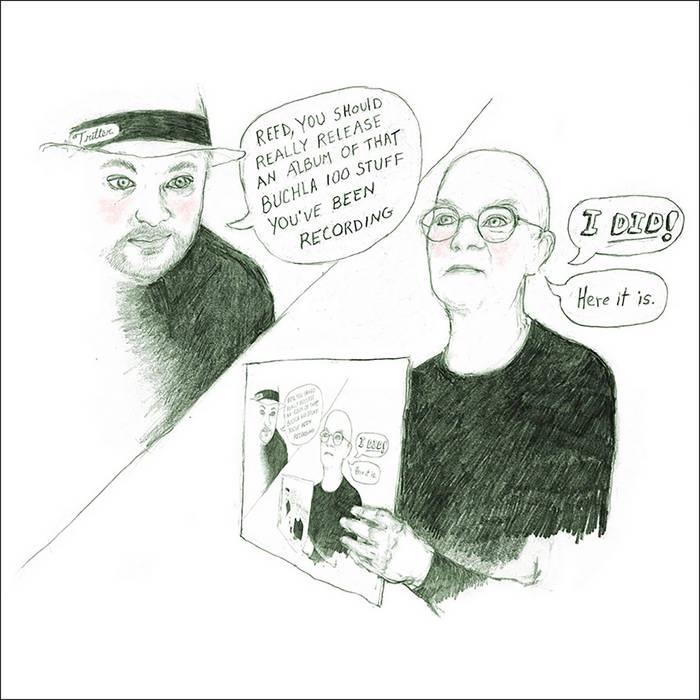
“Reed, you should really release an album of that Buchla 100 stuff you’ve been recording.”
“I did! Here it is.”
– From the sleeve illustration by Caroline Schutz
Buchla 100 Album is a conversation.
It is a conversation, as illustrated by the cartoon sleeve image, between two electronic musicians who can trace their friendship back to their studies at Oberlin College in Ohio – David Baron, a formidable synth master, and Reed Hays, a similarly formidable synth genius.
Baron is classically-trained, adding his in-demand orchestral arrangements to pop tracks by Shaun Mendes and Meghan Trainor (to name but a few), while also holding down a parallel career in commercial sound work for clients like Verizon.
The classically-trained Hays’s career has followed a broadly similar path. Baron veered toward pop, but only after spell working with New York avant gardist Charlie Morrow. Hays similarly found himself immersed among New York’s sonic avant garde, also working with Morrow and then Phill Niblock, while also providing commercial music for major US broadcasters. In more recent years, he found a fast friendship in Erasure’s Vince Clarke, releasing two albums as Reed & Caroline with fellow Oberlin alumnus Caroline Schutz on Clarke’s VeryRecords, DJing with Clarke on Staten Island’s Maker Park Radioo, and adding his evocative cello to Clarke’s emotionally-fraught solo album Songs Of Silence. When Clarke ventured out on his own for shows in London and New York, it was the reassuring presence of Hays that appeared on-stage with him.
In 2023, Baron released The Arp 2500, a paean to the seminal 1970 synth created by Alan Robert Pearlman. The album found Baron making exclusive use of Pearlman’s synth. In that way, Hays’s Buchla 100 Album is a conversational response to his friend’s album, given it finds Hays at the synth which has provided him with creative sustenance and inspiration for years.
The Buchla is a curious synth, and, by most accounts, an absolute bugger to use. I spoke to Clarke about this almost ten years ago, when I was helping prepare the first Reed & Caroline album for release. He said he’d owned one, back in the days where his studio was in a circular space at the back of his house in Chertsey, but he’d gotten rid of it because he found it too difficult to use. It was a frank, and somewhat surprising, admission for someone who seems able to master any piece of electronic kit put in front of him. It wasn’t just him, though. I spoke to another Buchla enthusiast who said he’d been enlisted by a major, Bristol-based trip-hop collective, to set up a Buchla system in their studio, which they ultimately found unfathomable.
Originally designed by Don Buchla in the 1960s following a commission from San Francisco Tape Music Center founders Ramon Sender and Morton Subotnick, the Buchla synth deployed unique pressure-sensitive inputs, making it a awkward proposition compared to synths with a keyboard controller like the nascent Moog (or the Arp 2500). Somehow, Hays is a member of a small subset of Buchla aficionados who don’t see it as remotely troublesome or hard to use. I’ve always thought that Hays’s mastery of the cello is what means he finds the Buchla so accessible, but I can’t even read music, let alone play it, so what do I know?
The Buchla achieved a weird prominence at the hands of one Owsley Stanley, a peripheral member of Ken Kesey’s acid-tripping Merry Pranksters, who used the synth to create weird and trippy sounds for their happenings. I mention this for two reasons – first because (shhhh – don’t tell anyone!) Hays and I have a project referencing this lined up as a future Mortality Tables Product, and secondly because Hays’s coveted Buchla 100 modules were originally intended for Owsley.
So you could see this as a conversation between two friends, and their two favoured instruments. You could also see this as a fluid conversation between Hays and his Buchla. Prior to recording this album, Hays had gone through an extended spell of finding electronic composition unsatisfying, preferring instead to focus on his daily cello practice. This gives Buchla 100 Album an air of catharsis, almost as if you can hear the coldness toward electronic music slowly thawing as he explores resonant pathways on pieces like ‘Cardinal’.
‘Cardinal’ is emblematic of the way these pieces evolve. Beginning with thin, ahem, reedy sounds, ‘Cardinal’ feels inquisitive, as if finding its own path, taking in a wandering bassline and tuned percussion that nods to a Martin Denny-like exotica. I can well imagine this as a piece of through-composition, watching Hays as he gently guides the track where it wants to go while also allowing the Buchla to determine its own course. It feels curiously symbiotic, with the Buchla as an extension of Hays, and Hays as an extension of the Buchla.
Elsewhere, ‘Quantus’ has a spiky angularity, nudging forward on a resolute drum pattern while sounds ping-pong effervescently around it. It embodies a sort of controlled chaos, where sounds are anchored into place by the rhythm but allowed freedom to skip around all over the place. An extended breakdown finds Hays permitting the rhythm track to swing, injecting a jazz-like fluidity to proceedings, before it concludes with swooning, evocative, synth strings.
Not that this is a purely instrumental affair. ‘Silkworms’ and ‘Liquid Time’ represent a welcome return for Reed & Caroline and their deft brand of leftfield, science-infused, electronic pop. ‘Silkworms’ is a discussion of tiny creatures living on the moon, framed by a determined beat, cute, wriggling sounds and melodies, Schutz’s quietly affecting vocal, and wild, howling sounds that nod to Fad Gadget’s ‘Back To Nature’. ‘Liquid Time’ begins with a funereal, organ-like melody before opening out into an wall of pointillist pulses that flip-flop between slow ‘n’ steady and fast ‘n’ intense. Schutz’s vocal here is both mournful and wholly realistic, singing about the passage of time and a climate-ravaged, polar ice cap-melted, fully submerged world with a calm and unswerving frankness. It may be aspirational to hope for a third Reed & Caroline LP at this point, but if these two tracks provide a glimmer of hope, I’m happy to keep everything crossed that it may materialise.
‘Aria’ is, unquestionably, the album’s most poignant moment. To me, it feels like a moment of transition, between the classical practice that Hays honed while electronic music felt too daunting, and his tentative return to the electronic music form. It is a piece held in place by a stirring, mellifluous melody that will haunt you long after it fades into silence. In its own way, ‘Aria’ embodies the sentiment of albums like Wendy Carlos’s Switched On Bach, Don Dorsey’s Bachbusters or any of the early electronic albums that paired electronics with classical composition as a means of illustrating the potential of emerging synthesiser technology.
I said this felt like a conversation. Hays is a natural, enigmatic, engaging, humorous, self-deprecating conversationalist. For me, privileged as I am to have enjoyed many of these conversations, Buchla 100 Album (For David Baron) is your opportunity to appreciate Hays talking with you, through the electronic curiosity of the Buchla 100, in his inimitable, masterful way. It may have been intended to be a private chat between two friends, but it is one that we are all able to enjoy.
A welcome, and, as a friend, might I say overdue, return.
Buchla 100 Album (For David Baron) was released May 30 2025.
https://buchlareed.bandcamp.com/album/buchla-100-for-david-baron
(c) 2025 Further.
 Further.