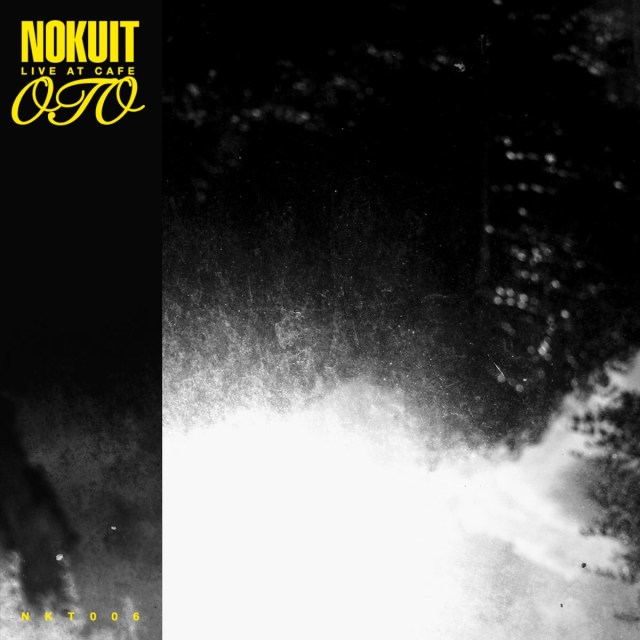
Nokuit – Live At Cafe OTO

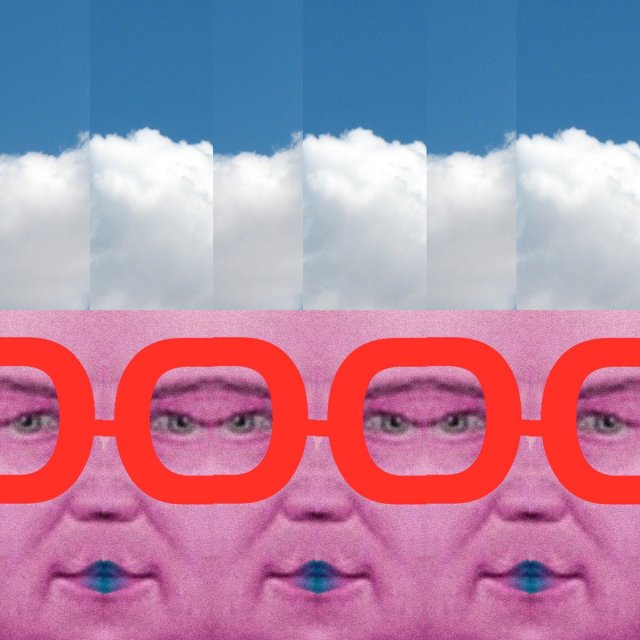
Live At Cafe OTO captures the debut 30-minute live performance by sound artist and NKT cassette label head Nokuit, recorded at London’s experimental music epicentre during the summer of 2018.

Presented as a single piece, the set is a bold, antagonising stew of sonic motifs right from the get-go: snatches of news broadcasts, spinning and eddying sounds, recordings of parade ground preparations, noir atmospheres, predatory electronic tones, metallic distortion and squalls of what might be violins are all melded together into something that, in another artist’s hands, might have been noise for noise’s sake.

Instead, the set consists of brief segments of pieces taken from previous Nokuit releases, each one carefully and delicately composed with a curatorial zeal that gives the set a soundtrack-y tension and a claustrophobia-inducing awareness of the value of intricate detail. The result is a busy, restless urgency that is never still for a second and never anything but enveloping and engaging in the completeness of its sonic breadth.

As a piece of brooding, dark ambience, Live At Cafe OTO sounds vaguely like one of the imagined soundtracks for cult books issued by the Bibliotapes imprint, only here the narrative we have is entirely of our own design. Nokuit himself calls it a ‘soundtrack to a film that has left its screenwriters behind’; and yet, in the closing, piano and grubby synth symphony that edges us to the set’s conclusion, we hear faithful echoes of everything from the first Terminator movie to Blade Runner to any other film relying on shadowy, bleak representations of dystopian futures as its central concern.

Live At Cafe OTO by Nokuit was released February 21 2020 by NKT.

Words: Mat Smith

(c) 2020 Further.

3 Questions: Piney Gir

Kansas City’s Piney Gir delivered one of last year’s most memorable albums with You Are Here, the latest record in a body of work that showcases her deft, brilliantly obscure angle on love, life and everything in between. The album was originally titled It’s Been A Shit Year For Everyone, which was both utterly accurate and pretty miserable, so she changed it.

Her latest single from the album, the album highlight ‘Puppy Love’, was released on Valentine’s Day and features Piney accompanied by the distinctive Wille J. Healey. Following the release of the new single, Further. spoke to Piney about Muppets (I’m always happy to talk about the influence of The Muppets, FYI), Dolly Parton and the merits of writing on the move.

Read our review of You Are Here over at Documentary Evidence.

What’s your earliest memory?

My earliest memory is kinda odd, because I was an actual baby; it was in our old apartment before we moved (we moved when I was two) so I must have been younger than two – and the memory is a bit inconsequential! I remember sitting in a high chair eating something (I’m not sure what) and watching Big Bird on TV.

The Muppets have always been a big part of my life and in the early years they educated me on pop culture. I wasn’t allowed much secular music or pop culture as a kid, but I saw Elton John on The Muppet Show singing ‘Crocodile Rock’ with a bunch of crocodiles and I thought Elton was a muppet dressed in feathers and colours with crazy glasses. I figured if he wasn’t a muppet he might have been from another planet… from Sesame Street to The Muppet Show and all the Muppet Movies: Caper, Manhattan, Christmas Carol – they have all been a huge influence on me over the years and I still love them.

The Dark Crystal was frightening at the time and really triggered some deep fears of the dark side when I watched it. I should re-watch it and see if it still has that effect on me! We didn’t have fancy cable growing up so I didn’t see Fraggle Rock until recently, and it’s great! I guess anything from the Jim Henson Studio makes me happy.

What’s the best piece of advice you’ve been given?

Hmmm… I don’t feel like people give me advice very often; I wonder why that is? I’m very open to receiving advice if anyone has any for me.

I think Dolly Parton put it well when she said, “You’ll never do a lot unless you’re brave enough to try.” I guess she was certainly a brave woman who I really admire and her courage gives me courage… she also said, “Find out who you are and do it on purpose.” Which is great advice for anyone.

She’s a bit of a legend, Dolly! I once sang, not with her, but at her, on the One Show on BBC TV… Me and Mike Monaghan (my drummer, but he also drums with lots of people, Gaz Coombes, Willie J. Healey, Young Knives, St. Etienne…), we were invited to be part of a ‘human juke box’ and Dolly Parton was a guest on the show. When she arrived we sang her own songs at her. There was about 20 of us, including a really bossy Dolly Parton look-a-like. It was crazy to be about three feet away from Dolly though, breathing the same air and singing her songs to her – pretty surreal!

I have a signed, autographed photo of her in my studio. She inspires me every day.

Where are you most productive or inspired?

Oddly, I write a lot when I’m on the move.

Something about the rhythm of walking, or the boredom of sitting on the tube or a train or a plane makes my brain go all prolific. It’s mundane tasks where my brain and creativity can function separately from my body that somehow make room for my muse to shine. If I feel a bit creatively blocked I’ll go for a walk or take a train journey by myself and I’ll get inspired.

I guess that’s in regards to songwriting. When it comes to recording that’s best suited for the studio, and I like to change that side of the process up quite a bit, so it’s never the same twice. That keeps recording fresh and playful and fun.

Puppy Love by Piney Gir was released February 14 2020.

Interview: Mat Smith

(c) 2020 Further.

3 Questions: Novelty Island

Further. favourites Novelty Island release their new single ‘Windows’ on February 20 2020. The follow-up to the spacey, singalong electronic pop of ‘Saturn Alarms’, ‘Windows’ is a sedate and tender song full of chill-out reference points that eddy and spin from its gauzy core – languid beats, icicle-sharp melodies and delicate harmonies.

As he prepares the band’s debut EP Welcome To Novelty Island, we spoke to Novelty Island mastermind Tom McConnell about what makes him tick.

What’s your earliest memory?

Hearing ‘Hello, Goodbye’ by The Beatles in a car.

What’s the best piece of advice you’ve been given?

It’s not really advice from a specific person, and it sounds very obvious, but I’ve realised how important it is to finish ideas. We take it for granted that our favourite artists not only had these great ideas, but that they saw them through and actually finished so many of them.

Where are you most productive or inspired?

I work from Abbey Road Institute which is a pretty inspiring place.

‘Windows’ by Novelty Island is released February 20 2020.

Interview: Mat Smith

(c) 2020 Further.

In Conversation: Kemper Norton

kempernorton_oxlandcylinder.jpg

Kemper Norton is a Cornish electronic music adventurer who often uses the local history of his home county as the basis for complex, evocative albums that defy easy classification.

His latest work, Oxland Cylinder, is the counterpart to last year’s Brunton Calciner. The titles of these two albums might sound like some sort of abstract concatenation of random words but they are in fact the names of facilities developed for the extraction of arsenic, a lucrative byproduct of the tin mining that Cornwall was once famed for.

Further. spoke to Kemper Norton to find out more about his enduring interest in developing music inspired by the mythology and stories of his local surroundings.

Your albums Brunton Calciner and Oxland Cylinder are concerned with the arsenic manufacturing process that has left abandoned facilities across the Cornish and Devonshire hills. What was it that made you want to use these as the basis for an album?

They’re one of the classic picture postcard icons of Cornwall and have led to areas of the coast being designated a World Heritage site, but I wanted there to be a wider awareness of their original purpose and role in the industrial revolution, and in the West Country and the global economy.

The creation of arsenic as a byproduct of the mining process also tapped into many themes of toxicity, domestic life and physical transformation that I’m interested in at the moment. They’re also buildings that I’ve seen every day growing up and I wanted to explore them more deeply before the landscape changes further into the view from a millionaire’s second home, and it becomes less accessible.

History – Cornish history especially – has a big presence in your work. The new album includes an old tin miners’ song interpolated into the piece ‘Halan’ that threads through Brunton Calciner and Oxland Cylinder, while 2017’s Hungan used a mythical pirate active along the coast as its foundations.

How do you go about researching and unearthing things like that? What is it about the history of this county that inspires you so much? Or is history in general something that inspires you?

I have never been interested in personal songwriting based on my own experiences in a literal way. There are loads of artists doing that and I don’t think we need another bloke telling his stories or desires, but I do feel there are neglected areas and people in history that still have interesting stories, at least to me! History, particularly social history and folklore – both old and modern – have always been a big influence, and I’m sure they will continue to be. As I grew up mainly in Cornwall, that’s bound to be a major element.

I don’t think there’s necessarily anything unique or magical about Cornwall any more than other counties or countries though – that’s part of its image that tourists go for and which residents exploit. The history of Coventry, Croatia or car parks will all have resonance and amazing hidden stories.

You have, on occasion, described your music as being ‘rural electronics’. What does that mean, in practice? Is it a style that comes from what you’re inspired by, or do you think it’s more a set of rules governing how you approach making your music?

When I started I just thought it was an honest way of pointing out that my upbringing is generally rural and I wasn’t that influenced by many urban styles of music, although that’s definitely changed.

The synth sounds, samples and field recordings were explicitly meant to sound rural in the North Cornwall sense – blasted by the Atlantic, rough, salty and hopefully unique. I was aware of artists like Aphex Twin and it was great that a Redruth boy could make it so far, so that in itself was inspiring, but I hope I’ve manage to avoid using tropes and conventions used by other artists too much. That’s pretty much the only rule!

Although it would be tempting to associate you with the hauntological genre, your music doesn’t seem intent on creating this wistful sense of nostalgia but instead seems to mourn that which is at the point of being lost from memories completely. Is that a conscious part of what you do?

Definitely. I can’t be nostalgic for Britain in the 1970s, Doctor Who or the Radiophonic Workshop because they’re not my memories or influences – I only moved to the UK in 1982 as a child. I also think that type of nostalgia for those specific cultural touchstones and era seems both oversaturated and close to cosy UKIP nationalism to me.

The idea of any kind of golden age is bollocks, particularly a recent British one. I’m also not interested in easy references to shared cultural memories of television or whatever. In terms of focusing on specific histories or stories being on the verge of lost , that’s definitely a theme in my work but it’s not necessarily limited to a specific era or mood.

If we take Brunton Calciner and Oxland Cylinder as representative of your interest in taking historical inputs as a starting point, how did you go about actually converting those inputs into music?

I’m not that technical. I use a combination of samples, field recordings and sounds as a mood board for a specific album, and then they undergo a range of processes including granular synthesis and effects processing. Some come out the other end intact, whereas other sounds are absolutely unrecognisable, and others become base sounds for new instruments and melodies. Then they attempt to become songs!

Recently I’ve become interested in using as few sound sources as possible. Most of Brunton Calciner is based on two samples which are layered and continually reprocessed, which ties in with the themes of the album.

The two most recent albums exhibit a strong sense of narrative, meaning its presentation felt more like a radio play than an experimental electronic album. Was that deliberate? Do you see your music as being a form of story telling?

I like stories and narrative in music, and no matter how much I try to avoid it I can’t help creating or following a narrative in an album. It’s rather old-fashioned but I do see each album as a story, with a beginning, middle and end during construction, however ambiguous. At the same time, I don’t think it matters if listeners deconstruct or ignore that.

Do you think could be inspired in the same way by, say, the history of somewhere like London? Or is it under-appreciated histories that appeal to you the most?

Everywhere is interesting if you look at it closely. Even Surrey.

Oxland Cylinder by Kemper Norton is released February 24 2020.

Interview: Mat Smith

(c) 2020 Further.

John Chantler & Johannes Lund – Andersabo

Johs&John1_front

A second duo outing for Swedish / Australian John Chantler (pump organ, synths) and Denmark’s Johannes Lund (saxophone), recorded during a residency in Sweden’s Andersabo.

Consisting of three long tracks, each piece here is its own unique soundworld full of clashing sounds, vibrant tensions and noisy interplay. Opener ‘Back Of The House’ has a playful quality thanks to Lund’s rapid, fluttering saxophone cycles, performed in such a way that he never seems to pause once for breath; his sax might be the focal point but it is the swirling, droning, seesawing organs that set the mood here, creating a beautiful discordant energy.

‘Open Field & Forest’ acts as a moment of quiet repose, Chantler’s sounds acting like a bed of ambient noise over which field recordings of birdsong, creaking wood and insectoid chatter are overlaid. Lund arrives in the piece’s final minutes with some processed, murky bleating that sounds like metallic scraping, but on the whole this piece is a delicate pause for reflection.

In contrast, ‘Under Barn Floor’ is a busy, maximalist summation of both the preceding pieces, built up from earthy, growling sounds, shimmering organ layers and a grubby, subtly nihilistic intensity.

Andersabo by John Chantler and Johannes Lund was released February 12 2020 by Johs & John.

(c) 2020 Further.

3 Questions: Charlotte Spiral

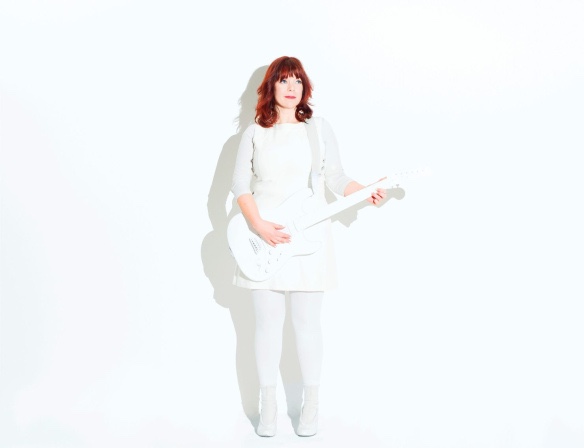
Charlotte Spiral is a duo of Amy Spencer and Avi Barath, two former Goldsmiths students now writing complicated songs laced with lyrics loaded with emotional uncertainty; those words are only matched in their complexity by the many-layered musical architecture that supports Spencer’s distinctive voice.

“I kind of like it that people think my name’s Charlotte,” laughs Amy. “The name Charlotte Spiral came from a pose in figure skating. We started putting the music on top of old figure skating videos and then Avi and I decided that our band name should have something to with it because it’s so elegant. We wanted that to be reflected in the music.”

Upon the release of their debut EP, the gorgeous, mesmerising and haunting Ideal Life, Charlotte Spiral spoke to Further. about fake medicine and ‘A Lovely Bunch Of Coconuts’ – very probably the one and only time that song’s going to get a mention here, and highly unlikely to feature on their debut album, I imagine.

What’s your earliest memory?

Amy: When my brother and I were kids my grandparents would look after my brother and I, mostly after school and also in the summer when our parents were at work.

I have a strong memory of them sitting together on a bench under the apple tree in the garden. My granddad loved music and he could sing beautifully – he could play the harmonica and even the spoons! My grandma would sing that song ‘I’ve Got A Lovely Bunch Of Coconuts’. I’m sure she sang many other songs too but for some reason that one sticks!

Avi: There is a place in Rhodes that is meant to be very beautiful called Butterfly Valley. Sadly, my earliest memory is of being very sick there. My dad tricked me and gave me a Mentos sweet, which he told me was medicine. I think it actually worked…

What’s the best piece of advice you’ve been given?

Amy: Stop worrying!

Avi: Trust your instincts.

Where are you most productive or inspired?

Amy: I often get ideas for lyrics when I’m travelling or walking somewhere. It’s usually just a line or two that I will finish once I have a chord progression and melody.

Avi: It changes all the time to be honest, but recently it’s been wherever there is a piano.

Ideal Life by Charlotte Spiral is released February 7 2020.

Interview: Mat Smith

(c) 2020 Further.

Avi Pfeffer – A Lasting Impression

avipfeffer.jpg

Classical music and electronics are currently locked in a comfortable embrace. This has arisen largely as a consequence of modern compositional methods which rely heavily on the ambience and atmospherics that a careful-deployed analogue synth or some after-hours digital manipulation can add to the music.

It wasn’t ever thus. From more or less the beginning of synthesizer technology becoming more accessible, the game in town was to produce electronic arrangements of classical pieces, and that’s the jumping-off point for Boston composer Avi Pfeffer’s A Lasting Impression.

The four-part suite uses classical structures and figures but is delivered entirely electronically. Beats drift in then ebb away, melodic gestures re-emerge continually and Pfeffer deploys a dizzying array of sounds, textures and rhythms throughout the almost hour-long album. The tonality of these collected sounds is especially important – this isn’t gauzy, drifting ambience or modern glitch-heavy soundtrack noir, but bold, grandiose sounds arranged into longform movements. I’ve never quite grasped the vernacular to articulate why this is, but there’s something about hearing electronics used in this way – a particular challenge when your diet consists primarily of people twiddling modular synth knobs or making electronic pop – that makes me think of Don Dorsey’s distinctive retrofuturism.

Dorsey made a series of electronic albums in the mid-1980s that essentially took Bach’s music and recreated their austere presentation with an enviable kitlist of cutting-edge electronic equipment, much as Wendy Carlos had done twenty years before. He also went on to be the in-house sound designer for Walt Disney World, composing the fresh, euphoric, scientific-sounding music that’s still memorably piped into places like Epcot and Tomorrowland.

I get the same feeling of hearing something exceptionally forward-looking yet locked in a particular era when listening to A Lasting Impression. If the press release had said Pfeffer had written these pieces thirty-five years ago and they’d languished, unreleased, I’d have not been surprised. To do this type of thing today is brave. We’re not used to hearing electronics like this in 2020, and so to enjoy it requires a little adjustment. Once you do, it’s a perfectly enjoyable record, full of interesting details and moments.

My personal favourite sequence arrives with the gleeful, squelchy opening minutes of the third part, largely because it transports me to the deck of Narcoossee’s on a balmy Florida evening several years ago watching The Electrical Water Pageant (originally scored by Dorsey) burble and fizz its inimitable way past with my daughters; just for giving me the the opportunity to reminisce about that makes this album entirely worth it.

A Lasting Impression by Avi Pfeffer is released February 7 2020 by Pumpedita.

Words: Mat Smith

(c) 2020 Further.

Take Five: Sad Man

sadman_kingofbeasts.jpg

Sad Man is the alias of Bournville-based Andrew Spackman. The last few years have seen Spackman deliver an incredibly prolific series of electronic albums that straddle the gulf between odd rhythmic gestures and jazz, the result being a suggestion that those two worlds aren’t necessarily so dissimilar or incompatible as they might first appear.

His latest album, The King Of Beasts, is due to be released on February 10 2020, and finds Spackman proffering a highly accessible, many-layered journey through the musical themes that have coloured his recent output, while placing a greater emphasis on traditional jazz reference points.

Further. spoke to Spackman about his formative musical influences, in the process no doubt distracting him from his work on what is probably another Sad Man album expected to land later this year. “It’s definitely not an exercise in being, or looking, cool!” he warns.

Geoff Love & His Orchestra – Big Western Movie Themes

My parents didn’t seem to have any particular interest in music. They were teenagers before the teenage revolution really got going, and so they still had quite an old-fashioned view of entertainment. My mum, however, was a big fan of musicals and westerns, and we had an old 1960s Radiogram that sat in the living room. It didn’t seem to get used much, but I was particularly fond of how you could stack the 7-inch records in such a way that once one finished the next would drop down on top of the previous record. That probably horrifies the purist vinyl collectors out there.

My parent owned a few records. Mostly they were compilation albums of movie music from the Music For Pleasure series on EMI. I particularly remember listening to this record, Big Western Movie Themes by Geoff Love & His Orchestra. Although the orchestration was probably very heavy-handed, it suited the bombastic scale of these western themes. When I listened I could see the barren landscapes of Spaghetti Westerns, the beating heat of rocky canyons, and sound of cowboy boots on the front step of the O.K. Corral. Beguiling stuff.

Mike Oldfield – Incantations

Up until the age of nine I shared a bedroom with my brother. He was much older than me and his taste in music would today be described as ‘Yacht Rock’, which is now rather cool, but back then, it was not. His stereo played host to a blur of Billy Joel, Christopher Cross, and Hall & Oates. In amongst this smothering smooth-fest sat a collection of Mike Oldfield albums: Incantations, Platinum, QE2

Even at the age of nine I preferred instrumental music. I liked listening and trying to understand how all the instruments wove together. Also, the idea that Mike Oldfield played all these instruments too fascinated me. I remembered watching him on Blue Peter and he had this extraordinary technique when playing the guitar and very long fingernails. The track that I particularly liked was the live version of a track called ‘Punkadiddle’, which has the most amazing guitar solo on it. I later learned that Mike Oldfield got that sound by playing his guitar through the tape heads of an old tape recorder to give that fantastic fuzz / distortion sound with seemingly endless sustain.

Incantations features the vocals of Maddy Prior on ‘Part 2 – Song of Hiawatha’ and strings arranged by David Bedford. Like many of his albums, it is a cocktail of styles and instrumentation, with no fixed genre reference point. I’m not sure if it completely lasts the rest of time, but putting it context, he pretty much did everything before any one else had even got out of bed.

The Albion Band – Lark Rise To Candleford

When I was about 15 years old my school staged the National Theatre’s adaption of Lark Rise To Candleford. The play featured music by the Albion Band, made up of Fairport Convention’s Ashley Hutchings, Shirley Collins, Martin Carthy and others. I had a very minor role in it, but it brought me into contact with folk rock music, played on this occasion by an excellent line up of local musicians. A few years later I went on the play for several folk rock bands too.

My love of folk music has continued, despite it seeming incongruous with my electronic music output as Sad Man. I love The Unthanks, This Is The Kit, Kate Rusby and Lau.
The The – Soul Mining

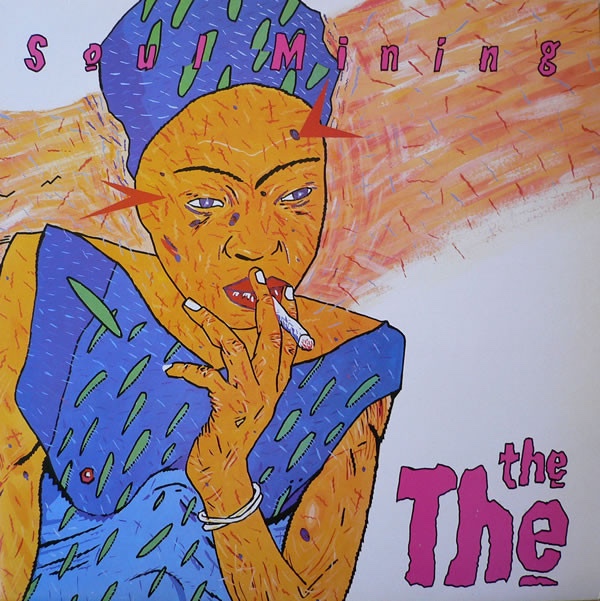
My first introduction to The The came when I was 19 and I had just bought a Triumph Spitfire. It was a beautiful green colour, and despite the constant smell of petrol, the ill-fitting doors and the extortionate insurance cost, I loved that car. It also had a very nice Pioneer stereo with speakers fitted into the doors, which, when you were in the driving seat, weren’t far off ear height.

I would often drive around the country roads with the top down late at night, to and from a pub where I worked in the evenings. On the stereo was The The. First was the Infected album (my first introduction to Neneh Cherry) but then later I discovered Soul Mining with its use of the Roland TR 606, pounding drums and chanting by Zeke Manyika. I think The The are the only band that I’ve ever had a fan thing for. I saw them play at the Albert Hall with Jonny Marr on Guitar. They were perfection.

David Toop – Ocean Of Sound Volume 3 – Booming On Pluto: Electro For Droids

When I moved to Bristol in 1997 my musical tastes had already travelled through rock music, folk rock, progressive rock, shoegaze, funk rock, grunge and indie music. Apart from the odd album from The Art of Noise, Tangerine Dream and some others, very little of what I listened to was electronic.

The Gloucester Road in Bristol had several second-hand record shops, and when I moved there and started making experimental and electronic music I also started buying CDs and records and expanding my repertoire: records by Scanner, Black Dog, Jack Dangers, anything on Warp records, Mu-Ziq , DJ Shadow, Jimi Tenor, Black Dog, Red Snapper, Labradford, Plaid…

I bought Booming On Pluto from the bargain bucket and loved its electro sound. Afrika Bambaataa, To Rococo Rot and A Guy Called Gerald all feature on this album and it’s a real classic. I guess once I’d heard this, the future of music for me was no longer guitars and distortion pedals, although I’m still very partial to a good distortion pedal (ProCo Rat, ZVE Fuzz Factory, Fuzz Face).

The King Of Beasts by Sad Man is released on February 10 2020.

Interview: Mat Smith

(c) 2020 Further.

Charlotte Spiral – Ideal Life

Charlotte_Spiral_-_press_shot_(landscape)_1024_746_90.jpg

Charlotte Spiral is a duo of vocalist Amy Spencer and multi-instrumentalist accomplice Avi Barath, two former Goldsmiths students now making stirring, yet endlessly fragile, music together.

Their debut EP, Ideal Life, contains three songs poised perilously on the tightrope between mournfulness and hope, each track a discrete soundworld of emotive layers over which Spencer’s tender, engaging vocal is allowed ample room to manoeuvre. ‘End Of Summer’ carries a tragic quality, its altered piano and gently shuffling jazz rhythm a perfect foil for Spencer’s quiet and understated anguish. There is a resigned tonality here, amplified by plaintive harmonies and a brutal, haunting dead stop following the line ‘Maybe this is the way it’s supposed to be.

‘Wide Eyed’, with its unwavering Casio preset rhythm and languid, amorphous backdrop, is perhaps – by a whisker – the EP’s towering moment. We find ourselves being moved through Spencer’s innermost thoughts, comprising everything from a delicate defiance to a fear of being unloved, its diaristic outpourings laced with such pathos and longing that it would surely soften the heart of even the hardest and most curmudgeonly of souls, and whose arrangement stays with you long after it concludes.

Ideal Life by Charlotte Spiral is released February 7 2020. Charlotte Spiral play Servant Jazz Quarters on February 4 2020 – tickets can be purchased here.

Words: Mat Smith

(c) 2020 Further.

Sunda Arc – Tides

Tides - Sunda Arc.jpg

My first introduction to Sunda Arc came with a December 2018 show supporting Go Go Penguin at the Royal Albert Hall in London. I was left speechless as brothers Nick and Jordan Smart presented a thrilling, loud, bass-rich techno-inflected set that fused intricate electronics with Jordan Smart’s clarinet; it contained such velocity and intensity that I honestly figured the roof of the 1867 concert venue was going to collapse.

The duo quickly released their debut EP Flicker in the days that followed and it didn’t disappoint, capturing the precise essence of that live set that felt so compatible with Go Go Penguin’s own – in spite of Go Go Penguin’s flavour of jazz being written with electronics but played acoustically, whereas Sunda Arc keep the electronics in. It was, perhaps inevitably, more restrained than the live show had been, but only in volume.

Their debut album, Tides, is, in comparison, strangely muted. Aside from the juddering Warp-inflected ‘Dawn’, the slowly growing shimmer of ‘Everything At Once’, the utterly gorgeous ‘Cluster’, and the ominous kick drums of ‘Hymn’, it’s not that the album lacks energy, it just feels like that energy might have taken on a more rueful, less recognisably euphoric tone. A sparseness, or even a brittleness, permeates through these pieces, spliced in with a cautious fragility maybe. Listen to all the components of the aforementioned ‘Hymn’ and it’s hard to know precisely where that comes from – its juddering electro rhythm has plenty of forward motion, and its central melody is not immediately plaintive, questioning or uncertain.

‘Secret Window’ takes that maudlin disposition and attaches it to delicate piano loops and mournful reeds, while ‘Vespers’ does the same only with sheets of ice-bright Bob Fripp-style atmospherics. These are pieces that feel like they could erupt into something edgy and dangerous at any moment, but instead they stay firmly bedded down in an achingly beautiful, yet ultimately sorrowful place.

Once you realise that this is just where Tides wants to stay, it makes for an incredibly well-crafted, detailed and wonderfully minimalist record, full of meticulous gestures and an ever-shifting palette of complex sounds. In spite of the Smart brothers’ role in hip Norwich modern jazz unit Mammal Hands, any overtones from that group lurking around on Tides are discrete, tentative and sporadic. The mysterious ‘Collapse’ is the exception, Jordan’s bass clarinet leading this album centrepiece through an atmospheric, electronically-structured ride through a vibrant, edgy, futuristic souk.

Tides by Sunda Arc is released February 7 2020 by Gondwana.

Words: Mat Smith

(c) 2020 Further.