Music journalist for Electronic Sound and occasional press release writer for VeryRecords. Father, husband, vegan. Co-founder of Mortality Tables - mortality-tables.com
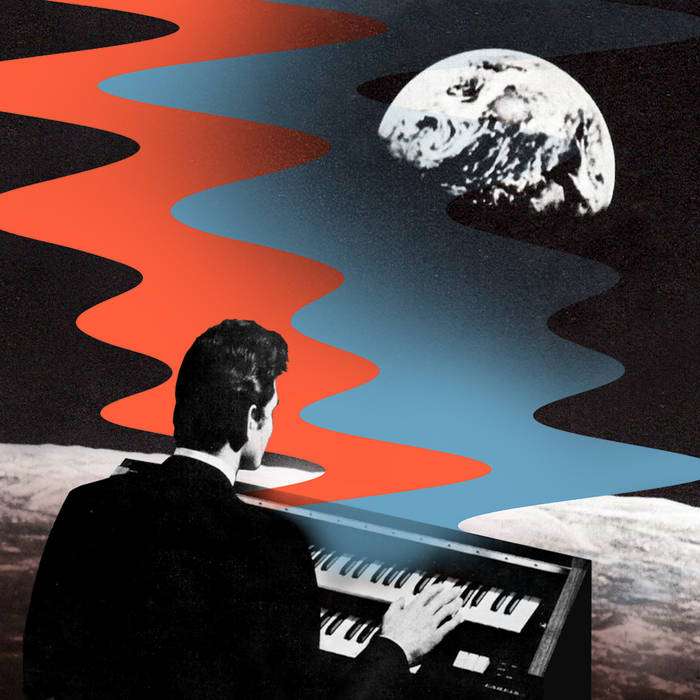
One Universal Breath is (indirectly) a product of grief. In the wake of her father’s passing, Scottish electronic artist Veryan caught sight of a solitary practitioner of Tai Chi across from where she was sat in a Parisian park. That inspired her to take up the ancient Chinese martial art as a way of reaching an acceptance of death, and its inextricable link to life. That, in turn, inspired the twelve tracks that comprise Veryan’s contribution to the brilliant Quiet Details imprint, marking yet another high watermark in Veryan’s discography and QD’s faultless catalogue.
Given its genesis, One Universal Breath is naturally a deeply spiritual, contemplative collection. However, Veryan’s conceit is to avoid resorting to wispy ambience and New Age-isms, characteristics that might be expected for music intended to align the body and mind. These pieces are characterised by subtle rhythmic interjections that provide focus as well as momentum. Somewhat surprisingly, given how balanced these pieces are between forward propulsion and lightness, they originally grew out of beat-free, more ambient soundscapes; separate them from their rhythms and these pieces are vaguely Bladerunner-y and sci-fi soundtrack-friendly. The same pieces, inextricably linked; yin and yang; life and death.
Opener ‘Lift Hands’ sets the tone for the album, with a deep, bassy root beat that acts as a guide rope throughout the whole track. To that solid beat are added electro-symphonic swirls and a spiralling, ringing melody that spins and flutters like an inquisitive dragonfly. The effect is quietly euphoric and gently uplifting. ‘Diagonal Flying’ does something similar, only here there is the addition of a white noise sound that evokes the idea of air currents or waves crashing onto some faraway beach. A similar feeling emerges on ‘Grasp The Sparrow’s Tail’, which is delivered through a sense of latency, of something about to emerge from the calm. Here, Veryan presents a bass pattern that has a determinedly motorik dimension that reminds me of Nitzer Ebb’s ‘Join In The Chant’. That rhythmic shape is poised beneath resonant strings, while light percussion sounds begin to cluster and build with intentionality as the piece progresses.
‘Step Forward To The Seven Stars’ offers a suite of wavering tones which are imperfect yet strangely engaging. Those gently wonky sounds are joined by a slow motion break, while flute-like notes sketch the outline of hope and salvation. It represents one of the album’s sparsest and enveloping moments, but its linearity is complemented by unusual interventions that happen along the way. These create a sense of uncertainty, as if there is more than one path available. One of the best tracks here is ‘Needles At The Bottom Of The Sea’, which contains a delicate central melody that is freighted with the haunting quality that makes so much of Veryan’s music so engaging; simple, understated, yet devastating. It is one of the busiest tracks, the melody offset by a sequence which undulates and fluctuates like it’s trying to escape from something. ‘Needles At The Bottom Of The Sea’ is immediately powerful and resonant, caught in the interstitial space between hope and despair.
That’s not to suggest that this whole album leans into a sense of calm. Two tracks – ‘Part Wild Horses Mane’ and ‘Fair Lady Works The Shuttles’ – contain mysterious elliptical tones and a sort of creeping noir tension. That sense of foreboding, so different from tracks elsewhere, reminds me of Thomas Newman’s soundtrack to Less Than Zero, or what Nine Inch Nails might have sounded like if they’d recorded The Downward Spiral at a spiritual retreat instead of Sharon Tate and Roman Polanski’s house in Benedict Canyon.
The album’s title track is the piece that unifies the whole album and its myriad dualities. On this piece, Veryan deploys crisp and unswerving beats with delicate melodic interfaces. There is a sense of motion yet stillness; of positivity yet reflectiveness; meditative yet danceable; soft yet firm. We find enveloping strings that wrap themselves comforting around you, and a pulsing bass line that rises and falls like the breath of the title. It embodies the premise of this entire album, being at once towering, yet welcoming, marking the conclusion of an utterly mesmerising achievement.
One Universal Breath by Veryan is released 21 August 2024 by Quiet Details.
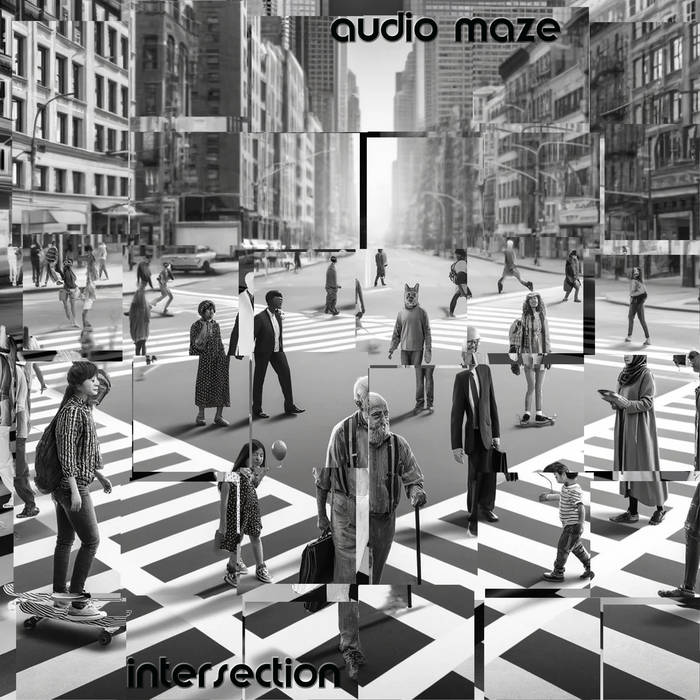
Damon Vallero describes his new Audio Maze album as “a meeting place and a platform for departure”. Its dub-inflected soundscapes carry a sense of fluid motion, of coming and going. Even at its most languid – as on the widescreen ‘Grand Land’ – there is a feeling of restlessness, even though its constituent parts (a slow-motion rhythm, a metronomic bass pulse, a softly ebbing and flowing melody) suggest a resolute stillness. It transpires that it’s an unplaceable, half-heard sound off in the distance that conjures this feeling of nothing being settled, of everything moving. One of the album’s many highlights is ‘Circle Of Sand’, containing myriad distinct intersections – a submerged bassline that is felt more than heard; a voice whose words cannot be deciphered; a rhythm that feels like the juddering sound of a train passing through a station; a jazzy piano riff that seems to splinter and fall apart gracefully as the rest of the track follows a very different path. This is an album filled with complex detail just beneath its surface textures. Absorbing and richly nuanced. Released 30 May 2024.
Xuma is a duo of Harriett and Chris Robins Kennish. Based near Brighton, they make music built from the foundational structures of dance music, with slowly-evolving minimal sequences and crisp, danceable beats offset by Harriett’s often blissed-out vocals. ‘I Know Her’ drifts gently into a dreamy garage-y framework of driving beats and jazzy sounds, over which Harriett deploys layers of euphoric, arms-in-the-air vocals. ‘Joyful’ is one of the album’s many highlights, with vocals converted into loops of shimmering, beatific texture over sounds and rhythms that sound like they are soundtracking a Goan (or maybe Hove?) sunrise. ‘Invisible’ strikes a minimalist techno pose, its feathery electronics fluttering ceaselessly over a stalking pitch-bent bassline, while closing track ‘Relent’ adopts a laidback, half-speed Café Del Mar vibe. Jasmine is a hidden gem of an album, and one that resolutely follows its own stylistic path. I had the pleasure of hanging out with Harriett and Chris on Brighton beach recently, and two nicer people making brilliantly diverse electronic music you will not meet. Released 20 June 2024.
Antenne is Brighton-based James Dean’s homage to a mysterious pirate radio station, which broadcast continuously from a point in the 1990s before coming to a sudden halt in 1996. This is his evocation of the energy of the station, deploying his trademark sinewy synth melodies, club-oriented beats and a sense of latency. On ‘I Feel Eye See’, he uses a muted hardcore break but instead of hitching it to 1992-vintage head-cleaning hoover noises, he layers the beats with pretty, overlapping spirals and a fuzzy blanket of warm, emotive textures. ‘Oriam Speedway’ ventures into a suggestion of kosmische electronic rock, fused again to suppressed rave beats. My personal favourite track is ‘Controller 29’, whose structures steadily coalesce out of a delicate web of interwoven synth lines that ripple with intense motion. Those patterns quickly fade out of view, only to firm up around a motorik beat and a fluttering melody that nods to Kraftwerk’s ‘Neonlicht’. Another fine release in the Bunkr catalogue. Released 28 June 2024.
Another exceptional release from the Quiet Details label, easily one of the most interesting imprints issuing music today. To catch people up on the concept, the idea is that each handpicked artist is asked to produce a body of music that responds to the name of the label. Every release in the series has been a joy to listen to, and the latest – from Tresor stalwart Emile Facey – is no exception. Like some of the other releases surveyed in this post, Facey’s ‘The Unfading Spark’ relies principally on the suggestion of movement and energy. In standout pieces like opener ‘Broken Through’ or ‘Signal Beckons’ or ‘Wisps Of Vapour’, there is this feeling of high-octane techno structures itching to punch their way through the gauzy, enveloping textures that dominate the tracks. These potentially competing forces create a compelling tension – soothing on the one hand, fidgety and restless on the other – that somehow knits together seamlessly, making for an enriching and engaging listen. Released 10 July 2024.
There is not a lot that Rupert Lally can’t turn his hand successfully to. While he might be best known as a prolific (and stylistically dexterous) composer of electronic music, Lally is also an accomplished author and, via his blog, an avid documenter of underrated films and their soundtracks. Profiler, like 2022’s Hacker, brings together these interests into a neat and tidy package. Not just a hypothetical soundtrack, Profiler comes with a detailed plotline and is presented as a lost 1980s crime flick, with Lally’s music leaning authoritatively into the synth sounds of that decade. That means rich, infectious melodies, big beats and a sense of bold, shiny vibrancy.
In spite of Lally’s intuition for period authenticity, there’s plenty of room here for his distinctive noir-ish sensibilities. ‘The Unsub’ is a brooding, unsettling and mysterious short cue, its key focal point being a series of uncoiling tendrils of synth sequences that lead to a cloying, claustrophobic atmosphere full of tension and danger. ‘Possible Suspect’ is the track that feels most like it was unearthed from a bankrupt studio’s archives, with a dense drum machine beat filled with a kitchen sink’s worth of percussion presets and fills and a sharp, sinewy synth melody resting atop a sequence that feels like it was created from a short vocal sound imported into a sampling keyboard. Avid readers of Further. will know how much of a fan of Lally’s music I am, and this imaginative collection is undoubtedly up there with his best. Released 19 August 2024.
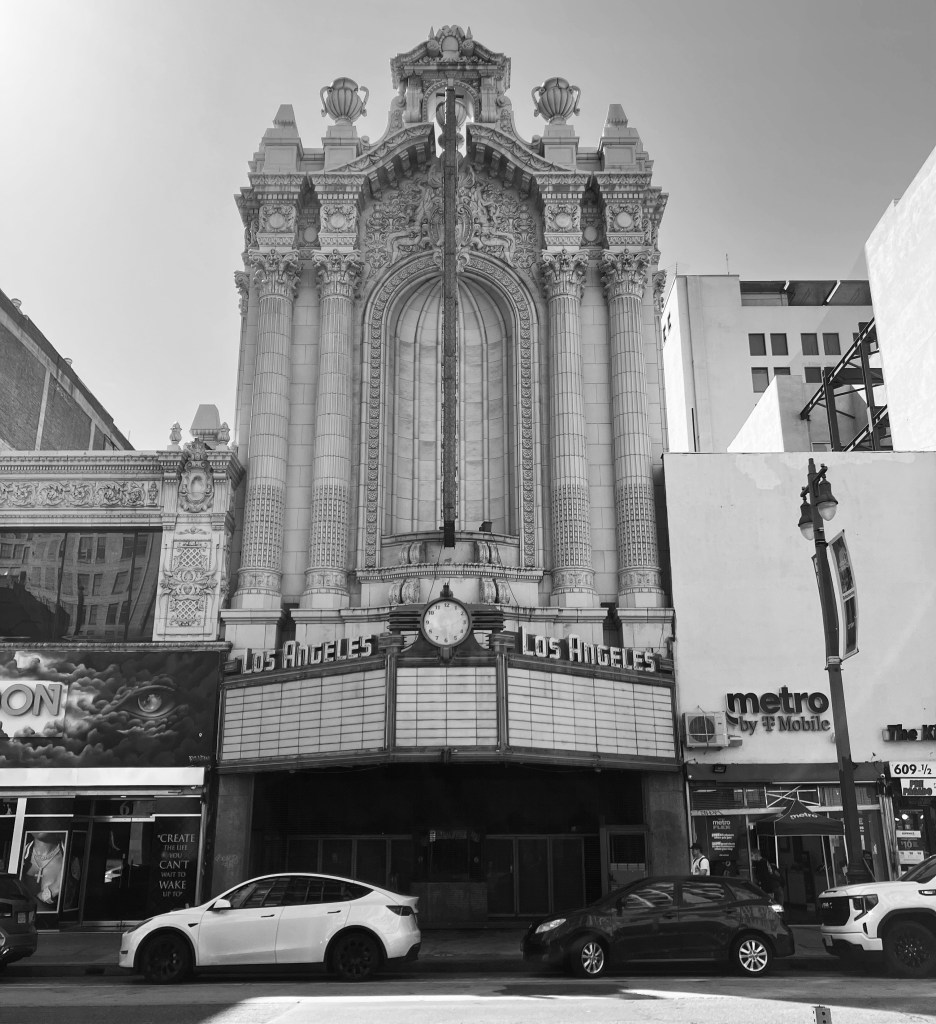
The Los Angeles Theatre, Downtown LA (from Mortality Tables Instagram)
Went to Hollywood. Visited Amoeba Records and flicked through the CDs. Bought a Nick Cave / Mick Harvey / Blixa Bargeld soundtrack for $1. Found copies of the limited-edition reissues of Chorus and Erasure by Erasure and felt proud that the liner notes I’d written had made it all the way to Hollywood. Walked along Hollywood Boulevard and took pictures of the stars belonging to The Beatles and jazz musicians and looked at the Capitol Building, which is a lot shorter than it looks. Then again, Hollywood has made a business out of making things appear different to how they really are.
In North Hollywood, we visited the Iliad Bookshop on Cahuenga. Stroked the resident cats and bought a book about David Byrne and an old 1909 music dictionary, figuring that it might be helpful to learn some basic music knowledge as a music journalist. Good second-hand music book selection. Found a rare Charles Ives biography but it was too bulky to contemplate taking it back to the UK.
Went for brunch at Crossroads, a vegan restaurant on Melrose. Billed as fine dining and presented as a very smart dining room, but actually very casual. Lots of classic rock photos around the room – Devo, Guns n’ Roses, Freddie Mercury, Page / Plant etc – and great soundtrack playing at a volume loud enough to be interesting and low enough to allow conversation. Went there again for lunch twice; same vibe, different food, different soundtrack. Went for dinner at the Calabasas restaurant toward the end of the trip; different neighbourhood; same vibe; harsher aircon.
Took a drive to Hermosa Beach for jazz brunch at the Lighthouse, famed for its use in La La Land. Ate avocado toast, drank good coffee, listened to the Hafez Karimi Trio and enjoyed looking at the record sleeves on the walls. Walked onto the pier outside where Ryan Gosling sings ‘City Of Stars’ in the film. Felt very alive, momentarily. An enthusiastic young street musician was playing guitar while a very disinterested older lady filmed him. Noticing her attention, he started playing with his guitar behind his head. She didn’t show any more enthusiasm while he was performing for her. Staying with La La Land, later in the trip my wife and I took an early morning walk to Cathy’s Corner in Griffith Park, where Gosling and Emma Stone dance around a bench after a party.
Hafez Karimi Trio, The Lighthouse – July 7 2024
Checked into the Sunset Marquis. Famous for being a music industry haunt, but ultra-discrete. Massive Beyoncé poster hanging by the pool. Photos of rock musicians everywhere. Ordered a vodka and grapefruit because that’s what the main protagonist was drinking in The Shards by Bret Easton Ellis in the chapter I’d re-read a day before.
Walked along the Sunset Strip. Walked past the carpark of Mel’s Diner where Buffalo Springfield formed, Mark Mothersbaugh‘s ‘Chernobyl green’ Mutato Muzika studio complex, the old Tower Records (now a Supreme), the Viper Room, the Roxy. Stopped in at The Rainbow for dinner and drinks and, even though I’m not into most of the groups whose photos and memorabilia line the walls, there is something quite magical about being in a place so synonymous with the LA music scene. Ordered drinks from the outside bar, where Lemmy used to sit and play video games all night. Bumped into Jon D’Amico (“Okay, so watch” is the catchphrase he didn’t know he had) from Rock ‘N’ Walk Tours. Jon had walked us along the Sunset Strip when we were here last year and I cannot recommend his tours highly enough. He knows all of the secrets of the Strip. I had planned to publish an interview with him last year but never got around to it. I’ll try to fix that, Jon.
Mutato Muzika, Sunset Boulevard
Finished a long night on the Sunset Strip drinking whisky in a very dark bar at the front of the Sunset Marquis, its impenetrable, discrete, shadowy corners populated by more rock photos. Getting very drunk did not help, and I just felt like shit the next day. Apparently, the week after we were here, Keith Richards checked in while the Stones were playing California. During our stay I spoke at length to Logan Steppert, a bellhop who is also an electronic musician. His brilliantly atmospheric 2013 EP Bogenvia with Mike Gaydusek can be found here.
Went to the Whisky A Go-Go three times. My wife loves this venue. She came of age listening to countless bands who played here during the metal 1980s. The first show was an electronic rock trio called Love Stereo (tasting notes of Joy Division) – check out their debut single ‘Fool’ on Bandcamp here. They were followed by Rebel Star, a Bowie tribute band. Their version of ‘Heroes’ had me in floods.
The main draw of two of the Whisky shows was Fast Times, a quintet of Spicoli (Johnny Ventura – vocals, guitar), Kazzy Nova (Eddie Ayala – bass), Riff (Lance Turner – guitar), Crash Diamond (Matt Olofson – drums), and Squid (Sudwyn Munshi – keyboards) who play incendiary sets of 1980s classics, and who are named after the Cameron Crowe movie Fast Times At Ridgemont High. (Sean Penn’s character in the movie is called Spicoli.) We saw them twice last year and found ourselves completely besotted by what they do, hence wanting to see them again this year. Their versions of ‘Personal Jesus’, ‘Enjoy The Silence’, ‘Blue Monday’, ‘Shout’ and ‘Whip It!’ are absolute perfection. They play the Whisky every Monday and anyone with the remotest interest in 1980s music should check them out. My youngest daughter wound up plucking notes on Kazzy Nova’s bass on our second visit, and now wants to learn how to play. Thanks Kazzy.
Fast Times, Whisky A Go-Go – July 8 2024
Right at the end of the holiday we went to the Valley Relics Museum in Van Nuys, where they have loads of exhibits related to Fast Times At Ridgemont High, which was filmed in the area. They also have a Tower Records neon sign from the old La Brea store.
We listened to a lot of Weezer in the rental car on this trip. My wife is obsessed with Weezer. We walked down Montana Avenue in Santa Monica because Rivers Cuomo sings about taking a stroll past places like the Aero cinema in the song ‘Aloo Gobi’.
My Guns n’ Roses-loving wife got to see Gilby Clarke performed on our third and final trip to the Whisky. She wanted to marry him when she was 14 but ended up with me, and has been perpetually disappointed ever since. One of his support groups, Cinema Stereo, reminded me of a messy marriage between Pink Grease and The Hives, fronted by someone who effortlessly blends shades of Elton John, Mick Jagger and Freddie Mercury. Ones to watch. They will be huge one day.
Found ourselves on the old Route 66 a bunch of times, and consequently couldn’t get the song out of my head. Went on the 101 far too many times than was enjoyable, and it reminded me of the 1988 Depeche Mode film / concert of the same name every time I merged into the nail-bitingly stressful traffic. Went to the Pasadena Rose Bowl so my two daughters could go to the huge flea market there. Liked being at the place where 101 was recorded. A singer serenaded us with songs, including a whole section of Neil Diamond songs. My dad loved Neil Diamond.
The previous weekend we went to the Los Feliz flea, which is no longer in Los Feliz but in an old parking lot in Downtown. Bought a US CD copy of The White Room by The KLF from Rock & Sock, a husband and wife team – he sells music; she sells socks and cute cat hairgrips. Had a nice conversation with the husband about Bill Drummond, The KLF and music in general. I needed that. I’d lost my appetite for food before the flight to LA, and I’d simultaneously completely lost interest in music, something which has always given me support and comfort during difficult moments in my life. That conversation gently rekindled my interest in the latter. I don’t know his name, but I want him to know how important that conversation was.
The KLF The White Room (from Mortality Tables Instagram)
I originally bought The White Room as a teenager from Music Junction in Stratford-upon-Avon, where I grew up. I remember that on the way back home from the shopping trip with my mum and sister where I bought that cassette, we were walking through Clopton Court, where we had lived in an apartment until 1984, when I was seven and my sister was three. We bumped into my dad as we walked along the road that fringed the squat, red brick apartment buildings. He looked stony-faced. We asked what had happened. He had reversed his new red, G-registration Toyota into a signpost at the leisure centre where he’d taught me to swim and was on his way to the Swinton Insurance office at the top of Henley Street to make a claim. It was the first new car he’d ever owned and he absolutely loved it. When I got home and played The White Room, it left me feeling a little disappointed. I can’t help thinking that my dad’s disappointment in having wrecked the car he cherished so much had something to do with that.
Went to Disneyland. Felt sad when I walked past the Sherman Brothers‘ door on Main Street. So many of their songs were part of my childhood, and my daughters’ childhoods. I am unashamedly a fan of Disney, and hoped it would give me some joy during a holiday where I generally felt numb. On our final night at Disneyland, I really enjoyed ‘It’s A Small World’, whose pretty theme tune was a Sherman Bros. composition; I’ve been on that ride countless times but this was the first time it really moved me.
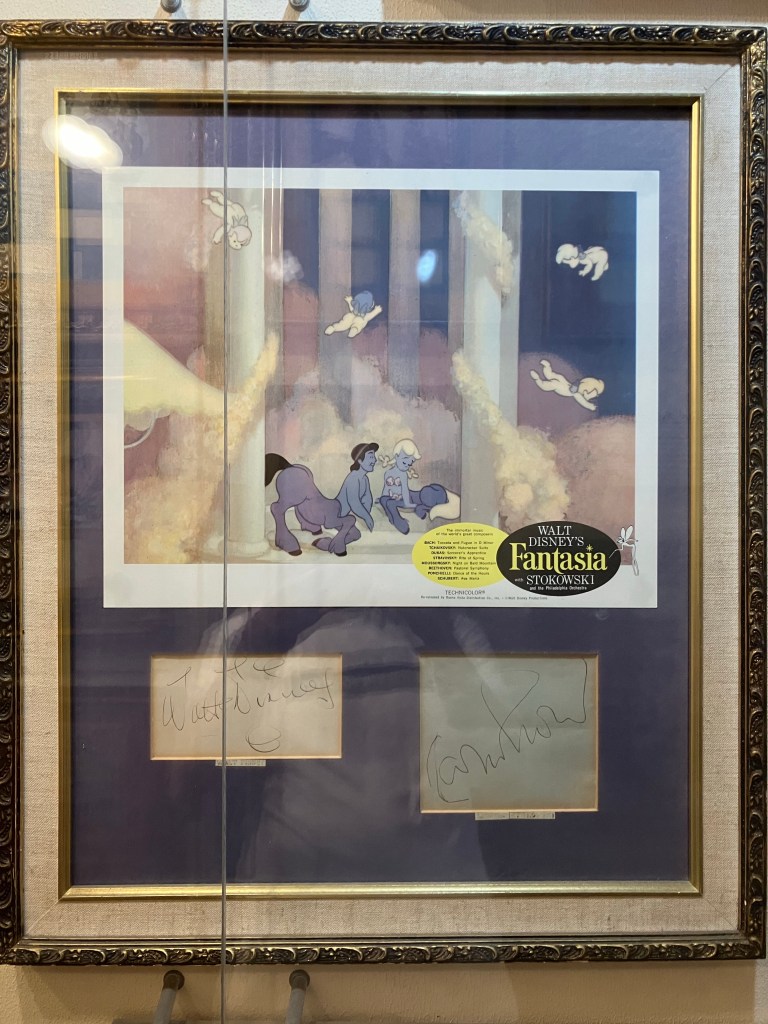
Later in the trip we visited the Hollywood Museum, located in a genuine slice of old Hollywood, the Max Factor makeup building off Hollywood Boulevard. On the wall was a framed print from Disney’s ambitious Fantasia with the signatures of Walt Disney and Leopold Stowkowski beneath it, which took my breath away. I keep finding out interesting things about Stowkowski and his involvement with experimental music, something I hope to write about in the future. Went to the Hollywood Bowl to listen to 1980s and 1990s Disney songs played with a full orchestra, conducted by Sarah Hicks, who had been the conductor at the Rufus Wainwright Proms concerts I reviewed for Clashlast year. The Disney concert was very special, in an absolutely incredible venue up in Griffith Park. My eldest daughter cried when she got to hear Susan Egan (Meg from Hercules) and Jodi Benson (Ariel from The Little Mermaid) perform on stage.
Dropped in to Highland Park for a few hours. Went to an incredible vinyl-only record store called Gimme Gimme Records. I didn’t buy anything – transporting vinyl on Transatlantic flights is something I’ve done before and it’s inordinately stressful – but I found a copy of Thomas Dolby’s The Flat Earth, whose Assorted iMaGes sleeve by Baker Dave I’d written about on the flight over. Found myself looking at Neil Diamond LPs. Visited Licorice Pizza in Studio City. Found myself looking at Neil Diamond LPs again.
Went to a hip place called Justine’s Wine Bar in Frogtown. Ate good vegan food and enjoyed a playlist curated by the guy at the bar consisting of late-70s / early-80s post-punk music – New Order, Wire etc. I recommended that he listen to Rema Rema and watch Marco Porsia’s documentary about them, What You Could Not Visualise. I admitted that I’m biased, as I’m in Marco’s film. He asked me if I was in “the industry” – a very Los Angeles term – which I suppose I am.
Checked into a beautiful 1920s Airbnb off Beachwood Drive. In the lounge were loads of interesting books, including Jon Wozencroft’s book on Neville Brody. It was a moment of complete coincidence, as Jon was one of a small number of collaborators I’d been messaging during the holiday. Although I was taking an enforced break from an intense period of Mortality Tables activities, I chose the holiday as the perfect time to revisit discussions with Jon about a Mortality Tables sound / visual project we’ve been working on for a while.
In Downtown LA, we visited The Last Bookstore. Looked through the second-hand vinyl and found more Assorted iMaGes sleeves I’ve written about, as well as some of Baker Dave’s designs for Phil Collins albums. More Neil Diamond LPs. Got mildly frustrated by the aisles of people taking photos of people looking at books to post on social media, and who then walked out the store without buying a single book. I also didn’t buy a book, but both of my daughters did.
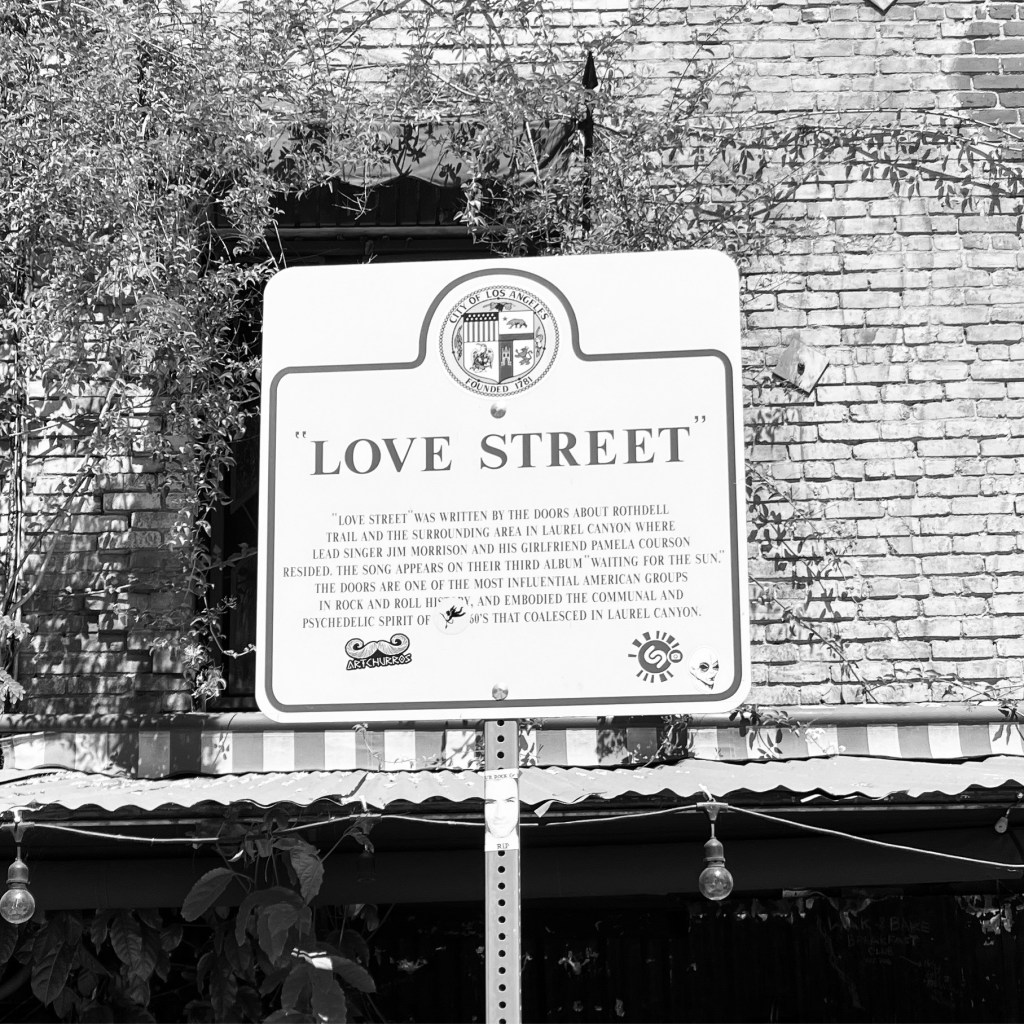
Drove out to Laurel Canyon and stopped in on the Canyon Country Store. Bought coffee from the front porch and used the restroom, which is down in the basement in the stockroom. Mama Cass from Mamas And Papas used to live here when she had nowhere else to stay. Saw the apartment where Jim Morrison used to live, its balcony overlooking the store. He wrote ‘Love Street’ from Here Comes The Sun while living there, calling it the “store where the creatures meet”.
Toward the end of the holiday, my wife booked for us to visit Lake Shrine, an oasis of spiritual calm tucked away in a bend on Sunset Boulevard in Pacific Palisades close to Santa Monic. George Harrison’s memorial service was held here, and they hold some of Gandhi’s ashes. My wife and daughters left me on my own for a while. I meditated, reflected, cried and listened. I read a message from my friend Gareth, who had offered me his typically accurate advice on how to approach grief. We checked into an Airbnb cabin high up in Topanga Canyon on the day we visited Lake Shrine. I spent a lot of time outside, just listening to sounds from across the canyon.
During the entire vacation I was often visited by hummingbirds and dragonflies. I fell in love with the sound of hummingbirds during my time in LA. I looked up the symbolism of both. I wasn’t surprised at all at why they featured so prominently during this trip, at this precise moment in my life.
///
My father passed away five days before we left for Los Angeles.
I spent a lot of the vacation in a state of raw numbness. I could feel no joy. Things that should have made me happy left me feeling nothing. My mood fluctuated ceaselessly but I couldn’t ever get myself out of this awful intermediate, middling place where nothing made me happy and nothing impressed me.
My father’s influence on my music taste was just one of the most significant and powerful things he unwittingly gave me, so I wasn’t surprised when I suddenly lost my appetite for listening to anything. I wouldn’t have ventured into music journalism without the seeds he planted at the start of the 1980s – watching Gary Numan on The Old Grey Whistle Test together while my mother was out at work waitressing and when I should have been in bed; listening to ‘Joan Of Arc’ and ‘Joan Of Arc (Maid Of Orleans)’ by OMD in the car on Saturday mornings while he worked his second job as a debt collector; him bringing home a VHS copy of Soft Cell’s Non-Stop Exotic Video Show VHS that he’d borrowed from a colleague at his day job in a factory and letting me watch something that was patently not suited to a five-year-old boy.
Later, he brought home a TDK cassette of The Innocents by Erasure and asked me if I liked them as he handed over the copy a friend had made. He was completely unaware of just how significant that transaction would prove to be in my life. I had the opportunity to tell him how transformative these moments were before Alzheimer’s fully ravaged his mind and took him further and further from us.
My mother and sister tasked me with creating a playlist for his funeral while we were on holiday. It was the mixtape I never thought I’d have to make and I found it extraordinarily painful to compile. It can be found here.
We wanted to include something from the 1950s. He grew up in the rock ‘n’ roll era and it felt appropriate to include something from that period, but I found myself panicking that I couldn’t think of a single song that he liked from that decade. I was at the Knott’s Berry Farm theme park at the time, walking by myself to a viewing platform. As I rounded a corner into a different themed area of the park, the music changed and Eddie Cochran’s ‘C’mon Everybody’ began playing. Dad loved that song. It somehow unlocked the entire playlist.
Less than ten days before he passed away, my Mortality Tables collaborative project released The Engineer, which involved contributions from over thirty artists. It was loosely inspired by my father, who worked as a mechanical engineer for more or less all of his adult life. We deliberately released it on what would turn out to be my last Father’s Day with a father, and paid all profits to the Alzheimer’s Society.
I had been working on The Engineer for over ten years and was determined to release it this year. I now know why I was so driven to make that happen in 2024. The Engineer can be found here.
Words and photos: Mat Smith
Thanks to Logan Steppert, Jon Paul Gwozdz, Fast Times, Tommy Gelinas.
Slow Clinic is a project of mastering engineer James Edward Armstrong. On the three pieces presented here, it’s self-evident that Armstrong has an exceptional ear for detail and nuance. ‘Accept’, ‘Hold’ and ‘Wander’ are all constructed from field recordings made in Farnham, Surrey using an old dictaphone, upon which Armstrong layers gentle, undulating guitar drones. These drones were built from a chain of effects pedals but were otherwise fully unprocessed after they’d been recorded. At times resonant, at others contemplative, there is an appreciable openness to these pieces, and, perhaps, a vulnerability: they are imperfect, in the sense that the base layer dictaphone recordings are bathed in a hissy white noise where you can almost hear the tape mechanism. Moments of clarity find their way through, but that lo-fi bed of static is a constant. And, in that sense, this is Armstrong at his most accepting. For someone so well-versed in addressing deficiencies and errors in other artists’ material, with this EP he doesn’t seek to address those that present themselves in his own work. One can only imagine that process was strangely freeing and cathartic for an artist usually drawn to the most macroscopic of details. Released 27 March 2024.
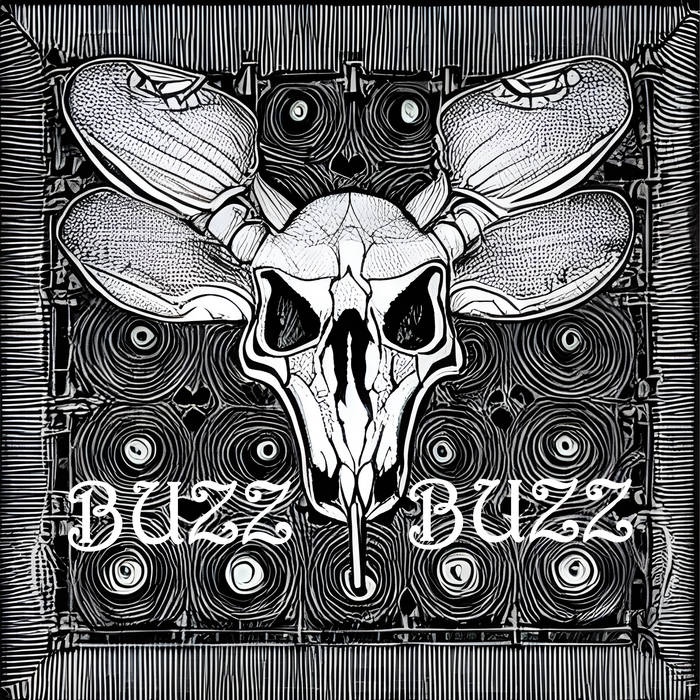
MORAY NEWLANDS – BUZZ BUZZ (Wormhole World)
The latest album from Dundee’s Moray Newlands acts as a tribute to The Wasp Factory, Iain Banks’ debut novel. Forty years on from the publication of The Wasp Factory, it remains a book that is fraught with controversy and whose unswerving violence and vivid, twisted narrative launched Banks as his generation’s Anthony Burgess. When I first read the book, sometime in the early 1990s, the violence wasn’t what gripped me; instead it was a sort of compassion for Frank, the 16-year-old protagonist. Not, I stress, because I felt some sort of nihilistic familiarity with his character, but because of how deeply troubled and disturbed he was. I don’t think I had read a book, up to that point, where I felt as much sorrow for the main character as I did disgust. It proved to be good practice for when I read American Psycho.
Newlands’ album is, then, appropriately balanced – empathetic in places but just as unflinchingly brutal as Banks’ narrative. The two opening pieces, ‘The Sacrifice Poles’ and ‘Snake Park’ are mournful, symphonic and curiously moving. So moving in fact that you don’t notice the creeping undertow of sibilant buzzing sounds and dark shadows, all of which are fully realised on ‘The Bunker’, where the sound of birds and softly squalling sounds act as metaphors for Frank’s torturous ways. Buzz Buzz is like the Bibliotapes cassette that somehow never got released, moving episodically through the book’s pivotal scenes and figures. Here we meet Saul, a dog that is purported to have inflicted a grievous injury on young Frank (‘Old Saul’s Skull’). We encounter his brother, Eric, forever changed by his grim experiences as a medical volunteer, one of the book’s most harrowing moments (‘What Happened To Eric’). In a moment of grim, fairground whimsy, we alight upon Frank’s cousin, ‘Esmerelda’, killed after he attached her to a large kite which takes her far out to sea. The motive? Because he’d killed too many boys and needed to create a semblance of evenhandedness.
Elsewhere, we hear the sonic embodiment of Frank’s wasp-destroying mechanism on the title track, a stew of clocks, wound-up cogs, struck matches, dubby pulses and angry – nay fearful – buzzing. Even now, when confronted with the idea of Frank’s Heath Robinson torture device, I find myself instead thinking about an episode of Bagpuss where his mice companions use a similarly ramshackle machine to make digestive biscuits. I think it is a device my teenage brain used to prevent me from being too impacted by Frank’s callous traits. Finally, we arrive at the album’s closing moment, ‘What Happened To Me’, the sonic portrayal of a pivotal confrontation between Frank and his father, wherein we learn a lot about Frank – or maybe, just maybe, nothing at all. Newlands depicts this in a searching, inquisitive, but ultimately unresolved electro-symphonic tearjerker, a droning, undulating voice sound reminding us of Frank’s hymenopteran prey.
This album is not for the faint-hearted. There are moments here that are exceptionally terrifying, much like The Wasp Factory itself. My overriding impression, however, like my first reading of the book, is one of compassion toward poor Frank, in no small part thanks to Newlands’ clever sound design and masterful use of emotional texture. A powerful work of arresting, complex detail. Digital edition released 24 May 2024.CD edition released 28 June 2024.
WHETTMAN CHELMETS – A NEW PLACE (Quiet Details)
A New Place began life as a song by Whettman Chelmets’ young daughter. You can hear that song in the first two minutes of ‘Prelude To A New Place’, the first of the three tracks which constitute this release. That voice, imperfect, untrained and innocent, lends these pieces a sense of nostalgic optimism, which I can only liken to the feelings that wash over me whenever I look at old photographs of my children. There is a thick blanket of gauzy texture draped over these three pieces through which fragmentary details and ideas appear – a guitar, resonant brass, strings, a half-melody, children’s voices, discordant buzzing, the click of a computer mouse. At different points, these interventions can appear almost impenetrable, often threateningly dissonant, but those moments, like all the segments here, evolve away rapidly. In the final judgment, A New Place is a wonderfully evocative album full of ceaseless motion, and one of the most beatific albums I’ve had the pleasure of listening to. A resounding, emotional achievement for Chelmets, and another fine release from the consistently-brilliant Quiet Details imprint. Released 29 May 2024.
ASHER LEVITAS – Above The Pale Green (Waxing Crescent)
This four-track EP from Asher Levitas is bordered by two tracks that occupy similar stylistic ground. Opener ‘Fence – Stream – River’ begins with the the sound of gently flowing water and a metal fence being stroked by a stick, out of which rises a soft and delicate tapestry of ambient pads that sit on the frontiers between wistful, nostalgic and hopeful. A brief swirl of gurgling analogue synth evokes the notion of a meandering stream. A similar combination of field recordings and elegiac textures occurs on the closing track, which gives this EP its name. Except that where the first piece offers sense of optimism, ‘Above The Pale Green’ feels restless and uncertain.
If you only listened to those two tracks, you’d wind up with a completely unrepresentative impression of this EP. ‘Nowhere To Be’ is a woozy, slowly-evolving minimal synth pop cut overlaid with a haunting, wordless vocal and simple, pinprick melodies. It’s a lot like finding an early 1980s electronic demo tape in the loft of the house you’ve moved into, suitably draped in years of nostalgic fuzziness. If that wasn’t surprising enough, ‘You Don’t Have To’ is a further departure in the form of a plaintive, open and tender piano ballad. The keyboard sounds wonky and slightly imperfect and is augmented by subtle interventions off in the background. A grubby, dissonant melody, soaring textures and fragile rhythm in the middle eight usher in a more nuanced and layered conclusion. Having the bravery to fit three highly distinct and, on paper, incompatible styles together is a rare moment of daring, but Levitas executes it impeccably. Released 14 June 2024.
LOULA YORKE – Speak, Thou Vast And Venerable Head (Quiet Details)
The second Quiet Details review in this round-up comes from Oram Award winner Loula Yorke, and arrives hot on the heels of her recent masterpiece Volta. Heard in the context of that album, which relied less on the rave-inspired modular improvisations of her earlier work in favour of conscious composition, Speak, Thou Vast And Venerable Head feels unhurried and unburdened by expectation. It’s as if Volta reset those expectations and allows a sense of levity and freedom to enter Yorke’s electronic structures. The central piece here is the 13-minute ‘Monolithic Undertow’, which shares its title with Harry Sword’s landmark book about drones. Again, Yorke upsets expectation with this piece. Rather than being a dense block of intensely wavering drones, ‘Monolithic Undertow’ extends out on a intricate web of dubby, restless bass arpeggios, over which Yorke layers gently modulating clouds of intangible electronic texture. These are pieces filled with vast, open landscapes of sound and a sense of constant, fluid motion. Released 19 June 2024.
The latest release from the Dustopian Frequencies imprint is themed around the idea of space. Specifically, the ten artists invited to contribute were asked to identify with a space – whether real or imaginary – and bring it to life with a sound response. The result is a compilation that covers considerable ground, each track as different to the next and each one representing the artist’s complete freedom to express the characteristics of their spatial inspiration.
Max Schreiber’s ‘Fox do Douro’ is a key piece. A sparse, developing track, ‘Fox do Douro’ is built from crashing waves of metallic sound, harsh breathing noises and what initially feels like minimal percussion that eventually becomes a recurring half-melody. I don’t know whether it’s the snatches of overheard conversation twisting around a thick bassline or an impenetrable nest of drones, but something in Schreiber’s piece manages to sound both empty and full simultaneously. It ultimately reveals an almost ghostly dimension, as if evoking a haunted space.
Another highlight is Spongeboy’s ‘Dark Vapours (Fogwalking 2)’, wherein a creeping, expanding bass note and an overwhelmingly unsettling atmospheric quality creates a vaguely ‘Stranger Things’ vibe. Sweeping tones and a quickening pace heightens the tension as the track becomes louder and more forthright, while discordancy – delivered through competing drones and sibilant whispers – arrives around the halfway mark, leading this key track further into dark, sinister corners. A crisp, mechanical rhythm briefly appears toward the end, suggesting this could have developed into a far longer piece, with plenty more to explore.
Soxsa Lab’s ‘Sublimity’ contains chiming tones that could be a stringed instrument subjected to deep distortion, creating a series of textures that are both calming and contemplative but also decisively unpredictable and fractured. There is an inner rhythm here that exist solely in the form of the clipped, echoing edges of a central loop, assuredly never faltering even as other sounds blur into a fog of dissonance.
Elsewhere, Darinau offers rippling Morricone-esque guitar fragments set to white-noise-fringed textural loops and minimalist xylophone motifs on ‘Huset I Skogen’. Although undoubtedly subjected to electronic processing, stylistically augmenting this with other pieces on the album, this squarely leans into a more openly modern classical atmosphere. Another tangentially electronic piece comes in the form of Emanuele Ippopotami’s ‘One Step And I Fall’. The key focus here is a plucked guitar melody, set to a loped drone and odd non-percussion percussive interjections. This piece is characterised by vast open spaces, where every space is completely occupied. Distorted, heavy almost, death metal riffs expose themselves toward the end of the track, completely disrupting time (and space).
We are never really told what the inspirational spaces actually are for each of these tracks, and I can well imagine that was deliberate. It leaves us speculating, forming our own images from the sounds we hear. There is one exception, in the form of Laura Mars’ ‘Dreaming In Cryo Chambers’. While that title instils the idea of some sort of futuristic lab, the sounds here feel like the were recorded outside a train station. The blurry presentation and processing employed by Mars approximates what it feels like to arrive at Euston to catch a train home after a particularly heavy night out, where the whole world seems to be spinning uncontrollably. By the end, any discernible sounds have been stretched out into long strands of fluctuating drones, offset by swirls of crisp white noise, representing a bold and visceral spatial exploration.
Spaces was released May 25 2024 by Dustopian Frequencies.
RAE-YEN SONG & TOMMY PERMAN – ○ SQUIGODA SONG CYCLE ● WATER~LAND~AIR ○
It may appear, at least in terms of its credits, that this is a duo recording between conceptual artist Rae-Yen Song and composer / sound designer Tommy Perman. There are, in fact, two other ‘players’ that contributed to this series of three soundscapes, created to accompany an exhibition (‘life-bestowing cadaverous soooooooooooooooooooot’) at Glasgow’s Centre For Contemporary Arts. The first is the sound of fermenting tea fungus – kombucha, to give it its more acceptable and hipster-marketable name – and the second is the environment itself, required to encourage the transformation process.
The sounds of fermentation, recorded with contact mics, are readily audible as the trickling, bubbling, oozing noises that underpin ‘water’. Elsewhere, the ever-inventive Perman uses his sound design chops to deploy slowed-down, macroscopic clouds of ambient texture that approximate the sound of bubbles bursting on the surface of the liquid. Elsewhere, Song employs rudimentary instruments, including a drum made from a bacterial cellulose layer of skin recovered from the top of the tea fungus. That resonant tapping is what underpins the second piece here, ‘land’, creating a contemplative, barren wilderness of rhythmic pulses that remind me of sections from Midori Takada’s Through The Looking Glass. At times beatific, at others grotesque, these three pieces display an incredible unexpectedness that exists in an unparalleled, undocumented domain of close-up sonic investigation.
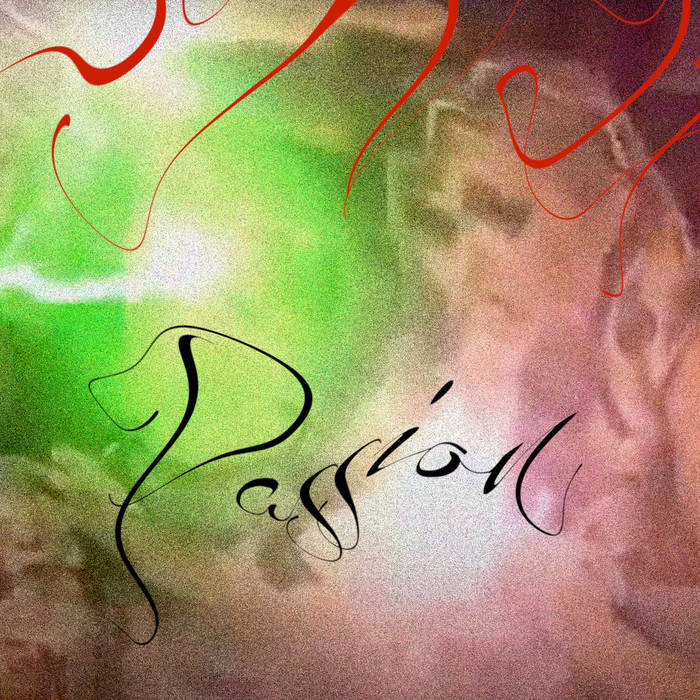
Two wildly unpredictable, twenty-plus minute tracks, allegedly constructed by the completely untraceable D.J. VLK using only samples from a turn-of-the-millennium paranormal NBC TV show, ‘Passion’, of which there were – remarkably – 2051 episodes. That’s over five years of uninterrupted daily TV consumption, which our valiant DJ consumed while simultaneously consuming egg and cheese sandwiches from a local deli. That’s a lot of protein, and a lot of paranormal TV.
Whether you believe the backstory or not (Strategic Tape Reserve have, after all, cornered the market in sonic obfuscation and music of dubious, yet deliciously enjoyable, provenance), there’s no denying the inventiveness on display here. A collage of disparate rhythms, speech samples and outwardly incompatible musical movements, the two long tracks comprising ‘Passion’ fizz and crackle with intense, dizzying energy and endless, endless juxtapositions: hip-hop one moment, lo-fi drum ‘n’ bass the next, backwards folk music á la boycalledcrow after that, all swiftly subsumed by a tapestry of sound art moments punctured by disparate snippets of out-of-place dialogue in the minutes that follow. Later, we hear a truly inspired sequence of vocodered voices over vaguely mediaeval sounds and psychedelic folk motifs. Truly bonkers, and all the proof that vegans need that too much egg and cheese will only bring about utter chaos in the world*.
Released 26 April 2024. Please note, the writer is himself vegan, and is not in any way opposed to the consumption of egg and cheese. In fact, this release rather suggests to him that a return to vegetarianism at some point in the future wouldn’t be totally out of the question. Bandcamp: here.
PHIL DODDS – MANY MOONS AGO (Waxing Crescent)
The occasion of turning 40 earlier this year prompted Waxing Crescent label founder Phil Dodds to blow the cobwebs off some old USB drives and release some of his own music, all made back in 2009 and 2010. I honestly don’t know why he waited so long. The pieces here are infused with a sort of Sweatson Klank-style electronic hip-hop nous, all chunky machine rhythms, fat bass sounds, spiralling synths that occasionally veer toward the psychedelic and a continual sense of lurking, latent energy.
‘Marsh Of Decay’ stands out, its restless, lo-fi dubby framework continually dancing on a precipice of firming up into something harder but staying resolutely fractured and in a state of flux right until it reaches a hard stop. ‘Seven Up’, a collaboration with Propa, is another highlight. This feels like two artists in ceaseless conflict with each other, where the way that the sounds are presented suggest that they’re being rapidly erased almost as soon as they first appear. Another collaboration, ‘Lifted’ (with Qman1) is a high-grade, low-key masterpiece, featuring a detuned breakbeat and amorphous clouds of swirling, ephemeral textures. ‘Many Moons’ is an unexpected, illuminating collection that feels a million miles from the material Dodds normally curates and presents through Waxing Crescent.
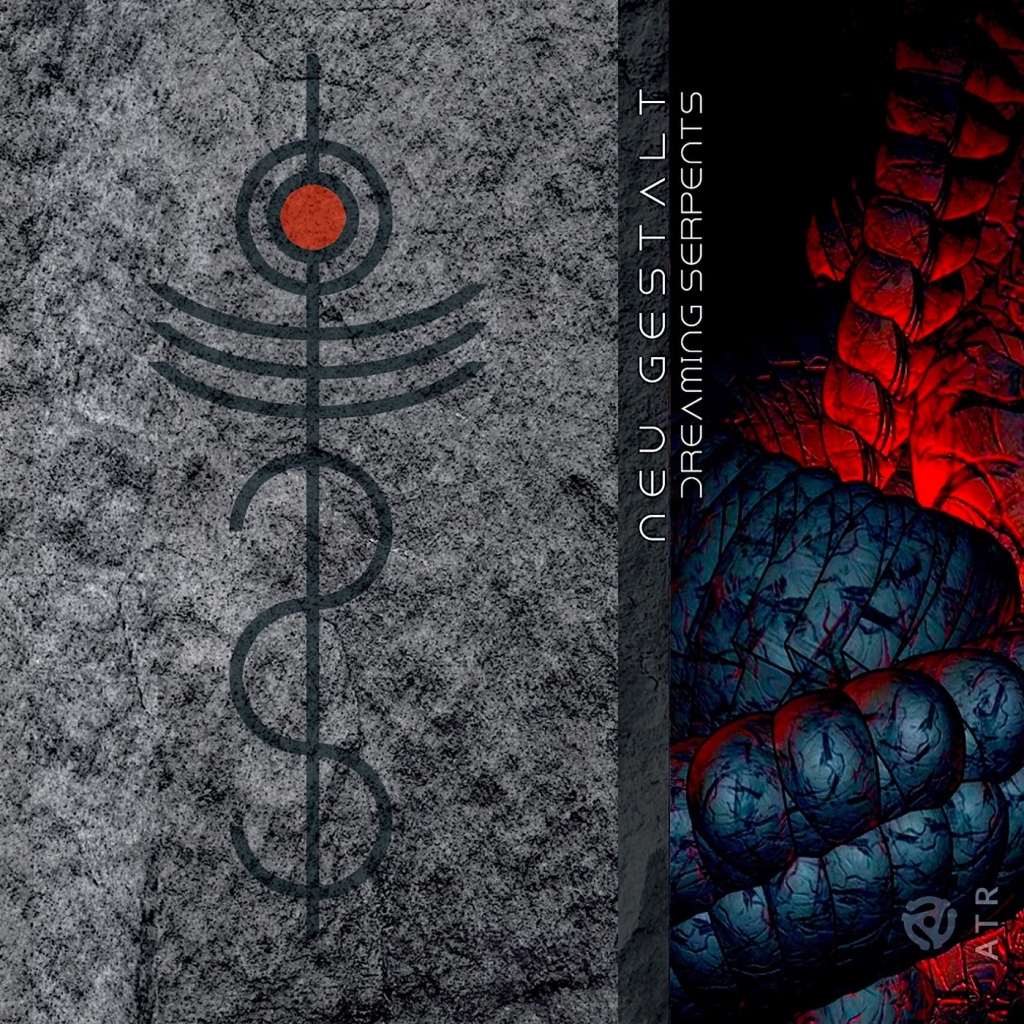
For his fifth Neu Gestalt album, and his first since 2019, Edinburgh’s Les Scott used a series of vintage Akai samplers to process his own bass and electric guitar playing, both played with a variety of techniques including the use of an EBow. That approach gives these ambient pieces a lyrical fluidity and distinctive texture but also a recognisably electronic edge, while the addition of crisp but unobtrusive beats and occasional vocal samples provide delicate framing for Scott’s guitar.
Opening track ‘On Darker Days’ is one of the most arresting pieces here, featuring splintering sounds and a melodic, maudlin guitar hook that wouldn’t sound out of place on a Depeche Mode song. ‘Restless Universe’ is another highlight, wherein squalls of fuzzy clouds of guitar texture and pin-prick melodies yield a tense, hypnotic piece. ‘Difference Engines’ begins with a truly beautiful, if sorrowful, sequence of guitar notes that’s when layered, are nothing short of heart-wrenching. This writer’s personal favourite piece is the sparse ‘Flickering Diodes’, whose elliptical, reverb-soaked melody recalls Coil at their most inquisitive and mysterious. A masterful return for the imaginative Scott.
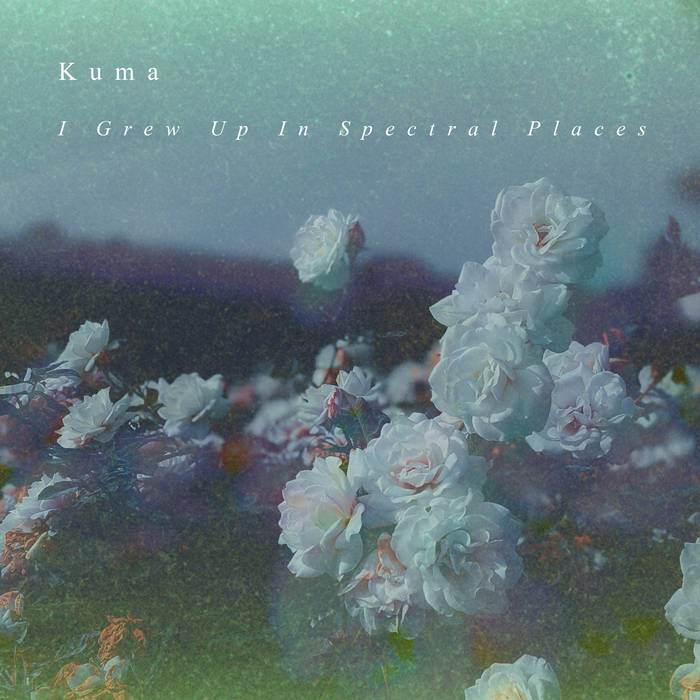
For this third album for Thomas Ragsdale’s Frosti imprint, Kuma is credited with ‘tapes, voice, synth, ghosts, coffee, low end theory’. Let’s stop there for a moment and look at that. ‘Ghosts’ and ‘coffee’. The inclusion of those two sources immediately tell you that this collection of nine pieces points in a resolutely different direction. The fact that Kuma says it was ‘invoked’, not ‘recorded’ is another clue to what these pieces sound like.
On one level, pieces like ‘Peacocks Have Very Mean Little Eyes’ and ‘Eden But With The Snakes Let In’ (top marks for digging into titles that sound like quotes from Welcome To Night Vale) have a textural levity that ties Kuma’s work to the broader reaches of ambient music but listen closely and the dependency on looped voices adds a chilling, unpredictable, from-the-beyond-the-grave spookiness. On that title track, the sort of grey, smothering quality that exists elsewhere is replaced by layers and spinning cycles of voices that appear to howl loudly into your ear canal, suggesting that perhaps Kuma invoked a particularly pissed-off, angry restless spirit during the sessions that begat the album’s central moment.
Luce Mawdsley is a Liverpool-based composer and multi-instrumentalist. Their latest album was recorded in the city’s Scandinavian Church and found Mawdsley playing guitar, organ and percussion alongside Nicholas Branton (clarinets) and Rachel Nicholas (viola). Describing their music as part of a journey, the title of the album focuses in on the starting point of Mawdsley’s own journey in Formby, a town in the North-West of England; the nebulousness refers to where they find themselves arriving today, as a non-binary, neurodivergent artist.
There is a sense of grace and harmony here, infused with expansive atmospheres inspired by Western cinema soundtracks. Pieces like the title track bounce and sway with a melodic levity, the three musicians weaving in and out of another like converging tributaries of water. Elsewhere, ‘The Growing Rooms’ has a devastating, heart-wrenching quality, its reverberating slide guitar reminding this writer of a motif running through Francis Lai’s ‘Love Story’ or sections of Mark Knopfler’s music from ‘Local Hero’. On many of these pieces, including the plaintive opening piece ‘Latex Feather’, Mawdsley is content for Nicholas’ viola to act as the music’s focal point, offering questing, searching, swooning, lyrical reflections of Mawdsley’s ceaseless curiosity.
Prompted by a harrowing trip to A&E amid a breakdown, Githerments And The MRI represents an astonishing release in the catalogue of prolific and consistently inventive sound artist Xqui, wherein the recorded sounds of an MRI scanner become central characters in his idiosyncratic sound world.
Noisy, complex and nuanced, this is Xqui at his most terrifying – and this comes from the perspective of a writer who has interviewed him, where the mask that he wears when he decides to come out of the shadows left me with endless nightmares. This is often so terrifying that if you’re about to go for an MRI scan, listening to this slab of caustic sound art may prompt you to cancel. There are, however, plenty of moments here that poke their way through the industrial atmospherics dominating these two twenty-minute pieces. Dub rhythms occasional emerge from the threatening whir of the scanner; a ticking clock fashions itself into a springy King Tubby mixing desk cast-off; a brief sample of Erik Satie offers a much-needed sense of respite; effusive backwards melodies offer a mournful moment of reflection. While these pieces might sit as complete polar opposites to more ethereal Xqui works like Hymns For Terry Francis, they add new and fascinating insights into the mind of this prolific creator.
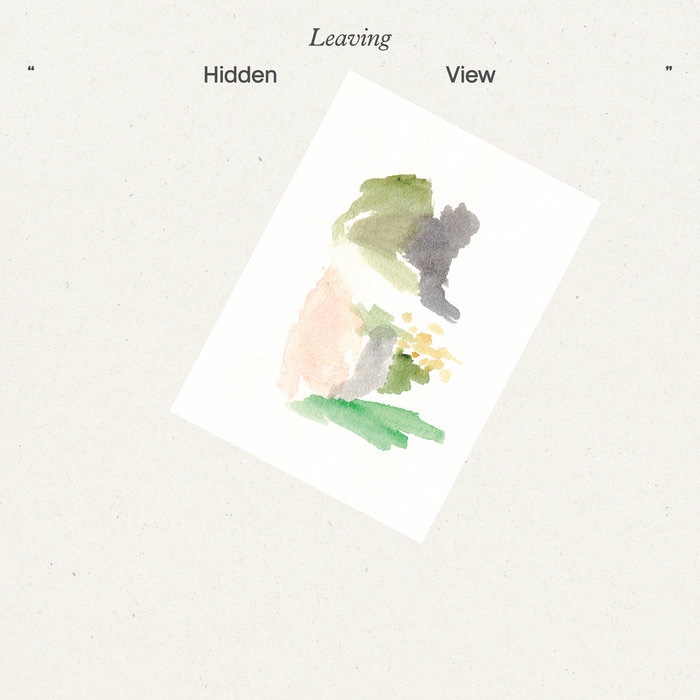
Leaving is the alias of Perth’s Rupert Thomas, who first came to my attention as one half of the duo Erasers, whose ConstantConnection album was a personal highlight from 2022. For Hidden View, Thomas’s second solo album, he explores fragile, sparse arrangements that evoke a sense of emotional trepidation and the wild naturalistic environments surrounding his home.
Usually consisting of off-kilter rhythms, minimal effects and haunted, enquiring synth melodies, pieces like the standout ‘Mirrored Feeling’ offer a sense of restlessness and unease; at first glance, they are bathed in beatific, enveloping ambient texture and persuasive layers of undulating melodies, but listen closely and those emotive gestures are gently punctured by a pinprick of doubt and darkness. Elsewhere, on the subtle widescreen atmospherics of key track ‘Hidden Dreams’ he assiduously evokes those brief moments spent in the weird interzone between wakefulness and sleep. Thomas has a seemingly innate ability to produce synth passages that imprint themselves devastatingly into your consciousness, making for an instrumental album with a low-key expressive depth.
“Eventually found a guesthouse. Not very nice: a park-bench bed with two blankets for a mattress, stone walls and a shared squat toilet, but it had an ashram ambience and great acoustics for the guitar. I could really feel those bass notes.
Spent the evening understanding the layout of the city, eating and playing the guitar. I met the devil in New Delhi railway station and sold my soul for his guitar tunings. Robert Johnson is taking over my fingers.”
– Carl M Knott, January 26 2006
Kullu is the new album from electronic musician and former folk artist boycalledcrow, the alias of Chester’s Carl M Knott.
The album is an audio travelogue of Knott’s travels through India in 2005 and 2006, just after he’d graduated. That journey was part of Knott’s concerted efforts to overcome the intense feelings of stress and anxiety that had gnawed away at him throughout his adolescence. Along the way, he documented his travels in a blog and accumulated countless memory cards of photos and videos. He stayed in basic accommodation and made numerous fast friends from around the world, one of whom, an artist called James, provides the album’s sleeve image.
Knott made copious field recordings during his travels, and this diary-like library of sounds forms the basis of the ten tracks on Kullu. We hear busy, vibrant towns from the back of an auto rickshaw, rapturous tabla rhythms, blurred chanting and tanpura drones, as well as Knott’s own playing, made using a guitar bought in Dehradun for £27.
Knott took these foundational sounds, then augmented and processed them in the style that he has developed on albums such as // M E L O D Y_M A N (Waxing Crescent, 2023) and Mystic Scally (Wormhole World, 2020). These pieces roam freely between the engaging and unpredictable; joyous yet reflective; uplifting yet inquisitive. They are pieces filled with constant motion; taken as a whole, these pieces allow the listener to follow Knott’s journey through the remote Kullu Valley and along the Beas river that bisects the Himalayas.
This is an album of intense discovery, of new sounds and new atmospheres, and a sense of healing and catharsis. Knott wrote in his blog about trying to avoid being drawn into the well-worm paths of mediation and yoga, unlike most of the travellers he met between New Delhi railway station and his time in the Kullu Valley.
Instead, the pieces on Kullu find someone acutely listening to the turning of the world around him. It represented an awakening of Knott’s approach to documenting the sounds he is drawn to, fused with a distinctive, emotive and original compositional style.
1. Charas 2. Pretty In The Sun 3. Joy 4. Vipassana 5. Tuktuk 6. Milk And Honey 7. Golden City 8. Kanashi 9. Sadhu 10. Kali
Music and production by Carl M Knott. Mastered by Antony Ryan at RedRedPaw. All field recordings and photographs by Carl M Knott, India, 2006. Design by Neil Coe. Video editing by Neu Gestalt.
Digital edition and limited cassette edition of 25 copies released May 3 2024 through mortalitytables.bandcamp.com
All proceeds from sales of Kullu will go to CHUMS. CHUMS provides mental health and emotional wellbeing support for children, young people and their families.
boycalledcrow is the alias of Chester-based sound artist Carl M Knott (Wonderful Beasts, Spacelab). Knott, a former folk musician, uses his myriad acoustic influences to create unique, strange and beautiful compositions.
The latest release from Brighton sound artist Simon James was recorded at Cathedral Quarry in the Lake District. Its first four pieces are essentially unadorned field recordings made in a cave, full of chilly atmospherics and incessantly dripping water, evoking a sense of vast space but also a macroscopic focus on miniature events. The final piece, ‘Exquisite Friction (Binaural)’, was made with a double mid-side microphone and transforms the cave ambience to trace outlines and alien textures, blending metallic tones and watery subterranean depth. Released 20 March 2024.
Simon James recently worked with local residents to create Neolithic Cannibals, a multidisciplinary arts initiative taking place at Brighton’s Lighthouse Project Space between 4 and 19 May – visit www.lighthouse.org.uk for more details.
FOUND OBJECT – EVERY SILVER LINING
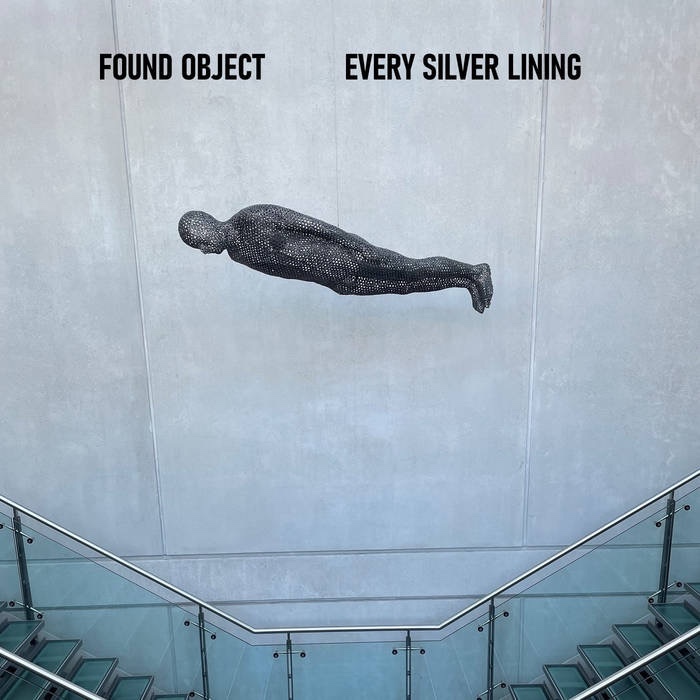
Found Object is the alias of Pete Allen, a former drummer who makes rhythmic instrumental electronic music that nods squarely in the direction of a certain legendary Düsseldorf quartet while also isolating the emotive melodic qualities of early 1980s synth pop. Not for Allen banks of vintage gear – all of the tracks here made using the iPhone Beatwave app. Tracks like the astute and moving ‘Silver Lining’ carry a rhythmic firmness and emotional turbulence of Depeche Mode’s ‘Nothing To Fear’, while ‘Mephisto’ (this writer’s personal favourite) stacks cyclical layers of icicle-sharp hooks on top of an unswerving beat that offers a sense of perpetual movement through the murky, neon-lit quarters of a thriving metropolis in the early hours.
Allen is also a frequent collaborator with powerful Kidderminster vocalist and electronic musician Jess Brett. Their ode to Berlin’s stately Unter den Linden thoroughfare is a triumphant pop moment for both artists.
Every Silver Lining was released 6 March 2024. Unter den Linden with Jess Brett was released 25 March 2024.
GVANTSA NARIM – CRUEL NATURE (Cruel Nature)
The latest album from Georgian sound artist Gvantsa Narimanidze derives its name from the label releasing it. Split into two long tracks, each lasting around twenty-five minutes, the album finds Narimanidze in deeply reflective mode. ‘Cruel’ offers a sort of sonic dualism, with drifting, ethereal, ascending tones occupying the upper registers and an unsettling, undulating drone and outline of a bass-heavy pulse operating as a foundation layer. ‘Nature’ adopts a similar pose, only its high end shapes are less uniformly soothing and its underpinning dronescape is more intensely restless. Released 29 March 2024.
THE NIGHT MONITOR – HORROR OF THE HEXHAM HEADS (Fonolith / Library Of The Occult)
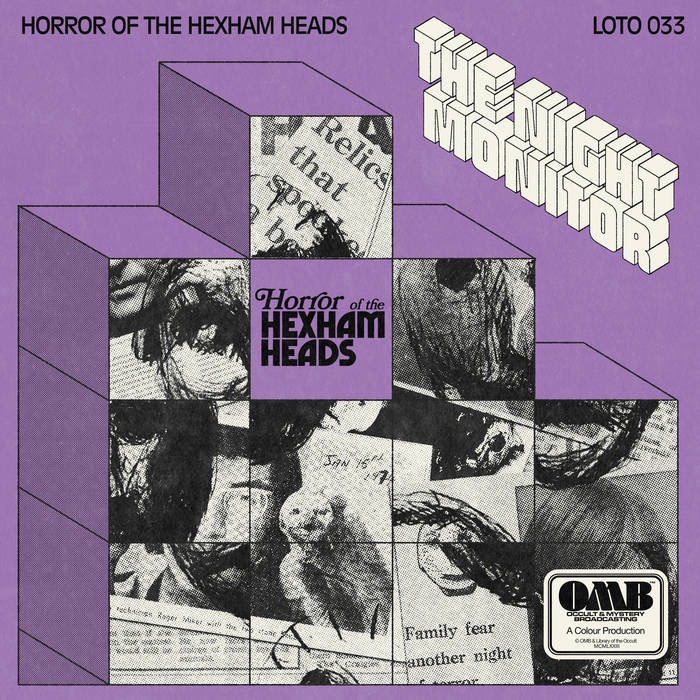
Neil Scrivin has truly cornered the market in freaky electronic music inspired by unexplained phenomena and paranormal activity. His first collaboration with Library Of The Occult is inspired by two carved stone faces that appeared, inexplicably, in a Northumberland family garden in 1971, foreshadowing a bunch of strange activities that I’m far too disturbed by to search for on the internet. Scrivin has assuredly outdone himself this time, stripping his compositions back to almost skeletal forms. ‘The Witch’, one of my favourite pieces, pairs rich and resonant synth sweeps with scratchy, nails-on-glass screeching that had me glancing at the window to make sure nothing was trying to break in (and, for context, I was in a plane flying at 35,000 feet in the air at the time). The shortest interlude here, ‘How Does Your Garden Glow’, is one of the collection’s finest moments. It might last barely a minute but its edgy, metronomic pacing and unwinding, slowly-writhing melody is – no pun intended – wonderfully haunting. Released 5 April 2024.
SERMONS BY THE DEVIL – BAPTISM OF DESIRE
The latest album from New Jersey’s Sermons By The Devil arrives with a manifesto of sorts: “If free will is the last battleground of youth, then dancing is the most rebellious thing that can be done as humans.” These pieces are indeed danceable, though I found myself moving almost involuntarily to each one, leaving me wondering what free will I had in the face of these persuasive moments. Each of these tracks rely on subtle shifts and intense repetition. You will find tasting notes of Micro-phonies-era Cabaret Voltaire soundtracking a pagan muzak rave. The two opening tracks are among the best. ‘Black Magik’ carries itself on a low-slung, nagging bass-heavy rhythm with a sort of heavy, ritualistic intent. Swirling spirals of brooding synths act as an offset but this is a grubby, minimalistic and insistent track. Meanwhile, ‘Fetishes And Sacrifice’ mines a chunky electro beat overlaid with ground-out bass synths and intensely-worked, restless sweeps. At almost nine minutes it is an intense and often disorienting highlight, relentless and urgent In spite of its slow tempo. A wonderfully dark collection from the self-styled ‘official house band of the apocalypse.’ Released 11 April 2024.
On face value, ‘Central Park: A Picture-In-Sounds’ is just an eight-and-a-half minute field recording from Central Park in New York, beautifully mastered by Alex from the quiet details label. There’s more to it than meets the ear, and its development has occupied me almost ceaselessly since 2021.
The location of the recording isn’t random. It is derived from your age and your life expectancy in 1874. I made a special map of Central Park divided up into areas corresponding to those life expectancies, and the ‘performer’ makes the recording in that area.
Why 1874? That was the year that the American radical composer Charles Ives was born. One of his compositions was ‘Central Park In The Dark’ (1906), with which Ives intended to evoke the sounds of the park that he heard while sat on a bench not far from his apartment on Central Park West. Incidentally, Ives is the guy with the beard in the illustration by Savage Pencil that gave Mortality Tables its entire visual identity.
Savage Pencil – Mortality Tables illustration (detail)
Why life expectancies? That’s because being a composer wasn’t Ives’s main occupation. For the majority of his working life, Ives worked in life insurance, way Downtown on Nassau Street, near Wall Street.
Why eight-and-a-half minutes? Because that’s how long the first recorded version of ‘Central Park In The Dark’ (made in 1951) lasted.
Mortality Tables – Central Park: A Picture-In-Sounds (Performance #1)
The intention is to publish the instructions for making a performance / recording of ‘Central Park: A Picture-In-Sounds’, along with more details about Ives and his work in both music and insurance, in October of this year.
A couple of other explanations, maybe. A list of life expectancies is called a mortality table. You may now see where the name Mortality Tables comes from. And my main occupation involves working with insurance companies. That’s why Ives is important to me, as an inspiration, and as a role model.



















You must be logged in to post a comment.