

If you’ve spent any time at all with the music of Ergo Phizmiz, you’ll have become accustomed to a certain non-linearity in what he does. Sounds and beats arrive, wobble uncontrollably and rapidly wriggle off in an unexpected direction, usually just as you think you’ve got them figured out. That same maverick spirit can be found in his latest film, The Madonna Of Bedminster, which premiered at London’s Horse Hospital in September.
Set in Bedminster, a suburb of Bristol, the film is an assemblage of different, disconnected ideas orbiting around a central narrative that takes in Brexit, Israel / Palestine, anti-capitalism, religion (and its demise), climate disaster, and the ramifications of societal change.
“We lived in Bedminster for three years,” explains Phizmiz. “The film is a farewell of sorts to the area. Where we lived was a public transport black hole. It was a 30 to 40 minute walk to the nearest public transport. So we very much spent three years in Bedminster. The experiences you see in the film of walking down endless streets is a reflection of my own experience. A trip out of Bedminster felt like a pilgrimage.”
That notion of escaping the town is encapsulated by Joe and Mary, who argue and bicker their way from the town’s market to a garden centre on the periphery of the town – Mary, it seems, is obsessed with plants, which Joe cannot fathom at all. After Mary pays for a small shrub, they instantly get teleported out into open countryside, which seems to really trouble poor Joe. Arthur Ransome and Bram Stoker (I vaguely recognise those names) are hapless estate agents who can’t find the house they’re supposed to be showing. Their comedic frustration as they walk along Phizmiz’s “endless streets” is ultimately rewarded by a vision of the Madonna on a street called Little Paradise – a street which is strewn with the fly-tipped trash of broken dreams. To underscore the madcap theatricality of the estate agents, Phizmiz soundtracked this section with a borrowed 78 of pleasantly bouncy jazz.
Later, we meet Lucretia, a young homeless girl living in a bin (“The whole country is a bin,” she points out, deftly), who carries an umbrella during the daytime because of sensitivity to light, and forages for food at night. Only as the film progresses does she reveal, matter-of-factly, that she is a vampire. A scene where she breezily walks along a terraced Victorian Bedminster street shouting “I’m a vampire,” in the direction of passing cars only seems to reinforce the idea of societal indifference.
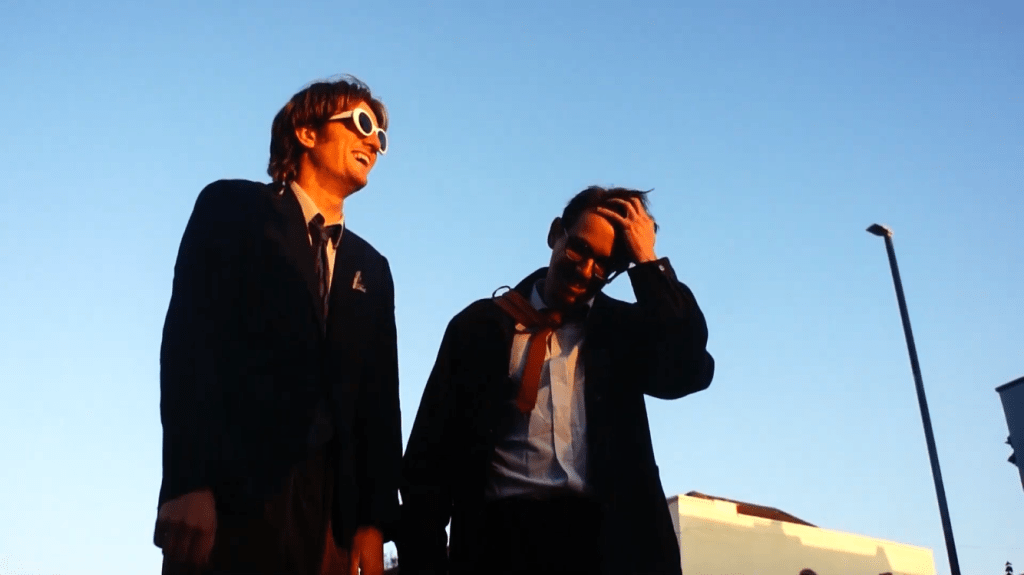
And then there’s Jonathan, played by Elvis Herod, one of Phizmiz’s oldest friends, easily one of the most endearing characters in the film. Jonathan is revealed as a ghost hunter and social critic decrying “bankers and wankers”. In one scene, he offers to show the viewers his meditation routine, something he excitedly calls ‘Lemurian Light Singing’. The process begins quietly and then his trance gradually gets more and more intense. By the end he is speaking forcibly in tongues and flailing his arms around wildly. It’s crazy, but mesmerising, like a lot of what happens in The Madonna Of Bedminster.
“Elvis and I have worked together on and off since 2001, mostly in theatre,” says Phizmiz. “He is the most impressive actor I know. He’s like a box of fireworks. He’s an endlessly inventive guy – he did the Lemurian Light Singing bit in one take about five minutes after having the concept described to him. He’s a ‘King Actor’ in the way Orson Welles described himself.”
The film is laced with sudden cuts to brooding philosophy, delivered to the screen like the pauses for dramatic explanation in a silent movie. “What do you do when the screaming of constant death is the drone that obscures the pulse of your planet?” asks one, ruminating on the conflict between Israel and its neighbours and an obliviousness to nature. A street busker insists that World War 3 has already started – has been quietly going on for a while, in fact – before talking about the controlling / controlled influence of the media, big themes which are offset by the idea of pointlessly buying luxury goods. Sprinkles of optimism arrive in the form of Santa Claus, who, against a backdrop of broken society and escalating conflict, offers a sense of hope. Footage of pigeons, seagulls, spiders and snails act as a much-needed salve for the challenging notions elsewhere in the film.

This is a long film, running at over two hours. Recognising this, Phizmiz inserted an intermission featuring his friend Goodiepal performing as a European exotic dancer in Worm Sound Studio in Rotterdam. I won’t spoil it, but suffice to say that it’s genuine comedy gold.
“It gives me endless joy,” says Phizmiz with a smile. “There’s an extended 16-minute version of it that gets a bit more X-rated.”
Like the events unfolding slowly on-screen, Phizmiz’s soundtrack is just as unpredictable. Cheerful Latin jazz makes frequent appearances, but there are other sequences where he leans into squalls of intense noise. A lot of these sections appear to have been made by dragging a bow across amplified structures hung with random bits of borrowed tat. (The structure is called the Large Hadron Calliope.)

Wonderfully strange and strangely wonderful, The Madonna Of Bedminster is a wonky, abstract, playful, earnest, hyperaware reflection of the world in which we live. If it feels a little weird, take a good look around you, or at the news. Is the film really so much weirder than the times we are living through? When you ask yourself that question, nothing about The Madonna Of Bedminster is weird at all.
The Madonna Of Bedminster arrives on YouTube on the night of November 1 2024. Listen to The soundtrack at Bandcamp here.
Words: Mat Smith
Ergo Phizmiz collaborated with my Mortality Tables project with his release ‘LF16 / The Tin Drummer Has Collapsed’ in the LIFEFILES series. mortality-tables.com
(c) 2024 Further.

 Further.
You must be logged in to post a comment.