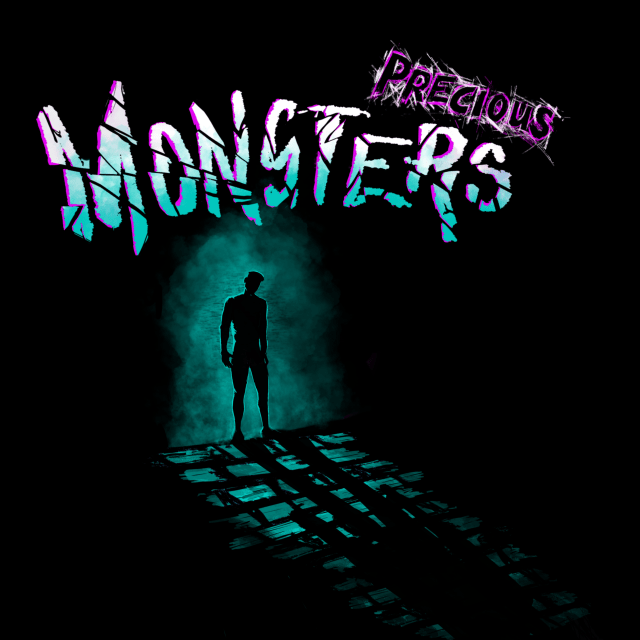
London fourpiece band Precious released their debut single ‘Monsters’ earlier this week. Consisting of intense, Rowland S. Howard-esque guitar shapes and a heavyweight rhythm section, the group embrace the dynamic atmospheres of post-rock, with frontman George Latinio-Butler delivering a vocal edged with a threatening urgency, framing lyrics concerned with innocence, mental health and addiction.
Today Further. presents the video for ‘Monsters’, reflecting the themes of the song using manipulated scans of guitarist Will Coath’s own brain.
“Using the brain is extremely poignant in relation to the song’s key theme,” says George Latinio-Butler. “It helps represent this in the best possible way – the monsters are inside each and every person, whether manipulating or torturing you, guiding you or biting you. It’s ironic that people are scared of fictional characters or animals when the scariest thing out there surely is the development of a person’s character over time.
“The music itself is presented as a journey,” continues Latinio-Butler. “It’s like a persistent voice to the painful choruses finally culminating in a crescendo, perhaps signifying a violent ending. The dream-like bridge represents the idea of Groove Child, almost like the inner child: cling onto the Groove Child, be wild, or be forever envious of that free spirit.”
Precious are George Latinio-Butler (vocals), Will Coath (guitar), Dan Preston (drums) and Dan Treacher (bass). Listen to ‘Monsters’ on Spotify.
‘Monsters’ by Precious was released April 23 2020. ‘Monsters’ artwork by Maggie Fraser.
One of electronic music history’s dependable certainties is its seemingly limitless capacity to reveal a treasure trove of enthusiasts, marginal figures and experimenters whose endeavours casually disrupt our carefully-curated notions of what happened when and by whom; these figures occupy a weird, amorphous hinterland bordered on the one side by the early works of John Cage, Karlheinz Stockhausen, Groupe de Recherches Musicales or the BBC Radiophonic Workshop, and on the other side by the later ‘standardisation’ of electronic music through synthesizer technology.
Malcolm Pointon (1940 – 2007) was one such individual. Pointon was a Cambridge lecturer and classically-trained pianist, whose importance and legacy were actually hiding in plain sight, albeit not his early, pioneering electronic experiments in the 1970s: Pointon was the subject of two moving documentaries in 1999 and 2007 that told of his suffering with Alzheimer’s, which would claim his life just after the second film aired, sixteen years after his diagnosis at the unthinkable age of just 51. Those films, in many ways, did much to raise the profile of a still incurable disease and the impact it has on families and its sufferers, as seen through the lens of Pointon, his wife, Barbara and his two sons.
Writer, researcher and electronic music historian Ian Helliwell has arguably done for Pointon’s musical influence what Paul Watson’s films did for his stolen final years. Through his Tone Generation broadcasts, documentary film Practical Electronica and Tape Leaders book, Helliwell has highlighted, with exceptional detail, the work of frequently overlooked hobbyists and enthusiasts, amateur instrument builders and electronics fanatics like Pointon; a group of unsung heroes whose dexterity with a soldering iron contributed to the tangle of patch cables, valves and transistors that is electronic music’s less-than-linear history. Helliwell curated some of Pointon’s recordings for Electromuse, released in 2016 by the Public Information label, with all proceeds going to the Alzheimer’s Society. These were thrilling recordings built from tapeloops and home-built bits of equipment, for the most part realised in Pointon’s shed.
Electromuse was the title of Pointon’s column for Practical Electronics (PE), one of a number of hobbyist magazines that Helliwell began collecting in earnest as part of his research. “Malcolm penned his Electromuse columns for PE in the early to mid-70s,” explains Helliwell. “These tied in with two electronic construction projects – the PE Sound Synthesiser and the Minisonic – both of which were designed by Doug Shaw with input from Pointon.”
“The composition of ‘Symbiosis’ was an interesting venture. For once I had to think in terms of musical material which could be bent to accommodate anyone who wishes to recreate it, from the skilled musician to the enthusiastic amateur. The form of the piece is quite straightforward: it begins quietly, gets louder and quicker, settles in the middle, gets quicker again and returns again to nothingness; beginning, middle and end.”
– Malcolm Pointon ‘Symbiosis Intro’ from Electromuse (Public Information, 2016)
One of the pieces on the Electromuse LP was ‘Symbiosis’, a piece presented with a graphic score to accompany the Minisonic project that had been published in June 1975 in Practical Electronics. “To me, it seemed a fascinating proposition in a mainstream hobbyist magazine,” enthuses Helliwell. He’s correct: the idea of something so bold and artistically adventurous in a magazine you could pick up in any WH Smith on any suburban British high street does seem remarkable, but it was also surprisingly practical. The Minisonic itself was a stylus-operated device and hardly the easiest thing to play; it was intended to be built by enthusiasts whose focus was more on its construction and not necessarily for people like Pointon who could confidently follow a conventional score. Thus a graphic score – in this instance a relatively straightforward musical diagram as opposed to a highly conceptual set of instructions in the style of Cornelius Cardew’s Treatise – would enable non-musicians to conjure some sort of passable musical output from their jury-rigged Minisonic construction, specifically droning textures, oscillating sequences, heavy blocks of sound and wandering, unstructured melodies.
That universality caught Ian Helliwell’s attention. “On the one hand it all tied in so well with my research and interest in electronic music,” he says. “But being unable to read conventional music notation myself, it had an even greater resonance. It meant that properly scored piece of music was now feasible for me to follow and interpret – at least in theory.”
Using the carefully-preserved reel-to-reel recording of ‘Symbiosis’ that Barbara Pointon had kept within her late husband’s archive, Helliwell was able to compare the score against Pointon’s version, and he was drawn to how readily it matched the visual appeal of Pointon’s instructions. “Several years after first hearing Pointon’s original, I was contacted by electronics constructor and musician, Paul Williams,” recalls Helliwell. “He shared with me a recording of ‘Symbiosis’ he’d made in 1978, and it was most intriguing to compare the two interpretations. This was the catalyst I needed to inspire me to record my own version in 2017.”
Helliwell’s version of the score saw him deploying his own, self-built electronic instruments. “The Minisonic was intended to be played with a Stylophone-type pen making contact with a conductive strip,” he explains. “I’d previously built two Hellitron Stylus machines that operate along those lines. Although a rhythm is not in Pointon’s score, as such, I also used my Percussimate rhythm machine, initially to keep time. In the end I decided it sounded very effective in one section and it had to stay in the recording.”
After that, the germ of an idea formed in Helliwell’s mind: he would reach out to friends, likeminded soldering enthusiasts and other electronic musicians. “I simply approached people I was friends with, or I knew a little bit, and who I felt would be a good match for this kind of challenge,” recalls Halliwell. “I wanted musicians with an affinity with experimental sound, and who had an interest in older equipment and something of the history of electronic music. It was entirely up to them how they approached the graphic score and what gear they used.”
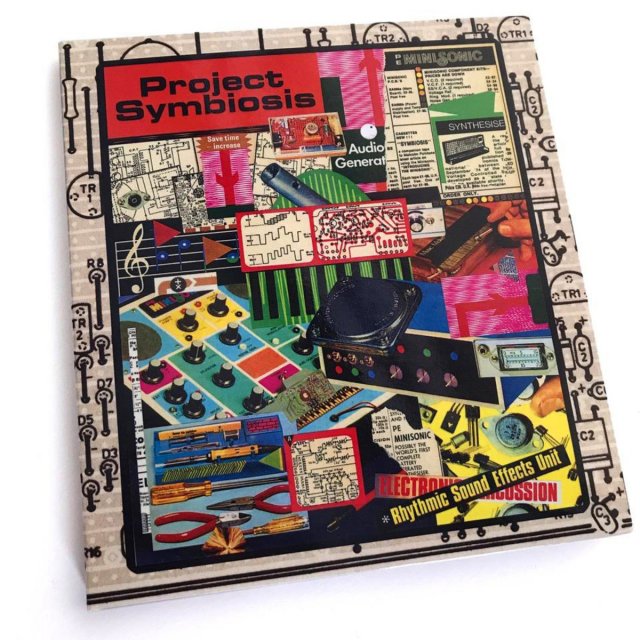
The results have been compiled on CD released by Helliwell earlier this year called Project Symbiosis, placing Malcolm Pointon’s original, Paul Williams’ piece and Helliwell’s own alongside new versions by the likes of Resonance FM’s Daniel Wilson, Apollo 440 co-founder James Gardner and Steve Duckworth, who used to build the types of projects documented in Practical Electronics back in the 1970s. Paris-based Peter Keene approached his version with such purity that he went so far as to build his own Minisonic using circuit diagrams sent to him by Helliwell.
Another contributor was 808 State’s Graham Massey. “I haven’t really used graphic scores before,” he says. “My first attempt at ‘Symbiosis’ was a bit loose and Ian had me redo it, which I was grateful for. The second attempt I was much more focussed, as I delved deeper into the score.”
If using a graphic score was a new thing for Massey, the culture of home-built electronics wasn’t. “I was in an electronics club at high school,” he recalls. “Also, my dad worked in electronic engineering, so he would build stuff like radiograms in the shed. He built me a fuzzbox with an audio oscillator in it and my first guitar amp was a repurposed PA system from the McVities biscuit factory with a long-wave radio built in, with a massive tannoy horn attached. Then there was a telephone rotary dialler gate device that we used on my electric violin, and he built The Astroban, an electric mono string guitar with telephone pickups at either end. That’s been on a lot of my records over the past thirty years.”
Massey was keen to approach his version of ‘Symbiosis’ with a reverential nod toward the equipment it was originally designed for. “I wanted to use a synth I have called the E&MM Spectrum,” he says. “Electronics & Music Maker was an electronic music magazine from the 70s, and this synth was a kit that you built monthly. I didn’t build it – someone gave it to me – but this seemed in keeping with the project, and it has some really nice modulation possibilities linked in stereo. I also used a little bit of the ARP 2600.”
Performing ‘Symbiosis’ at Graham Massey’s studio. EM&M Spectrum (lower left) and ARP 2600 (centre), with Pointon’s score for ‘Symbiosis’. (c) Graham Massey
Brighton sonic adventurer and one of Ian Helliwell’s Tone Generation collaborators Simon James opted not to use his trademark Buchla system for his version of ‘Symbiosis’. “I used a Roland System 100 on loan from my friend Pablo at Toy Drum studio, and I also used a Roland Space Echo RE-201. The combination worked really well. The System 100 is such a rich synthesizer.”
James had also never really worked extensively with graphic scores before. “I did a live Theremin performance with Ian and Sarah Angliss a long time ago where we had the graphic score running on a screen in front of us and we all played along,” he recalls. “I remember the combination of that screen and a mirror ball making me so dizzy that I nearly fell off the stage. I joke that I have a mirror ball ban on my rider since then. But while I haven’t done many graphic scores, I’ve done music inspired by architecture, which often means using the shape of a structure or building and representing that with sound elements. In The Shadow Of The Skylon or pieces from my Shenzhen / Shanghai – China release are good examples of this.”
Roland System 100 (c) Simon James
The idea of sitting through ten versions of the same piece might seem a little daunting. The reality is that each of these interpretations are, in their own way, improvisations based on visual cues rather than the generally faithful playing you’d hear with multiple versions of a classical piece. Pointon’s score even includes an instruction to improvise – slowly – around a specific cluster of notes, a process that would be familiar to him from being an accomplished jazz pianist, itself a relatively playful concept within a genre of music that has a tendency to lean toward rigid, grid-like forward motion. “It’s fascinating to hear all the versions,” reflects Graham Massey. “To me it feels like a road map seen through different lenses.”
“Overall, I wanted to reflect something of the analogue DIY sensibility of yesteryear, but mixed with a contemporary approach,” concludes Ian Helliwell. “Even though ‘Symbiosis’ is 45 years old, I felt that it still has a modern relevance, and could even be used in schools nowadays to introduce pupils to electronic sounds and ways of putting them together.”
Project Symbiosis was released 6 January by Helliwell Industries in a limited edition of 100 CD copies, incuding comprehensive liner notes and a reproduction of Malcolm Pointon’s score. Buy Project Symbiosis through Bandcamp.
Ian Helliwell’s website, containing comprehensive details of his various projects and Analogue Sound Workshops in Brighton can be found here.
I fondly remember a time when war was the only existential threat I used to worry about. When I first saw the title of the new Doomed Bird Of Providence EP, I initially thought that it was a slightly dated depiction of the parlous state of things around us; a pre-COVID view of the world, if you will, of knife-edge crises concerning dictatorships, WMDs, terrorism and displomatic emergencies caused by seized oil tankers.
This isn’t the subject matter of this four-track EP, however, and anyone with a passing knowledge of Australian-born, London-based Mark Kluzek’s band would appreciate that their evocative instrumental music is principally concerned with the past.
Where the band’s earlier releases directed their unflinching lenses at Australia’s colonial legacy, this release is focussed on Kluzek’s grandfather and his journey from his invaded homeland of Poland in the Second World War, through Europe, to Scotland and thence to Australia. Using hand-me-down recollections from relatives and a book detailing his grandfather’s military troop’s journey during the war, Kluzek’s piano compositions were designed to evoke each pivotal stage of an escape that he owes his existence to.
With Kluzek’s mesmerising playing dominating the foreground, accompanied by fiddle and militaristic drumming, the EP’s title track begins with a languid, almost wistful air, somewhere between resignation at the oncoming invasion and a regretful look back at the home that was soon to be abandoned. As the tracks progress, a firmness, a determination and yet also a tension beings to set in, with the final track – ‘But Something To Aim For’ exhibiting a hopeful, yet desperate sense of urgency amid a wall of rising, cacophonous layered instrumentation. These pieces are framed by a folk music palette, itself a nod in the direction of Eastern European traditions, lacing their tonalities with echoes of the past and a profound sense of loss.
The Doomed Bird Of Providence have always excelled at producing such historically-informed narratives, whether about tuberculosis diaries or natural disasters, loading each of their pieces with a semi-imagined first-person perspective that is all the more remarkable considering they operate squarely in the field of instrumental music. Rumbling Clouds Of War Hover Over Us cements that yet again, yielding four breathtaking soundtracks to a deeply personal subject matter that convey so much – without saying a single word.
Rumbling Clouds Of War Hover Over Us by Doomed Bird Of Providence is released April 17 2020 by 10 To 1 Records.
As things like self-isolation and social distancing became phrases and concepts the majority of the world has quickly become accustomed to, it’s been the art of the hasty pivot that has characterised lockdown: businesses that relied on face-to-face interactions suddenly thrust themselves into the hitherto unknown territory of digital engagement, restaurants suddenly offered take-out where they previously relied on seated diners, wholesale retailers suddenly became direct-to-customer operations; we have moved from the need to see, touch and meet people to drinking espresso and gin over video conference, walking in the middle of the road to bypass another pedestrian walking toward you, and following authoritarian one-way systems around supermarkets. None of this we could have conceived of a few months ago, yet we are now all – mostly – suddenly expert.
The way we consume and enjoy music was almost immediately disrupted by the measures governments put in place. Gigs and festivals were cancelled; release dates got put back; pressing plants shut down; critical calendar entries like Record Store Day were postponed; venues were almost immediately shuttered. These are existential events for artists, bands, labels, designers and the countless individuals and businesses that support the music industry.
In response, all manner of COVID-19 projects quickly sprang up: compilation releases to support frontline essential workers; isolation playlists were hastily assembled, often comprising lots of soothing ambient music; live-streamed solo bedroom gigs delivered your favourite artist into your front room; noodling Soundcloud tracks appeared with high velocity, the product of idle fingers, a need for expression, boredom and the advantage of a broadband connection.
One very special and highly distinctive project to emerge from this is Touch: Isolation, announced last week by Touch. “The pack of COVID-19 cards came down quite quickly, and we wanted to respond to some immediate problems many of our artists were experiencing,” says Jon Wozencroft, who founded the label 38 years ago, later bringing in Mike Harding to work with him.
Available through Bandcamp for a minimum £20 subscription, all of which is divided up among its contributors, Touch: Isolation consists of at least twenty tracks from Touch artists, each one mastered by Denis Blackham – that, in itself, an example of the label’s dependable obsession with quality presentation despite the speed with which the project was conceived and realised. At the time of writing, releases have already come through from Jana Winderen, Chris Watson, Bana Haffar, Mark Van Hoen and Richard Chartier with tracks incoming from Howlround, Claire M Singer, Fennesz, Oren Ambarchi, Philip Jeck, Carl Michael von Hausswolff and others who have issued released material through Touch.
Touch: Isolation – Chris Watson ‘Gobabeb’. Photograph by Jon Wozencroft.
“By the nature of what we do, it’s quite hand-to-mouth,” Wozencroft continues. “For Mike and I, the project is also a declaration of intent in a personal sense because we’ve both been experiencing some highs and lows in recent months.” Those lows are self-evident and are common to most of us, yet uniquely personalised to our own lives; the Touch highs include recent releases like Eleh’s brilliant Living Space, nurturing new artists on the label and Hildur Gudnadottir‘s success at the Oscars. Wozencroft justifiably calls it the “culmination of years of collaboration and shared ambition”. The idea of Touch going on hiatus just because normal life has been paused would thus have been a terrible, terrible notion.
“Between Mike and I it was kind of a Eureka decision to step ahead and do this,” he continues. “In effect, we pressed the switch in the third week of March and in no time we had a strong response from almost everyone we asked.”
A critical signifier of Touch has always been Wozencroft’s photographic accompaniment to the imprint’s releases, which presented a challenge for Touch: Isolation. “I had to think hard about how the Isolation series could be given a visual counterpoint, given the lockdown restriction,” he says. The result is a series of photographs of trees, leaves, pools, each one of something strangely quotidian yet now, thanks to the lockdown, mostly off limits; each one was taken on March 25 on Hampstead Heath’s West Heath and Golder’s Hill areas, just as the lockdown began.
“I’d been going to Hampstead Heath since being a teenager growing up in North London,” Wozencroft continues. “It was always a special trip, and so it was a challenge to make this familiar space reflect a certain unreality; the suspended state of beauty in the full gleam of the recent sunshine. But also its rarity and rawness as an urban environment in the current conditions. I was also remembering the damage of the Great Storm of 1987 – seeing the evidence of regeneration and a landscape transformed, and that sense of faith in the future.
“For me,” he concludes, “it’s about hope and detail, the hidden and its brilliance.”
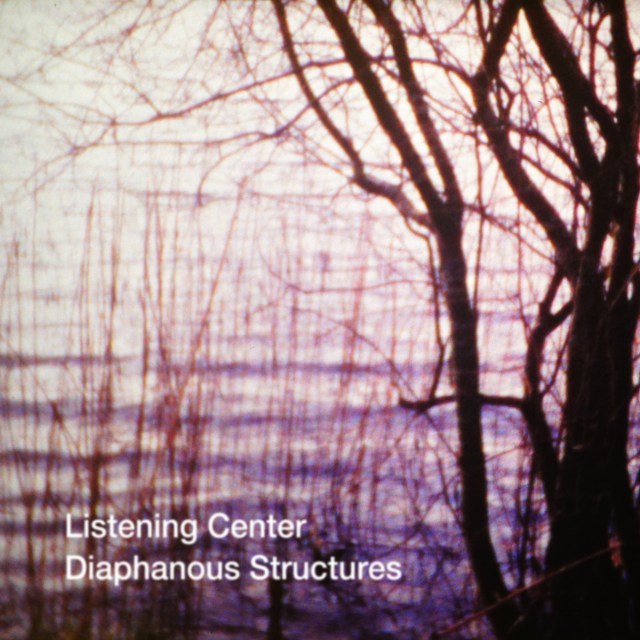
Listening Center is the project of Beacon, NY electronic musician David Mason, and Diaphanous Structures is the follow-up to last year’s Retrieving.
Where Retrieving was an album that managed to straddle the elastic explorations of 1970s Moog excursions and the fragile architecture of 1981-vintage synthpop, Diaphanous Structures is a much more meditative exercise. Built, for the most part, on delicate, almost wistful layers of gentle, swaying electronics, these eleven pieces nevertheless proceed with a sense of purpose, sidestepping any notion of directionless musing on the part of Mason.
Devoid of beats and obvious rhythms, pieces like ‘Sapling Three’ rely on a languid form of forward motion, buzzing with latent energy and overlapping, effervescent arpeggios. With the addition of soft reverb and subtle modulations and a coda filled with urgent bass sequences, these pieces take on a melodic intricacy without ever sounding anything other than minimalistic.
Elsewhere, ‘Concentric Circles’ carries a gauzy, melancholic edge, the sparsest of patterns creating a stirring, heart-wrenching micro-masterpiece, while ‘A Torn Hedge’ ripples with a brooding mystique and sense of compelling danger; what can Mason see through that hedge? What lies just behind its frontier? Was that tear placed there precisely to permit a voyeuristic glimpse of something elusive?
The album is punctured by three short, sub-one minute vignettes, wrapping complete and intense emotion in the briefest of statements. While ‘Sad Center’ has a profoundly moving quality, the wonderful ‘Interior Hue’ is a classically-leaning piece nodding contentedly in the direction of early electronic albums and the long shadow cast by their innovative sound palettes.
Diaphanous Structures by Listening Center was released April 9 2020 by Temporary Tapes.
Today, Further. presents the first play of Matthew Barton’s new single ‘Christie Christie’, due for release tomorrow. Barton first hit our radar with the mesmerising ‘Orchid’, a sensitive slice of avant pop released earlier this year.
‘Christie Christie’ finds Barton in rockier territory while still showcasing a personal lyrical and compositional style that defies categorisation. “It’s a song about escape,” he explains, “whether that’s fleeing from a situation, another person – or yourself. Is the lyric an internal monologue, or an address from a lover? What has Christie done that means they must flee so rapidly? Or what has been done to them? Caught doing what? I wanted to explore in the song the meaning of loyalty (“the ties won’t sever but the will just might“), identity (“a misfit no more in a foreign land“), and memory (“inside I store the silhouette of your head in the light“) in the face of a seemingly urgent situation.”
Reflecting the inner anguish in the song, Barton’s evolving arrangement of keyboard, banjo and layered process is designed to augment the song’s themes of confusion, tension, conflict and paranoia while never letting his singular vocal style be subsumed. “I guess at its heart the song is about the ‘fight or flight’ impulse,” he says.
With dream-like artwork by the Dutch Expressionist artist Tinus van Doorn, ‘Christie Christie’ is another strange trip into Barton’s subconscious. Listen to ‘Christie Christie’ below.
Matthew Barton is currently working on his debut EP, which will be released by Knife Punch Records later this year. Barton has also contributed songs to some benefit compilations – Z-Tapes’ Hope For European Bedrooms to benefit DIY artists hit by COVID-19, and two compilations benefiting healthcare and community services in the wake of COVID-19: Brace Cove Records’ Quarantine Comp and Under The Counter Tapes’ Banders.
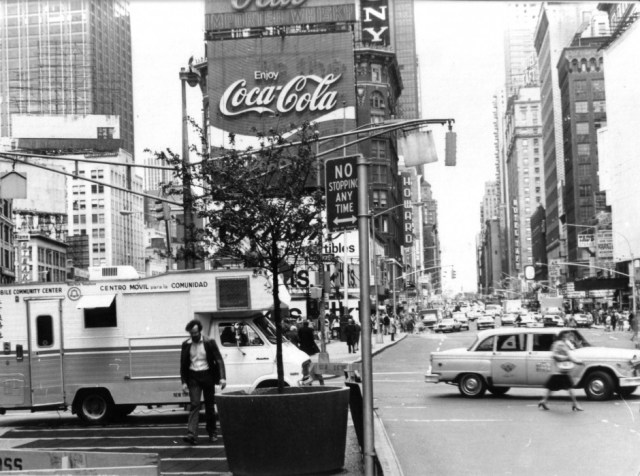
It’s 6am on a balmy New York morning in October 2017; Reed Hays, one half of Reed & Caroline, is leading me to a specific section of Times Square. On the way, he tells me what the area was like when he lived nearby in the late 1980s, a time when this part of the city was shorthand for a gaudy seediness, bordered by low-rent porn cinemas and XXX-rated video stores, with pickpockets and scammers taking advantage of the tourists that have congregated at the intersection between Broadway and Seventh Avenue for over 100 years.
Our destination is an unmarked, nondescript triangular grate between 45th and 46th streets, covering a ventilation shaft from the subway tracks running just below the street. Unimpressive it may be, but it is the location of what may well rank among the most frequently-visited works of art on the planet, even though the vast majority of those visiting Times Square have no idea that it’s even there. This is Max Neuhaus’s Times Square, originally – and appropriately – titled Underground Music(s). Neuhaus installed his most famous piece of sound art here in 1977 after four years of back and forth with New York’s transit authority, and it ran continuously, 24/7, until 1992; it was restored and activated again in 2002, and has again run uninterrupted ever since*.
Neuhaus was no stranger to New York’s art world in 1977, and neither was he an unknown in the field of sound. He had started out as an avant garde percussionist, realising definitive versions of pieces by Karlheinz Stockhausen’s Zyklus and moving on to embrace electronics for a recording of John Cage’s Fontana Mix. By the mid-60s he had moved squarely into the domain of sound art, creating pieces like Fan Music (1967) on rooftops in the Bowery, where the volume and nature of the sonic output depended entirely upon the prevailing weather, a read across to Cage’s obsession with chance and the I Ching. Fan Music was the first of what Neuhaus would call his Place pieces for their physical and geographical characteristics, and it is within this series that Times Square would become his most prominent work.
“The work is an invisible block of sound,” wrote Neuhaus about Times Square in 1992, just as the installation concluded its first run. “Its sonority, a rich harmonic sound resembling the after ring of large bells, is an impossibility within its context. Many who pass through it, however, can dismiss it as an unusual machinery sound from below ground.” The sound is elusive, varying according to where you stand on the grate, appearing to swell and move toward the periphery of your hearing imperceptibly. With timetabled regularity a subway train interrupts the sound, distorting and confusing the otherwise smooth resonances of the piece.
The sound – a calming, ringing drone, in the manner of La Monte Young and Marian Zazeela’s Dream House works – is a major seventh chord made up of many tiny pulses arranged rapidly in sequence, similar to the work of fellow duration music aficionado Phill Niblock. Hays and I ponder how the sound was made, assuming that for it to have been activated in the 1970s it must have been of analogue construction, though period synths of that time needed a stable electric current to prevent them from going out of tune; precise schematics of Neuhaus’s design aren’t readily available, but we conclude that the subway system must have provided the constant current, which might explain the protracted delay in realising the work, alongside securing permission to use of one of transit authority’s ventilation shafts.
What to make of this work? On the one hand, many critics have celebrated Neuhaus’s desire to democratise art by making something like this available freely to so many; on the other hand, its lack of signage or discernible identifying markings means it remains the exclusive preserve of those in the know, thus making it both anti-elitist and elitist simultaneously; Neuhaus himself wrote about moving from the rarefied environs of Carnegie Hall to Times Square as a way of engaging with the ‘culturally uninitiated’, which doesn’t come across as hugely democratic. He observed the piece almost daily on CCTV and volunteered ways of stopping the area’s many street performers – particularly the guitar-strumming Naked Cowboy (Google at your peril) who was something of an offensive nemesis to the artist – from using the piece as a makeshift stage. Some have drawn a thematic link between Times Square and Cage’s 4’33”, the former being bounded by geographical detail and the latter by temporal limits; one whose sounds can never be allowed to operate among complete silence with the other unable to be anything other than hypothetically silent.
Even at 6am, perhaps the ideal time to experience Times Square, the area crackles with a grim energy and if it wasn’t for the precise navigation skills of Hays, I doubt I would have even found the right grate. The billboards are illuminated, a few dispossessed people drag suitcases to or from red-eye flights, an early morning TV programme is being filmed in full view of a small gathering of people keen to catch a glimpse of whichever celebrity figure is being interviewed – but it’s certainly about as quiet as this place ever gets.
Reed Hays at Times Square, October 23 2017 06:15 (Photo: Mat Smith)
Mat Smith at Times Square, October 23 2017 06:15 (Photo: Reed Hays)
Only a couple of hours later, the area will be flooded with selfie-snapping tourists and modern day scammers dressed in abysmal Sesame Street costume rip-offs, making Neuhaus’s work more or less undetectable unless you happen to tune into it while fleetingly passing through.
Some six months later I found myself doing just that on my way to see Reed & Caroline perform down on the Lower East Side. My only clue to the location of Times Square was the fact that the Naked Cowboy ceased his afternoon performance at the precise moment that I was being carried along by the crowd of awestruck tourists, their eyes raised upward toward the famous neon advertisements, blissfully unaware of the meditative sonic events taking place just beneath their feet.
Words: Mat Smith.
With thanks to Reed Hays, Pidu Russek at the Estate of Max Neuhaus, Dia Art Foundation, Neil Mason and Tin Soldiere. This unpblished piece was originally written for Electronic Sound but was not ultimately published. * At the time of writing, owing to the ongoing COVID-19 outbreak, Times Square is not currently operational (according to the Dia Art Foundation, who maintain the piece), concluding the second run that began in 2002. I Heart NY.
(c) 2018 – 2020 Mat Smith for Electronic Sound / Further.
In sociological terms, a dyad is the smallest possible social group, consisting of just two counter-parties. In the case of Stockholm-based Johannes Burström’s latest project, those two elements are his double bass and electronics, the result being a thirty-seven minute exploration of the sonic potential of an instrument, well beyond its normal, familiar setting.
The approach Bürstrom took reminds me chiefly of Toshimaru Nakamura’s work for no-input mixing boards, here using a microphone to record the sounds of the bass as it was subjected to a loop played through a device placed above it. As far as one can tell from the notes on Burström’s Bandcamp page, the similarity with Nakamura’s work is that the process seemed to involve no actual playing of the bass in the traditional sense, only that the bass responded using tension, resonance and vibrations to the pre-programmed loop from a computer.
In spite of that, it remains possible to discern that the instrument being ‘played’ is a bass. There is an earthy, elastic quality to the resultant sounds that are immediately recognisable, whether in the context of expressive jazz motifs or in the whole-instrument manipulations used by improvising players like Tom Wheatley.
For the most part, however, the chance-filled sound world that emerges here is a dirty, slowly-evolving, almost industrial bed of beautiful noise somewhere between a rapidly-spinning washing machine and quietly humming air-conditioning unit. To do that with an instrument like a bass, with all its distinctive, springy tonalities is a testament to Burström’s interventions and sense of sonic adventure.
Dyad by Johannes Burström was released March 27 2020 by BoogiePost Recordings.
Indigenous Mix 3 is the counterpart to The King Of Beasts, the latest album from Andrew Spackman’s Sad Man alias. The King Of Beasts offered all the expected characteristics of a Sad Man album in the form of jerky, vibrant electronic music that draws heavily on the legacy of jazz music, giving his pieces a natural freedom and looseness that is rare to find in music made on a grid.
Here, each of the album’s twelve pieces are given a substantial makeover, the approach varying between incorporating tribal percussion and throwing out some of the jazzier reference points in favour of a skewed, wonky electronica, and most points in between. That approach gives the mixes of ‘Carbonated’ and ‘Kalifornia’ an awkward, clipped, chunky quality offering a firmness in place of the original’s lightness of touch.
Elsewhere, ‘After After’ is re-rendered as a longform electro workout full of ringing motifs and buzzing melodies, while a standout new version of ‘Door’ becomes a metallic hip-hop groove knocked off course by springing, unpredictable electronic percussion and nauseatingly spiked vocal samples.
Indigenous Mix by Sad Man is released April 1 2020.
Read Further.’s interview with Andrew Spackman about ten of his musical influences here.
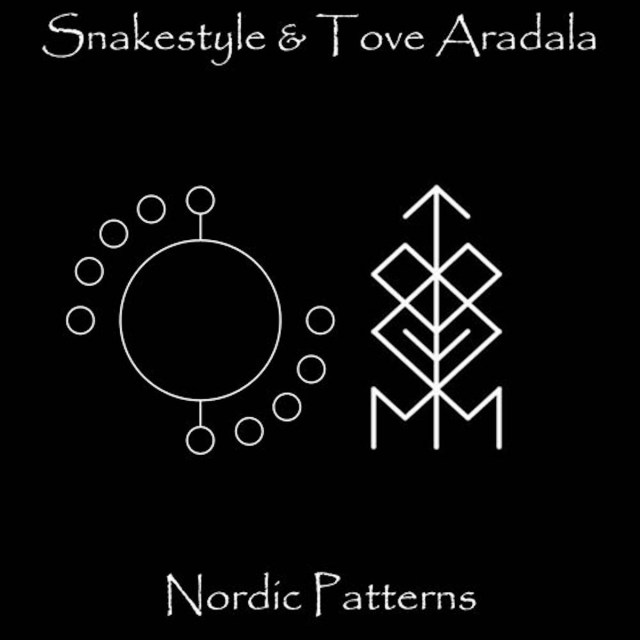
Somewhere along the lines, Nordic culture got a major overhaul, becoming shorthand for sleek minimalism and clinical modernism. Nordic Patterns, a collaboration between electronic musician Matthew Leigh Embleton’s Snakestyle alias and Tove Aradala seeks to redress that, delving deep into the essential fabric of Norse tradition with all its attendant mystique and rich, unique mythology.
Tove Aradala, or Tove Aradala Barbrosdotter Buhe-Stam to give her full name, is well-placed to comment on this. A High Priestess of the Temple Of The Eternal Goddess, a reconstituted religion which taps into the essential polytheism of Norse culture, a belief system which celebrated multiple spirits, gods and creatures. Using sections of Eddas (holy texts), songs and pieces written in the spirit of the region’s folkloric essence, Nordic Patterns affixes Aradala’s gentle singing and resonant chanting to an intricate, entrancing electronic backdrop crafted by Embleton. The album began with a series of field recordings on the Swedish island of Gotland in August 2019 before Embleton returned to London to complete the tracks.
Pieces like ‘Gnisvärd’ exemplify the approach. Here Aradala took traditional folk song rewrote it as the coda to a sparse backdrop of ebbing and flowing electronic sequences wrapped in hazy, frosty textures. Echoing sampled vocals wend their way through the piece, like voices lifted from an old Edison Cylinder, creating a subtle tension between the present and the past. Embleton reveals himself as a sensitive collaborator to Aradala, bathing her ethereal, yet commanding, voice in shimmering reverb and framing her vocal with structures built with a naturalistic fragility. On ‘Klangstenen’, that backdrop is fashioned from liquified, jazzy tones and beats reduced to a primal essence of clicks and pulses; on ‘Trullhalsar’ it is a landscape of dubby bass and wavering, tentative melodies.
The key piece here is ‘Hoburgsgubben’, a nine minute unlikely ambient pop song that flows with meditative purpose. Deeply poignant synth melodies, a shrouded, unobtrusive beat and a general air of serenity envelop joyous lyrics written by Aradala that beautifully celebrate midwinter, and all its frosty promise.
Nordic Patterns by Snakestyle & Tove Aradala was released March 27 2020 by Alex Tronic Records














You must be logged in to post a comment.