This is the first in a series of releases from Fields We Found, the catalyst being a period of illness which prompted Alex Gold to focus in on the things that gave him joy, including the process of making music. The overall series is called resolve / relate.
The four tracks here are inspired by nostalgia for Gold’s halcyon nights spent clubbing at places like Fabric. Each has the relentless chugging rhythms of especially solid techno sets, offset by minimal interventions – a cluster of notes approximating a repeating melody, deep bass lines, oscillator sweeps, unfurling drones, tuned percussion – that add to a sense of forward momentum. The EP is rounded out with a remix of ‘rhythm structure 1.1’ by Brendan Moeller, who recently released an album on Gold’s Quiet Details imprint.
Each of these pieces are, however, draped with a sort of foggy impenetrability, like the club is choked with dry ice. The figures of fellow clobbers are reduced to mere shuffling outlines, while strobes and lights create jagged shapes as they try to cut through the haze. It approximates both the fallibility of memory, as filtered through our nostalgic recollections, and the vibrancy of a club situation where the only thing that matters is the trance-like state created by extreme repetition.
Gold’s practice is entirely live, improvising and recording direct to tape. This gives tracks like ‘rhythm structure 1.2’ a spontaneity, almost like he is helming a DJ set and constantly keeping an ear on each track’s energy. ‘rhythm structure 1.3’ is this writer’s personal favourite, opening with white noise-tinged sequences that whine discordantly, prefacing a delicate suite of notes that slowly emerge from the background and assert themselves as the unswerving focal point of the track. As they do so, a sense of extreme, swirling turbulence begins to become obvious down in the foundation layer – restless, unplaceable sounds; sibilant noise; tension; discordancy.
A powerful – yet restrained – signal of intent from Gold.
Allmanna Town are a duo of Phil Dodds (Waxing Crescent) and Jonas Geiger Ohlin (The New Emphatic). There is, however, a third member of this duo – the Library of Congress C-1 cassette deck, used to manipulate sounds which are then edited and reconstructed using a variety of electronic tools.
Dodds and Ohlin’s first release together was ‘LF24 / C.FXNOISE’, part of the LIFEFILES series through my own Mortality Tables project. The proposition with ‘LF24 / C.FXNOISE’ was to use old cassettes I’d accumulated in the 1990s, which were then completely skewed through their intensive approach to re-augmentation.
‘1911’ consists of six short cuts (or ‘samples’ as they call them). There’s a digital edition, or you can shell out on a lathe-cut 7-inch which will have probably sold out by the time you’ve read this. On these pieces, you can really hear, first and foremost, the joint love this pair have for 1990s electro and techno. ‘Sample 28’ is a slow-motion electro-ambient piece that uses a crisp, sparse beat, while ‘Sample 04’ rides a neat 4/4 rhythm.
The trick is to listen to what’s going on behind these beats. The manipulation of tape sources leads to fluttering, unplaceable textures of unknown provenance. On ‘Sample 04’ the effect is to subsidise the regimentation of the the beats with a dreamy, floating motion. On ‘Sample 32’ – the longest track here, at 2’15” – beneath what could be a late-80s digital house piano loop and some sort of classical motif, we hear a web of chatter that sounds like a vocal warm-up from Hatsune Miku.
The whole thing lasts less than ten minutes, but it carries with it an intensity of imagination lacking in far longer releases. Expect great things from this inventive duo.
My good friends over at Electronic Cafe are hosting their next live event at 229 in London on April 12 2025, featuring DJ Paul Dakeyne, epic aunt group Magentic Skies (who I wrote about for Electronic Sound) and the return of synth duo Vicious Pink.
Sadly I can’t make it, but if you’re in London and a fan of electronic pop music, it’ll be well worth attending.
KEMPER NORTON – TALL TREES (AND OTHER TALES) (Zona Watusa)
I absolutely love Kemper Norton. His music, very often inspired by Cornish folklore, mythological figures or its forgotten Industrial Age contribution, has a highly distinctive and wonderfully idiosyncratic originality. For Tall Trees (and other tales), he focuses his attention on his own personal history and mythology, celebrating a bunch of nightclubs that have closed their dance floors for good. “None of these places still exist, and some of the people have gone too,” he writes. “But not all of them.” This is club music as filtered the disjointed fog of memory, of too many nights out that you thought you’d remember forever but now can’t. That poignancy and nostalgia is all over Tall Trees, but it’s elusive, hidden beneath grids of dirty beats and lysergic energy. The eponymous opener is punishing and insistent, but it’s also ever-so-slightly wonky, as if the neatness of Kemper Norton’s grid itself is protesting against the uniformity of recollection. The two parts of ‘Victor Dragos’ carry a vital latency, with suggestions of rapid-fire hardcore beats subsumed under washes of amorphous, psychedelic texture and restless acid house pulses. A truly original work from one of electronic music’s most enigmatic of mavericks. Released 28 November 2024.
Scotland-based electronic musician Veryan released her latest EP just before Christmas. Containing three tracks featuring prominent piano and breathy vocal textures, Paper Hearts has a sort of frozen quality to it, as if the pieces were created while looking across a frosty winterscape. The title track features an icicle-sharp countermelody and a sinewy arpeggio filled reminiscent of Higher Intelligence Agency’s Colourform album from thirty years ago (ah, the memories…). Veryan’s music has always carried a searching, inquisitive dimension, embodied here by the unfurling textures and refracted journey of ‘Gossamer’. The EP concludes with ‘Soft Lights Dance On Walls’, whose circular central piano motif leans into classical minimalism, while its shimmering electronic accompaniment is freighted with a powerfully contemplative energy. Released 23 December 2024.
I’ve regularly written about Quiet Details releases here, and, on the strength of their first release of 2025, it seems like it will be another year of high quality, gently reflective albums. Wil Bolton’s contribution to the series was inspired by journeys around South Korea, featuring accumulated field recordings, instruments found and played on his journey, and electronic arrangements of extreme subtlety. In many ways, what Bolton has delivered with South Of The Lake is the very essence of what Quiet Details founder Alex Gold was seeking to achieve with this series. Pieces like the standout ‘Sun Tree Trail’ are deeply contemplative, evoking the Buddhist notion of being the still point in the turning world, wherein the listener is surrounded by bird calls, running water and a textural accompaniment of singing bowls and synths that rest lightly and comfortingly upon you. Last year, I spent some time at Lake Shrine in Los Angeles, not far from Pacific Palisades. It was a transcendent experience, and one of the most significant places I’ve ever had the privilege to visit. My only disappointment was the sound of cars whizzing down the mountain toward the Pacific Coast Highway, something that took some intense meditation to ignore completely. If I ever get to go back, South Of The Lake is what I would choose to listen to while there. Bolton’s album is a truly beautiful listening experience. Released 8 January 2025.
RUNAR BLESVIK – ALL THE DIFFERENCE (Fluttery Records)
Runar Blesvik is a Norwegian pianist and composer whose work seeks to transcend the frontiers of modern classical music, a genre with some of the least defined of frontiers to begin with. Accompanied by strings from the Arcobaleno String Quartet, clarinettist Jussan Cluxnei and Blesvik’s own piano and electronic textures, All The Difference is a gently ruminative listening experience that subtly demonstrates the emotional power of his compositional sleight of hand. The album opens with the achingly minimalist ‘Finding’, wherein Blesvik’s piano is accompanied by sepia-tinted static, a powerfully restrained statement that might have been overburdened by layers of additional sounds or melodies in the hands of another composer. That’s not to say these pieces are all uniformly sparse – ‘One And The Other’ adds strings, rhythms and a beatific synth motif to create a soaring piece that rises quickly before falling back into comparative quietude. Across the remaining tracks, Blesvik pivots his classical vision toward jazzy levity, blissful Terry Riley circularity, gamelan chimes and ambient atmospherics, rendering All The Difference an impactful, exquisite listen, executed with extreme precision. Released 10 January 2025.
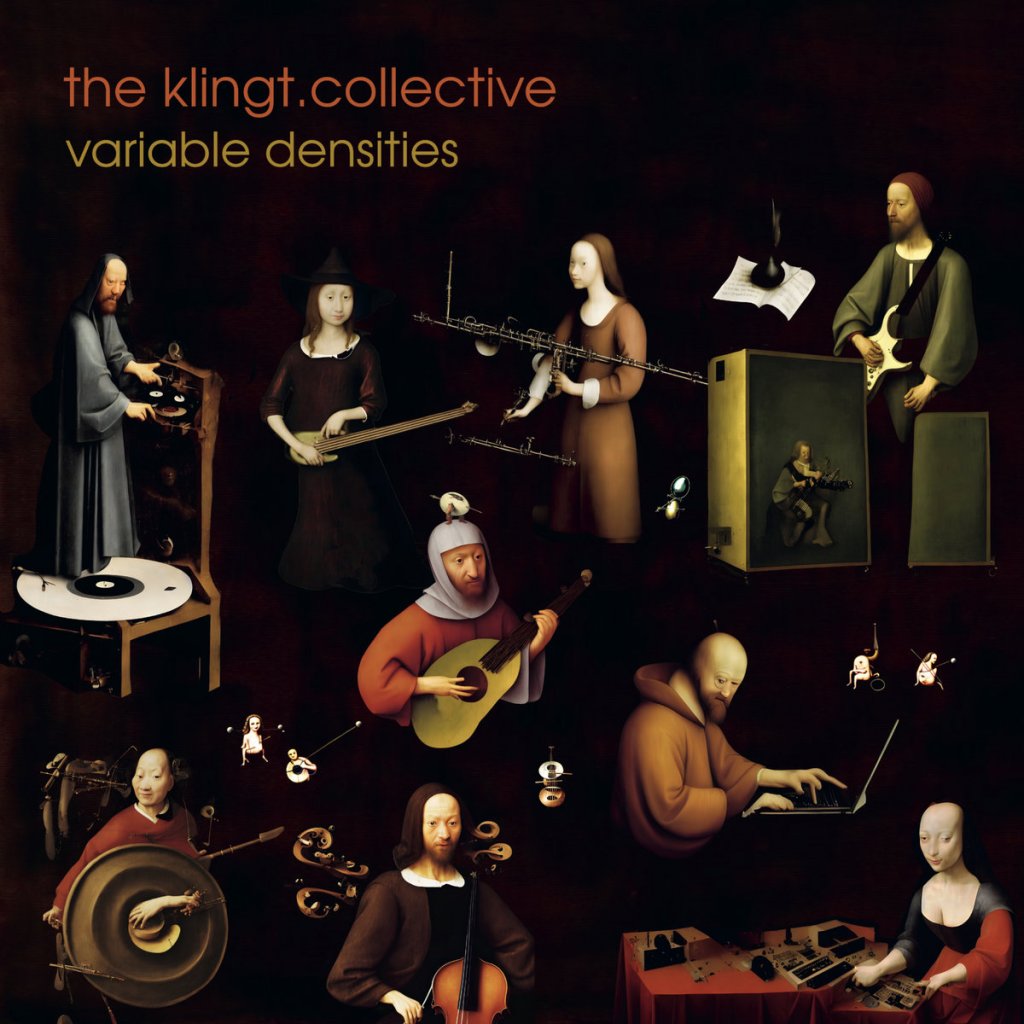
THE KLINGT.COLLECTIVE – VARIABLE DENSITIES (Interstellar)
Viennese experimental unit the klingt.collective consists of Martin Brandlmayr (drums), Angélica Castelló (recorders and tapes), dieb13 (turntables), Klaus Filip (ppooll), Susanna Gartmayer (bass clarinet), Noid (cello), Billy Roisz (electronics and bass), Martin Siewert (guitars and electronics) and Oliver Stotz (guitars and electronics). Variable Densities was recorded at the densités festival in north-eastern France back in October 2023 and highlights just how seasoned these improvising musicians are. No mistaking, this is a large group, and the capacity for everyone to be playing over everyone else to assert dominance is high. Fortunately, that isn’t the case. There are moments of multitimbral, densely-layered intensity where necessary, but for the most part Variable Densities finds small sub-units working an idea to its conclusion before another sub-unit starts a new idea. This creates unexpected, unpredictable juxtapositions as different ideas coalesce, with electronics, tapes and turntables nestling up against strings, percussion, guitar and other traditional instruments. There’s a constant fluidity within these exchanges which means nothing hangs around for long or outstays its welcome. A diverse and compelling listening experience full of vitality, energy and impressive meshing together of disparate influences. Released 11 January 2025.
wræżlivøść is a Polish pianist and sound artist. His debut three-track release was recorded in Poland, Denmark and the US, and fuses classical piano with extreme sound processing. The result is an EP that is in constant flux, with moments of noise intersected by meditative piano – some of it recorded from his graduation concert at Det Jyske Musikkonservatorium in Aarhus in April of this year – and long, ambient drones pulled out of the myriad sound sources. It is at once chaotic and beautiful, its different textures and sequences being sliced together with rough and sudden cuts that make each track wonderfully unpredictable. The ten-minute ‘wræżlivøść II’ is a marvel, ranging from ear-splintering bursts of noise to dexterous notes, finally collapsing into quiet and soothing textures generated from rippling piano reverberations. Released 27 September 2024. Thanks to Phil Dodds for the recommendation.
Snowdrops are a duo of Christine Ott (ondes Martenot, xylophone, piano) and Mathieu Gabri (piano, keyboards, electric hurdy-gurdy, vibraphone) who make music that leans into the expansive realm of modern classical music. Their sound is, however, hard to pin down, offering a compelling symbiosis of electronics and classical reference points with an evenness that few operating in this genre are prepared to offer, instead favouring a light spraying of synths over relatively traditional playing. The centrepieces of this collection are ‘Crossing’ and ‘Arctic Passage’. Both are long and evolving pieces that the duo have performed for a few years. ‘Crossing’ begins and ends with delicate circular motifs, but at its height is a rousing, stentorian piece where electronic threads and resonant piano collide. ‘Arctic Passage’ is darker, containing drone-y electronic textures that sound like grim frozen winds across the tundra, and sprinkles of brittle melodies and ondes Martenot fluctuations. Elsewhere, the beguiling ‘Ligne de Mica’ is a deep listening exercise for ondes Martenot, analogue synth and Bartosz Szwarc’s accordion, its gentle interwoven undulations taking on a mysterious, unknowable quality where individual elements are barely distinguishable from the next. Another beautiful and engaging release from this remarkable duo. Released 25 October 2024.
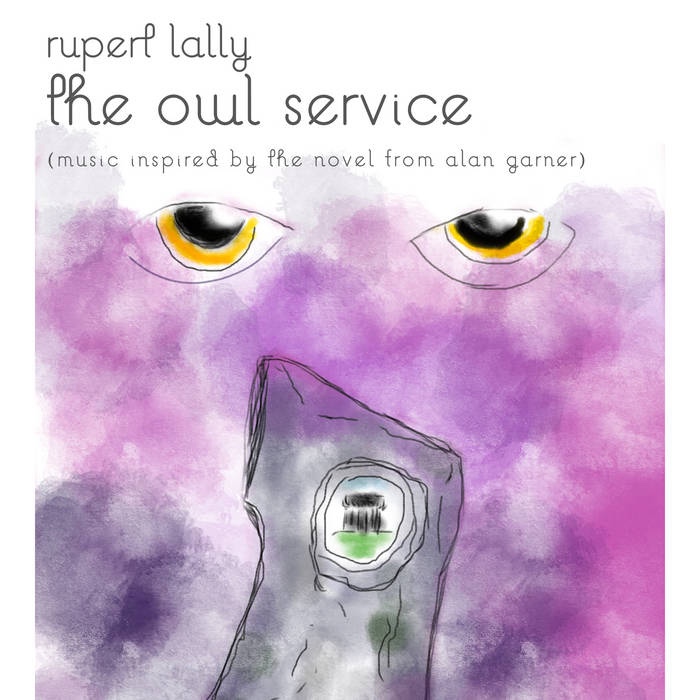
The Owl Service is Rupert Lally’s seventh soundtrack to accompany a book. His first was for J.G. Ballard’s High Rise, and the intermittent series has taken in William Golding’s Lord Of The Flies and Frank Herbert’s Dune. This time he attaches his compositional nous to Alan Garner’s 1967 award-winning children’s book. At the risk of repeating myself, only with different words and different context (last time it was about film), Lally is an avid reader – and accomplished author – and he has a honed skill for creating music that plots narrative and its key events. Key to the 18 cues that comprise his score for The Owl Service are strings, arranged in such a way as to create a sort of maudlin, mysterious tension throughout the unfolding events. Key pieces like ‘A Night In The Woods’ eschew the strings for wispy synth textures and slowly-unfurling electronic melodies, but its moments such as ‘Ghost Images’ and ‘The Argument’, where strings and synths effortlessly intertwine themselves that stand out the most. A remarkable and carefully-considered score, and several worlds away from his subsequent album, Interzones, released through my Mortality Tables venture. Released 31 October 2024. Interzones by Rupert Lally & Friends was released 29 November through Mortality Tables.
DOGS VERSUS SHADOWS & NICHOLAS LANGLEY – SALT COAST (Strategic Tape Reserve)
I’ve had the pleasure of working with both Lee Thompson (Dogs Versus Shadows) and Nicholas Langley in different capacities this year. Even after getting to appreciate their methods and processes well because of that, Salt Coast is a surprise. Both know a thing about how to transform sounds almost to the point of being unrecognisable, but Salt Coast finds the pair creating a sort of impenetrable fogginess around noises, melodies and borrowed segments. ‘Marching Through The Radiation’ and ‘Crabtree’ are cases in point – what could be fairground melodies are subjected to such a blanket of echoes that any twee gentility they once possessed are returned as a murky, queasy cues for distressing scenes in a horror film. Probably involving clowns. I’m reluctant to suggest that the technique is analogous to degradation, which has become shorthand for the gauziness of memory; what Thompson and Langley do here is smother their inputs, not decay them. It’s both terrifying and beautiful in its own special way. Released 1 November 2024. Nicholas Langley collaborated with Mortality Tables on LF25 / Matthew’s Hand, part of the LIFEFILES series.
Stephen Reese is a singer-songwriter from Toronto. A purveyor of smart rhythmic electronic pop, Reese is also a deft lyricist, able to dive deep into emotional themes but also unafraid of levity, metaphor and humour. He first invited me to listen to an early mix of his debut album back in 2022 as we bonded over our love of Erasure and the synth mastery of Vince Clarke, and its strange and beautiful cocktail of sounds and styles really grabbed me. ‘Bog Mound’ is one of many highlights, sounding as fragile, sparse and mysterious as tracks from Depeche Mode’s A Broken Frame, Reese offering a plaintive lyric that seems to be concerned with falling face-first into a muddy puddle. ‘Shatter Pattern’ is dark and edgy, Reese’s vocal containing a sort of dream-like ethereality while a sparse melody encircles a shuffling rhythm. ‘Bathysphere’, which opens the collection, features a submerged beat and clusters of sonar-like pulses, framing a lyric where he gives a small submarine a lonely, isolated personality. Intensely maudlin, stirring yet infused with wryness, it reminds me of Sparks and Reed & Caroline, sung with a quality that suggests Reese has a penchant for folk tunes. A brilliant debut. Released 23 November 2024.
Overtones is a remarkable study of the resonant frequencies contained within a single 200-year-old handbell. The bell was struck, shaken and played with a bow to generate a series of tones and textures, all of which were then processed with techniques that owe a debt to the pioneers of musique concrète. Everyday Dust is something of a modern-day tapeloop aficionado, and his experience with these processes shows through here in the form of an evolving series of considered sequences or movements; the effect is one of slow evolution, rather than the restless jumping around that colours a lot of tape pieces. Heard as a single 30-minute piece, Overtones is simultaneously euphoric and elegiac, yet dark and ominous, qualities that make this immediately recognisable as the work of Everyday Dust. Released 29 November 2024.
If you’ve spent any time at all with the music of Ergo Phizmiz, you’ll have become accustomed to a certain non-linearity in what he does. Sounds and beats arrive, wobble uncontrollably and rapidly wriggle off in an unexpected direction, usually just as you think you’ve got them figured out. That same maverick spirit can be found in his latest film, The Madonna Of Bedminster, which premiered at London’s Horse Hospital in September.
Set in Bedminster, a suburb of Bristol, the film is an assemblage of different, disconnected ideas orbiting around a central narrative that takes in Brexit, Israel / Palestine, anti-capitalism, religion (and its demise), climate disaster, and the ramifications of societal change.
“We lived in Bedminster for three years,” explains Phizmiz. “The film is a farewell of sorts to the area. Where we lived was a public transport black hole. It was a 30 to 40 minute walk to the nearest public transport. So we very much spent three years in Bedminster. The experiences you see in the film of walking down endless streets is a reflection of my own experience. A trip out of Bedminster felt like a pilgrimage.”
That notion of escaping the town is encapsulated by Joe and Mary, who argue and bicker their way from the town’s market to a garden centre on the periphery of the town – Mary, it seems, is obsessed with plants, which Joe cannot fathom at all. After Mary pays for a small shrub, they instantly get teleported out into open countryside, which seems to really trouble poor Joe. Arthur Ransome and Bram Stoker (I vaguely recognise those names) are hapless estate agents who can’t find the house they’re supposed to be showing. Their comedic frustration as they walk along Phizmiz’s “endless streets” is ultimately rewarded by a vision of the Madonna on a street called Little Paradise – a street which is strewn with the fly-tipped trash of broken dreams. To underscore the madcap theatricality of the estate agents, Phizmiz soundtracked this section with a borrowed 78 of pleasantly bouncy jazz.
Later, we meet Lucretia, a young homeless girl living in a bin (“The whole country is a bin,” she points out, deftly), who carries an umbrella during the daytime because of sensitivity to light, and forages for food at night. Only as the film progresses does she reveal, matter-of-factly, that she is a vampire. A scene where she breezily walks along a terraced Victorian Bedminster street shouting “I’m a vampire,” in the direction of passing cars only seems to reinforce the idea of societal indifference.
And then there’s Jonathan, played by Elvis Herod, one of Phizmiz’s oldest friends, easily one of the most endearing characters in the film. Jonathan is revealed as a ghost hunter and social critic decrying “bankers and wankers”. In one scene, he offers to show the viewers his meditation routine, something he excitedly calls ‘Lemurian Light Singing’. The process begins quietly and then his trance gradually gets more and more intense. By the end he is speaking forcibly in tongues and flailing his arms around wildly. It’s crazy, but mesmerising, like a lot of what happens in The Madonna Of Bedminster.
“Elvis and I have worked together on and off since 2001, mostly in theatre,” says Phizmiz. “He is the most impressive actor I know. He’s like a box of fireworks. He’s an endlessly inventive guy – he did the Lemurian Light Singing bit in one take about five minutes after having the concept described to him. He’s a ‘King Actor’ in the way Orson Welles described himself.”
The film is laced with sudden cuts to brooding philosophy, delivered to the screen like the pauses for dramatic explanation in a silent movie. “What do you do when the screaming of constant death is the drone that obscures the pulse of your planet?” asks one, ruminating on the conflict between Israel and its neighbours and an obliviousness to nature. A street busker insists that World War 3 has already started – has been quietly going on for a while, in fact – before talking about the controlling / controlled influence of the media, big themes which are offset by the idea of pointlessly buying luxury goods. Sprinkles of optimism arrive in the form of Santa Claus, who, against a backdrop of broken society and escalating conflict, offers a sense of hope. Footage of pigeons, seagulls, spiders and snails act as a much-needed salve for the challenging notions elsewhere in the film.
This is a long film, running at over two hours. Recognising this, Phizmiz inserted an intermission featuring his friend Goodiepal performing as a European exotic dancer in Worm Sound Studio in Rotterdam. I won’t spoil it, but suffice to say that it’s genuine comedy gold.
“It gives me endless joy,” says Phizmiz with a smile. “There’s an extended 16-minute version of it that gets a bit more X-rated.”
Like the events unfolding slowly on-screen, Phizmiz’s soundtrack is just as unpredictable. Cheerful Latin jazz makes frequent appearances, but there are other sequences where he leans into squalls of intense noise. A lot of these sections appear to have been made by dragging a bow across amplified structures hung with random bits of borrowed tat. (The structure is called the Large Hadron Calliope.)
Wonderfully strange and strangely wonderful, The Madonna Of Bedminster is a wonky, abstract, playful, earnest, hyperaware reflection of the world in which we live. If it feels a little weird, take a good look around you, or at the news. Is the film really so much weirder than the times we are living through? When you ask yourself that question, nothing about The Madonna Of Bedminster is weird at all.
The Madonna Of Bedminster arrives on YouTube on the night of November 1 2024. Listen to The soundtrack at Bandcamp here.
Words: Mat Smith
Ergo Phizmiz collaborated with my Mortality Tables project with his release ‘LF16 / The Tin Drummer Has Collapsed’ in the LIFEFILES series. mortality-tables.com
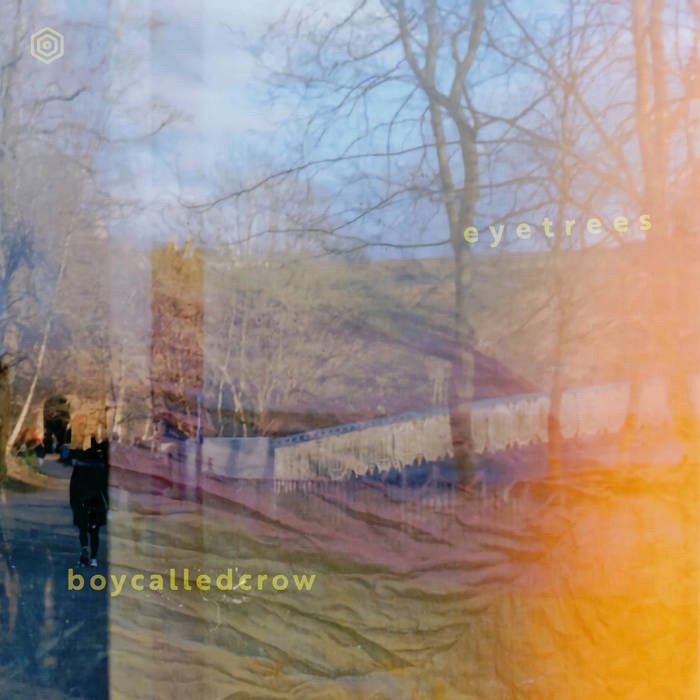
Carl M Knott’s music as boycalledcrow has always had a tendency to lean into the haze and uncertainty of emotions. There is often a brightness to his fractured acoustic guitar melodies, but these motifs are scaffolded by sounds that seem to pull against his effusive gestures. Not so on eyetrees, his new album for the Hive Mind imprint. This is easily Knott’s most uniformly optimistic album to date, and one whose openness and tenderness leaves an indelible mark on the listener.
A preview of eyetrees, ‘westbury’, was released through my Mortality Tables collaborative project in 2023, and a new version is included here. It found Knott interacting with a field recording of nature sounds, laying pretty acoustic guitar notes over a stew of pointillist rhythms and sounds that seemed to arrive with a playful, random edge. You hear that approach again on ‘sweet dunes’, where the sounds of breezes blowing across sand and the crashing violence of waves interact with a soft and hauntingly beautiful guitar melody. On ‘honeybee’ his guitar takes on a levity and bounciness, evoking the idea of a bee dancing from flower to flower in pursuit of sweetness.
Taken all together, eyetrees is the album that best reflects Knott’s previous life as a folk musician. English folk music was originally the music of the village and rurality, but Knott’s recent melding of plucked strings with electronics has skewed the form to a kind of post-industrial urban, modern living chaos. On tracks like the tender ‘a blissful day with her’ or ‘my friend, janu’, that skew is more or less completely removed, and Knott’s true colours are finally revealed.
This is Knott going back to nature. He talks in the press release about the gravitational pull of the countryside and its impact on his state of mind. He talks openly about mental health struggles, and a feeling of impeding death, something that walks in fields and woods helped to counteract. On eyetrees, that manifests itself in a kind of turbulence that usually resides in the background of the pieces here, while his acoustic guitar playing – mostly left alone, or just subtly manipulated – represents the salve of nature.
eyetrees can thus be heard as the sonic equivalent of standing outdoors in the sunshine and taking a series of deep and therapeutic breaths.
eyetrees by boycalledcrow was released October 11 2024 via Hive Mind.
Words: Mat Smith
boycalledcrow has collaborated with Mortality Tables on two projects – ‘LF13 / Westbury’ in the LIFEFILES series and ‘Kullu’, an album that found Knott revisiting his post-university travels through India.mortality-tables.com
One Universal Breath is (indirectly) a product of grief. In the wake of her father’s passing, Scottish electronic artist Veryan caught sight of a solitary practitioner of Tai Chi across from where she was sat in a Parisian park. That inspired her to take up the ancient Chinese martial art as a way of reaching an acceptance of death, and its inextricable link to life. That, in turn, inspired the twelve tracks that comprise Veryan’s contribution to the brilliant Quiet Details imprint, marking yet another high watermark in Veryan’s discography and QD’s faultless catalogue.
Given its genesis, One Universal Breath is naturally a deeply spiritual, contemplative collection. However, Veryan’s conceit is to avoid resorting to wispy ambience and New Age-isms, characteristics that might be expected for music intended to align the body and mind. These pieces are characterised by subtle rhythmic interjections that provide focus as well as momentum. Somewhat surprisingly, given how balanced these pieces are between forward propulsion and lightness, they originally grew out of beat-free, more ambient soundscapes; separate them from their rhythms and these pieces are vaguely Bladerunner-y and sci-fi soundtrack-friendly. The same pieces, inextricably linked; yin and yang; life and death.
Opener ‘Lift Hands’ sets the tone for the album, with a deep, bassy root beat that acts as a guide rope throughout the whole track. To that solid beat are added electro-symphonic swirls and a spiralling, ringing melody that spins and flutters like an inquisitive dragonfly. The effect is quietly euphoric and gently uplifting. ‘Diagonal Flying’ does something similar, only here there is the addition of a white noise sound that evokes the idea of air currents or waves crashing onto some faraway beach. A similar feeling emerges on ‘Grasp The Sparrow’s Tail’, which is delivered through a sense of latency, of something about to emerge from the calm. Here, Veryan presents a bass pattern that has a determinedly motorik dimension that reminds me of Nitzer Ebb’s ‘Join In The Chant’. That rhythmic shape is poised beneath resonant strings, while light percussion sounds begin to cluster and build with intentionality as the piece progresses.
‘Step Forward To The Seven Stars’ offers a suite of wavering tones which are imperfect yet strangely engaging. Those gently wonky sounds are joined by a slow motion break, while flute-like notes sketch the outline of hope and salvation. It represents one of the album’s sparsest and enveloping moments, but its linearity is complemented by unusual interventions that happen along the way. These create a sense of uncertainty, as if there is more than one path available. One of the best tracks here is ‘Needles At The Bottom Of The Sea’, which contains a delicate central melody that is freighted with the haunting quality that makes so much of Veryan’s music so engaging; simple, understated, yet devastating. It is one of the busiest tracks, the melody offset by a sequence which undulates and fluctuates like it’s trying to escape from something. ‘Needles At The Bottom Of The Sea’ is immediately powerful and resonant, caught in the interstitial space between hope and despair.
That’s not to suggest that this whole album leans into a sense of calm. Two tracks – ‘Part Wild Horses Mane’ and ‘Fair Lady Works The Shuttles’ – contain mysterious elliptical tones and a sort of creeping noir tension. That sense of foreboding, so different from tracks elsewhere, reminds me of Thomas Newman’s soundtrack to Less Than Zero, or what Nine Inch Nails might have sounded like if they’d recorded The Downward Spiral at a spiritual retreat instead of Sharon Tate and Roman Polanski’s house in Benedict Canyon.
The album’s title track is the piece that unifies the whole album and its myriad dualities. On this piece, Veryan deploys crisp and unswerving beats with delicate melodic interfaces. There is a sense of motion yet stillness; of positivity yet reflectiveness; meditative yet danceable; soft yet firm. We find enveloping strings that wrap themselves comforting around you, and a pulsing bass line that rises and falls like the breath of the title. It embodies the premise of this entire album, being at once towering, yet welcoming, marking the conclusion of an utterly mesmerising achievement.
One Universal Breath by Veryan is released 21 August 2024 by Quiet Details.
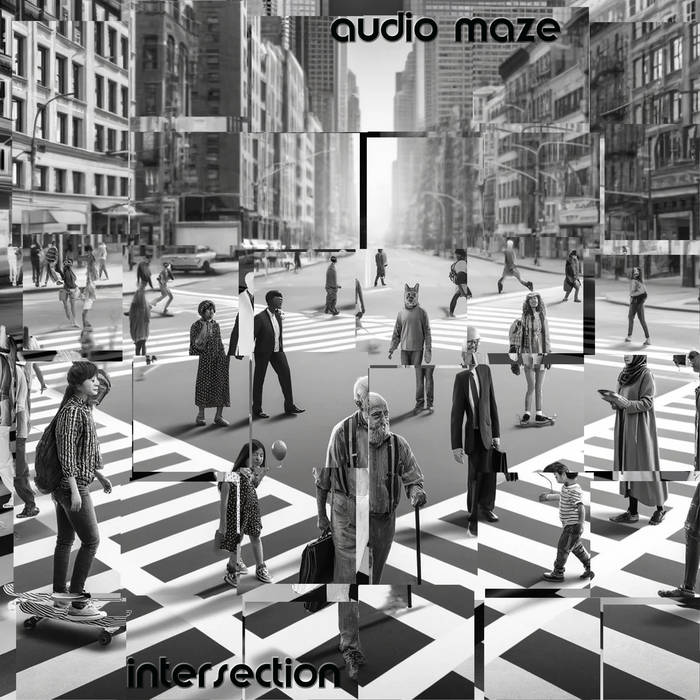
Damon Vallero describes his new Audio Maze album as “a meeting place and a platform for departure”. Its dub-inflected soundscapes carry a sense of fluid motion, of coming and going. Even at its most languid – as on the widescreen ‘Grand Land’ – there is a feeling of restlessness, even though its constituent parts (a slow-motion rhythm, a metronomic bass pulse, a softly ebbing and flowing melody) suggest a resolute stillness. It transpires that it’s an unplaceable, half-heard sound off in the distance that conjures this feeling of nothing being settled, of everything moving. One of the album’s many highlights is ‘Circle Of Sand’, containing myriad distinct intersections – a submerged bassline that is felt more than heard; a voice whose words cannot be deciphered; a rhythm that feels like the juddering sound of a train passing through a station; a jazzy piano riff that seems to splinter and fall apart gracefully as the rest of the track follows a very different path. This is an album filled with complex detail just beneath its surface textures. Absorbing and richly nuanced. Released 30 May 2024.
Xuma is a duo of Harriett and Chris Robins Kennish. Based near Brighton, they make music built from the foundational structures of dance music, with slowly-evolving minimal sequences and crisp, danceable beats offset by Harriett’s often blissed-out vocals. ‘I Know Her’ drifts gently into a dreamy garage-y framework of driving beats and jazzy sounds, over which Harriett deploys layers of euphoric, arms-in-the-air vocals. ‘Joyful’ is one of the album’s many highlights, with vocals converted into loops of shimmering, beatific texture over sounds and rhythms that sound like they are soundtracking a Goan (or maybe Hove?) sunrise. ‘Invisible’ strikes a minimalist techno pose, its feathery electronics fluttering ceaselessly over a stalking pitch-bent bassline, while closing track ‘Relent’ adopts a laidback, half-speed Café Del Mar vibe. Jasmine is a hidden gem of an album, and one that resolutely follows its own stylistic path. I had the pleasure of hanging out with Harriett and Chris on Brighton beach recently, and two nicer people making brilliantly diverse electronic music you will not meet. Released 20 June 2024.
Antenne is Brighton-based James Dean’s homage to a mysterious pirate radio station, which broadcast continuously from a point in the 1990s before coming to a sudden halt in 1996. This is his evocation of the energy of the station, deploying his trademark sinewy synth melodies, club-oriented beats and a sense of latency. On ‘I Feel Eye See’, he uses a muted hardcore break but instead of hitching it to 1992-vintage head-cleaning hoover noises, he layers the beats with pretty, overlapping spirals and a fuzzy blanket of warm, emotive textures. ‘Oriam Speedway’ ventures into a suggestion of kosmische electronic rock, fused again to suppressed rave beats. My personal favourite track is ‘Controller 29’, whose structures steadily coalesce out of a delicate web of interwoven synth lines that ripple with intense motion. Those patterns quickly fade out of view, only to firm up around a motorik beat and a fluttering melody that nods to Kraftwerk’s ‘Neonlicht’. Another fine release in the Bunkr catalogue. Released 28 June 2024.
Another exceptional release from the Quiet Details label, easily one of the most interesting imprints issuing music today. To catch people up on the concept, the idea is that each handpicked artist is asked to produce a body of music that responds to the name of the label. Every release in the series has been a joy to listen to, and the latest – from Tresor stalwart Emile Facey – is no exception. Like some of the other releases surveyed in this post, Facey’s ‘The Unfading Spark’ relies principally on the suggestion of movement and energy. In standout pieces like opener ‘Broken Through’ or ‘Signal Beckons’ or ‘Wisps Of Vapour’, there is this feeling of high-octane techno structures itching to punch their way through the gauzy, enveloping textures that dominate the tracks. These potentially competing forces create a compelling tension – soothing on the one hand, fidgety and restless on the other – that somehow knits together seamlessly, making for an enriching and engaging listen. Released 10 July 2024.
There is not a lot that Rupert Lally can’t turn his hand successfully to. While he might be best known as a prolific (and stylistically dexterous) composer of electronic music, Lally is also an accomplished author and, via his blog, an avid documenter of underrated films and their soundtracks. Profiler, like 2022’s Hacker, brings together these interests into a neat and tidy package. Not just a hypothetical soundtrack, Profiler comes with a detailed plotline and is presented as a lost 1980s crime flick, with Lally’s music leaning authoritatively into the synth sounds of that decade. That means rich, infectious melodies, big beats and a sense of bold, shiny vibrancy.
In spite of Lally’s intuition for period authenticity, there’s plenty of room here for his distinctive noir-ish sensibilities. ‘The Unsub’ is a brooding, unsettling and mysterious short cue, its key focal point being a series of uncoiling tendrils of synth sequences that lead to a cloying, claustrophobic atmosphere full of tension and danger. ‘Possible Suspect’ is the track that feels most like it was unearthed from a bankrupt studio’s archives, with a dense drum machine beat filled with a kitchen sink’s worth of percussion presets and fills and a sharp, sinewy synth melody resting atop a sequence that feels like it was created from a short vocal sound imported into a sampling keyboard. Avid readers of Further. will know how much of a fan of Lally’s music I am, and this imaginative collection is undoubtedly up there with his best. Released 19 August 2024.
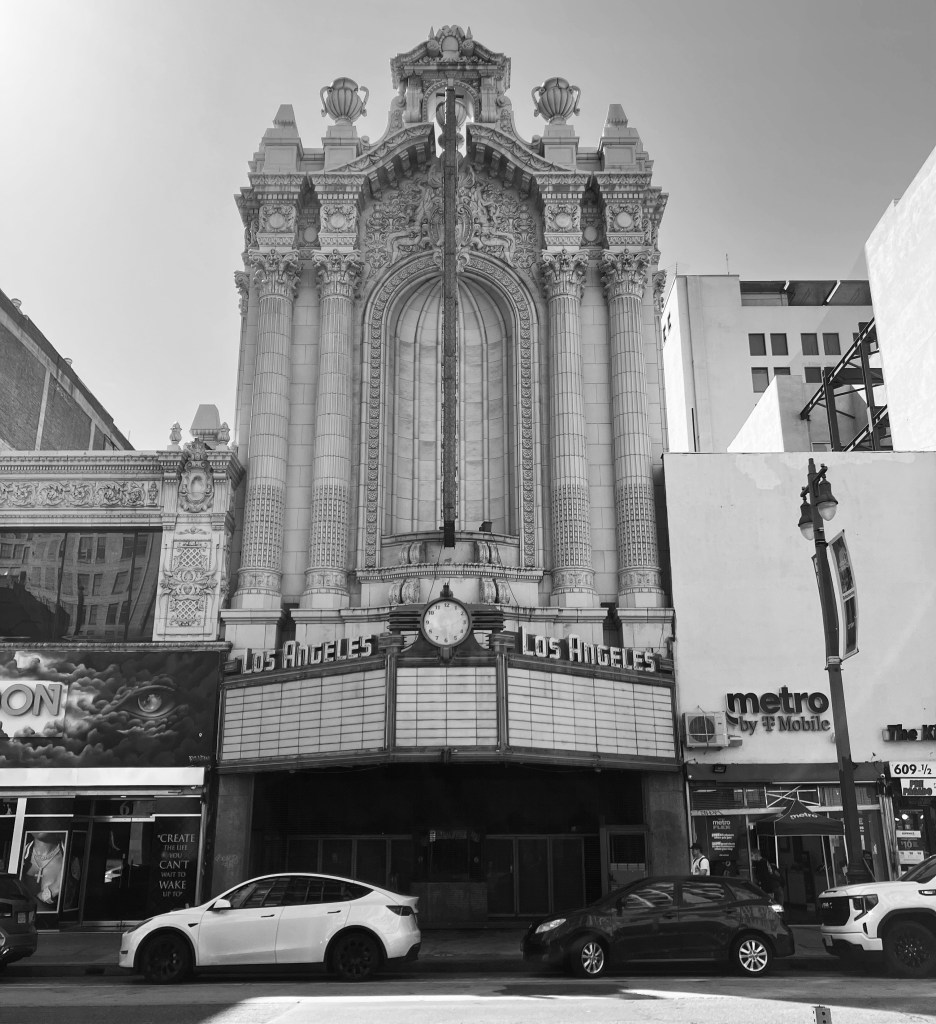
The Los Angeles Theatre, Downtown LA (from Mortality Tables Instagram)
Went to Hollywood. Visited Amoeba Records and flicked through the CDs. Bought a Nick Cave / Mick Harvey / Blixa Bargeld soundtrack for $1. Found copies of the limited-edition reissues of Chorus and Erasure by Erasure and felt proud that the liner notes I’d written had made it all the way to Hollywood. Walked along Hollywood Boulevard and took pictures of the stars belonging to The Beatles and jazz musicians and looked at the Capitol Building, which is a lot shorter than it looks. Then again, Hollywood has made a business out of making things appear different to how they really are.
In North Hollywood, we visited the Iliad Bookshop on Cahuenga. Stroked the resident cats and bought a book about David Byrne and an old 1909 music dictionary, figuring that it might be helpful to learn some basic music knowledge as a music journalist. Good second-hand music book selection. Found a rare Charles Ives biography but it was too bulky to contemplate taking it back to the UK.
Went for brunch at Crossroads, a vegan restaurant on Melrose. Billed as fine dining and presented as a very smart dining room, but actually very casual. Lots of classic rock photos around the room – Devo, Guns n’ Roses, Freddie Mercury, Page / Plant etc – and great soundtrack playing at a volume loud enough to be interesting and low enough to allow conversation. Went there again for lunch twice; same vibe, different food, different soundtrack. Went for dinner at the Calabasas restaurant toward the end of the trip; different neighbourhood; same vibe; harsher aircon.
Took a drive to Hermosa Beach for jazz brunch at the Lighthouse, famed for its use in La La Land. Ate avocado toast, drank good coffee, listened to the Hafez Karimi Trio and enjoyed looking at the record sleeves on the walls. Walked onto the pier outside where Ryan Gosling sings ‘City Of Stars’ in the film. Felt very alive, momentarily. An enthusiastic young street musician was playing guitar while a very disinterested older lady filmed him. Noticing her attention, he started playing with his guitar behind his head. She didn’t show any more enthusiasm while he was performing for her. Staying with La La Land, later in the trip my wife and I took an early morning walk to Cathy’s Corner in Griffith Park, where Gosling and Emma Stone dance around a bench after a party.
Hafez Karimi Trio, The Lighthouse – July 7 2024
Checked into the Sunset Marquis. Famous for being a music industry haunt, but ultra-discrete. Massive Beyoncé poster hanging by the pool. Photos of rock musicians everywhere. Ordered a vodka and grapefruit because that’s what the main protagonist was drinking in The Shards by Bret Easton Ellis in the chapter I’d re-read a day before.
Walked along the Sunset Strip. Walked past the carpark of Mel’s Diner where Buffalo Springfield formed, Mark Mothersbaugh‘s ‘Chernobyl green’ Mutato Muzika studio complex, the old Tower Records (now a Supreme), the Viper Room, the Roxy. Stopped in at The Rainbow for dinner and drinks and, even though I’m not into most of the groups whose photos and memorabilia line the walls, there is something quite magical about being in a place so synonymous with the LA music scene. Ordered drinks from the outside bar, where Lemmy used to sit and play video games all night. Bumped into Jon D’Amico (“Okay, so watch” is the catchphrase he didn’t know he had) from Rock ‘N’ Walk Tours. Jon had walked us along the Sunset Strip when we were here last year and I cannot recommend his tours highly enough. He knows all of the secrets of the Strip. I had planned to publish an interview with him last year but never got around to it. I’ll try to fix that, Jon.
Mutato Muzika, Sunset Boulevard
Finished a long night on the Sunset Strip drinking whisky in a very dark bar at the front of the Sunset Marquis, its impenetrable, discrete, shadowy corners populated by more rock photos. Getting very drunk did not help, and I just felt like shit the next day. Apparently, the week after we were here, Keith Richards checked in while the Stones were playing California. During our stay I spoke at length to Logan Steppert, a bellhop who is also an electronic musician. His brilliantly atmospheric 2013 EP Bogenvia with Mike Gaydusek can be found here.
Went to the Whisky A Go-Go three times. My wife loves this venue. She came of age listening to countless bands who played here during the metal 1980s. The first show was an electronic rock trio called Love Stereo (tasting notes of Joy Division) – check out their debut single ‘Fool’ on Bandcamp here. They were followed by Rebel Star, a Bowie tribute band. Their version of ‘Heroes’ had me in floods.
The main draw of two of the Whisky shows was Fast Times, a quintet of Spicoli (Johnny Ventura – vocals, guitar), Kazzy Nova (Eddie Ayala – bass), Riff (Lance Turner – guitar), Crash Diamond (Matt Olofson – drums), and Squid (Sudwyn Munshi – keyboards) who play incendiary sets of 1980s classics, and who are named after the Cameron Crowe movie Fast Times At Ridgemont High. (Sean Penn’s character in the movie is called Spicoli.) We saw them twice last year and found ourselves completely besotted by what they do, hence wanting to see them again this year. Their versions of ‘Personal Jesus’, ‘Enjoy The Silence’, ‘Blue Monday’, ‘Shout’ and ‘Whip It!’ are absolute perfection. They play the Whisky every Monday and anyone with the remotest interest in 1980s music should check them out. My youngest daughter wound up plucking notes on Kazzy Nova’s bass on our second visit, and now wants to learn how to play. Thanks Kazzy.
Fast Times, Whisky A Go-Go – July 8 2024
Right at the end of the holiday we went to the Valley Relics Museum in Van Nuys, where they have loads of exhibits related to Fast Times At Ridgemont High, which was filmed in the area. They also have a Tower Records neon sign from the old La Brea store.
We listened to a lot of Weezer in the rental car on this trip. My wife is obsessed with Weezer. We walked down Montana Avenue in Santa Monica because Rivers Cuomo sings about taking a stroll past places like the Aero cinema in the song ‘Aloo Gobi’.
My Guns n’ Roses-loving wife got to see Gilby Clarke performed on our third and final trip to the Whisky. She wanted to marry him when she was 14 but ended up with me, and has been perpetually disappointed ever since. One of his support groups, Cinema Stereo, reminded me of a messy marriage between Pink Grease and The Hives, fronted by someone who effortlessly blends shades of Elton John, Mick Jagger and Freddie Mercury. Ones to watch. They will be huge one day.
Found ourselves on the old Route 66 a bunch of times, and consequently couldn’t get the song out of my head. Went on the 101 far too many times than was enjoyable, and it reminded me of the 1988 Depeche Mode film / concert of the same name every time I merged into the nail-bitingly stressful traffic. Went to the Pasadena Rose Bowl so my two daughters could go to the huge flea market there. Liked being at the place where 101 was recorded. A singer serenaded us with songs, including a whole section of Neil Diamond songs. My dad loved Neil Diamond.
The previous weekend we went to the Los Feliz flea, which is no longer in Los Feliz but in an old parking lot in Downtown. Bought a US CD copy of The White Room by The KLF from Rock & Sock, a husband and wife team – he sells music; she sells socks and cute cat hairgrips. Had a nice conversation with the husband about Bill Drummond, The KLF and music in general. I needed that. I’d lost my appetite for food before the flight to LA, and I’d simultaneously completely lost interest in music, something which has always given me support and comfort during difficult moments in my life. That conversation gently rekindled my interest in the latter. I don’t know his name, but I want him to know how important that conversation was.
The KLF The White Room (from Mortality Tables Instagram)
I originally bought The White Room as a teenager from Music Junction in Stratford-upon-Avon, where I grew up. I remember that on the way back home from the shopping trip with my mum and sister where I bought that cassette, we were walking through Clopton Court, where we had lived in an apartment until 1984, when I was seven and my sister was three. We bumped into my dad as we walked along the road that fringed the squat, red brick apartment buildings. He looked stony-faced. We asked what had happened. He had reversed his new red, G-registration Toyota into a signpost at the leisure centre where he’d taught me to swim and was on his way to the Swinton Insurance office at the top of Henley Street to make a claim. It was the first new car he’d ever owned and he absolutely loved it. When I got home and played The White Room, it left me feeling a little disappointed. I can’t help thinking that my dad’s disappointment in having wrecked the car he cherished so much had something to do with that.
Went to Disneyland. Felt sad when I walked past the Sherman Brothers‘ door on Main Street. So many of their songs were part of my childhood, and my daughters’ childhoods. I am unashamedly a fan of Disney, and hoped it would give me some joy during a holiday where I generally felt numb. On our final night at Disneyland, I really enjoyed ‘It’s A Small World’, whose pretty theme tune was a Sherman Bros. composition; I’ve been on that ride countless times but this was the first time it really moved me.
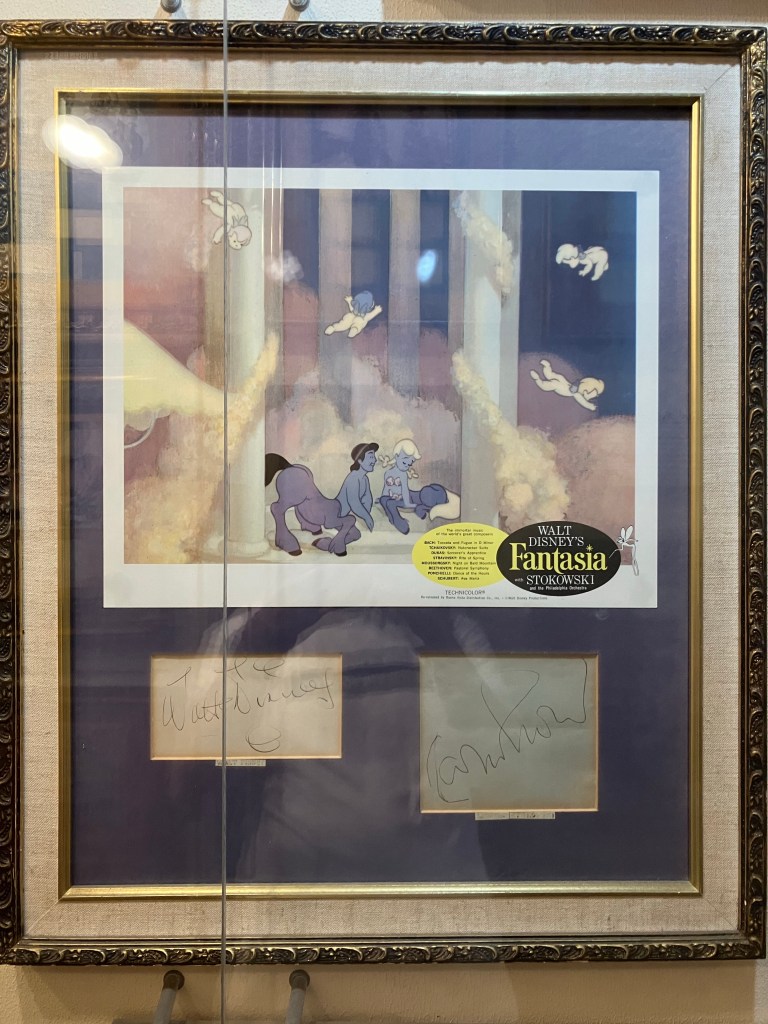
Later in the trip we visited the Hollywood Museum, located in a genuine slice of old Hollywood, the Max Factor makeup building off Hollywood Boulevard. On the wall was a framed print from Disney’s ambitious Fantasia with the signatures of Walt Disney and Leopold Stowkowski beneath it, which took my breath away. I keep finding out interesting things about Stowkowski and his involvement with experimental music, something I hope to write about in the future. Went to the Hollywood Bowl to listen to 1980s and 1990s Disney songs played with a full orchestra, conducted by Sarah Hicks, who had been the conductor at the Rufus Wainwright Proms concerts I reviewed for Clashlast year. The Disney concert was very special, in an absolutely incredible venue up in Griffith Park. My eldest daughter cried when she got to hear Susan Egan (Meg from Hercules) and Jodi Benson (Ariel from The Little Mermaid) perform on stage.
Dropped in to Highland Park for a few hours. Went to an incredible vinyl-only record store called Gimme Gimme Records. I didn’t buy anything – transporting vinyl on Transatlantic flights is something I’ve done before and it’s inordinately stressful – but I found a copy of Thomas Dolby’s The Flat Earth, whose Assorted iMaGes sleeve by Baker Dave I’d written about on the flight over. Found myself looking at Neil Diamond LPs. Visited Licorice Pizza in Studio City. Found myself looking at Neil Diamond LPs again.
Went to a hip place called Justine’s Wine Bar in Frogtown. Ate good vegan food and enjoyed a playlist curated by the guy at the bar consisting of late-70s / early-80s post-punk music – New Order, Wire etc. I recommended that he listen to Rema Rema and watch Marco Porsia’s documentary about them, What You Could Not Visualise. I admitted that I’m biased, as I’m in Marco’s film. He asked me if I was in “the industry” – a very Los Angeles term – which I suppose I am.
Checked into a beautiful 1920s Airbnb off Beachwood Drive. In the lounge were loads of interesting books, including Jon Wozencroft’s book on Neville Brody. It was a moment of complete coincidence, as Jon was one of a small number of collaborators I’d been messaging during the holiday. Although I was taking an enforced break from an intense period of Mortality Tables activities, I chose the holiday as the perfect time to revisit discussions with Jon about a Mortality Tables sound / visual project we’ve been working on for a while.
In Downtown LA, we visited The Last Bookstore. Looked through the second-hand vinyl and found more Assorted iMaGes sleeves I’ve written about, as well as some of Baker Dave’s designs for Phil Collins albums. More Neil Diamond LPs. Got mildly frustrated by the aisles of people taking photos of people looking at books to post on social media, and who then walked out the store without buying a single book. I also didn’t buy a book, but both of my daughters did.
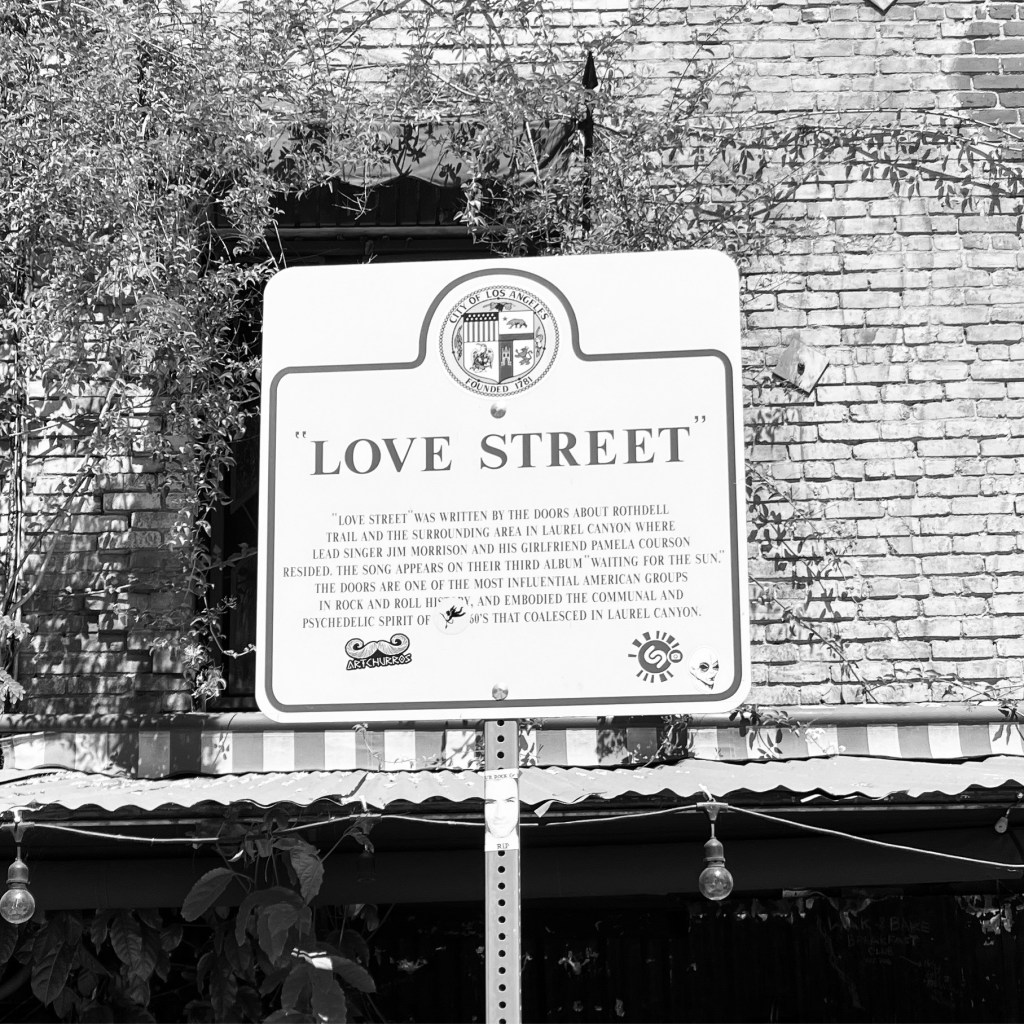
Drove out to Laurel Canyon and stopped in on the Canyon Country Store. Bought coffee from the front porch and used the restroom, which is down in the basement in the stockroom. Mama Cass from Mamas And Papas used to live here when she had nowhere else to stay. Saw the apartment where Jim Morrison used to live, its balcony overlooking the store. He wrote ‘Love Street’ from Here Comes The Sun while living there, calling it the “store where the creatures meet”.
Toward the end of the holiday, my wife booked for us to visit Lake Shrine, an oasis of spiritual calm tucked away in a bend on Sunset Boulevard in Pacific Palisades close to Santa Monic. George Harrison’s memorial service was held here, and they hold some of Gandhi’s ashes. My wife and daughters left me on my own for a while. I meditated, reflected, cried and listened. I read a message from my friend Gareth, who had offered me his typically accurate advice on how to approach grief. We checked into an Airbnb cabin high up in Topanga Canyon on the day we visited Lake Shrine. I spent a lot of time outside, just listening to sounds from across the canyon.
During the entire vacation I was often visited by hummingbirds and dragonflies. I fell in love with the sound of hummingbirds during my time in LA. I looked up the symbolism of both. I wasn’t surprised at all at why they featured so prominently during this trip, at this precise moment in my life.
///
My father passed away five days before we left for Los Angeles.
I spent a lot of the vacation in a state of raw numbness. I could feel no joy. Things that should have made me happy left me feeling nothing. My mood fluctuated ceaselessly but I couldn’t ever get myself out of this awful intermediate, middling place where nothing made me happy and nothing impressed me.
My father’s influence on my music taste was just one of the most significant and powerful things he unwittingly gave me, so I wasn’t surprised when I suddenly lost my appetite for listening to anything. I wouldn’t have ventured into music journalism without the seeds he planted at the start of the 1980s – watching Gary Numan on The Old Grey Whistle Test together while my mother was out at work waitressing and when I should have been in bed; listening to ‘Joan Of Arc’ and ‘Joan Of Arc (Maid Of Orleans)’ by OMD in the car on Saturday mornings while he worked his second job as a debt collector; him bringing home a VHS copy of Soft Cell’s Non-Stop Exotic Video Show VHS that he’d borrowed from a colleague at his day job in a factory and letting me watch something that was patently not suited to a five-year-old boy.
Later, he brought home a TDK cassette of The Innocents by Erasure and asked me if I liked them as he handed over the copy a friend had made. He was completely unaware of just how significant that transaction would prove to be in my life. I had the opportunity to tell him how transformative these moments were before Alzheimer’s fully ravaged his mind and took him further and further from us.
My mother and sister tasked me with creating a playlist for his funeral while we were on holiday. It was the mixtape I never thought I’d have to make and I found it extraordinarily painful to compile. It can be found here.
We wanted to include something from the 1950s. He grew up in the rock ‘n’ roll era and it felt appropriate to include something from that period, but I found myself panicking that I couldn’t think of a single song that he liked from that decade. I was at the Knott’s Berry Farm theme park at the time, walking by myself to a viewing platform. As I rounded a corner into a different themed area of the park, the music changed and Eddie Cochran’s ‘C’mon Everybody’ began playing. Dad loved that song. It somehow unlocked the entire playlist.
Less than ten days before he passed away, my Mortality Tables collaborative project released The Engineer, which involved contributions from over thirty artists. It was loosely inspired by my father, who worked as a mechanical engineer for more or less all of his adult life. We deliberately released it on what would turn out to be my last Father’s Day with a father, and paid all profits to the Alzheimer’s Society.
I had been working on The Engineer for over ten years and was determined to release it this year. I now know why I was so driven to make that happen in 2024. The Engineer can be found here.
Words and photos: Mat Smith
Thanks to Logan Steppert, Jon Paul Gwozdz, Fast Times, Tommy Gelinas.

















 Further.
You must be logged in to post a comment.