A warning: if you’re the kind of person that massively freaks out at the insect-based challenges on shows like I’m A Celebrity, Get Me Out Of Here or The Challenge, Insects is not the compilation album for you. Containing 12 tracks each inspired by insects, if you’re even remotely scared of humming, buzzing, flapping or the amplified sound of insectoid limbs scurrying across a kitchen surface, this is likely to send you into a complete panic. For everyone else, this is a sharply-executed curatorial exercise by the always-remarkable Dustopian Frequencies imprint.
Key tracks for this reviewer include ‘Anopheles Genus Takeover’ by BMH (WCR’s Kate Bosworth and Matt Jetten) which has the sinister nihilism of an imaginary soundtrack to Iain Banks’ ‘The Wasp Factory’, until Bosworth issues the line “There are no tin openers anymore,” which is a trademark bit of wry humour I’ve come to look for in BMH’s savagely inventive music. Dave Clarkson’s squelchy techno banger ‘Hive Mind’ is another, providing further evidence of an alchemical skill that Clarkson has for turning pretty much any sound – toys, sweets, fairground rides, caves – into electronic music gold, in this case imagining a swarm of killer bees descending on an illegal outdoor rave.
At the other extreme, Linear North’s beetling, sub-bass-heavy ‘Brains Nor Backbone’ has a weird mournfulness and sensitivity toward the insect population, with phrasing that pivots on a quote nodding in the direction of Franz Kafka’s Metamorphosis.
A recurring memory kept popping into my head while writing this. It was of being in a room in London’s Natural History Museum when my daughters were very small, a curator pulling out drawer after drawer of glass topped boxes, each containing a selection of different insects. This compilation is a lot like being back in that room, only each successive display case is accompanied by a vivid, visceral and very occasionally panic-inducing soundscape.
Insects was released January 23 2026 by Dustopian Frequencies.
wræżlivøść is a Polish pianist and sound artist. His debut three-track release was recorded in Poland, Denmark and the US, and fuses classical piano with extreme sound processing. The result is an EP that is in constant flux, with moments of noise intersected by meditative piano – some of it recorded from his graduation concert at Det Jyske Musikkonservatorium in Aarhus in April of this year – and long, ambient drones pulled out of the myriad sound sources. It is at once chaotic and beautiful, its different textures and sequences being sliced together with rough and sudden cuts that make each track wonderfully unpredictable. The ten-minute ‘wræżlivøść II’ is a marvel, ranging from ear-splintering bursts of noise to dexterous notes, finally collapsing into quiet and soothing textures generated from rippling piano reverberations. Released 27 September 2024. Thanks to Phil Dodds for the recommendation.
Snowdrops are a duo of Christine Ott (ondes Martenot, xylophone, piano) and Mathieu Gabri (piano, keyboards, electric hurdy-gurdy, vibraphone) who make music that leans into the expansive realm of modern classical music. Their sound is, however, hard to pin down, offering a compelling symbiosis of electronics and classical reference points with an evenness that few operating in this genre are prepared to offer, instead favouring a light spraying of synths over relatively traditional playing. The centrepieces of this collection are ‘Crossing’ and ‘Arctic Passage’. Both are long and evolving pieces that the duo have performed for a few years. ‘Crossing’ begins and ends with delicate circular motifs, but at its height is a rousing, stentorian piece where electronic threads and resonant piano collide. ‘Arctic Passage’ is darker, containing drone-y electronic textures that sound like grim frozen winds across the tundra, and sprinkles of brittle melodies and ondes Martenot fluctuations. Elsewhere, the beguiling ‘Ligne de Mica’ is a deep listening exercise for ondes Martenot, analogue synth and Bartosz Szwarc’s accordion, its gentle interwoven undulations taking on a mysterious, unknowable quality where individual elements are barely distinguishable from the next. Another beautiful and engaging release from this remarkable duo. Released 25 October 2024.
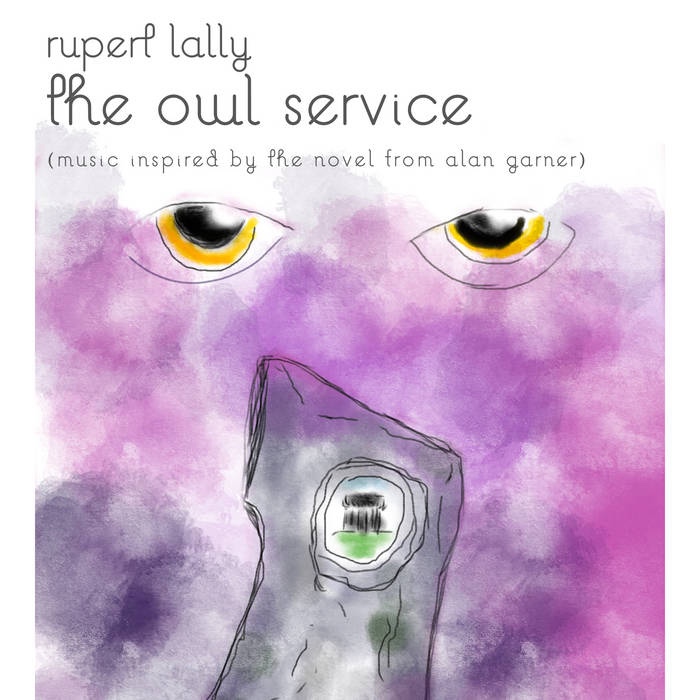
The Owl Service is Rupert Lally’s seventh soundtrack to accompany a book. His first was for J.G. Ballard’s High Rise, and the intermittent series has taken in William Golding’s Lord Of The Flies and Frank Herbert’s Dune. This time he attaches his compositional nous to Alan Garner’s 1967 award-winning children’s book. At the risk of repeating myself, only with different words and different context (last time it was about film), Lally is an avid reader – and accomplished author – and he has a honed skill for creating music that plots narrative and its key events. Key to the 18 cues that comprise his score for The Owl Service are strings, arranged in such a way as to create a sort of maudlin, mysterious tension throughout the unfolding events. Key pieces like ‘A Night In The Woods’ eschew the strings for wispy synth textures and slowly-unfurling electronic melodies, but its moments such as ‘Ghost Images’ and ‘The Argument’, where strings and synths effortlessly intertwine themselves that stand out the most. A remarkable and carefully-considered score, and several worlds away from his subsequent album, Interzones, released through my Mortality Tables venture. Released 31 October 2024. Interzones by Rupert Lally & Friends was released 29 November through Mortality Tables.
DOGS VERSUS SHADOWS & NICHOLAS LANGLEY – SALT COAST (Strategic Tape Reserve)
I’ve had the pleasure of working with both Lee Thompson (Dogs Versus Shadows) and Nicholas Langley in different capacities this year. Even after getting to appreciate their methods and processes well because of that, Salt Coast is a surprise. Both know a thing about how to transform sounds almost to the point of being unrecognisable, but Salt Coast finds the pair creating a sort of impenetrable fogginess around noises, melodies and borrowed segments. ‘Marching Through The Radiation’ and ‘Crabtree’ are cases in point – what could be fairground melodies are subjected to such a blanket of echoes that any twee gentility they once possessed are returned as a murky, queasy cues for distressing scenes in a horror film. Probably involving clowns. I’m reluctant to suggest that the technique is analogous to degradation, which has become shorthand for the gauziness of memory; what Thompson and Langley do here is smother their inputs, not decay them. It’s both terrifying and beautiful in its own special way. Released 1 November 2024. Nicholas Langley collaborated with Mortality Tables on LF25 / Matthew’s Hand, part of the LIFEFILES series.
Stephen Reese is a singer-songwriter from Toronto. A purveyor of smart rhythmic electronic pop, Reese is also a deft lyricist, able to dive deep into emotional themes but also unafraid of levity, metaphor and humour. He first invited me to listen to an early mix of his debut album back in 2022 as we bonded over our love of Erasure and the synth mastery of Vince Clarke, and its strange and beautiful cocktail of sounds and styles really grabbed me. ‘Bog Mound’ is one of many highlights, sounding as fragile, sparse and mysterious as tracks from Depeche Mode’s A Broken Frame, Reese offering a plaintive lyric that seems to be concerned with falling face-first into a muddy puddle. ‘Shatter Pattern’ is dark and edgy, Reese’s vocal containing a sort of dream-like ethereality while a sparse melody encircles a shuffling rhythm. ‘Bathysphere’, which opens the collection, features a submerged beat and clusters of sonar-like pulses, framing a lyric where he gives a small submarine a lonely, isolated personality. Intensely maudlin, stirring yet infused with wryness, it reminds me of Sparks and Reed & Caroline, sung with a quality that suggests Reese has a penchant for folk tunes. A brilliant debut. Released 23 November 2024.
Overtones is a remarkable study of the resonant frequencies contained within a single 200-year-old handbell. The bell was struck, shaken and played with a bow to generate a series of tones and textures, all of which were then processed with techniques that owe a debt to the pioneers of musique concrète. Everyday Dust is something of a modern-day tapeloop aficionado, and his experience with these processes shows through here in the form of an evolving series of considered sequences or movements; the effect is one of slow evolution, rather than the restless jumping around that colours a lot of tape pieces. Heard as a single 30-minute piece, Overtones is simultaneously euphoric and elegiac, yet dark and ominous, qualities that make this immediately recognisable as the work of Everyday Dust. Released 29 November 2024.
The latest release from the Dustopian Frequencies imprint is themed around the idea of space. Specifically, the ten artists invited to contribute were asked to identify with a space – whether real or imaginary – and bring it to life with a sound response. The result is a compilation that covers considerable ground, each track as different to the next and each one representing the artist’s complete freedom to express the characteristics of their spatial inspiration.
Max Schreiber’s ‘Fox do Douro’ is a key piece. A sparse, developing track, ‘Fox do Douro’ is built from crashing waves of metallic sound, harsh breathing noises and what initially feels like minimal percussion that eventually becomes a recurring half-melody. I don’t know whether it’s the snatches of overheard conversation twisting around a thick bassline or an impenetrable nest of drones, but something in Schreiber’s piece manages to sound both empty and full simultaneously. It ultimately reveals an almost ghostly dimension, as if evoking a haunted space.
Another highlight is Spongeboy’s ‘Dark Vapours (Fogwalking 2)’, wherein a creeping, expanding bass note and an overwhelmingly unsettling atmospheric quality creates a vaguely ‘Stranger Things’ vibe. Sweeping tones and a quickening pace heightens the tension as the track becomes louder and more forthright, while discordancy – delivered through competing drones and sibilant whispers – arrives around the halfway mark, leading this key track further into dark, sinister corners. A crisp, mechanical rhythm briefly appears toward the end, suggesting this could have developed into a far longer piece, with plenty more to explore.
Soxsa Lab’s ‘Sublimity’ contains chiming tones that could be a stringed instrument subjected to deep distortion, creating a series of textures that are both calming and contemplative but also decisively unpredictable and fractured. There is an inner rhythm here that exist solely in the form of the clipped, echoing edges of a central loop, assuredly never faltering even as other sounds blur into a fog of dissonance.
Elsewhere, Darinau offers rippling Morricone-esque guitar fragments set to white-noise-fringed textural loops and minimalist xylophone motifs on ‘Huset I Skogen’. Although undoubtedly subjected to electronic processing, stylistically augmenting this with other pieces on the album, this squarely leans into a more openly modern classical atmosphere. Another tangentially electronic piece comes in the form of Emanuele Ippopotami’s ‘One Step And I Fall’. The key focus here is a plucked guitar melody, set to a loped drone and odd non-percussion percussive interjections. This piece is characterised by vast open spaces, where every space is completely occupied. Distorted, heavy almost, death metal riffs expose themselves toward the end of the track, completely disrupting time (and space).
We are never really told what the inspirational spaces actually are for each of these tracks, and I can well imagine that was deliberate. It leaves us speculating, forming our own images from the sounds we hear. There is one exception, in the form of Laura Mars’ ‘Dreaming In Cryo Chambers’. While that title instils the idea of some sort of futuristic lab, the sounds here feel like the were recorded outside a train station. The blurry presentation and processing employed by Mars approximates what it feels like to arrive at Euston to catch a train home after a particularly heavy night out, where the whole world seems to be spinning uncontrollably. By the end, any discernible sounds have been stretched out into long strands of fluctuating drones, offset by swirls of crisp white noise, representing a bold and visceral spatial exploration.
Spaces was released May 25 2024 by Dustopian Frequencies.
PAUL RESET / EVERYDAY DUST – ARCHIVE 23 (Dustopian Frequencies)
A new split cassette release from Dustopian Frequencies pairs two artists comfortable operating deep under cover, with a track apiece influenced by the numerologically significance of the number 23. The release notes claim that both tracks were created using processes that were in some way developed with that number as a catalyst, but both are staying tight-lipped about precisely how. If you know, you know, I guess. Paul Reset’s ‘DotXm’ is a trip through his sound archive, presented as a collage of beats (electro, dub, fractured breakbeats) and interventionist overlays that veer from stalking, horror soundtrack synths and industrial bleakness that taps into a vivid and harrowing vision of dystopia. In contrast, Everyday Dust’s ‘Red Scavenger’ is dark and ominous, relying on processed sounds and haunting melodies inserted into a blanket of murky, impenetrable texture that nods squarely in the direction of Coil. There’s a flute melody at the start of this piece that is so utterly displaced that I can’t tell if it’s a particularly expansive Herbie Mann-style riff or some sort of ritualistic Pagan Muzak. The fear of the number 23 is, apparently, eikositriophobia, something you might well begin to experience if you listen to Everyday Dust’s piece in the dark and haunting chill of the early hours. Released December 28 2023.
BMH – EYE-EYE_[II]_IMMORTAL INFLUENCE (Colander)
The latest album from BMH, a duo of Dark Train’s Kate Bosworth and Matt Jetten, is quite honestly bonkers. In a good, nay great, way. Here you’ll find found sound, abstract percussion, rural accents, beautiful and abrasive noise, metallic kitchen sink percussion sounds, Coil-esque psychological terror, a sort of detuned 1990s Warp-style deep pulsing electronica and an ongoing commentary (with lots of laughter) that runs throughout the album that feels like an insight into Bosworth and Jetten’s creative practice. Honestly, this is an absolute joy to listen to and the perfect antidote to the unfortunate sequence of GWR train delays and cancellations that accompanied my first play of the album. My personal favourite track is ‘Radio Times’, which evolves from deep-slung dubby electronica to a sort of Heath Robinson playfulness that sounds like Brian Cant making sounds with the wind-up metal toys from the end of Bric-A-Brac. Released January 15 2024.
PEARL HOME RECORDS – CORNISH WIND (Pearl Home Records)
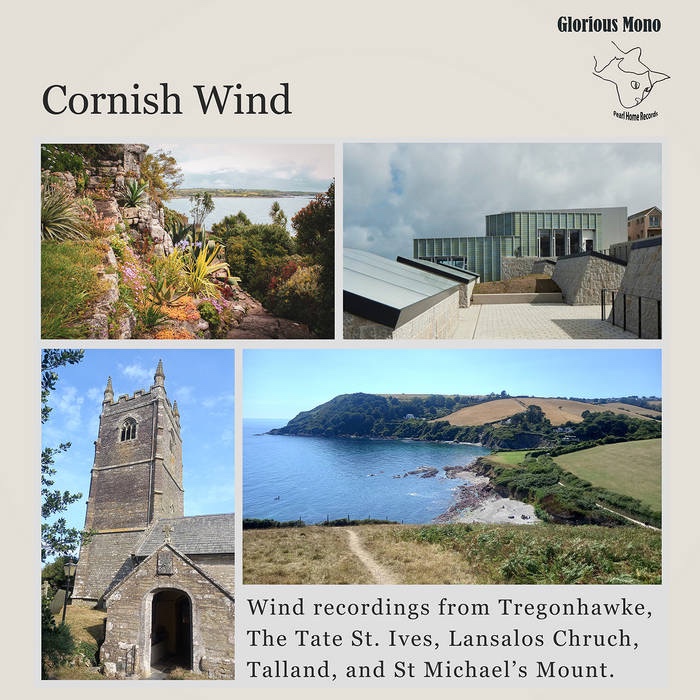
Several decades ago, this type of vinyl record wouldn’t have seemed out of place. While hanging out in my friend Steve’s record shop (Junkwax) in Penzance at the weekend, I alighted upon Sounds Of West Cornwall, a 1970 LP from the defunct Cornwall-based Sentinel label, which included various field recordings made in the westernmost part of the county, as well as arrangements of traditional songs. This lathe cut 7-inch looks like it could very well be one of those old Sentinel LPs, and includes recordings of wind made at five locations – Tregonhawke Beach, Tate St. Ives, St. Ildierna’s Church in Lansallos, Talland and St. Michael’s Mount off the coast of Marazion. As most field recordists will tell you, recording breezes and gusts of wind is fraught with problems, but Cornish Wind contains wonderfully tranquil, yet dramatic, sonic postcards of fairly typical Cornish weather. Easy, breezy. Released 18 January 2024.
VARIOUS ARTISTS – TFL VOL 1 (Moolakii Club Audio Interface)
I remember talking to Neil Stringfellow (Audio Obscura) as he was about to head to London to record sounds on the Elizabeth Line for this compilation, curated by Chris Bullock (Bone Music). When Stringfellow returned, he commented on how incredibly quiet and airy the line and its stations were. That quality feeds into his piece for TfL Vol 1, which is full of peaceful silences and unhurried rhythmic moments. The Elizabeth Line is, however, an enigma. Most of the Undergound is old, cramped and noisy, and that can be heard best on pieces like Moray Newlands’ edgy ‘176 Seconds’ and Looptronica’s cloying ‘Bakerloo Line’, where the clamorous abundance of captured passenger voices over a thudding techno pulse approximates a fairly typical trip during rush hour. Elsewhere, Stoltz’s ‘Central Undersound’ has a sort of industrial, symphonic quality, not unlike Laibach busking in a carriage of a Central Line train after a late night recording session at Guerilla for Nova Akropola. Released January 24 2024.
LETTERS FROM MOUSE – CLOTA (SubExotic)
Clota is a welcome return for Edinburgh’s Steven Anderson (Letters From Mouse). Very much a continuation of his focus on Scottish topographies and mysteries that began with An Garradh and the Robert Burns-focused Tarbolton Bachelors Club, Anderson’s focus here is the mythical Celtic goddess Clota. Believed to be the goddess of the River Clyde, that gives the seven enveloping modular synth pieces on Clota a beautiful flowing fluidity. In pieces like opening track ‘Frogspawn’, Anderson taps into a sense of wispy ephemerality, as if highlighting the way that the goddess Clota has become largely forgotten as time has passed. The key track here is ‘Bowling Greens And Tennis Courts’, featuring birdsong, footsteps and other field recordings alongside fragile reverb-drenched melodies. Released 26 January 2024.








 Further.
You must be logged in to post a comment.