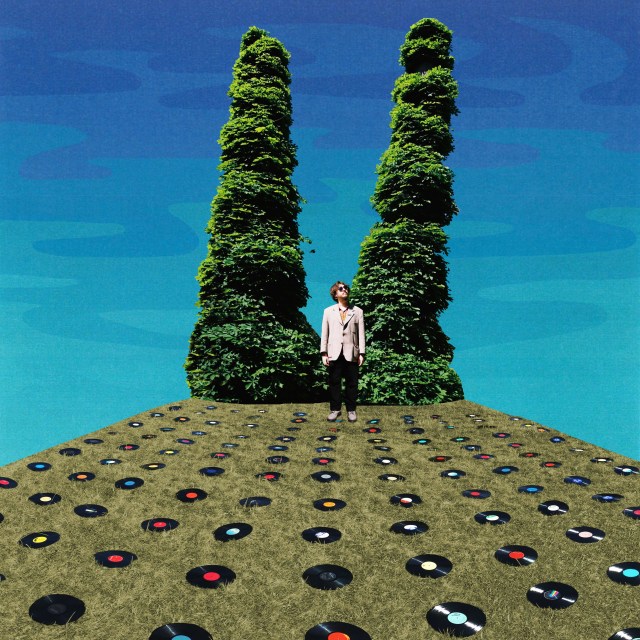
Sad Man – Indigenous Mix 3

Indigenous Mix 3 is the counterpart to The King Of Beasts, the latest album from Andrew Spackman’s Sad Man alias. The King Of Beasts offered all the expected characteristics of a Sad Man album in the form of jerky, vibrant electronic music that draws heavily on the legacy of jazz music, giving his pieces a natural freedom and looseness that is rare to find in music made on a grid.

Here, each of the album’s twelve pieces are given a substantial makeover, the approach varying between incorporating tribal percussion and throwing out some of the jazzier reference points in favour of a skewed, wonky electronica, and most points in between. That approach gives the mixes of ‘Carbonated’ and ‘Kalifornia’ an awkward, clipped, chunky quality offering a firmness in place of the original’s lightness of touch.

Elsewhere, ‘After After’ is re-rendered as a longform electro workout full of ringing motifs and buzzing melodies, while a standout new version of ‘Door’ becomes a metallic hip-hop groove knocked off course by springing, unpredictable electronic percussion and nauseatingly spiked vocal samples.

Indigenous Mix by Sad Man is released April 1 2020.

Read Further.’s interview with Andrew Spackman about ten of his musical influences here.

Words: Mat Smith

(c) 2020 Further.

Snakestyle & Tove Aradala – Nordic Patterns

Somewhere along the lines, Nordic culture got a major overhaul, becoming shorthand for sleek minimalism and clinical modernism. Nordic Patterns, a collaboration between electronic musician Matthew Leigh Embleton’s Snakestyle alias and Tove Aradala seeks to redress that, delving deep into the essential fabric of Norse tradition with all its attendant mystique and rich, unique mythology.

Tove Aradala, or Tove Aradala Barbrosdotter Buhe-Stam to give her full name, is well-placed to comment on this. A High Priestess of the Temple Of The Eternal Goddess, a reconstituted religion which taps into the essential polytheism of Norse culture, a belief system which celebrated multiple spirits, gods and creatures. Using sections of Eddas (holy texts), songs and pieces written in the spirit of the region’s folkloric essence, Nordic Patterns affixes Aradala’s gentle singing and resonant chanting to an intricate, entrancing electronic backdrop crafted by Embleton. The album began with a series of field recordings on the Swedish island of Gotland in August 2019 before Embleton returned to London to complete the tracks.

Pieces like ‘Gnisvärd’ exemplify the approach. Here Aradala took traditional folk song rewrote it as the coda to a sparse backdrop of ebbing and flowing electronic sequences wrapped in hazy, frosty textures. Echoing sampled vocals wend their way through the piece, like voices lifted from an old Edison Cylinder, creating a subtle tension between the present and the past. Embleton reveals himself as a sensitive collaborator to Aradala, bathing her ethereal, yet commanding, voice in shimmering reverb and framing her vocal with structures built with a naturalistic fragility. On ‘Klangstenen’, that backdrop is fashioned from liquified, jazzy tones and beats reduced to a primal essence of clicks and pulses; on ‘Trullhalsar’ it is a landscape of dubby bass and wavering, tentative melodies.

The key piece here is ‘Hoburgsgubben’, a nine minute unlikely ambient pop song that flows with meditative purpose. Deeply poignant synth melodies, a shrouded, unobtrusive beat and a general air of serenity envelop joyous lyrics written by Aradala that beautifully celebrate midwinter, and all its frosty promise.

Nordic Patterns by Snakestyle & Tove Aradala was released March 27 2020 by Alex Tronic Records

Words: Mat Smith

Christian Wallumrød Ensemble – Many

As innovative as it is, modern classical music has settled into something of a comfortable pattern, with a relatively predictable interplay between acoustic instruments and electronics. What once felt like progressive, modernistic flourishes now feel familiar; there’s nothing wrong with this, per se, but with a few notable exceptions, it’s often easy to form an impression of what a modern classical album will sound like before you’ve even put it on.

One of those exceptions is Norwegian composer and ensemble leader Christian Wallumrød. After a series of celebrated albums for the venerable ECM label, alternative musical paths in his sibling electronic duo Brutter, and parallel time spent in the Dans Le Arbre quartet, Wallumrød released the brilliant Kurzsam And Fulger through Hubro in 2016. His is a modern classical that nudges into jazz territory without ever fully giving in to that movement’s improvisatory pedigree, creating music with an inherent fluidity that nods to traditions in its foundations, but which aggressively looks to more experimental territory for its final appearance.

Wallumrød’s new ensemble recording, Many, finds inspiration in the musique concrète innovations made by Pierre Schaeffer at the Groupe de Recherche Musicales in 1950s Paris or the early deployment of tape technology by John Cage and Karlheinz Stockhausen. What you won’t find here, however, are moments of forcibly-processed sound or intrusive technological gestures. This is an album which – at times – is heavily electronic without using heavy electronics, its reverential concession to musique concrète being some of its confounding, nonconformist rhythmic basis. A piece like ‘Danszaal’ with its chiming trumpet and saxophone passages from Eivind Lønning and Espen Reinertsen respectively progresses with a dizzying, stop-start judderiness that nevertheless carries subtle, microtonally shifting beauty. A similar effect is achieved on ‘Staccotta’, led by Wallumrød’s unswerving piano stabs and plucked cello, blasts of brass and a breakdown into pure electronics giving this a playful, elusive, ever-changing quality.

Elsewhere, that use of electronics is more prominent, and each of Wallumrød’s ensemble – himself, Lønning, Reinertsen, cellist Tove Törngren Brun and drummer / percussionist Per Oddvar Johansen – is credited with the use of electronics alongside their usual instrument. Opening track ‘Oh Gorge’ weaves sprinkles of bleeping, synths around Brun’s mesmeric cello cycles, the whole thing pushed through a heavy echo that gives any of the additional elements – Johansen’s vibraphone, Wallumrød’s upper register piano playing – a sense of spinning out from a turbulent vortex. ‘Abysm’ is perhaps the moment where the electronics take over, the whole piece dominated in the foreground by droning synth textures, effects, loops and a general feeling of wild experimentation, its discordant tendencies operating at odds with a prevailing sense of calm.

The key piece here, perhaps, is the fourteen-minute ‘El Johnton’, a series of three movements that begins with a strident piano, saxophone and brushed snare passage that sounds like the coda to a Billy Joel song, before evolving into something firmer and yet more free. The following section develops as a thrilling minimalist, electroacoustic sound field of electronic pulses, bursts of synthetic tones and arrays of metallic non-rhythms, offset with unpredictable acoustic interventions, almost as the extremest counterpoint to the opening passage; brief passages of that starting point’s piano section drift in and out like melodic memories, suggesting and forcing a connection between the two with the most unlikely sonic construction. By the time the original section is reprised, it feels altered somehow, less straight, its traditional structure sounding suddenly alien after being mauled, manipulated and brutally erased in the ten intervening minutes.

Many by the Christian Wallumrød Ensemble was released February 28 2020 by Hubro.

Words: Mat Smith

(c) 2020 Further.
Jazzrausch Bigband – Beethoven’s Breakdown

The follow-up to last year’s Christmas album Still! Still! Still! and the reissue of 2018’s Dancing Wittgenstein, Beethoven’s Breakdown exemplifies what composer / arranger Leonhard Kuhn and bandleader Roman Sladek’s Jazzrausch Bigband do best: namely, creating large-scale sonic landscapes occupying the nexus of jazz, classical music and house music.

If that still seems unlikely, one cursory listen to the group’s arrangement of Beethoven’s ‘Moonlight’ sonata should help dispel any sort of notion that this is some sort of novelty hybrid. Here, the piece’s familiar melodic motif is interwoven with a thudding dance beat and freeform brass solos that swing gently on the framework of the composition, never detracting, but highlight this Munich-based sixteen-piece band’s dexterity within the jazz oeuvre. The major surprise are the small, subtly evolving circular sections running throughout the piece, creating a familiar sensation for anyone used to hearing the tweaked modulations of a minimal techno track, but here providing the connective tissue between that strain of dance music, Terry Riley and Ornette Coleman’s harmolodics. It perhaps shouldn’t work, but it does.

Beethoven’s Breakdown sees Kuhn and Sladek distinctively re-interpreting three Beethoven pieces – the aforementioned ‘Moonlight’ sonata, his Symphony No. 7 and the two-part String Quartet No. 14. Each one is delivered with the flair and sensitivity that Jazzrausch Bigband have become known for, in other words being respectful of the source material, the jazz tradition and the expected formalism of house while still allowing enough room for gentle improvisation. Leonhard Kuhn’s synths are deployed carefully, never detracting from the traditional jazz instrumentation but also providing interesting detail and colour throughout.

The album also includes a four-part sonata composed by Kuhn and featuring the trombone of Nils Landgren. This piece nods firmly in the direction of Beethoven but have more of an open, less densely-packed dimension that allows greater room for soloing – Landgren’s expressive trombone, the combined pianos of Severin Krieger and Kevin André Welch and Kuhn’s blipping electronics.

The element that is perhaps least appreciated, yet omnipresent, here is Silvan Strauß’s drum technique, wherein the entire album hinges on his ability to play unwavering robotic drum machine patterns and more complex polyrhythms, often alongside Kuhn’s programmed rhythms.

Beethoven’s Breakdown by Jazzrausch Bigband is released March 27 2020 by ACT Records.

Words: Mat Smith

(c) 2020 Further.

Novelty Island – Welcome To Novelty Island

We’ve been championing Novelty Island at Further. since their second single ‘Saturn Alarms’ dropped into our inbox earlier this year. Welcome To Novelty Island, the band’s highly-anticipated debut EP, collects together last year’s first single ‘Magdapio Falls’, ‘Saturn Alarms’ and last month’s ‘Windows’ single with new track ‘The End Of The Whirl’, each discrete track highlighting the songwriting prowess and deft melding of retro-futurist sounds by the band’s Tom McConnell. McConnell hails from an indeterminate location somewhere in the north of England, and his group may or may not be named after an especially bonkers Vic and Bob skit.

‘Magdapio Falls’ is an understated singalong gem, featuring deft choruses, woozy retro synths and a wonky, space-age sensibility. Possessing an inner uncertainty and indecision in its lyrics, something about ‘Magdapio Falls’ feels like you’re being propelled gently through distant galaxies, the combination of delicate electronics and spiky guitars on the bridge having a brilliantly emotional quality, while Mellotron-esque chords nod back to The Beatles. Some of ‘Magdapio Falls’ sedateness creeps into ‘Windows’, a tender song filled with psychedelic, chill-out reference points that eddy and spin from its gauzy core – a trippy stew of languid beats, icicle-sharp melodies and delicate harmonies.

‘Saturn Alarms’ is the counterpoint to the languid, laidback structure of those songs, being an urgent rush through the turbulent reaches of our solar system and the omnipresent sauce junk floating around out there, replete with catchy vocals and star-scraping electronics. Poised somewhere between vintage electronic pop and wiry indie rock, the track was named after some inexplicable graffiti that McConnell spotted tagged onto his mother’s house in Liverpool, and thenceforth transformed into a tightly-executed pop monster.

New track ‘The End Of The Whirl’ buzzes on grimy, droning synths, vintage 1981 one-note melodies and a thudding glam-rock R&B stomp of a piano and drums rhythm. ‘All of this white noise is so hard to understand,’ sings McConnell as the track breaks down briefly into a slowed-up soundfield of accelerating synths and polyrhythms. Its upbeat, urgent, playful sounds and melodic juxtapositions are precisely what the world needs right now.

Welcome To Novelty Island was released March 20 2020.

Words: Mat Smith

(c) 2020 Further.
First Play: Matthias – Hold Me (Matt Pop Radio Edit)

Matthias is Matt Danforth, a Canadian electronic musician known for producing upbeat music full of faithful synth sounds and brilliant, sparkling melodies; music that nods reverently in the direction of classic synth pop but without ever sounding like a pastiche.

His most recent single, ‘Hold Me’ features vocals from his frequent collaborator Mark Bebb (Andy Bell, Shelter, Form). The track includes one of Bebb’s most impassioned vocals in a career of impassioned vocals, here set to a gripping, happy-sad mood that’s the perfect complement to the vocals.

Following December’s single release, ‘Hold Me’ has been given stunning remix treatments by Further. Favourites Circuit3, Reed & Caroline’s Reed Hays with Phil Garrod (featuring a rare Moog and Hays’s distinctive cello), Darwinmcd, People Theatre, Nature Of Wires, MDA/ADM and the inestimable Matt Pop.

Today we’re pleased to bring you an exclusive first play of Matt Pop’s brilliantly-executed, high energy Radio Edit.

Hold Me – The Remixes by Matthias is released February 28 2020.

Words: Mat Smith

(c) 2020 Further.
In Conversation: Wrangler

Wrangler is a trio of Stephen Mallinder (Cabaret Voltaire, Creep Show), Ben ‘BengeEdwards (The Maths) and Phil Winter (Tunng). Their third album, A Situation, takes the current, destabilised state of the world and sets it to smart electronics, laced with heavy doses of angular funk.

Further. spoke to Mal, Benge and Phil about the genesis of the latest record, how they work together and what J. G. Ballard would make of modern Britain.

The subject matter across the whole of A Situation makes for uncomfortable listening, and yet it sounds incredibly, infectiously funky. Was it a conscious thing to make it danceable instead of utterly bleak?

Mal: I don’t think it is ever ‘overthought’. We make music and rhythms that speak for us, and lyrically I hope don’t we don’t hold any punches. Words should cut through just as the music should, this isn’t a time to look the other way, I hope we can go toe-to-toe with the world we inhabit and nothing hits harder than rhythm, so it’s perfect synergy for us.

Benge: We simply try to make music that we would want to listen to, or dance to, and this is what comes out when we all get together. That’s the great thing about being in a band with three producers – we each have individual styles, but when blended together something unique comes out

Phil: I think people have always needed an escape, when times are tough. A lot of my favourite music has combined a reflection of ongoing problems with a groove that can bring them together.

It seems that the process of making each Wrangler record has started from a fundamentally different place each time. Why is that? Is it to avoid getting too comfortable?

Mal: I’d like to think we grow with every release. It is the ultimate challenge to create your own sound and aesthetic without repeating yourself. I like to think Wrangler are distinct, and recognisable but also keep reinventing ourselves.

Benge: We don’t plan things out very much – we tend to respond to the situation we find ourselves in each time we get together. Sometimes there might be a new piece of gear that we are exploring in the studio, or we might be responding to other circumstances around us. When we were making this album there was a pretty messed up political situation so that fed into the tracks as well.

Phil: It’s pretty unconscious for me. I never have any idea how it will turn out. Equipment and to a degree, whatever I’ve been getting into, will have an effect for sure.

How do the three of you work together?

Mal: It’s easy – we get in a room together (either the studio or just set up to jam) and magic happens! Well, most of the time. In the studio we all chip away at what each of us has done until there’s consensus – which is when it sounds like Wrangler. But importantly, if it sounds like a new version of ourselves, that’s when we know we’ve got it right.

Although we live in different places we have to be together. Often it’s been a while since we’ve actually been together so it’s proper crazy because there’s so many ideas – and bits of new gear – to share.

Benge: We usually work from a starting point of some kind. Maybe Phil plays some loops from his laptop, or I get up some wonky synth-sketch that I have been working on and we go from there. And Mal always has a bunch of vocal ideas hidden away somewhere. One time I remember he came in and sang all these amazing but really dark phrases and I wondered how he had thought of them. Later on I found newspaper he’d been reading lying on the sofa, with all the phrases circled in marker pen.

Phil: I think we’re quite traditional in our approach. We get together, we chat and we play.

I thought I could hear a nod back to the early Warp, slightly disjointed techno sound and also vintage electro on this record, yet it doesn’t sound nostalgic. What kind of reference points were feeding into A Situation?

Mal: I think we are conscious not to ponder the process too much and just let it flow. The beauty of early techno was its simplicity and rawness so we try to think like that. Techno, in the first instance, is music you hear with your muscles.

Benge: I definitely think there are some early 90s sounds coming in to the recent stuff. I’ve been buying lots of those early digital synths that you can get really cheap at the moment, and we used some of them on this record. Maybe we used less of the older analogue gear this time.

Phil: Yeah, there was definitely a lot more black plastic around. And LEDs.

The last track features a poem inspired by The Atrocity Exhibition. What would Ballard make of where we are today? Would he be pleased that he got it so right? Or would he be as horrified as we all find ourselves?

Mal: I think Jim Ballard knew where we were heading, and his later books told cautionary tales of the potential of a collapsing world and the growth of a conflicted and materialistic island mentality. I think his earlier dreams of future worlds would be a little flattened by what we are at present, but I’m sure we all hang our hopes on solutions and resolutions.

A Situation by Wrangler is released February 28 2020 by Bella Union. Wrangler play The White Hotel in Manchester on February 28 and Electrowerkz in London on February 29 (with support from MICROCORPS – Alexander Tucker).

Interview: Mat Smith

Thanks to Zoe.

(c) 2020 Further.

Nokuit – Live At Cafe OTO

Live At Cafe OTO captures the debut 30-minute live performance by sound artist and NKT cassette label head Nokuit, recorded at London’s experimental music epicentre during the summer of 2018.

Presented as a single piece, the set is a bold, antagonising stew of sonic motifs right from the get-go: snatches of news broadcasts, spinning and eddying sounds, recordings of parade ground preparations, noir atmospheres, predatory electronic tones, metallic distortion and squalls of what might be violins are all melded together into something that, in another artist’s hands, might have been noise for noise’s sake.

Instead, the set consists of brief segments of pieces taken from previous Nokuit releases, each one carefully and delicately composed with a curatorial zeal that gives the set a soundtrack-y tension and a claustrophobia-inducing awareness of the value of intricate detail. The result is a busy, restless urgency that is never still for a second and never anything but enveloping and engaging in the completeness of its sonic breadth.

As a piece of brooding, dark ambience, Live At Cafe OTO sounds vaguely like one of the imagined soundtracks for cult books issued by the Bibliotapes imprint, only here the narrative we have is entirely of our own design. Nokuit himself calls it a ‘soundtrack to a film that has left its screenwriters behind’; and yet, in the closing, piano and grubby synth symphony that edges us to the set’s conclusion, we hear faithful echoes of everything from the first Terminator movie to Blade Runner to any other film relying on shadowy, bleak representations of dystopian futures as its central concern.

Live At Cafe OTO by Nokuit was released February 21 2020 by NKT.

Words: Mat Smith

(c) 2020 Further.
In Conversation: Kemper Norton

kempernorton_oxlandcylinder.jpg

Kemper Norton is a Cornish electronic music adventurer who often uses the local history of his home county as the basis for complex, evocative albums that defy easy classification.

His latest work, Oxland Cylinder, is the counterpart to last year’s Brunton Calciner. The titles of these two albums might sound like some sort of abstract concatenation of random words but they are in fact the names of facilities developed for the extraction of arsenic, a lucrative byproduct of the tin mining that Cornwall was once famed for.

Further. spoke to Kemper Norton to find out more about his enduring interest in developing music inspired by the mythology and stories of his local surroundings.

Your albums Brunton Calciner and Oxland Cylinder are concerned with the arsenic manufacturing process that has left abandoned facilities across the Cornish and Devonshire hills. What was it that made you want to use these as the basis for an album?

They’re one of the classic picture postcard icons of Cornwall and have led to areas of the coast being designated a World Heritage site, but I wanted there to be a wider awareness of their original purpose and role in the industrial revolution, and in the West Country and the global economy.

The creation of arsenic as a byproduct of the mining process also tapped into many themes of toxicity, domestic life and physical transformation that I’m interested in at the moment. They’re also buildings that I’ve seen every day growing up and I wanted to explore them more deeply before the landscape changes further into the view from a millionaire’s second home, and it becomes less accessible.

History – Cornish history especially – has a big presence in your work. The new album includes an old tin miners’ song interpolated into the piece ‘Halan’ that threads through Brunton Calciner and Oxland Cylinder, while 2017’s Hungan used a mythical pirate active along the coast as its foundations.

How do you go about researching and unearthing things like that? What is it about the history of this county that inspires you so much? Or is history in general something that inspires you?

I have never been interested in personal songwriting based on my own experiences in a literal way. There are loads of artists doing that and I don’t think we need another bloke telling his stories or desires, but I do feel there are neglected areas and people in history that still have interesting stories, at least to me! History, particularly social history and folklore – both old and modern – have always been a big influence, and I’m sure they will continue to be. As I grew up mainly in Cornwall, that’s bound to be a major element.

I don’t think there’s necessarily anything unique or magical about Cornwall any more than other counties or countries though – that’s part of its image that tourists go for and which residents exploit. The history of Coventry, Croatia or car parks will all have resonance and amazing hidden stories.

You have, on occasion, described your music as being ‘rural electronics’. What does that mean, in practice? Is it a style that comes from what you’re inspired by, or do you think it’s more a set of rules governing how you approach making your music?

When I started I just thought it was an honest way of pointing out that my upbringing is generally rural and I wasn’t that influenced by many urban styles of music, although that’s definitely changed.

The synth sounds, samples and field recordings were explicitly meant to sound rural in the North Cornwall sense – blasted by the Atlantic, rough, salty and hopefully unique. I was aware of artists like Aphex Twin and it was great that a Redruth boy could make it so far, so that in itself was inspiring, but I hope I’ve manage to avoid using tropes and conventions used by other artists too much. That’s pretty much the only rule!

Although it would be tempting to associate you with the hauntological genre, your music doesn’t seem intent on creating this wistful sense of nostalgia but instead seems to mourn that which is at the point of being lost from memories completely. Is that a conscious part of what you do?

Definitely. I can’t be nostalgic for Britain in the 1970s, Doctor Who or the Radiophonic Workshop because they’re not my memories or influences – I only moved to the UK in 1982 as a child. I also think that type of nostalgia for those specific cultural touchstones and era seems both oversaturated and close to cosy UKIP nationalism to me.

The idea of any kind of golden age is bollocks, particularly a recent British one. I’m also not interested in easy references to shared cultural memories of television or whatever. In terms of focusing on specific histories or stories being on the verge of lost , that’s definitely a theme in my work but it’s not necessarily limited to a specific era or mood.

If we take Brunton Calciner and Oxland Cylinder as representative of your interest in taking historical inputs as a starting point, how did you go about actually converting those inputs into music?

I’m not that technical. I use a combination of samples, field recordings and sounds as a mood board for a specific album, and then they undergo a range of processes including granular synthesis and effects processing. Some come out the other end intact, whereas other sounds are absolutely unrecognisable, and others become base sounds for new instruments and melodies. Then they attempt to become songs!

Recently I’ve become interested in using as few sound sources as possible. Most of Brunton Calciner is based on two samples which are layered and continually reprocessed, which ties in with the themes of the album.

The two most recent albums exhibit a strong sense of narrative, meaning its presentation felt more like a radio play than an experimental electronic album. Was that deliberate? Do you see your music as being a form of story telling?

I like stories and narrative in music, and no matter how much I try to avoid it I can’t help creating or following a narrative in an album. It’s rather old-fashioned but I do see each album as a story, with a beginning, middle and end during construction, however ambiguous. At the same time, I don’t think it matters if listeners deconstruct or ignore that.

Do you think could be inspired in the same way by, say, the history of somewhere like London? Or is it under-appreciated histories that appeal to you the most?

Everywhere is interesting if you look at it closely. Even Surrey.

Oxland Cylinder by Kemper Norton is released February 24 2020.

Interview: Mat Smith

(c) 2020 Further.

John Chantler & Johannes Lund – Andersabo

Johs&John1_front

A second duo outing for Swedish / Australian John Chantler (pump organ, synths) and Denmark’s Johannes Lund (saxophone), recorded during a residency in Sweden’s Andersabo.

Consisting of three long tracks, each piece here is its own unique soundworld full of clashing sounds, vibrant tensions and noisy interplay. Opener ‘Back Of The House’ has a playful quality thanks to Lund’s rapid, fluttering saxophone cycles, performed in such a way that he never seems to pause once for breath; his sax might be the focal point but it is the swirling, droning, seesawing organs that set the mood here, creating a beautiful discordant energy.

‘Open Field & Forest’ acts as a moment of quiet repose, Chantler’s sounds acting like a bed of ambient noise over which field recordings of birdsong, creaking wood and insectoid chatter are overlaid. Lund arrives in the piece’s final minutes with some processed, murky bleating that sounds like metallic scraping, but on the whole this piece is a delicate pause for reflection.

In contrast, ‘Under Barn Floor’ is a busy, maximalist summation of both the preceding pieces, built up from earthy, growling sounds, shimmering organ layers and a grubby, subtly nihilistic intensity.

Andersabo by John Chantler and Johannes Lund was released February 12 2020 by Johs & John.

(c) 2020 Further.