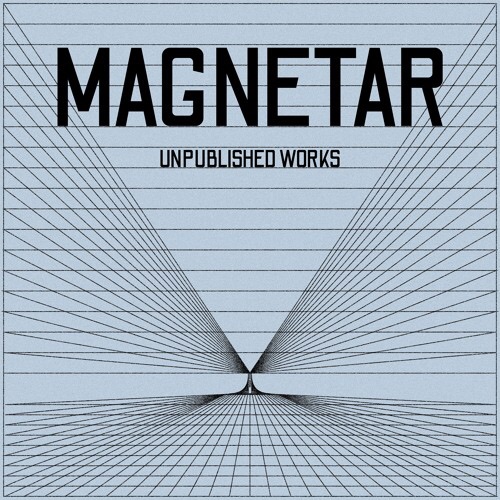
Perdurabo – Magnetar (Unpublished Works)

Of all my musical adventures in 2024, one of the highlights was working with Perdurabo on the release of his debut album, Magnetar, concluding with a live Q&A at the event space at Shoreditch’s Strongroom. It is a great privilege to get to know an album from the inside out, and an even greater privilege to be able to ask its creator open questions about its genesis.

Perdurabo is the solo project of Davide Arneodo, a key member of Italian rock group Marlene Kuntz. Magnetar saw him (mostly) put down his guitar and create a suite of bold electronic tracks filled with complex textures and enormous, infectious melodies. The album saw him collaborating with a number of vocalists, including Miro Shot.

Miro Shot makes an appearance on ‘Grain Of Sand’, a pivotal track included on a new EP of extra tracks recorded during the Magnetar sessions. It is a strong indicator of Arneodo’s sound. For the first three minutes, the track is defined by rising tension. Miro Shot’s half-sung, half-spoken poetry rests on top of a largely uninterrupted drum pattern, upon which Arneodo adds swirling, minimal electronic sounds, loops and drones that create the suggestion of a storm cloud suddenly about to break. When it finally does break, Arneodo floods the track with a huge, elliptical melody that matches a rising anguish in both the vocal and the rhythm.

As ‘Grain Of Sand’ judders to a rapid conclusion, its tense, melodic atmospherics are taken up by ‘The New Element’, wherein a forlorn synth riff is juxtaposed with a forceful, determined drum pattern. There’s a sniff of industrial music to these tracks, poised as they are on the precipice between hope and despair.

The EP concludes with ‘Soak Up My Tears’, whose clipped piano notes and wafting strings act as the gateway to the track’s mournful, dejected emotional core. If you were to isolate those elements from a restless beat and a stabbing bass sequence, Arneodo could well be crafting a modern classical symphony here. That he decided to hitch those plaintive gestures to electronic structures filled with uncertainty is key to what makes his work as Perdurabo so compelling.

A second album is in the works. One can only hope that these pieces both conclude the Magnetar project and indicate where he intends to take this project next.

Magnetar (Unpublished Works) by Perdurabo was released March 7 2025 by Perdurabo World

Words: Mat Smith

(c) 2025 Further.

Billy Malm – SPÄTZLE

On occasion, I write press releases for artists. I think of it as a side hustle to a side hustle, given that writing for this blog and Electronic Sound isn’t my main job. I find it a wonderful, liberating experience. A review needs to be relatively objective whereas a press release, given its stated purpose of trying to attract attention to a particular product, is much more free.

As a upstanding, responsible, and, I hope, relatively good music journalist, one of the key disciplines you learn is that you don’t simply rewrite the press release when you’re composing a review. It’s not the first rule of review writing, but it’s fairly close to the top. However, I do notice that quite often the press releases I’ve written get copied completely and passed off as a review, or get subtly edited to show some modicum of originality. And I’m not fully sure how I feel about this, if I’m honest. I don’t know if I’m offended by the laziness, or flattered by the wholesale appropriation of my words.

So, with all of that said, I’m now going to appear completely hypocritical by lifting the entire press release text for Billy Malm’s SPÄTLZLE and pasting it in below.

Self-taught Euro-dance instrumentalist Billy Malm is back with a new collection of studio cuts showcasing the artist’s flair for combining sounds in the same way you might, for example, mix together different kinds of Fanta, maybe Fanta Limón and Fanta Orange, or if you have access to some of the more niche Fantas, like Strawberry or Haunted Apple, you can use those as well, and share that with a friend, giving them some of the mixed together Fantas to drink out of their own glass, so they can experience something that you made for them, even though it’s all just really Fanta and the components of the mixture were produced by the company that makes Fanta, probably in a factory or possibly a workshop if they do it in smaller batches for new flavour prototyping, but the mixture kind of becomes more than Fanta and you can tell by looking at it because it’s not a normal Fanta color, like there’s normally no brown Fanta or dark yellow Fanta, so the friend who you share it with gets this multisensory moment of realizing something unique for the first time and they can swirl it around in the glass and smell it as if they’re at a fancy wine tasting event, and they could be doing this as a funny joke or even in earnest because they are genuinely immersed in this personal act of creation you have prepared for them and to be honest, everyone knows that smell plays a significant role in how things taste, so there’s actually nothing ridiculous about them smelling their drink in this situation, and they might even take things a bit further, holding their ear close to the glass to observe how this combination of Fantas sparkles, perhaps noticing some surprising properties relating to the carbonation, for example that while the bubbles occur more frequently than in normal Fanta, they might sound less explosive when they burst, more like the tiny air pockets in the Fanta are just opening gently like cactus flowers when they reach the surface because this mixture somehow contains less internal violence than other Fantas or mixtures of Fanta that they’ve tried and this evidence of a seemingly miraculous harmony within the beverage might place in them a kernel of optimism that, given the right conditions, could develop into something that at this point in time, they don’t even have the ability to comprehend, and they might go so far as to pour a small amount of the drink you made for them onto the palm of their hand, to feel this thing, to really explore what it is by using the middle finger, ring finger and little finger to rub the liquid into the soft center of their hand, working it like a wholemeal dough, so that the sugars and the previously invisible dirt or dead skin on the skin starts to form tiny sticky tubular strands, kneading the mass, the actually quite disgusting dark micro baguettes of filth, which your friend frowns at, pulling back, suddenly realizing that maybe they’ve taken things too far and that the norms within society aren’t all just completely arbitrary, though some of them absolutely are, but in this case the disapproval earned from pouring sweet beverages on oneself does seem reasonable given this viscid, unheimlich outcome, and the friend looks to you for reassurance that there is a way back for them, a line they can grab before being swept out by the now relentless tides of chaos, swirling all around, threatening to pull apart any notion of stability they once held and you reach out and take the glass of mixed Fantas away from them and they meekly let you have it, this seemingly cursed chalice, this gift infused with so much hope that they irresponsibly abused potentially precipitating any number of currently unknowable consequences and you look them in the eye as they sheepishly return your gaze and raising the glass high between you and your friend, you release a what could be a moment of smile from one corner of your lips, above which a faint twitch ripples across the eyebrow (a waggle? your perceptive friend cautiously wonders) and you slowly draw the glass of mixed together Fantas back in a gentle arc and pour the contents of the vessel, approximately 250ml of Fanta-based liquid, over your head, the soda instantly absorbed into your hair and running down the facial features and neck as you roll the empty glass onto the middle of the laminate-topped table and start vigorously massaging the Fantas into your scalp like some high-fructose 2-in-1 shampoo/conditioner, laughing, cackling, on the precipice of what people refer to as hysteria, but without any trace of malice, and your friend, after a few abbreviated false starts, now fully joins in your extreme merriment, howling, shrieking, whooping, convulsing, yelping, hiccupping, coughing, resonant swells ringing off nearby surfaces when the frequencies of the two vocalizations of pure joy align, these roaring tsunamis of euphoric sound sweeping over and blocking out the rest of the world, the humming and hissing of hidden HVAC systems, babies crying, the traffic noises, concerned exclamations from passersby, some kind of alarm, religious bellringing, all squashed into insignificance by the laughter, all but perhaps the rising telltale buzz of the inevitable gathering wasps.


Maybe you can see why I did that. I’m not sure that one sentence even is a press release. It certainly intended to be one by the way it started, but that’s most definitely not how it ends up. I would posit that this is less a bit of sales-y text designed to sell a product and a work of surrealist art.

A traditional press release it may not be, but it is more than adequate preparation for what SPÄTLZE sounds like. This is a collection of fizzy, effervescent tracks that flip ceaselessly between wonky electro and leftfield techno. These pieces are dominated by heavy bass, sprays of seemingly random pulses, unpredictable synths and beats that seem hellbent on freeing themselves from a DAW grid-prison.

That’s not to suggest that tracks like the title track or ‘Fragola’ are wayward, messy sprawls. Far from it. There’s discipline here, in abundance, but Malm actively skews any sense of linearity. With ‘Spätzle’, when a steady, glass-like staccato sequence emerges, that’s his cue to mess everything else up, rather than allowing the track to coalesce around that pretty focal point. I appreciate that this analogy might get lost on non-British readers, but what Malm does here reminds me a lot of the late and lamented comedian Les Dawson. Dawson was a talented, almost virtuoso-standard pianist, but he would do these skits where he completely ballsed-up the music he was playing. It was a talent that he could only do convincingly, and with hilarious results, because he was so talented a player in the first place. So there you have it: Billy Malm is experimental electronic music’s Les Dawson. Go figure.

SPÄTZLE concludes with ‘How Are You Doing?’ (I’m fine, thanks). It begins with a web of siren-like sounds that nod in the direction of Fad Gadget’s ‘Back To Nature’, before ushering in a solid 4/4 rhythm that’s probably one of the tightest and unaltered set of beats on the whole album. Stuttering, chugging synths that sound like electronic wah-wah funk guitar, a sprightly bass pattern, friendly drones and harshly-filtered tones are then thrown in over the beats, creating an alternately playful and resolute finale to this brilliantly inventive, wonderfully madcap and boldly other banger of an album.

SPÄTZLE by Billy Malm was released January 30 2025 by Strategic Tape Reserve

Words: Mat Smith

(c) 2025 Further.

Temporary Bodies – Transformations In K

Utopian Mechanics is a Preston-based imprint fronted by Mike Warburton, who operates under the Temporary Bodies alias. For Transformations In K, Warburton used field recordings made around his Lancashire base, adding these to improvised sound structures that waft gently between brooding dark ambience and modern classical. These pieces are minimal in their architecture, structured from a restrained set-up – two keyboards, a loop pedal, some effects.

Opener ‘The Thickness Of Cotton Thread’ features hissing natural sounds. It’s hard to tell whether the sound is a car driving through a puddle at the side of the road or of wind rustling the leaves high in the trees, but it frames a beatific, stately composition that flits between meditative New Age-y chimes to sweet blocks of long keyboard tones that sound like they would work well at the mournful conclusion of Less Than Zero.

Elsewhere, ‘The Countenance Of Saints’ begins with sounds slowly emerging from a fog, like organ music in a coastal church heard from a boat floating off the shore. As the track coalesces, Warburton infuses the overlapping tones with equal measures of hope and despair, depending on where your personal emotions are operating while you listen. High-pitched, euphoric notes are held in place by rough, discordant textures, whose tense and disruptive atmospherics slowly overwhelm the piece.

The birdsong that frames ‘Pigs In Tokelau’ is a sweet plot device that ushers in some of Warburton’s most positive and euphoric playing. The pieces contains a sort of romantic yearning, even if occasional patches of distortion inject a feeling of doubt. In my mind’s eye, I see a callow young groom waiting for his future wife at the altar, the sounds reflecting emotions oscillating between excitement and nerves.

Warburton’s improvisatory technique suggests an artist with a deep understanding of the mechanics of emotional sound design. Transformations In K is an understated, restrained album packed with complex, fluctuating sentiments, making for a powerful and absorbing listening experience.

https://utopianmechanics.bandcamp.com/album/transformations-in-k

Transformations In K was released March 7 2025 by Utopian Mechanics.

Words: Mat Smith

(c) 2025 Further.

Fields We Found – rhythm structures 01

This is the first in a series of releases from Fields We Found, the catalyst being a period of illness which prompted Alex Gold to focus in on the things that gave him joy, including the process of making music. The overall series is called resolve / relate.

The four tracks here are inspired by nostalgia for Gold’s halcyon nights spent clubbing at places like Fabric. Each has the relentless chugging rhythms of especially solid techno sets, offset by minimal interventions – a cluster of notes approximating a repeating melody, deep bass lines, oscillator sweeps, unfurling drones, tuned percussion – that add to a sense of forward momentum. The EP is rounded out with a remix of ‘rhythm structure 1.1’ by Brendan Moeller, who recently released an album on Gold’s Quiet Details imprint.

Each of these pieces are, however, draped with a sort of foggy impenetrability, like the club is choked with dry ice. The figures of fellow clobbers are reduced to mere shuffling outlines, while strobes and lights create jagged shapes as they try to cut through the haze. It approximates both the fallibility of memory, as filtered through our nostalgic recollections, and the vibrancy of a club situation where the only thing that matters is the trance-like state created by extreme repetition.

Gold’s practice is entirely live, improvising and recording direct to tape. This gives tracks like ‘rhythm structure 1.2’ a spontaneity, almost like he is helming a DJ set and constantly keeping an ear on each track’s energy. ‘rhythm structure 1.3’ is this writer’s personal favourite, opening with white noise-tinged sequences that whine discordantly, prefacing a delicate suite of notes that slowly emerge from the background and assert themselves as the unswerving focal point of the track. As they do so, a sense of extreme, swirling turbulence begins to become obvious down in the foundation layer – restless, unplaceable sounds; sibilant noise; tension; discordancy.

A powerful – yet restrained – signal of intent from Gold.

https://fieldswefound.bandcamp.com/album/rhythm-structures-01

rhythm structures by Fields We Found is released March 19 2025.

Words: Mat Smith

(c) 2025 Further.

Allmanna Town – 1911

Allmanna Town are a duo of Phil Dodds (Waxing Crescent) and Jonas Geiger Ohlin (The New Emphatic). There is, however, a third member of this duo – the Library of Congress C-1 cassette deck, used to manipulate sounds which are then edited and reconstructed using a variety of electronic tools.

Dodds and Ohlin’s first release together was ‘LF24 / C.FXNOISE’, part of the LIFEFILES series through my own Mortality Tables project. The proposition with ‘LF24 / C.FXNOISE’ was to use old cassettes I’d accumulated in the 1990s, which were then completely skewed through their intensive approach to re-augmentation.

‘1911’ consists of six short cuts (or ‘samples’ as they call them). There’s a digital edition, or you can shell out on a lathe-cut 7-inch which will have probably sold out by the time you’ve read this. On these pieces, you can really hear, first and foremost, the joint love this pair have for 1990s electro and techno. ‘Sample 28’ is a slow-motion electro-ambient piece that uses a crisp, sparse beat, while ‘Sample 04’ rides a neat 4/4 rhythm.

The trick is to listen to what’s going on behind these beats. The manipulation of tape sources leads to fluttering, unplaceable textures of unknown provenance. On ‘Sample 04’ the effect is to subsidise the regimentation of the the beats with a dreamy, floating motion. On ‘Sample 32’ – the longest track here, at 2’15” – beneath what could be a late-80s digital house piano loop and some sort of classical motif, we hear a web of chatter that sounds like a vocal warm-up from Hatsune Miku.

The whole thing lasts less than ten minutes, but it carries with it an intensity of imagination lacking in far longer releases. Expect great things from this inventive duo.

https://allmannatown.bandcamp.com/

‘1911’ by Allmanna Town is released March 14 2025.

‘LF24 / C.FXNOISE’ was released through Mortality Tables on October 4 2024. Available here.

Words: Mat Smith

(c) 2025 Further.

Electronic Cafe – Vicious Pink / Magnetic Skies / Paul Dakeyne

My good friends over at Electronic Cafe are hosting their next live event at 229 in London on April 12 2025, featuring DJ Paul Dakeyne, epic aunt group Magentic Skies (who I wrote about for Electronic Sound) and the return of synth duo Vicious Pink.

Sadly I can’t make it, but if you’re in London and a fan of electronic pop music, it’ll be well worth attending.

Tickets are available through Dice here.

Electronic Cafe: here

Words: Mat Smith

(c) 2025 Further.

Shots – Kemper Norton / Veryan / Wil Bolton / Runar Blesvik / the klingt.collective

Kemper Norton - Tall Trees

KEMPER NORTON – TALL TREES (AND OTHER TALES) (Zona Watusa)

I absolutely love Kemper Norton. His music, very often inspired by Cornish folklore, mythological figures or its forgotten Industrial Age contribution, has a highly distinctive and wonderfully idiosyncratic originality. For Tall Trees (and other tales), he focuses his attention on his own personal history and mythology, celebrating a bunch of nightclubs that have closed their dance floors for good. “None of these places still exist, and some of the people have gone too,” he writes. “But not all of them.” This is club music as filtered the disjointed fog of memory, of too many nights out that you thought you’d remember forever but now can’t. That poignancy and nostalgia is all over Tall Trees, but it’s elusive, hidden beneath grids of dirty beats and lysergic energy. The eponymous opener is punishing and insistent, but it’s also ever-so-slightly wonky, as if the neatness of Kemper Norton’s grid itself is protesting against the uniformity of recollection. The two parts of ‘Victor Dragos’ carry a vital latency, with suggestions of rapid-fire hardcore beats subsumed under washes of amorphous, psychedelic texture and restless acid house pulses. A truly original work from one of electronic music’s most enigmatic of mavericks. Released 28 November 2024.

 https://kempernorton.bandcamp.com/album/tall-trees-and-other-tales

Veryan - Paper Hearts

VERYAN – PAPER HEARTS

Scotland-based electronic musician Veryan released her latest EP just before Christmas. Containing three tracks featuring prominent piano and breathy vocal textures, Paper Hearts has a sort of frozen quality to it, as if the pieces were created while looking across a frosty winterscape. The title track features an icicle-sharp countermelody and a sinewy arpeggio filled reminiscent of Higher Intelligence Agency’s Colourform album from thirty years ago (ah, the memories…). Veryan’s music has always carried a searching, inquisitive dimension, embodied here by the unfurling textures and refracted journey of ‘Gossamer’. The EP concludes with ‘Soft Lights Dance On Walls’, whose circular central piano motif leans into classical minimalism, while its shimmering electronic accompaniment is freighted with a powerfully contemplative energy. Released 23 December 2024.

https://veryan.bandcamp.com/album/paper-hearts-ep

Wil Bolton - South Of The Lake

WIL BOLTON – SOUTH OF THE LAKE (Quiet Details)

I’ve regularly written about Quiet Details releases here, and, on the strength of their first release of 2025, it seems like it will be another year of high quality, gently reflective albums. Wil Bolton’s contribution to the series was inspired by journeys around South Korea, featuring accumulated field recordings, instruments found and played on his journey, and electronic arrangements of extreme subtlety. In many ways, what Bolton has delivered with South Of The Lake is the very essence of what Quiet Details founder Alex Gold was seeking to achieve with this series. Pieces like the standout ‘Sun Tree Trail’ are deeply contemplative, evoking the Buddhist notion of being the still point in the turning world, wherein the listener is surrounded by bird calls, running water and a textural accompaniment of singing bowls and synths that rest lightly and comfortingly upon you. Last year, I spent some time at Lake Shrine in Los Angeles, not far from Pacific Palisades. It was a transcendent experience, and one of the most significant places I’ve ever had the privilege to visit. My only disappointment was the sound of cars whizzing down the mountain toward the Pacific Coast Highway, something that took some intense meditation to ignore completely. If I ever get to go back, South Of The Lake is what I would choose to listen to while there. Bolton’s album is a truly beautiful listening experience. Released 8 January 2025.

 https://quietdetails.bandcamp.com/album/south-of-the-lake

Runar Blesvik - All The Difference

RUNAR BLESVIK – ALL THE DIFFERENCE (Fluttery Records)

Runar Blesvik is a Norwegian pianist and composer whose work seeks to transcend the frontiers of modern classical music, a genre with some of the least defined of frontiers to begin with. Accompanied by strings from the Arcobaleno String Quartet, clarinettist Jussan Cluxnei and Blesvik’s own piano and electronic textures, All The Difference is a gently ruminative listening experience that subtly demonstrates the emotional power of his compositional sleight of hand. The album opens with the achingly minimalist ‘Finding’, wherein Blesvik’s piano is accompanied by sepia-tinted static, a powerfully restrained statement that might have been overburdened by layers of additional sounds or melodies in the hands of another composer. That’s not to say these pieces are all uniformly sparse – ‘One And The Other’ adds strings, rhythms and a beatific synth motif to create a soaring piece that rises quickly before falling back into comparative quietude. Across the remaining tracks, Blesvik pivots his classical vision toward jazzy levity, blissful Terry Riley circularity, gamelan chimes and ambient atmospherics, rendering All The Difference an impactful, exquisite listen, executed with extreme precision. Released 10 January 2025.

 https://runar-blesvik.bandcamp.com/album/all-the-difference

the klingt.collective - Variable Densities

THE KLINGT.COLLECTIVE – VARIABLE DENSITIES (Interstellar)

Viennese experimental unit the klingt.collective consists of Martin Brandlmayr (drums), Angélica Castelló (recorders and tapes), dieb13 (turntables), Klaus Filip (ppooll), Susanna Gartmayer (bass clarinet), Noid (cello), Billy Roisz (electronics and bass), Martin Siewert (guitars and electronics) and Oliver Stotz (guitars and electronics). Variable Densities was recorded at the densités festival in north-eastern France back in October 2023 and highlights just how seasoned these improvising musicians are. No mistaking, this is a large group, and the capacity for everyone to be playing over everyone else to assert dominance is high. Fortunately, that isn’t the case. There are moments of multitimbral, densely-layered intensity where necessary, but for the most part Variable Densities finds small sub-units working an idea to its conclusion before another sub-unit starts a new idea. This creates unexpected, unpredictable juxtapositions as different ideas coalesce, with electronics, tapes and turntables nestling up against strings, percussion, guitar and other traditional instruments. There’s a constant fluidity within these exchanges which means nothing hangs around for long or outstays its welcome. A diverse and compelling listening experience full of vitality, energy and impressive meshing together of disparate influences. Released 11 January 2025.

https://theklingtcollective.bandcamp.com/album/variable-densities

Words: Mat Smith

Shots: wræżlivøść / Snowdrops / Rupert Lally / Dogs Versus Shadows & Nicholas Langley / Stephen Reese / Everyday Dust

WRÆŻLIVØŚĆ – WRÆŻLIVØŚĆ

wræżlivøść is a Polish pianist and sound artist. His debut three-track release was recorded in Poland, Denmark and the US, and fuses classical piano with extreme sound processing. The result is an EP that is in constant flux, with moments of noise intersected by meditative piano – some of it recorded from his graduation concert at Det Jyske Musikkonservatorium in Aarhus in April of this year – and long, ambient drones pulled out of the myriad sound sources. It is at once chaotic and beautiful, its different textures and sequences being sliced together with rough and sudden cuts that make each track wonderfully unpredictable. The ten-minute ‘wræżlivøść II’ is a marvel, ranging from ear-splintering bursts of noise to dexterous notes, finally collapsing into quiet and soothing textures generated from rippling piano reverberations. Released 27 September 2024. Thanks to Phil Dodds for the recommendation.

https://wraezlivosc.bandcamp.com/album/wr-liv

SNOWDROPS – SINGING STONES (VOLUME. 1) (Gizeh)

Snowdrops are a duo of Christine Ott (ondes Martenot, xylophone, piano) and Mathieu Gabri (piano, keyboards, electric hurdy-gurdy, vibraphone) who make music that leans into the expansive realm of modern classical music. Their sound is, however, hard to pin down, offering a compelling symbiosis of electronics and classical reference points with an evenness that few operating in this genre are prepared to offer, instead favouring a light spraying of synths over relatively traditional playing. The centrepieces of this collection are ‘Crossing’ and ‘Arctic Passage’. Both are long and evolving pieces that the duo have performed for a few years. ‘Crossing’ begins and ends with delicate circular motifs, but at its height is a rousing, stentorian piece where electronic threads and resonant piano collide. ‘Arctic Passage’ is darker, containing drone-y electronic textures that sound like grim frozen winds across the tundra, and sprinkles of brittle melodies and ondes Martenot fluctuations. Elsewhere, the beguiling ‘Ligne de Mica’ is a deep listening exercise for ondes Martenot, analogue synth and Bartosz Szwarc’s accordion, its gentle interwoven undulations taking on a mysterious, unknowable quality where individual elements are barely distinguishable from the next. Another beautiful and engaging release from this remarkable duo. Released 25 October 2024.

https://snowdrops.bandcamp.com/album/singing-stones-volume-1

RUPERT LALLY – THE OWL SERVICE

The Owl Service is Rupert Lally’s seventh soundtrack to accompany a book. His first was for J.G. Ballard’s High Rise, and the intermittent series has taken in William Golding’s Lord Of The Flies and Frank Herbert’s Dune. This time he attaches his compositional nous to Alan Garner’s 1967 award-winning children’s book. At the risk of repeating myself, only with different words and different context (last time it was about film), Lally is an avid reader – and accomplished author – and he has a honed skill for creating music that plots narrative and its key events. Key to the 18 cues that comprise his score for The Owl Service are strings, arranged in such a way as to create a sort of maudlin, mysterious tension throughout the unfolding events. Key pieces like ‘A Night In The Woods’ eschew the strings for wispy synth textures and slowly-unfurling electronic melodies, but its moments such as ‘Ghost Images’ and ‘The Argument’, where strings and synths effortlessly intertwine themselves that stand out the most. A remarkable and carefully-considered score, and several worlds away from his subsequent album, Interzones, released through my Mortality Tables venture. Released 31 October 2024. Interzones by Rupert Lally & Friends was released 29 November through Mortality Tables.

https://rupertlally.bandcamp.com/album/the-owl-service-music-inspired-by-the-novel-from-alan-garner

DOGS VERSUS SHADOWS & NICHOLAS LANGLEY – SALT COAST (Strategic Tape Reserve)

I’ve had the pleasure of working with both Lee Thompson (Dogs Versus Shadows) and Nicholas Langley in different capacities this year. Even after getting to appreciate their methods and processes well because of that, Salt Coast is a surprise. Both know a thing about how to transform sounds almost to the point of being unrecognisable, but Salt Coast finds the pair creating a sort of impenetrable fogginess around noises, melodies and borrowed segments. ‘Marching Through The Radiation’ and ‘Crabtree’ are cases in point – what could be fairground melodies are subjected to such a blanket of echoes that any twee gentility they once possessed are returned as a murky, queasy cues for distressing scenes in a horror film. Probably involving clowns. I’m reluctant to suggest that the technique is analogous to degradation, which has become shorthand for the gauziness of memory; what Thompson and Langley do here is smother their inputs, not decay them. It’s both terrifying and beautiful in its own special way. Released 1 November 2024. Nicholas Langley collaborated with Mortality Tables on LF25 / Matthew’s Hand, part of the LIFEFILES series.

https://strategictapereserve.bandcamp.com/album/salt-coast

STEPHEN REESE – HYPERCATHETIC

Stephen Reese is a singer-songwriter from Toronto. A purveyor of smart rhythmic electronic pop, Reese is also a deft lyricist, able to dive deep into emotional themes but also unafraid of levity, metaphor and humour. He first invited me to listen to an early mix of his debut album back in 2022 as we bonded over our love of Erasure and the synth mastery of Vince Clarke, and its strange and beautiful cocktail of sounds and styles really grabbed me. ‘Bog Mound’ is one of many highlights, sounding as fragile, sparse and mysterious as tracks from Depeche Mode’s A Broken Frame, Reese offering a plaintive lyric that seems to be concerned with falling face-first into a muddy puddle. ‘Shatter Pattern’ is dark and edgy, Reese’s vocal containing a sort of dream-like ethereality while a sparse melody encircles a shuffling rhythm. ‘Bathysphere’, which opens the collection, features a submerged beat and clusters of sonar-like pulses, framing a lyric where he gives a small submarine a lonely, isolated personality. Intensely maudlin, stirring yet infused with wryness, it reminds me of Sparks and Reed & Caroline, sung with a quality that suggests Reese has a penchant for folk tunes. A brilliant debut. Released 23 November 2024.

https://stephenreese.bandcamp.com/album/hypercathectic


EVERYDAY DUST – OVERTONES (Dustopian Frequencies)

Overtones is a remarkable study of the resonant frequencies contained within a single 200-year-old handbell. The bell was struck, shaken and played with a bow to generate a series of tones and textures, all of which were then processed with techniques that owe a debt to the pioneers of musique concrète. Everyday Dust is something of a modern-day tapeloop aficionado, and his experience with these processes shows through here in the form of an evolving series of considered sequences or movements; the effect is one of slow evolution, rather than the restless jumping around that colours a lot of tape pieces. Heard as a single 30-minute piece, Overtones is simultaneously euphoric and elegiac, yet dark and ominous, qualities that make this immediately recognisable as the work of Everyday Dust. Released 29 November 2024.

https://everydaydust.bandcamp.com/album/overtones

Words: Mat Smith

(c) 2024 Further.

boycalledcrow – eyetrees

Carl M Knott’s music as boycalledcrow has always had a tendency to lean into the haze and uncertainty of emotions. There is often a brightness to his fractured acoustic guitar melodies, but these motifs are scaffolded by sounds that seem to pull against his effusive gestures. Not so on eyetrees, his new album for the Hive Mind imprint. This is easily Knott’s most uniformly optimistic album to date, and one whose openness and tenderness leaves an indelible mark on the listener.

A preview of eyetrees, ‘westbury’, was released through my Mortality Tables collaborative project in 2023, and a new version is included here. It found Knott interacting with a field recording of nature sounds, laying pretty acoustic guitar notes over a stew of pointillist rhythms and sounds that seemed to arrive with a playful, random edge. You hear that approach again on ‘sweet dunes’, where the sounds of breezes blowing across sand and the crashing violence of waves interact with a soft and hauntingly beautiful guitar melody. On ‘honeybee’ his guitar takes on a levity and bounciness, evoking the idea of a bee dancing from flower to flower in pursuit of sweetness.

Taken all together, eyetrees is the album that best reflects Knott’s previous life as a folk musician. English folk music was originally the music of the village and rurality, but Knott’s recent melding of plucked strings with electronics has skewed the form to a kind of post-industrial urban, modern living chaos. On tracks like the tender ‘a blissful day with her’ or ‘my friend, janu’, that skew is more or less completely removed, and Knott’s true colours are finally revealed.

This is Knott going back to nature. He talks in the press release about the gravitational pull of the countryside and its impact on his state of mind. He talks openly about mental health struggles, and a feeling of impeding death, something that walks in fields and woods helped to counteract. On eyetrees, that manifests itself in a kind of turbulence that usually resides in the background of the pieces here, while his acoustic guitar playing – mostly left alone, or just subtly manipulated – represents the salve of nature.

eyetrees can thus be heard as the sonic equivalent of standing outdoors in the sunshine and taking a series of deep and therapeutic breaths.

https://boycalledcrow.bandcamp.com/album/eyetrees

eyetrees by boycalledcrow was released October 11 2024 via Hive Mind.

Words: Mat Smith

boycalledcrow has collaborated with Mortality Tables on two projects – ‘LF13 / Westbury’ in the LIFEFILES series and ‘Kullu’, an album that found Knott revisiting his post-university travels through India. mortality-tables.com

(c) 2024 Further.  

Veryan – One Universal Breath

One Universal Breath is (indirectly) a product of grief. In the wake of her father’s passing, Scottish electronic artist Veryan caught sight of a solitary practitioner of Tai Chi across from where she was sat in a Parisian park. That inspired her to take up the ancient Chinese martial art as a way of reaching an acceptance of death, and its inextricable link to life. That, in turn, inspired the twelve tracks that comprise Veryan’s contribution to the brilliant Quiet Details imprint, marking yet another high watermark in Veryan’s discography and QD’s faultless catalogue.

Given its genesis, One Universal Breath is naturally a deeply spiritual, contemplative collection. However, Veryan’s conceit is to avoid resorting to wispy ambience and New Age-isms, characteristics that might be expected for music intended to align the body and mind. These pieces are characterised by subtle rhythmic interjections that provide focus as well as momentum. Somewhat surprisingly, given how balanced these pieces are between forward propulsion and lightness, they originally grew out of beat-free, more ambient soundscapes; separate them from their rhythms and these pieces are vaguely Bladerunner-y and sci-fi soundtrack-friendly. The same pieces, inextricably linked; yin and yang; life and death.

Opener ‘Lift Hands’ sets the tone for the album, with a deep, bassy root beat that acts as a guide rope throughout the whole track. To that solid beat are added electro-symphonic swirls and a spiralling, ringing melody that spins and flutters like an inquisitive dragonfly. The effect is quietly euphoric and gently uplifting. ‘Diagonal Flying’ does something similar, only here there is the addition of a white noise sound that evokes the idea of air currents or waves crashing onto some faraway beach. A similar feeling emerges on ‘Grasp The Sparrow’s Tail’, which is delivered through a sense of latency, of something about to emerge from the calm. Here, Veryan presents a bass pattern that has a determinedly motorik dimension that reminds me of Nitzer Ebb’s ‘Join In The Chant’. That rhythmic shape is poised beneath resonant strings, while light percussion sounds begin to cluster and build with intentionality as the piece progresses.

‘Step Forward To The Seven Stars’ offers a suite of wavering tones which are imperfect yet strangely engaging. Those gently wonky sounds are joined by a slow motion break, while flute-like notes sketch the outline of hope and salvation. It represents one of the album’s sparsest and enveloping moments, but its linearity is complemented by unusual interventions that happen along the way. These create a sense of uncertainty, as if there is more than one path available. One of the best tracks here is ‘Needles At The Bottom Of The Sea’, which contains a delicate central melody that is freighted with the haunting quality that makes so much of Veryan’s music so engaging; simple, understated, yet devastating. It is one of the busiest tracks, the melody offset by a sequence which undulates and fluctuates like it’s trying to escape from something. ‘Needles At The Bottom Of The Sea’ is immediately powerful and resonant, caught in the interstitial space between hope and despair.

That’s not to suggest that this whole album leans into a sense of calm. Two tracks – ‘Part Wild Horses Mane’ and ‘Fair Lady Works The Shuttles’ – contain mysterious elliptical tones and a sort of creeping noir tension. That sense of foreboding, so different from tracks elsewhere, reminds me of Thomas Newman’s soundtrack to Less Than Zero, or what Nine Inch Nails might have sounded like if they’d recorded The Downward Spiral at a spiritual retreat instead of Sharon Tate and Roman Polanski’s house in Benedict Canyon.

The album’s title track is the piece that unifies the whole album and its myriad dualities. On this piece, Veryan deploys crisp and unswerving beats with delicate melodic interfaces. There is a sense of motion yet stillness; of positivity yet reflectiveness; meditative yet danceable; soft yet firm. We find enveloping strings that wrap themselves comforting around you, and a pulsing bass line that rises and falls like the breath of the title. It embodies the premise of this entire album, being at once towering, yet welcoming, marking the conclusion of an utterly mesmerising achievement.

One Universal Breath by Veryan is released 21 August 2024 by Quiet Details.

Words: Mat Smith

(c) 2024 Further.