Shots: Paul Reset / Everyday Dust / BMH / Pearl Home Records / Moolakii Club Audio Interface / Letters From Mouse

PAUL RESET / EVERYDAY DUST – ARCHIVE 23 (Dustopian Frequencies)

A new split cassette release from Dustopian Frequencies pairs two artists comfortable operating deep under cover, with a track apiece influenced by the numerologically significance of the number 23. The release notes claim that both tracks were created using processes that were in some way developed with that number as a catalyst, but both are staying tight-lipped about precisely how. If you know, you know, I guess. Paul Reset’s ‘DotXm’ is a trip through his sound archive, presented as a collage of beats (electro, dub, fractured breakbeats) and interventionist overlays that veer from stalking, horror soundtrack synths and industrial bleakness that taps into a vivid and harrowing vision of dystopia. In contrast, Everyday Dust’s ‘Red Scavenger’ is dark and ominous, relying on processed sounds and haunting melodies inserted into a blanket of murky, impenetrable texture that nods squarely in the direction of Coil. There’s a flute melody at the start of this piece that is so utterly displaced that I can’t tell if it’s a particularly expansive Herbie Mann-style riff or some sort of ritualistic Pagan Muzak. The fear of the number 23 is, apparently, eikositriophobia, something you might well begin to experience if you listen to Everyday Dust’s piece in the dark and haunting chill of the early hours. Released December 28 2023.

BMH – EYE-EYE_[II]_IMMORTAL INFLUENCE (Colander)

The latest album from BMH, a duo of Dark Train’s Kate Bosworth and Matt Jetten, is quite honestly bonkers. In a good, nay great, way. Here you’ll find found sound, abstract percussion, rural accents, beautiful and abrasive noise, metallic kitchen sink percussion sounds, Coil-esque psychological terror, a sort of detuned 1990s Warp-style deep pulsing electronica and an ongoing commentary (with lots of laughter) that runs throughout the album that feels like an insight into Bosworth and Jetten’s creative practice. Honestly, this is an absolute joy to listen to and the perfect antidote to the unfortunate sequence of GWR train delays and cancellations that accompanied my first play of the album. My personal favourite track is ‘Radio Times’, which evolves from deep-slung dubby electronica to a sort of Heath Robinson playfulness that sounds like Brian Cant making sounds with the wind-up metal toys from the end of Bric-A-Brac. Released January 15 2024.
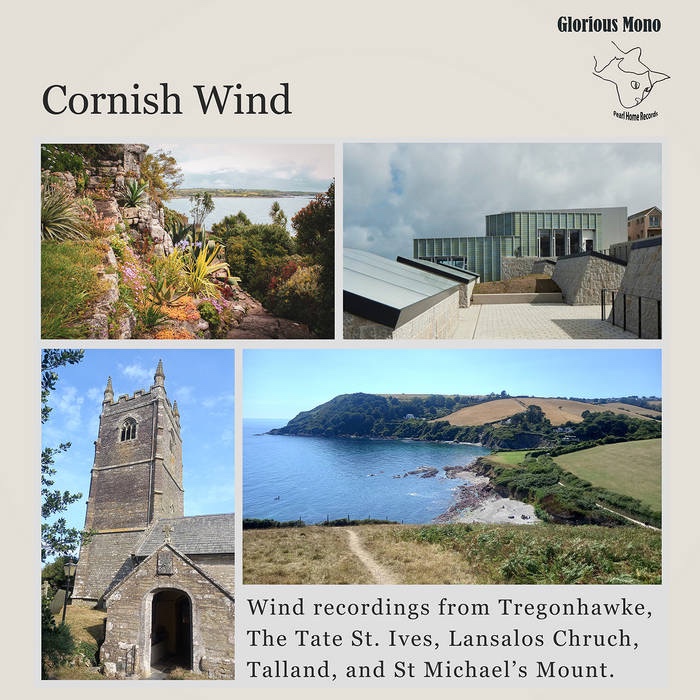
PEARL HOME RECORDS – CORNISH WIND (Pearl Home Records)

Several decades ago, this type of vinyl record wouldn’t have seemed out of place. While hanging out in my friend Steve’s record shop (Junkwax) in Penzance at the weekend, I alighted upon Sounds Of West Cornwall, a 1970 LP from the defunct Cornwall-based Sentinel label, which included various field recordings made in the westernmost part of the county, as well as arrangements of traditional songs. This lathe cut 7-inch looks like it could very well be one of those old Sentinel LPs, and includes recordings of wind made at five locations – Tregonhawke Beach, Tate St. Ives, St. Ildierna’s Church in Lansallos, Talland and St. Michael’s Mount off the coast of Marazion. As most field recordists will tell you, recording breezes and gusts of wind is fraught with problems, but Cornish Wind contains wonderfully tranquil, yet dramatic, sonic postcards of fairly typical Cornish weather. Easy, breezy. Released 18 January 2024.

VARIOUS ARTISTS – TFL VOL 1 (Moolakii Club Audio Interface)

I remember talking to Neil Stringfellow (Audio Obscura) as he was about to head to London to record sounds on the Elizabeth Line for this compilation, curated by Chris Bullock (Bone Music). When Stringfellow returned, he commented on how incredibly quiet and airy the line and its stations were. That quality feeds into his piece for TfL Vol 1, which is full of peaceful silences and unhurried rhythmic moments. The Elizabeth Line is, however, an enigma. Most of the Undergound is old, cramped and noisy, and that can be heard best on pieces like Moray Newlands’ edgy ‘176 Seconds’ and Looptronica’s cloying ‘Bakerloo Line’, where the clamorous abundance of captured passenger voices over a thudding techno pulse approximates a fairly typical trip during rush hour. Elsewhere, Stoltz’s ‘Central Undersound’ has a sort of industrial, symphonic quality, not unlike Laibach busking in a carriage of a Central Line train after a late night recording session at Guerilla for Nova Akropola. Released January 24 2024.

LETTERS FROM MOUSE – CLOTA (SubExotic)

Clota is a welcome return for Edinburgh’s Steven Anderson (Letters From Mouse). Very much a continuation of his focus on Scottish topographies and mysteries that began with An Garradh and the Robert Burns-focused Tarbolton Bachelors Club, Anderson’s focus here is the mythical Celtic goddess Clota. Believed to be the goddess of the River Clyde, that gives the seven enveloping modular synth pieces on Clota a beautiful flowing fluidity. In pieces like opening track ‘Frogspawn’, Anderson taps into a sense of wispy ephemerality, as if highlighting the way that the goddess Clota has become largely forgotten as time has passed. The key track here is ‘Bowling Greens And Tennis Courts’, featuring birdsong, footsteps and other field recordings alongside fragile reverb-drenched melodies. Released 26 January 2024.

Words: Mat Smith

(c) 2024 Further.

Tracks: Letters From Mouse – Tarbolton Bachelors Club

Tarbolton Bachelors Club is the latest album from Edinburgh’s Steven Anderson (Letters From Mouse). The follow-up to 2021’s An gàrradh, which drew its sound architecture from Anderson’s back garden, Tarbolton Bachelors Club again finds Letters From Mouse exploring localities. This time the connection is between the country park of Polkemmet near Whitburn and the village of Tarbolton, the common thread being Scotland’s Bard, Robert ‘Rabbie’ Burns.

The Polkemmet estate was acquired by the Baillie family in 1620, establishing a country house there which eventually became a hospital in the Second World War used by Polish soldiers escaping the Nazi occupation of Poland. The house was demolished in the 1960s but its grounds – including its mausoleum – were re-established as a country park.

Anderson included a track named after Polkemmet on 2020’s Proto Human. “The atmosphere in Polkemmet Country Park is pretty special, the history of the place is palpable and my family spend a fair bit of time there,” says Anderson. “I used to play at Polkemmet as a kid, and I was always mucking about in the river, sailing boats and stuff. I was too young to know or appreciate the history of the place and it’s only recently that I have really started to realise it’s significance. The atmosphere in the park is magical, especially in the woodland and it’s this I have tried to tap into with the music on Tarbolton Bachelors Club. I use a modular synth setup, which I think this can sound very organic, atmospheric and emotional. It’s perfect for a project like this.”

The album is named after the club, founded in a small thatched house in the village of Tarbolton, that appointed Burns as its first chairman when it was formed in 1780. Burns was then an unpublished poet and the bachelors’ club was intended as a place for local single men to come together, talk, dance and debate the issues of the day. The Tarbolton group would go on to inspire many Burns Clubs around the world, its membership observing one founding rule that stated members were not permitted to acknowledge the existence of the club, where masonic virtue was pre-eminent. In keeping with other lodges or clubs, the Tarbolton club issued ‘pennies’ to mark initiations or to celebrate members.

“The Masons are something I don’t know much about to be honest,” admits Anderson. “I can remember being in a hotel bar near Stranraer 20 years ago and the owner mentioned the Tarbolton Penny. At the time I had no idea what he was talking about but for some reason it stuck in my head. I remembered this when researching Burns for the album, and I even ended up buying a Tarbolton Penny on eBay.”

Anderson’s music is well-suited to exploring these sorts of narratives, something that shone through brightly on An gàrradh. “I’m definitely a bit old school here. I dislike the whole streaming culture and one-off songs or singles. I like to listen to an album from start to finish and a good story helps, I think. Telling that can be more challenging with instrumental music as opposed to using singing and lyrics which spell it out for you. Having a theme or concept just feels right to me.”

That being said, diving into the legacy and importance of Burns felt a little risky to Anderson. “I wasn’t sure how cool it would be,” he says. “However, I avoided bagpipes and Dan from Subexotic didn’t use any tartan in the artwork! I really only started to appreciate Rabbie later in life, and when I was putting this album together it has been amplified considerably. I’ve started to see what an impact he has had, not only in Scotland but across the world. Not bad for a cheeky chappie who was fond of the ladies.”

Stephen Anderson’s tour through the Tarbolton Bachelors Club

Elizabeth

“Elizabeth Bishop (1785 – 1817) was Robert Burns’ first child, conceived during an affair with Elizabeth Paton. Elizabeth married John Bishop, factor to the Baillie of Polkemmet and I believe they lived in Halfway House which is situated on the edge of the estate grounds.”

NS92476494

“This is the grid reference for where Polkemmet House used to stand. The footsteps you hear at the beginning and end of the track are me and my daughter walking to that exact spot.”

South Church Beastie

“Elizabeth is buried in the grounds of this church in my home town of Whitburn. The first building here was in erected in 1658 and has had repairs and extension. The reference to ‘Beastie’ links to the famous Burns poem, ’To A Mouse’.”

Tarbolton Penny

“Burns lived for a while in the Ayrshire town of Tarbolton which is where he founded the bachelors’ club, just before his works started drawing attention. At this club he entered into Freemasonry. In orders such as the Masons, tokens – also known as pennies – were issued for a variety of reasons including signifying a pivotal part of the mason’s initiation, celebrating a particular mason, or as proof of membership to a lodge.”

Stephen Anderson’s Tarbolton Penny

Trefoil

“Following the war Polkemmet House became Trefoil School and was run by Girl Guides movement. The school was opened by the Queen Elizabeth (then Princess Elizabeth), who later became the school’s patron. The school moved to Gogarburn which is just outside Edinburgh. After its time as a school, the house was used by the Scottish Police College.”

Cordiality

“Contrary to the pictures in your mind that the term bachelors’ club may generate, the one started by Burns was a civil affair where gentlemen debated the latest issues of the day and learned to dance – all without alcohol. It all sounds most cordial.”

Lily Bonie

“Expressing warm tenderness to his love-begotten daughter and welcoming his child, Burns wrote the following lines:

Welcome! lily bonie, sweet, wee dochter,
Tho’ ye come here a wee unsought for,
And tho’ your comin’ I hae fought for,
Baith kirk and queir;
Yet, by my faith, ye’re no unwrought for
That I shall swear!…
Lord grant that thou may ay inherit
Thy mither’s person, grace, an’ merit,
An’ thy poor, worthless daddie’s spirit,
Without his failins,
‘Twill please me mair to see thee
Than stocket mailens…”

Candles

“Burns was a known romancer and there is nothing more romantic than candlelight.”

Element C6

“Carbon has the symbol C and the atomic number 6. Coal contains mostly carbon and it’s with coal that our connection to Polkemmet lies. The National Coal Board, who operated many coal mines in the area, bought Polkemmet House. My father was a miner back in the day. He hated it, and it was dangerous dirty work indeed. There is no getting away from the historical importance of coal in this area.”

A Man’s A Man For A’ That

“This track was added after the album had been completed. I’ve been working on a project with my brother-in-law Martin Gibbons, who happens to be a really talented musician and singer. I asked Martin if he’d like to record a reading and I was thinking that I could sample it and use it somehow. I liked what he did though so set about adding some music as backing and I thought it worked really well. I think it does a great job of rounding off the album. It’s brilliant to have family involved and hopefully it’ll be a nice thing to look back on in years to come.”

Interview: Mat Smith

Tarbolton Bachelors Club by Letters From Mouse was released January 28 2022 by Subexotic.

(c) 2022 Further.

Letters From Mouse – Watching

Music for post-humanity: Watching is the follow-up to Edinburgh electronic musician Steven Anderson’s Proto Human, described by its creator as a casual surveying of the end of civilisation either through technology or a virus. Proto Human was released in February of this year, just as the world was lurching toward who knows what thanks to COVID-19, and where technological dependency was suddenly a reality for all of us if we actually wanted to stay connected. 

Watching imagines what comes next. This is an album of wide-open spaces, unhurried melodies and a serene, almost soothing sense of realism and perspective. Its purview is the notion that what is going on with the human race can’t be all that there is out in the galaxy, that life must exist somewhere beyond our understanding. The effect is to give tracks like the corporeally-minded ‘Blood And Bone’, the mystique-heavy ‘In The Corner’ and the questing ‘Helix Nebula’ a feeling of discovery, the use of vintage-sounding electronics evoking some of the earliest electronic music. 

There is a feeling of weightlessness to some of these pieces, while others suggest a weight being lifted from your shoulders. Beats drift into view gradually, pads ebb and flow around you like healing waves of cathartic sound, and melodies eddy and spin with grace and evanescence. Pieces like ‘1420 Megahertz’ and the haunting ‘Stars Went Missing’ are draped in foggy layers of thick reverb, meaning that when strident synth patterns and a crisp electro beat creep into view they are never presented aggressively, reinforcing a sense of expansiveness and wonder. 

Amid the most harrowing global events we hope to witness in our lives, Anderson has created an album that takes a step back and tries to focus its electronic attentions on far greater concerns through the lens of an almost scientific enlightenment. The thirteen tracks here are dominated by a stateliness and an unhurried, slowly-evolving sense of purpose, one that asks us to look skyward, away from the trials and tribulations of a virus-ravaged Earth. 

Watching by Letters From Mouse is released October 30 by Music Is The Devil. 

Words: Mat Smith 

(c) 2020 Further.