
The late Finnish composer Osmo Lindeman (1929 – 1987) is rarely mentioned when surveying the history of electronic music. Largely unheard outside of his native Finland, Lindeman was nevertheless a pioneering proponent and theoretician whose contributions we can now fully appreciate thanks to Sähkö’s career-spanning compilation.
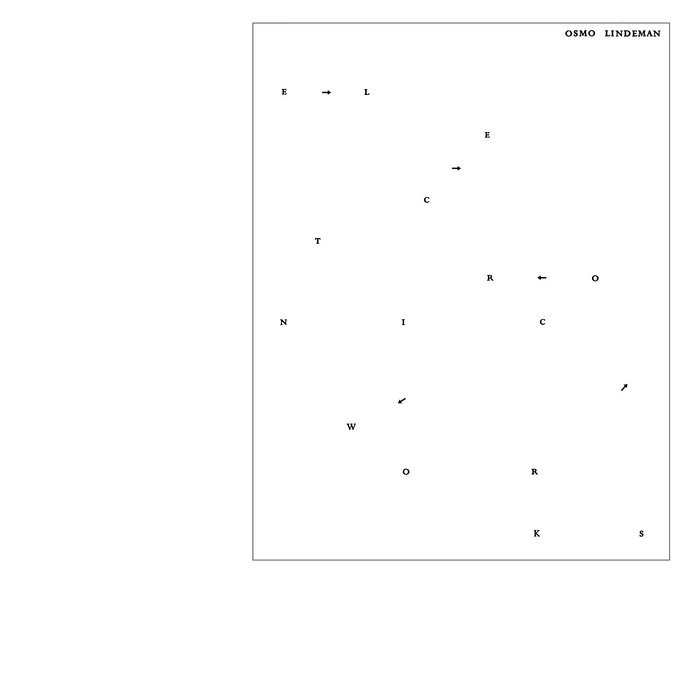
Lindeman was originally a jazz pianist who pivoted to avant garde composition, but who ultimately became frustrated with the challenges orchestras faced when attempting to interpret graphic scores like the one used for ‘Variabile’ (1967). He forcibly separated himself from orchestral composition in 1968 because of those unresolvable irritations, and took a trip to Poland to hang out with electronic composer Andrzej Dobrowolski at the Warsaw School Of Music. That experience led to Lindeman resolving only to work with nascent electronics thereafter, not least because it meant he no longer needed to rely on any other musician to respond to his musical vision than himself.
In 1969, Lindeman took delivery of a bespoke early digital electronic instrument designed for him by Erkki Kurenniemi. Dubbed the DICO, the instrument included a digitally-controlled sequencer-oscillator which was extremely rare for its time, and which meant that Lindeman’s embrace of electronic music could be achieved significantly more efficiently than those working with simple oscillators and tape that preceded him. That’s not to say that he didn’t make use of tape – a 1969 piece included here, ‘Mechanical Music For Stereophonic Tape’, shows that he also worked with the medium – but for the most part it was the DICO that became Lindeman’s tool of choice. Later, he would add the more commercially accessible Moog and EMS VCS-3 synthesisers, but the earliest pieces showcased on Electronic Works all relied on the instrument that Kurenniemi developed for him.
The two earliest pieces, ‘Kinetic Forms’ and ‘Is This The World Of Teddy’ both date from 1969, just after Lindeman had taken receipt of the DICO. Divided into movements, these pieces arrange rapidly-pulsing tones and arpeggios into various formations. Those clusters are alternately pretty and insistent, full of vibrant energy and motion, but focused and regimented. The designs of those earliest pieces are offset by 1970’s ‘Midas’, whose first half seems to be an exploration of white noise manipulations, while its second half approximates a wobbly, unpredictable Theremin-style howl. ‘Tropicana’, also from 1970, seems to swing with a jazz sensibility presumably deeply rooted in Lindeman’s musical DNA, even if the tools of expression are grids of gently swaying tones.
Some of the most interesting moments across Electronic Works come with Lindeman’s commercial work, specifically soundtracks for TV ads like Sunkist and Fin-Humus and his work for the Finnish National TV News. These pieces pop and fizzle with a sense of positive futurism, the music for the Sunkist ad in particular standing out for approximating bubbles bursting in a carbonated drink.

The collection also includes ‘Ritual’ (1972), one of the few Lindeman works ever released during his lifetime, originally appearing on the 1978 Suomalaista elektroakustista musiikkia LP, alongside pieces by Jukka Ruohomäki and Jarmo Sermilä (note to Sähkö: please make this a future reissue project!). It was a piece that should have raised Lindeman’s creative profile immeasurably, since it was awarded the Electronic And Computer Music prize at 1972’s International Musical Composition Contest. By the time of ‘Ritual’, Lindeman’s sonic palette had expanded to include standalone oscillators, a ring modulator, filter, noise generator, echo unit and tape machines, the latter most notably deployed on the eerie, manipulated, Monk-like voices that dominate the first part of the recording.

Although he continued making music – most notably with the commission of ‘Spectacle’ by Yleisradio Oy (the Finnish Broadcasting Company) in 1974 – Lindeman threw himself into academia, teaching electronic music at the Sibelius Academy in Helsinki and spending time at the University of Illinois and Columbia in New York. The latter placement offers the very strong likelihood of interactions with the Columbia-Princeton Electronic Music Center’s Vladimir Ussachevsky and Otto Luening, creating a bridge between electronic music’s accepted history and someone deserving of much more than a mere footnote mention.
Compiled from Lindeman’s private tapes, the beautifully-executed Electronic Works is an essential investigation into his largely unknown legacy in the development of electronic music theory and practice.
Electronic Works by Osmo Lindeman was released December 1 2023 by Sähkö. With thanks to Duncan.
Words: Mat Smith
(c) 2024 Further.
 Further.
You must be logged in to post a comment.