Two new releases from the anonymous and prolific Xqui highlight two different sides to the artist behind the mask – the noisy fan of processed found sound, and someone drawn to more melodic concerns.
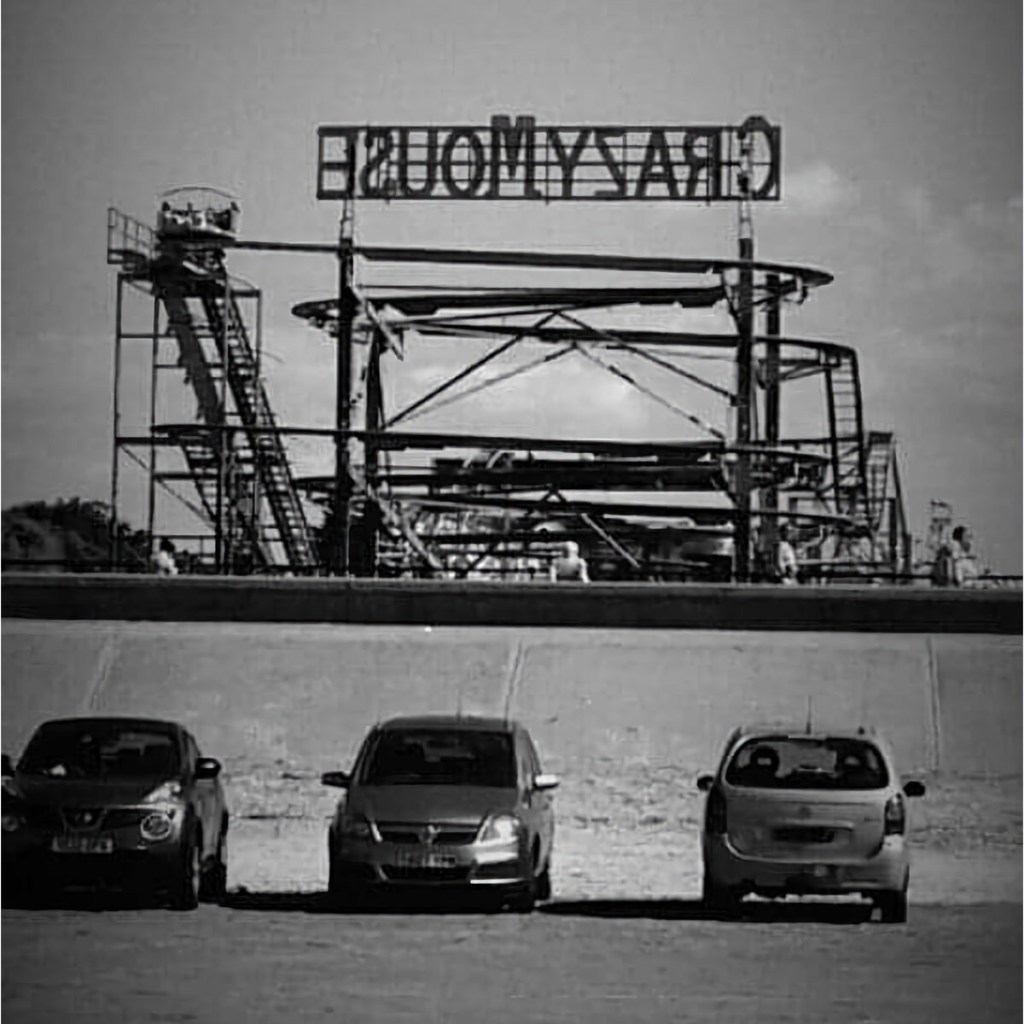
Laying A Pipeline seems fully in thrall to Depeche Mode’s 1983 album, and explores Xqui’s fascination with field recordings. The primary source material for this, hence the nod to Construction Time Again, was a building site on the industrial estate where the mysterious Xqui holds down his day job (presumably in his mask, much to the amusement of his co-workers).
It’s an homage, of sorts, to the Depeche album, but also to the overall act of opportunistically making field recordings and then manipulating them into new shapes which render their source fairly unknowable. I guess that’s allegorical to what happens on a building site, where an empty space is transformed into something with definition and purpose.
‘Service Dust’ is the standout here, for no other reason than it shows Xqui at his manipulative best, building a weird and alien sound world out of heavily-disguised voices and what sounds like hissing steam from a dystopian Metropolis factory production line. If this had been the 1960s, someone would probably had this banned for containing subversive, mind-controlling messages.
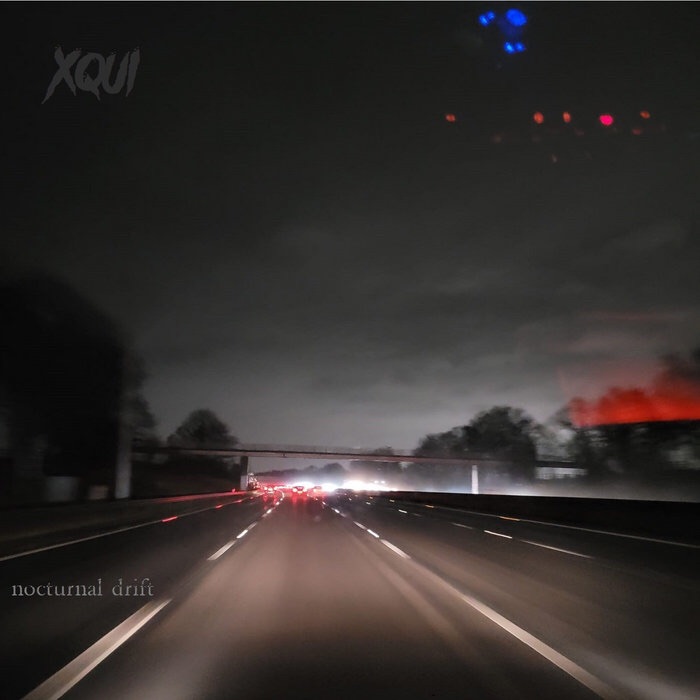
And then there’s Nocturnal Drift, for which I was going to use the adjective ‘noir’ because of its evocative, Lost Highway-esque sleeve photography. Only that was me being lazy and I hadn’t even heard the album at that point (yeah, yeah – never judge a book by its cover etc etc). Instead, this finds Xqui in the same general vicinity of his Vince Clarke-tipped Hymns album.
Quite where Xqui sourced the sounds from here is, like everything he does, somewhat unclear, however it is presented as a melodic, often classically-minded suite, occasionally joyful and frequently contemplative. The centrepiece is ‘Progressive Modernism’, which runs for an epic 28 minutes and, despite very little fluctuation in its short looped sound, never seems to run out of steam. It rather reminds me of the Philip Glass Buddha Box I zoned out to during the work-from-home-torture of the 2020 lockdown.
It also reminds me of hours spent staring at Mark Rothko’s bleak Four Seasons series of paintings at Tate Modern until they moved them someplace else. Like Rothko’s impenetrably dark canvases, the conceit is the level of detail that reveals itself under close examination and intense focus. The pace of ‘Progressive Modernism’ may be hesitatingly slow, but there is extreme restlessness and volatility in its myriad surrounding textures.
I hate to call this profound, as that might give Xqui a big head. In turn, that would require him to buy a bigger mask. In spite of those concerns, I can think of no better or more fitting word to describe Nocturnal Drift.
Laying A Pipeline was released April 3 2026 by Eustress Tapes. Nocturnal Drift will be self-released on April 30 2026 through xqui.bandcamp.com
You arrive at a nondescript doorway on Church St, near the triangular intersection with 6th Avenue.
Photo: Mat Smith
Behind a glass pane lined with black diagonal veins is tacked a piece of paper advertising Dream House. A scrappy note taped next to a buzzer on the left of the door gives you instructions to press button 3 for access, and advises that you might have to wait. It also expressly asks you not to press button 2 as it is a private residence. That private residence belongs to La Monte Young and Marian Zazeela, who have lived here since 1963, and who installed Dream House, in the third floor loft above their apartment, following its installation in other locations since it was first developed in 1969.
You ring the buzzer and wait. Nothing happens. You ring again. Still nothing happens. You phone a number on the poster and a laconic female voice eventually answers in a quiet, measured tone, there’s an abrupt mechanical buzz accompanied by a click and the door is unlocked.
As you enter the narrow stairwell, you become aware of an intense, oppressive, tantalising, seductive bass-heavy sound. It feels like you’ve entered a nightclub. There is a feeling of energy. Of promise. Of excitement. Of things about to happen. The sound seems to draw you in. You can’t make out the details fully, almost as if the sounds have been intentionally shrouded or obfuscated.
You ascend the stairs to floor 3 and make small talk with the monitor whose gently musical voice was your key to being permitted entry. She notices your English accent and informs you that there’s a version of Dream House in Germany. You take off your shoes, put $10 in a receptacle that the monitor points at wordlessly, and enter a white-painted door near the top of the stairs.
As you open the door, you first notice the intensity of the volume. It is so immediately overpowering that your body feels both repelled and attracted by its force. As the door closes softly behind you, you feel completely enveloped. You turn left, toward a square room at the end of the passageway. A multicoloured neon sign on the ceiling bears the words ‘Dream House’. This is Zazeela’s Dream House Variation I light sculpture.
A fellow guest, seated on a cushion in the main gallery, turns her head as you approach, even though your shoeless movements are barely detectable. You softly pad along the carpeted corridor to the square room and seat yourself against the wall immediately to the left of the entry way.
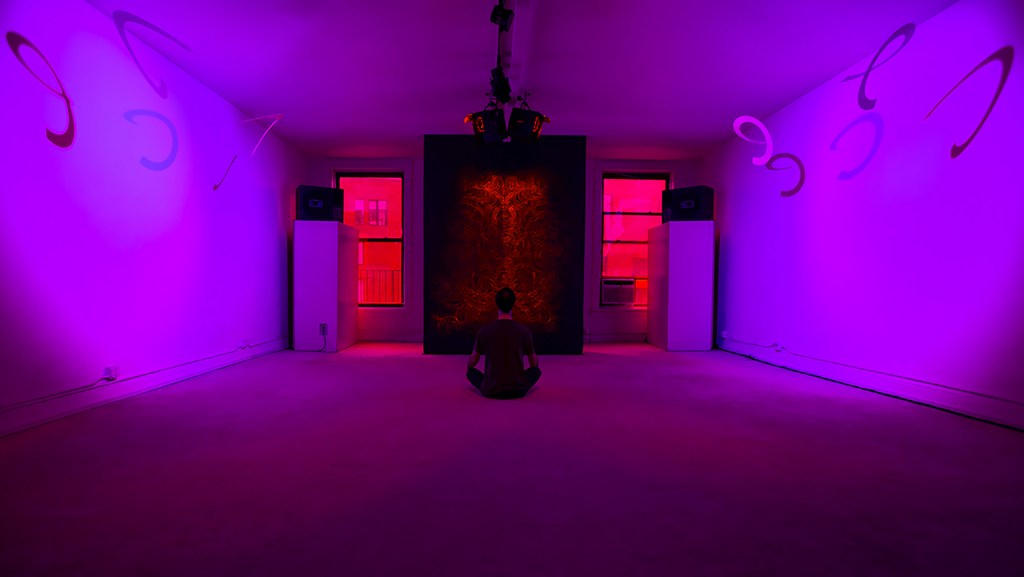
The whole room is bathed in a pink light and infused with the smell of incense. Spiralling crescent shapes are suspended from the ceiling, swaying gently and imperceptibly and bathed in lights from a series of spotlights. Together, the mobiles and lights form Zazeela’s Imagic Light, while the atmospheric pink lighting is itself another Zazeela artwork, Magenta Day / Magenta Night.
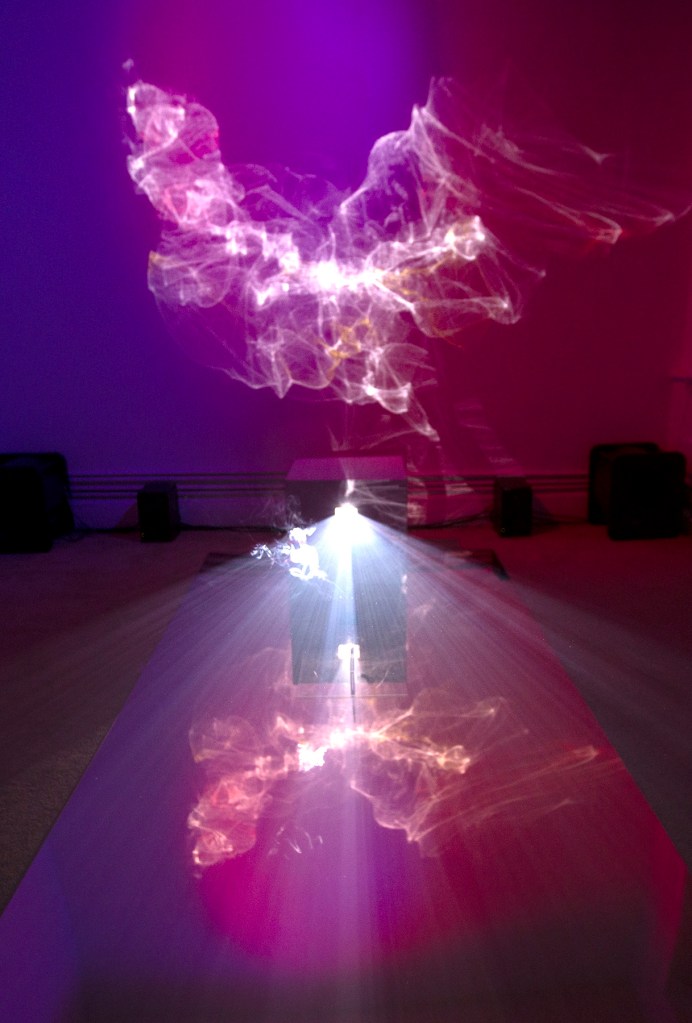
Between the two covered windows is a freestanding rectangular object containing a pattern that seems to move elusively as you try to decode it, comprising tiny details picked out with either LEDs or which reflect the coloured lights on the ceiling. Sometimes the pattern looks like a bear. Other times it is formless, spiralling, elusive shapes that writhe and twist like the crescent mobiles above. This is Jung Hee Choi’s Light Point Drawings Nos. 27, 28, 29 and 30 with still lights. A framed photograph of Pandit Pran Nath, Young’s and Zazeela’s guru, hangs on the opposite side of the room, next to the entrance. A bowl beneath it on a table may or may not contain the incense you can smell. Elsewhere, there is a photograph of Ustad Abdul Wahid Khan, a singer and teacher, whose students included Nath.
There are four tall white rectangular columns, each one occupying a corner of the room, with a large speaker placed on its top. The speakers are trained diagonally toward the centre of the carpet. It is from these that the intense sound is projected. The sound piece is Young’s The Base 9:7:4 Symmetry In Prime Time. Or, to give it it’s full title, The Base 9:7:4 Symmetry in Prime Time When Centered above and below The Lowest Term Primes in The Range 288 to 224 with The Addition of 279 and 261 in Which The Half of The Symmetric Division Mapped above and Including 288 Consists of The Powers of 2 Multiplied by The Primes within The Ranges of 144 to 128, 72 to 64 and 36 to 32 Which Are Symmetrical to Those Primes in Lowest Terms in The Half of The Symmetric Division Mapped below and Including 224 within The Ranges 126 to 112, 63 to 56 and 31.5 to 28 with The Addition of 119.
It is many things all at once. There is an obvious droning quality to the sound, but it is impossible to detect any distinct, discrete layers. You try to hear the intersections and anticipate the microtonal collisions, but it is impossible. You settle into the sound. You breathe deeply and listen both intently but also lightly.
After a while, it seems that distinct motifs appear within the sound. A sort of metallic, industrial ringing emerges out of the otherwise impenetrable bass envelopes, which you begin to recognise as a rapidly oscillating pulse rather than a block of held tones. You move your head slightly and the whole sonic image shifts and changes. Now a repeated, drum-like rhythm reveals itself. You move your head again, shift your position against the wall and it vanishes, leading you to conclude it possibly wasn’t ever there. You turn your head again and a new rhythmic device seems to appear. New frequencies which you’re sure weren’t there before seem to scream loudly.
Outwardly, nothing about this is serene. The sound rings uncomfortably in your ears. The relentless bass sits on your chest like a heavy weight. As I lean against the wall I can feel the vibrations in my spine. One of the other temporary residents of Dream House stands up, gathers her belongings and walks past you toward either the door or the smaller room at the other end of the corridor, which contains another light installation, Color (CNN/Twitch): live realization v.2, and a sound piece, The Tone-field: perceptible arithmetical relations in a cycle of eight Indian raga scale permutations, 23 IX 23 – 24 VI 20, New York, both by Choi.
As she moves past you, the departing temporary resident seems to abruptly cause the sound to change, as if she has disrupted the entire balance of the air hosting the sound waves as they cluster tightly in the centre of the room. Someone else decides to leave. The same thing happens again. You now know why your arrival prompted someone to turn their head: you have unintentionally created an interruption and, whether illusory or not, the sound seems to have adjusted itself to another surface to be both absorbed and deflected by.
And yet, while its intensity might be, at all times, cloying and extreme, you find yourself strangely comforted by it. I stayed there for around an hour. I was becalmed and also changed, in ways that I have only ever felt through meditation, experiencing a particularly visceral piece of art, or when I’ve performed John Cage’s 4’33”. My senses seemed suddenly sharper. Details that I hadn’t noticed before became more pronounced. Everything seemed at once more vivid, more colourful, more real. In short, I felt completely and utterly alive.
You leave the loft, pausing in at Choi’s works in the smaller East Gallery. The discordant collision – or maybe symbiosis – between Choi’s The Tone-field and Young’s The Base 9:7:4 Symmetry In Prime Time is discomfiting and unsettling, but also energising.
You descend the narrow stairs with the post-nightclub throb ebbing away behind you, and push the door open onto Church Street. You half expect to be suddenly drowned out by the harsh sonic savagery of Downtown Manhattan as Friday evening gets underway. You are reminded of a quote about New York from Giovanni’s Dream by James Baldwin: “There’s such power there – everything is in such movement.”
Except that it wasn’t like that at all. New York seemed strangely muted, its volume dulled, its lurid lightshow dimmed manifestly. It was as if Dream House had out-intensified New York’s intensity, either through force, volume, or more than likely just the way it had given you an enlarged and heightened sense of perspective.
As you walk down Church toward Canal, you stop, turn and glance back at the nondescript doorway and the building that it sits within. There is nothing remarkable there. It is an elegant loft building among many elegant loft buildings, barely distinguishable and possibly illusory. You look for the covered windows on the third floor but can’t make out anything obvious at all. The hum of traffic, sirens and conversations hide any trace of the sound uncoiling ceaselessly and so intensely behind that doorway. People walk past, fully oblivious, unaware, unbothered.
As you head back uptown, dealing with the serial interruptions of mistimed traffic intersections and Baldwin’s depiction of power and movement, you start to doubt that you were ever actually there. But then you notice echoes of Dream House sounds everywhere, wherever you turn, as if it was simply an amplified version of everything you experience every day in New York.
You smile, breathe, and walk on.
With thanks to Jung Hee Choi. This visit to Dream House took place on 9 February 2024.
a collaboration between visual poet Andrew Brenza and sound artist Alka
released today
“So many machines alive and singing in a single room…”
A new release from Mortality Tables, the collaborative project of Further.’s Mat Smith. Out now at mortalitytables.bandcamp.com
‘pod’ by Andrew Brenza (2023):
“Over a period of several months in the winter of 2022, a nameless entity, via manipulations of entangled particles across time, or pods, as they referred to them, transmitted an expressive model for the development of an eternally sustainable utopian consciousness into the plastic architecture of the author’s dreams. ‘pod’ is the visual-textual record of those transmissions.”
‘pod’ is published by ghosTTruth, an imprint of Montag Press (montagpress.com)
CREDITS
Words, narration and design by Andrew Brenza Sounds by Alka Mastered by James Edward Armstrong
Yifeat Ziv is a Jersulem-born, London-based sound artist who won one of the six coveted prizes at this year’s Oram Awards. With a practice focussed primarily on the use of voice, Ziv’s works include 2019’s Rish Rush, based on the prevalence of onomatopoeic gestures in all languages, performances at Café Oto, a collaboration with David Toop on his recent Apparition Paintings album, and sound installations at numerous galleries in Israel and the UK.
Amazonian Traces Of Self, Ziv’s latest work, arose from a ten-day AER Labverde residency in the Brazilian rainforest last year. For the piece, Ziv undertook a series of excursions into the rainforest, making field recordings of the natural ambience and capturing her own vocal improvisations, both of which are combined together into this thoughtful composition, here presented as a seventeen-minute live piece recored at Iklectik in January of this year, but which also has a parallel existence as a sound installation (The Echo Of Our Breath). The CD release is accompanied by an essay, designed to be read after listening to the piece.
If you are remotely environmentally-minded, any mention of the rainforest should, by rights, bring to mind the progressive deforestation and devastation that the natural landscape has endured as a consequence of humankind’s progress; whether for repurposing as land for rearing cattle or for growing the so-called ‘sustainable’ soya beans that propel the world’s biofuel hopes, the rainforest has decreased in size at a phenomenal rate – over 50% over the last 60 years.
By focussing its initial attentions on the natural sounds of the environment, the piece prompts complex emotions. There is a sense of tranquillity and serenity, but it also feels strangely unsettling, like a creeping sense of impermanence that coincides with Ziv’s reverberating vocal interjections – breath, a sort of staccato passage, tremulous, quivering passages and almost bird-like calls. These sounds feel alien, like they have no place in this location, something that Ziv describes as “vocal pollution”, an allegory for the way we have encroached upon, and starved, the Earth’s lungs. A middle section of wailing voices sounds like a desperate, mournful elegy to what is lost, what cannot be replaced and that which we have caused.
Yet as the piece progresses, Ziv’s layered vocal sounds take on a different hue. They feel curiously natural and optimistic, sitting in balanced evenness with the natural sounds that she is vocalising over. We start to feel a symbiosis between her sounds and those around her, almost as if she is gently reminding us of our dependency on this place, of how we can live in harmony with these spaces. A sense of optimism begins to emerge, a feeling that all is not lost, that our devastation of a place upon which we all depend for our live-giving oxygen is not yet entirely irreversible.
Amazonian Traces Of Self by Yifeat Ziv is released November 17 2020 by Flaming Pines – flamingpines.bandcamp.com
It’s 6am on a balmy New York morning in October 2017; Reed Hays, one half of Reed & Caroline, is leading me to a specific section of Times Square. On the way, he tells me what the area was like when he lived nearby in the late 1980s, a time when this part of the city was shorthand for a gaudy seediness, bordered by low-rent porn cinemas and XXX-rated video stores, with pickpockets and scammers taking advantage of the tourists that have congregated at the intersection between Broadway and Seventh Avenue for over 100 years.
Our destination is an unmarked, nondescript triangular grate between 45th and 46th streets, covering a ventilation shaft from the subway tracks running just below the street. Unimpressive it may be, but it is the location of what may well rank among the most frequently-visited works of art on the planet, even though the vast majority of those visiting Times Square have no idea that it’s even there. This is Max Neuhaus’s Times Square, originally – and appropriately – titled Underground Music(s). Neuhaus installed his most famous piece of sound art here in 1977 after four years of back and forth with New York’s transit authority, and it ran continuously, 24/7, until 1992; it was restored and activated again in 2002, and has again run uninterrupted ever since*.
Neuhaus was no stranger to New York’s art world in 1977, and neither was he an unknown in the field of sound. He had started out as an avant garde percussionist, realising definitive versions of pieces by Karlheinz Stockhausen’s Zyklus and moving on to embrace electronics for a recording of John Cage’s Fontana Mix. By the mid-60s he had moved squarely into the domain of sound art, creating pieces like Fan Music (1967) on rooftops in the Bowery, where the volume and nature of the sonic output depended entirely upon the prevailing weather, a read across to Cage’s obsession with chance and the I Ching. Fan Music was the first of what Neuhaus would call his Place pieces for their physical and geographical characteristics, and it is within this series that Times Square would become his most prominent work.
“The work is an invisible block of sound,” wrote Neuhaus about Times Square in 1992, just as the installation concluded its first run. “Its sonority, a rich harmonic sound resembling the after ring of large bells, is an impossibility within its context. Many who pass through it, however, can dismiss it as an unusual machinery sound from below ground.” The sound is elusive, varying according to where you stand on the grate, appearing to swell and move toward the periphery of your hearing imperceptibly. With timetabled regularity a subway train interrupts the sound, distorting and confusing the otherwise smooth resonances of the piece.
The sound – a calming, ringing drone, in the manner of La Monte Young and Marian Zazeela’s Dream House works – is a major seventh chord made up of many tiny pulses arranged rapidly in sequence, similar to the work of fellow duration music aficionado Phill Niblock. Hays and I ponder how the sound was made, assuming that for it to have been activated in the 1970s it must have been of analogue construction, though period synths of that time needed a stable electric current to prevent them from going out of tune; precise schematics of Neuhaus’s design aren’t readily available, but we conclude that the subway system must have provided the constant current, which might explain the protracted delay in realising the work, alongside securing permission to use of one of transit authority’s ventilation shafts.
What to make of this work? On the one hand, many critics have celebrated Neuhaus’s desire to democratise art by making something like this available freely to so many; on the other hand, its lack of signage or discernible identifying markings means it remains the exclusive preserve of those in the know, thus making it both anti-elitist and elitist simultaneously; Neuhaus himself wrote about moving from the rarefied environs of Carnegie Hall to Times Square as a way of engaging with the ‘culturally uninitiated’, which doesn’t come across as hugely democratic. He observed the piece almost daily on CCTV and volunteered ways of stopping the area’s many street performers – particularly the guitar-strumming Naked Cowboy (Google at your peril) who was something of an offensive nemesis to the artist – from using the piece as a makeshift stage. Some have drawn a thematic link between Times Square and Cage’s 4’33”, the former being bounded by geographical detail and the latter by temporal limits; one whose sounds can never be allowed to operate among complete silence with the other unable to be anything other than hypothetically silent.
Even at 6am, perhaps the ideal time to experience Times Square, the area crackles with a grim energy and if it wasn’t for the precise navigation skills of Hays, I doubt I would have even found the right grate. The billboards are illuminated, a few dispossessed people drag suitcases to or from red-eye flights, an early morning TV programme is being filmed in full view of a small gathering of people keen to catch a glimpse of whichever celebrity figure is being interviewed – but it’s certainly about as quiet as this place ever gets.
Reed Hays at Times Square, October 23 2017 06:15 (Photo: Mat Smith)
Mat Smith at Times Square, October 23 2017 06:15 (Photo: Reed Hays)
Only a couple of hours later, the area will be flooded with selfie-snapping tourists and modern day scammers dressed in abysmal Sesame Street costume rip-offs, making Neuhaus’s work more or less undetectable unless you happen to tune into it while fleetingly passing through.
Some six months later I found myself doing just that on my way to see Reed & Caroline perform down on the Lower East Side. My only clue to the location of Times Square was the fact that the Naked Cowboy ceased his afternoon performance at the precise moment that I was being carried along by the crowd of awestruck tourists, their eyes raised upward toward the famous neon advertisements, blissfully unaware of the meditative sonic events taking place just beneath their feet.
Words: Mat Smith.
With thanks to Reed Hays, Pidu Russek at the Estate of Max Neuhaus, Dia Art Foundation, Neil Mason and Tin Soldiere. This unpblished piece was originally written for Electronic Sound but was not ultimately published. * At the time of writing, owing to the ongoing COVID-19 outbreak, Times Square is not currently operational (according to the Dia Art Foundation, who maintain the piece), concluding the second run that began in 2002. I Heart NY.
(c) 2018 – 2020 Mat Smith for Electronic Sound / Further.




 Further.
You must be logged in to post a comment.