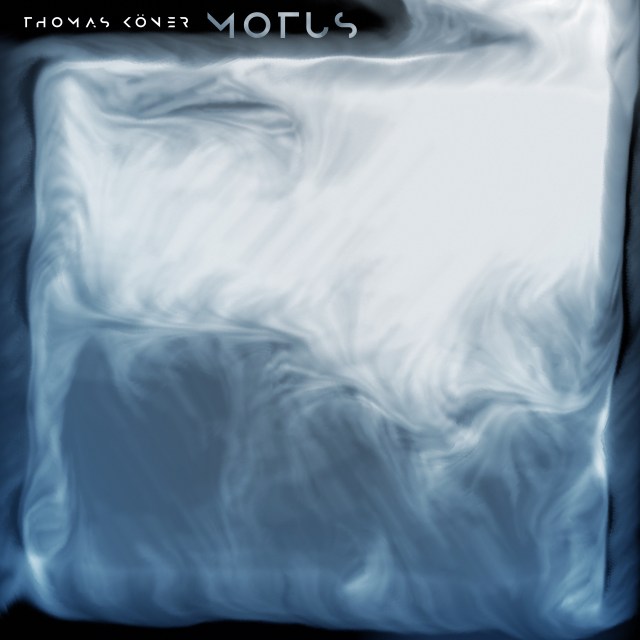
Thomas Köner – Motus

MP6_front.jpg

“I dream of a dance floor where Motus would be enjoyed,” says Thomas Köner. “What kind of society would allow that?”

His ambition isn’t necessarily wilfully controversial or provocative, but it nevertheless underpins a desire to unshackle music from the notion of grids, beats, BPMs and electronic music formalism. Motus is the latest instalment in Köner’s gently subversive approach to analogue synthesis, something I first experienced way back in June 1996 with ‘Untitled’, a track included on a CD given away with The Wire (Miaow! (…Cats What I Call Music)). That track was, on face value, a recording containing virtually nothing, a distant, ephemeral rumble easily overtaken by real life; to experience it, one had to tune everything out, turn it up loud and concentrate very hard. Only then could you hear the rich, undulating turbulence that the piece was actually constructed from. It was loud music, just presented very quietly.

Motus, comparatively, is bold, noisy and restless. Freed from the tyranny of the beat, tracks like ‘SUBSTRATE (Binaural)’ take their forward motion not from an obvious rhythm, but the ebbing waves of a modular sequence, whose pace only alters materially when the waveform is tweaked. The effect is, for those used to hearing music anchored to a pattern of kick drums, hi-hats and snare sounds, mildly unnerving. You want to attach these sequences to a rhythm, even though it’s not there, your inner clock suddenly thrown off track by a subtle modulation here or there.

Strangely, the effect of this – despite being made from nothing more than artificial waveforms and electrical current – is to remind you that nature does not cling rigidly to perfection. Gusts of wind don’t readily adhere to a quantised location on a screen; a bird’s flapping wings are not operating at a consistent BPM; your heart is more than likely not beating at precisely the same pace as it was when you started reading this (it will either have slowed down through disengagement or sped up through the panic of a beat-less musical world). It takes pieces like ‘SUBSTANCE (Suicide)’, and the other six tracks on Motus to make you realise that.

Motus by Thomas Köner is released February 6 2020 by Mille Plateaux.

Words: Mat Smith

(c) 2020 Further.
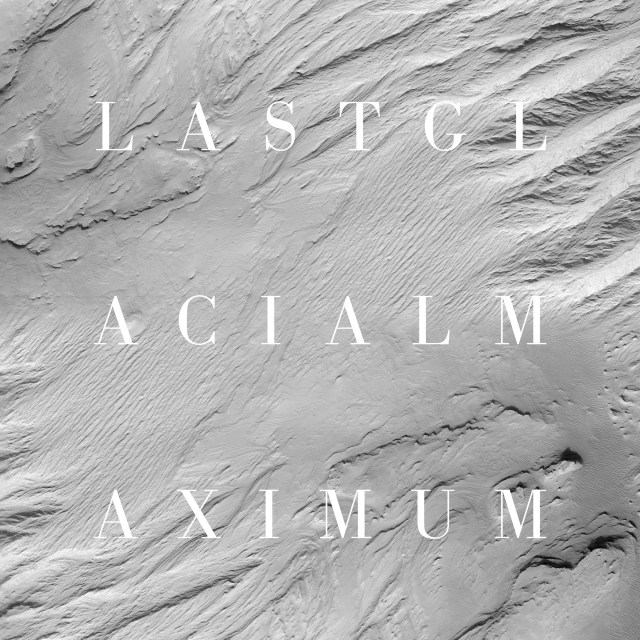
Richard Skelton – LASTGLACIALMAXIMUM

72d0cd62-eda7-4df4-81b1-0825ec841b75.jpg

Richard Skelton’s latest album is a forty-minute evocation of the growth, peak and accelerated thawing of the British and Irish glacial landscapes, presented as a series of eight movements of slow, developing tones that ebb away into quiet murmurs; basically, it’s like Morton Feldman, on ice.

The effect is powerfully disconcerting when heard in the context of climate change and the insistent messages of politician, scientists, protesters about the urgency of the corrective action that might be required to arrest the impact.

Across these movements there is a sense of stillness and calm, but also a slightly dizzying sensation. The precise instrumentation is not disclosed, and one never knows the origins of these long, eddying indeterminate tones and warped, muffled drones; at times it sounds like industrial, metallic noise, while at others we hear what could be an especially mournful, poignant cello, only presented like a vague outline of something that once was, but which can never be again. Sounds drift in and out, like gusts of wind across the arctic tundra, only presented as fleetingly melancholic, and edged with a frosty tension. There is a feeling of isolation, a panic-inducing out-of-placeness, that sensation being all the more remarkable given the levels of nothingness one experiences here.

Your response to music is often entirely situational. For me, I chose to listen to this during the clamour and franticity of a walk three and a half blocks from a hotel in New York to a downtown E train during the rush hour. Something about the slow, ominous passage of the music chimed menacingly with the post-work streetscene of manic Manhattan, a world removed from the subject matter of Skelton’s remarkable work, yet somehow entirely in tune with it.

LASTGLACIALMAXIMUM by Richard Skelton is released February 2 2020 by Corbel Stone Press

(c) 2020 Further.

Evil Gal – Brown Acid / The Village Of Doom

A cassette outing for this 28-minute outburst from Canada’s Evil Gal, originally released digitally last November, here released through the uncompromising Industrial Coast imprint. Evil Gal is an offshoot of New Brunswick’s Women Of The Pore (M Gatling), here with additional sonic architecture from Montréal’s Matthew Donnelly (Fecal Mutiliation).

Both artists have a long pedigree in the world of noise, but ‘Brown Acid’ and ‘The Village Of Doom’ play with a different, slightly more restrained sense of violence, feeling more like a low-budget soundtrack to a particularly vivid video nasty only available through the dark web. ‘Brown Acid’ creeps, prowls and stalks with extreme menace, proceeding on a murky bass sequence over which all manner of sounds – percussion, sax, general unholy disquietude – are overlaid. It’s a thick, gloopy sonic goo that leaves indelible stains on your psyche. In a good way.

‘The Village Of Doom’ is more sparse, though just as freakishly uncomfortable, opening with oscillating sounds like warbling sirens, the hiss of escaping air, distortion, micro-loops of unknown origin and randomised non-rhythms and electronics that sound both chaotic and intricate. Nothing here stays around for long; passages are cut off just as they start to become repetitive, engendering a queasiness and rapid motion that means its fourteen minute duration nonchalantly zips by before ebbing away into surprisingly pleasant texture.

Brown Acid / The Village Of Doom by Evil Gal is released January 3 2020 by Industrial Coast.

Words: Mat Smith

3 Questions: Matthew Barton

No matter how hard I try, no description of Rugby multi-instrumentalist Matthew Barton’s latest single ‘Orchid’ is going to get anywhere close to his own: “‘Orchid’ was inspired by Prince minimalism and the Casio organ sound of the Young Marble Giants,” he advises. “I wanted to write something simple and direct. I think of it as like Prince having a baby with a Georgia O’Keeffe painting at a video game arcade. Or something.”

If that sounds brilliantly odd, it’s because it is. Driven by layered, sparse preset rhythms and a shimmering keyboard melody as hypnotic as it is absent, the vast empty spaces of the music act as the perfect setting for Barton’s distinctively impassioned, soulful vocal. There is tender anguish writ large here, spliced together with a vulnerability heralding the arrival of a singular musical talent.

Matthew Barton is working on a cassette release for Knife Punch Records that is due for release in the Spring. In the meantime, Barton talks to Further. about almost drowning and getting stuff done. Listen to ‘Orchid’ below.

What is your earliest memory?

Probably being fished out of a swimming pool by my dad, having fallen in, unable to swim. That wasn’t the last time that happened either. Maybe I can trace my fascination with water back to that moment.

What’s the best piece of advice you’ve been given?

As a serial procrastinator, “You will never feel like you are ready – so just do it,” is useful and motivating. I’m trying to get better at that this year. Isn’t adulthood all about just pretending you know what you’re doing anyway?

Where are you most productive or inspired?

I find that new places, and new instruments, tend to spark ideas.

I have a lot of random voice memos on my phone recorded in weird places, usually while I’m just walking down streets, probably looking a bit bonkers.

New instruments too – my brother bought me a kalimba for my birthday and I’ve been writing some different stuff on that. You’ve just got to be open to everything around you.

Orchid by Matthew Barton was released January 21 2020.

Interview: Mat Smith

(c) 2020 Further.

Waclaw Zimpel – Massive Oscillations

waclawzempel_massiveoscllations.jpeg

For anyone interest in the rudiments of electronic music, titles don’t come much more thrilling than Massive Oscillations, the name of the second album by Polish multi-instrumentalist Waclaw Zimpel. It is both a perfectly accurate depiction of the structure of the title track’s enormous, ever-shifting undercurrent of snarling, wild, grinding synth lines, and the guiding principle that runs throughout the record.

The album finds Zimpel, an arsenal of vintage electronics from oscillators to tape machines, a piano, his clarinet and a guitar operating in a many-layered excursion into the underexplored territory between the slow evolutions of minimalism, avant-garde jazz and intense electronics. The four tracks were recorded at Willem Tweestudio in Den Bosch, Netherlands over a period of nine days and then mixed by James Holden, a musician who knows more than a thing or two about fusing together jazz and electronics (see his deployment of Ornette Coleman’s harmolodic theory with fellow auteur Marcus Hamblett for evidence).

Both ‘Massive Oscillations’ and ‘Sine Tapes’ deploy a tension between wandering electronics and Zimpel’s clarinet, resulting in something that can – on one level – appear meditative and soothing but at other times presages a dirty, turbulent discordancy. The expressive reed playing could easily be allowed to dominate, but instead it threads noisily through the wavering, oscillating tones that dominate the foreground, only rising to the top when developed into thick, heavy blocks of drones, squeals and resonant melodies.

‘Release’ is perhaps the biggest departure from the sonic architecture used on the preceding three tracks, given that the electronics take something of a backseat, reduced to textural white noise, gentle shimmers and air cylinder hissing. Here we find Zimpel exploring territory not dissimilar to Terry Riley’s In C, repeated motifs for prepared piano, clarinet and guitar quietly developing over the course of its eight beatific minutes. The introduction of heavenly vocals provides the piece with an unexpectedly transcendent, dream-like quality.

Massive Oscillations by Waclaw Zimpel is released January 31 2020 by Ongehood.

Words: Mat Smith

(c) 2020 Further.

OUTLANDS – The Joyous Thing: Secret Flight / BodyVice

Two polar opposite live performances forming part of The Joyous Thing, a weekend of events at Milton Keynes Gallery investigating the UK experimental music scene. The Joyous Thing is part of the nationwide OUTLANDS interdisciplinary project.

Secret Flight is a local MK electronic musician whose current concerns involve fusing reverb-drenched vocals to delicate synth melodies and minimalist rhythms. The result is dreamy, angelic, choir-like voices delivered with a gauzy, hypnotic warmth, only laced with an uncertain quality somewhere between intense rapture and crushing disappointment. Her last album, 2018’s My Forever Mirage is a brilliant and understated gem of an album. Listen to My Forever Mirage at Bandcamp.

BodyVice is the latest project from Natalie Sharp, best known for her audacious, confrontational performances as Lone Taxidermist and as a Gazelle Twin collaborator. For BodyVice, the subject matter is the intense and excruciating back pain that she suffers with, and finds her channelling her experience at the hands of doctors as they seek to identify the cause.

Beginning with a hospital gown-wearing male collaborator’s Irvine Welsh-style delivery of what initially sounds like a misty-eyed recollection of a Speedy J set at a Belgian rave – all intense beats of rising velocity and modulating electronics – it becomes apparent that he is, in fact, describing an MRI scan experience. What ensues is nothing short of unnerving – Sharp (with a collaborator and occasional flautist) rotating on turntables against a backdrop of howling, impenetrable noise to evoke the claustrophobia and unnatural experience of an MRI scan, all frantic, rising rhythms and industrial-strength walls of unending sound.

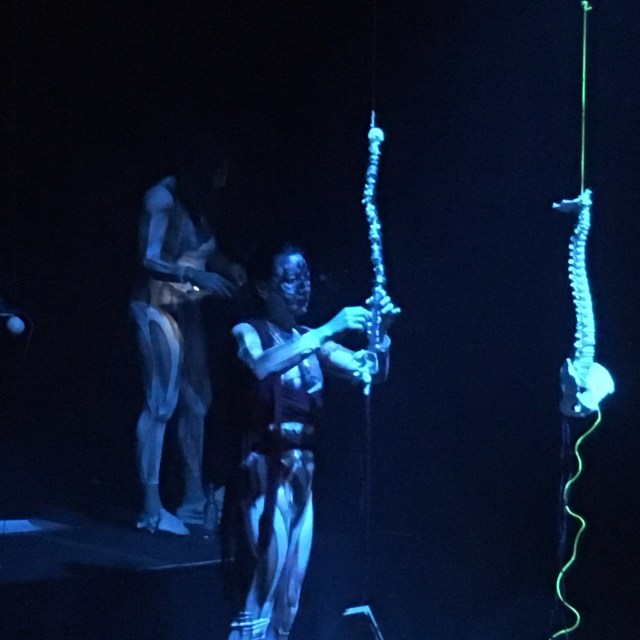
The performance then proceeds through angry lists of precautionary statements from a clipboard waiver, mesmerising sounds and non-melodies played on modified spinal chords (pun intended) designed by Tara Pattenden (Phantom Chips), guttural invocations worthy of Diamanda Galás and a thrilling coda of punishing, strobe-lit industrial techno as Sharp douses herself in fake blood while screaming.

According to Sharp, BodyVice is a reaction against the proliferation of stale, insipid electronic-musician-on-stage-with-MacBook performances. It is most definitely that. It is also uncomfortable, challenging and frequently terrifying; as a physical, visual and aural metaphor for Natalie Sharp’s chronic pain, it is forcibly and viscerally accurate.

January 25 2020. Thanks to Zoe and Simon. MK Gallery: mkgallery.org

Words and terrible photographs: Mat Smith

(c) 2020 Further.

First Play: Novelty Island – Saturn Alarms

Novelty Island is the brainchild of Tom McConnell, who hails from an indeterminate location somewhere in the north of England, and whose group may or may not be named after a Vic and Bob skit.

Featuring deft choruses, woozy retro synths and a wonky, space-age sensibility, Novelty Island released their debut single, ‘Magdapio Falls’ last year and follow that understated, singalong gem with ‘Saturn Alarms’ which will be released this Friday.

Both tracks feature on the debut Novelty Island EP, Welcome To Novelty Island, which is due to land in March. ‘Saturn Alarms’ is the counterpoint to ‘Magdapio Falls’s languid, laidback structure, being an urgent rush through the turbulent reaches of our solar system and the omnipresent sauce junk floating around out there, replete with catchy vocals and star-scraping electronics. The track was named after some inexplicable graffiti that McConnell spotted tagged onto his mother’s house in Liverpool, and thenceforth transformed into a retro-futurist pop monster.

Listen to the exclusive first play of ‘Saturn Alarms’ below.

Novelty Island play The Social, London on March 19 and Shipping Forecast, Liverpool on 26 March. Saturn Alarms is released January 24 2020 through Ditto Music.

Words: Mat Smith

(c) 2020 Further.
3 Questions: YOVA

YOVA are a duo of Jova Radevska and Mark Vernon. Their first single, ‘Moondog’, was released last year and found the pair accompanied by a diverse group of players including Grumbling Fur’s Daniel O’Sullivan and PJ Harvey collaborator Rob Ellis.

On new single ‘Rain’, Jova ratchets up the mesmerising, enthralling innocence of her naturally soulful voice on a song detailing a painful, terminal break-up. The track has been given a a special mix from Erasure’s Vince Clarke that will be available from February 28. Both tracks will then be released as part of a four track digital bundle on March 6 2020.

To celebrate the release of ‘Rain’, Further. asked Jova and Mark our customary 3 Questions, with typically revealing results.

What is your earliest memory?

Jova Radevska: Wrapping my stuffed monkey in a blanket and also screaming my lungs out near a scarecrow in a cornfield with my grandmother.

Mark Vernon: The psychedelic colour of leaves, buildings, blues skies, clouds, stars and moon from the pram

What’s the best piece of advice you’ve been given?

JR: Trust yourself and don’t put all your Easter eggs in one basket.

MV: Never take no for an answer. Less is more. Don’t put the cart before the horse. The latter is from The Velvet Underground’s John Cale.

Where are you most productive or inspired?

JR: Mostly in solitude and when I’m sad and angry.

MV: When I’m either within reach of a keyboard or fretboard.

Rain by YOVA is out now. Listen here.

Interview: Mat Smith

Ocean Viva Silver – Îpe

ipe image.jpg

Ocean Viva Silver is the pseudonym of Valérie Vivancos, a Paris-based sound artist whose work centres around an interest in the physical properties of sound. Îpe, her new cassette for Industrial Coast, forms part of a series called Releasing The Spirit Of Object wherein a combination of electronics, found sound and musique concrète electroacoustics are used to explore a particular object. In the case or îpe, that object is a piece of wood, the intention being to identify its distinct voice within two twenty-minute compositions.

The end result is forty minutes of complex and thrilling noise, carefully curated so as not to become a sprawling, dissonant, ugly collection. On ‘Par Le Menu’, you hear blocks of reverberating sound juddering into view, forming a murky bass tone underpinning squeaks, taps, hissing, violent squalls of distorted electronics and an unpredictable universe of sonic colour. There are moments here of intense beauty, ambient pads emerging suddenly out of nowhere to give the piece a symphonic, beatific edge.

The B-side, ‘A Contrario’, dispenses with the languid pace of its counterpart and instead opts for a sense of turbulent volatility, all skittish sounds and a wild, restless, ever-changing harshness, interspersed with indecipherable vocal incantations.

Îpe by Ocean Viva Silver is released January 20 2020 by Industrial Coast.

Words: Mat Smith

(c) 2020 Further.

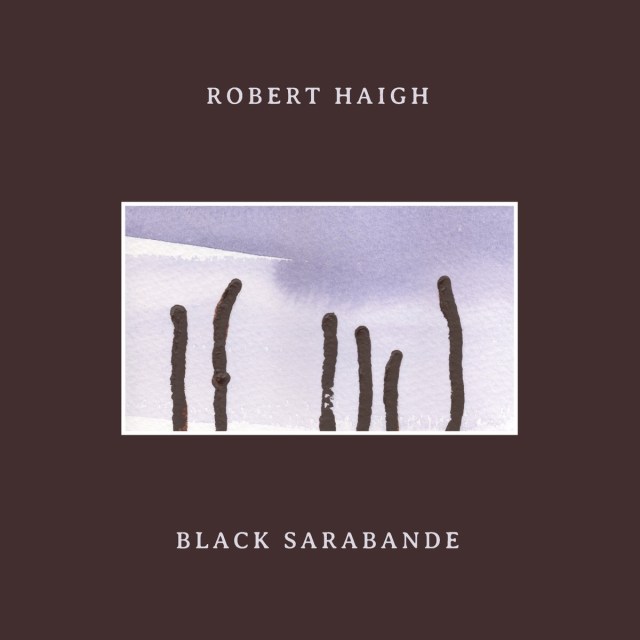
Robert Haigh – Black Sarabande

Everything I’ve ever written about any album, concert or piece of music is wrong.

I know this because of something that happened while I was quietly listening to ‘Arc Of Crows’ by pianist Robert Haigh, a track taken from his new album Black Sarabande, at the weekend while reorganising my loft. The experience was a poignant one in more ways than one, but not because of the crawling around on my knees sorting out boxes; that was just painful.

‘Arc Of Crows’ is an arresting, quiet, delicate piece of piano music nodding gently and reverently in the direction of Satie and it immediately stopped me in my tracks, a box of Christmas decorations in hand, and I found myself standing there for the entirety of its three minutes and forty-eight second duration, in that brief passage of time contemplating everything I have ever done, everything I have ever hoped for, the highs, the lows, the disappointments, the missed opportunities, the what-ifs, the future – the lot.

It very possibly had the profoundest effect on me that any piece of music has had or will ever have. Possibly this was owing to its sparseness, being simply Haigh’s piano accompanied by a soft, imperceptible sound in the background, somewhere between a brushed cymbal, muted traffic noise or a curtain of rain; or possibly because of its textures, its hidden depths and its delicate, resolute, outline.

Toward the end of my immersion in my thoughts, my teenage daughter arrived in the room in which the loft happens to be, and visibly and audibly recoiled at Haigh’s piece. She complained of it making her feel claustrophobic, panicked, uncomfortable and very possibly called it ‘weird’ (both of my daughters call all of the music I listen to ‘weird’, incidentally). She was still griping about it over lunch the next day. I’m at a loss to understand what it is that she heard that I didn’t, what quality it was that I found mesmerising but which she found anxiety-inducing.

Hence my conclusion that you can’t trust anything I write. Read on at your peril.

The reason Black Sarabande might have got me in a contemplative mood is possibly because it finds Haigh ruminating on his own life, specifically his childhood in the mining village of Worsbrough in South Yorkshire; his father was a miner and his early years were spent among the strange culture clash between the vestiges of the Victorian Industrial Age and the rural hills and dales through which progress had permanently left its mark.

That tension can be be found mournfully lurking in pieces like ‘Stranger On The Lake’ or ‘Ghosts Of Blacker Dyke’, not in an air of machine-driven harshness but just a sort of echo of one; little sounds drift in and out of view, sometimes melodically, sometimes as what could be a distant train clattering on its tracks, sometimes as unidentifiable noises with a brittle edge as if broken forcibly from something else, leaving only a vague impression of what was there before. Other pieces, like the genteel arpeggios of ‘Progressive Music’ are simply unadorned moments of intense wonder, like a hopeful sunrise on a frosty morning, full of promise and serenity and freighted with a welcome, disarming clarity.

Black Sarabande by Robert Haigh is released January 24 2020 by Unseen Worlds.

(c) 2020 Further.