Rupert Lally – Tiny Universes

Earlier this year, my Mortality Tables collaborative project released Lunar Forms by Switzerland-based sound artist Rupert Lally*. That album found Lally at what I would argue was his most inventive, using a specific and quirky Eurorack module to trigger randomised rhythms on a daily basis, which he then used as the foundation for the pieces on the album.

The album also found Lally in deeply ambient territory. It’s an area of his work that I’ve always enjoyed, and for Tiny Universes, his latest album, we (pleasingly) find him going even further in that direction.

His choice of title is instructive, if somewhat consciously oxymoronic. These 11 pieces are like studying pinhead-sized universes through a microscope, revealing an incomprehensible vastness that would not be implied by their ostensibly small stature. Musically, there’s a whiff of jazzy Kosmische, a smattering of Vangelis-esque Bladerunner-y widescreen vastness and a determined melodic momentum that’s often missing from a lot of ambient music. Lally is not afraid of introducing unsettling, discordant textures, instilling a feeling of discomfort and uncertainty as much as they seem to evoke the idea of wide-eyed, slack-jawed wonder, surprise and incomprehension.

Lally has always been a masterful electronic composer and sound designer, capable of using an adaptable array of tools and techniques within his work. The sleight-of-hand he deploys here is the art of the slow build. His melodies begin as quiet, ruminative gestures, which coalesce and harden as they progress, often without you noticing. These magnificent, delicate, unexpected, low-key crescendos are critical ingredients of pieces like ‘Cosmic Countdown’, where that aforementioned sense of motion is most acutely felt. Elsewhere, Lally’s approach is to allow pieces to form stately, stirring gaseous structures out of oscillating, restless layers of white noise, lending a creator’s guiding hand while also allowing the tracks to evolve and develop by themselves.

Unlike Lunar Forms, there are no rhythms on Tiny Universes. None. Not even the slightest trace, inference or suggestion. Perhaps they haven’t formed yet in these universes that have caught Lally’s attention. It leaves his melodic and atmospheric prowess utterly naked and untethered; a brave move, for sure, but one that he is effortlessly capable of owning. The result is an album representing yet another high watermark in his expansive back catalogue. And yes, I know I’m biased.

https://rupertlally.bandcamp.com/album/tiny-universes

Tiny Universes by Rupert Lally was released December 5 2025. It is available for a limited period as a pay-what-you-like release.

* There are a small number of CD copies of Lunar Forms available here.

Words: Mat Smith

(c) 2025 Further.

Shots: A.M. Boys / Cloud Canyons / Marco Avitabile / Critical Objects

A.M. BOYS – PRESENT PHASE

The second album from the NYC duo of John Blonde and Chris Moore is an enigma. As an example of leftfield electronic pop it’s up there with the best. Not only that, but Blonde and Moore’s conscious decision to evenly split the album between vocal tracks and instrumental pieces is unlike anything else on the market today. That largely from the way these pieces were written through intuition – if Blonde didn’t feel lyrics flowing when they were working on a track, he wouldn’t force them, and it would stay a pure instrumental piece. That gives each of these pieces an intentionality and purpose, not a sense of incompleteness. ‘Yesterday Yes’ is a good example of a track that exudes a bold, epically-building firmness – exceptionally lyrical in its melodic motif, only without lyrics. Elsewhere, the sublime ‘Ocean Ocean’ documents Blonde’s feelings as he sat watching the waves and surfers on Surfrider Beach, bringing some California warmth to their East Coast starkness. ‘Wounded Wrestler’ might be a note of romantic longing to an injured college sportsman, but its noisy, rough-edged delivery gives off an edge of a lost Throbbing Gristle track recorded live in a dark and murky Manhattan club. I interviewed Blonde and Moore for Electronic Sound. You can find that interview here. Released May 16 2005.

https://amboys.bandcamp.com/album/present-phase


CLOUD CANYONS – ECSTASY / DISCIPLINE

Cloud Canyons are an Italian quartet of Stella Baraldi, Michelle Cristofori, Laura Storchi and Nicola Caleffi. This single follows their 2023 debut album Dreaming Of Horses Running In Circles, and contains two long tracks that showcase a singular approach to electronic music. ‘Ecstasy’ is a dreamy affair, all pulsing arpeggios drenched in soft reverb to create hazy, gauzy, etiolated textures. There is a hint of white noise at the music’s fringes, like the lonely sound of rain on an apartment window. Over these sounds we hear mantra-like vocals that alternate between euphoric and uncertain, like the clipped voices of a half-heard conversation. ‘Discipline’ isn’t, alas, a Throbbing Gristle cover, but it does bear some similarity to Billie Ray Martin’s version of ‘Persuasion’. Over a grid of ceaseless beats, Cloud Canyons deploy a menacing bass pattern, minimalist, pointillistic high-pitched sounds and a fragile melody, while repeated vocals are processed into echoing beds of sound. It is at once energetic and insistent, carrying a sense of urgency and vital dark energy. The two tracks couldn’t be more different, but, really. who needs conformity anyway? Released July 25 2025.

https://cloudcanyonsband.bandcamp.com/album/ecstasy-discipline


MORAY NEWLANDS – THE RED RED EARTH (Wormhole World)

I’ve been meaning to write about this album for a while, ever since I read the opening line of Moray Newlands’ email that accompanied this album: “I’ve been ruminating on the inevitability of death and how it will come to us all at some point.” I spend an inordinate amount of time thinking the same thoughts, and my Mortality Tables project (which Newlands has contributed to) is almost entirely occupied with our essential impermanence. With a title inspired by the soil to be found near his home on the east coast of Scotland, the 16 pieces presented here represent his unfolding thoughts d reflections. Taking in soft and introspective piano, field recordings, wobbly vocal sounds, church bells, discordant strings, delicate electronics, inquisitive textures and quotes from Sylvia Plath, these pieces are far from maudlin, miserable reflections of Newlands’ thoughts. Instead, they carry a sort of openness and acceptance. The exception is ‘An Incident Has Occurred’ and its counterpart, ‘Another Incident Has Occurred’, which underline a brief sense of panicked uncertainty. The plaintive ‘(Put Me In) The Red Red Earth’, which closes the first half, and a version of Philip Glass’ ‘Closing’, which concludes the album, will just about finish you off and usher you to your own burial spot under the title’s red, red earth. Released August 15 2025.

https://wormholeworld.bandcamp.com/album/the-red-red-earth


MARCO AVITABILE – A FEW MEANINGFUL THINGS (Colectivo Casa Amarela)

Marco Avitabile is an Italian guitarist. There’s also a house DJ with the same name, but I’m guessing these aren’t the same person. Avitabile’s technique came out of heavier rock, but he has now established himself as a improviser, usually adding effects and processing to lift his music into a more structured style. His latest album for the Lisbon Colectivo Casa Amarela label is one freighted with tension, specifically the different directions we are all pulled in during our lives between family, work and our myriad passions. That essence manifests itself here in playing that is never angry or fractious, but which gently oscillates, as if Avitabile is using his instrument to ask questions in an attempt to make sense of his world. Key track ‘Copenhagen’ is an eight-minute guitar symphony, framed by an initial cluster of heavy guitar crashes and reverb that evolve into a poignant, heart-wrenching melody accompanied by subtle, unobtrusive electronics. The piece has a journeying, evolving quality, moving from the troubled, anguished darkness of its opening moments toward something much more euphoric. Released August 31 2025.

https://casaamarela.bandcamp.com/album/a-few-meaningful-things


CRITICAL OBJECTS – BLOSSOMING ACHE

In the last of these round-ups, I covered ‘Rewind’, the debut single from Critical Objects – the duo of Pinklogik and Veryan – and politely asked for more electronic pop from these two wonderful artists. Well, I’m pleased to say that’s happened. ‘Blossoming Ache’ is the duo’s second track, built from a powerful bass hook and determined beats, set in place beneath a series of spiralling melodies that have a fleeting, ephemeral delicateness. Pinklogik’s vocals are haunting and plaintive, alternating between innocence and world-weary disappointment, like a mournful choir heard through the haze of memory. As with ‘Rewind’, both Veryan and Pinklogik provide their own individual remixes to round out the release, offering up polar opposite explorations of the track’s layers – with Pinklogik ratcheting up the rhythmic element and Veryan turning the piece into a sparkling blend of vocals and textures that will have the hairs on the back of your neck standing to attention. I won’t repeat the earlier plea for more music from this duo; Veryan has already tipped me off that more is on the way. Released October 31 2025.

https://criticalobjects.bandcamp.com/album/blossoming-ache

Words: Mat Smith

(c) 2025 Further. 

Mariusz Szypura – Chopin Residue

Chopin Residue is a series of multi-media works by Polish artist and former indie rock musician Mariusz Szypura.

One part is a collection of ‘deconstructions’ of Chopin’s music, featuring the likes of Adrian Utley, Lee Ranaldo, Justin Meldal-Johnsen, John McEntire and many others. These pieces range from the ethereal, fleeting tones of ‘Prelude Op. 28 No. 20’ (with Charlie Draper on ondes Martenot and Theremin) to the ferocious guitar-heavy ‘Prelude Op. 28 No. 22’ with Ranaldo and saxophonist Zoh Amba, wherein strings emerge only to be battered down into submission. ‘Prelude Op. 28 No. 4’, with Utley, drummer Joey Waronker and thereminist Carolyn Eyck sounds like it belongs on Utley’s first Portishead album, with its chunky jazz rhythms and shimmering, maudlin guitar and electronic textures.

On the deconstruction of ‘Prelude Op. 28 No. 2’, Szypura presents Chopin’s mellifluous arpeggios as a snarling web of grubby synth sequences, offset by rigid drumming by John Stanier, feisty guitars from Sugar Yoshinaga and Draper’s electronics. ‘Prelude Op. 28 No. 15’ features jangly guitar from Ranaldo, measured kitwork from Stanier, and an array of tuned percussion from Milosz Pękala, the sum of whose parts is a long, hazy, psychedelic piece framed by the tracest outlines of classical melodicism.

Another part of this collection is a series of ‘reworks’ by Fennesz, Jim O’Rourke, Matthew Herbert, Christine Ott and others, which you are encouraged to play simultaneously with the deconstructions, if you happen to own two turntables.

Herbert’s version of ‘Prelude Op. 28 No. 22’ hitches sprinkles of Chopin’s piano to a dubby rhythm track, while Adrian Utley reimagines ‘Étude Op. 25 No. 12’ as a bouncy electronic wonderland complete with delicate, flute-like melodic gestures. Fennesz introduces skipping electronics and oscillating guitar to his version of ‘Berceuse Op. 57’, in the process turning the piece into a vibrant, unpredictable, becalming soundscape. Sean O’Hagan takes ‘Prelude Op. 28 No. 4’ and renders it as skipping, fragmented leftfield electro, while Jim O’Rourke subjects ‘Prelude Op. 28 No. 2’ to heavy reverb and phasing, the result of which sounds like an orchestra tuning up.

Christine Ott floods ‘Nocturne Op. 72 No. 1’ with layers of beatific ondes Martenot, an extension of her own prowess and practice as a solo artist and in the Snowdrops ensemble. Benoît Pioulard’s version of ‘Prelude Op. 28 No. 9’ is constructed entirely from layers of sensitively-arranged drones and swirling cycles of guitar feedback, while Abul Mogard approaches ‘Prelude Op. 28 No. 15’ as an opportunity to offer up a web of edgy, modular synth drones and white noise textures, through which occasionally poke amorphous elements from the piece on the deconstructions disc.

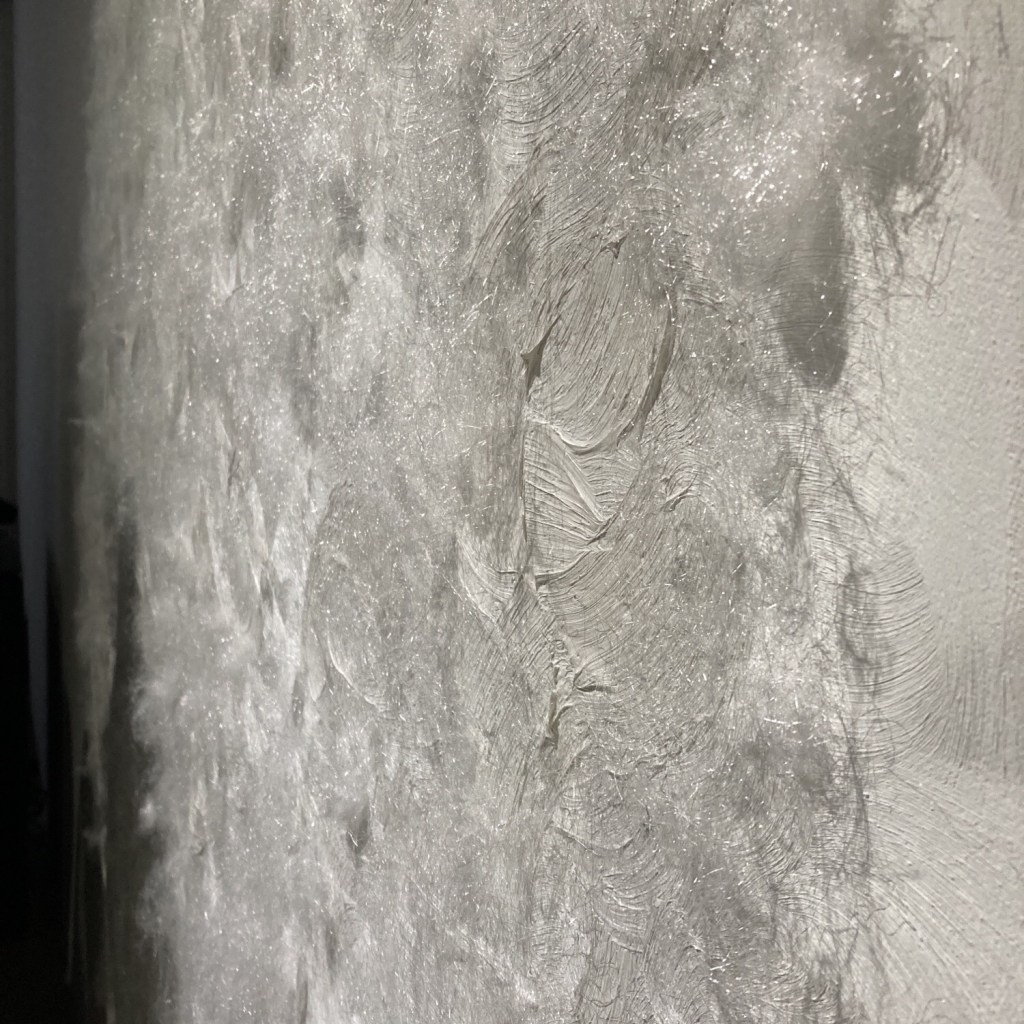
The process of lathe-cutting the vinyl albums of deconstructions and reworks yielded a third part of the collection, in the form of large circular artworks constructed using the plastic residues from the lathe process. Pure white and of varying textures – from fluffy and whispy to brittle, razor sharp and angular – these pieces were installed in the Fridman Gallery on New York’s Bowery between November 2 and November 9 2025. On one level, these pieces may be a comment on wastefulness; in another sense, they are no different from either the deconstructed Chopin pieces or their reworks, for they are entirely new structures arising from something else.

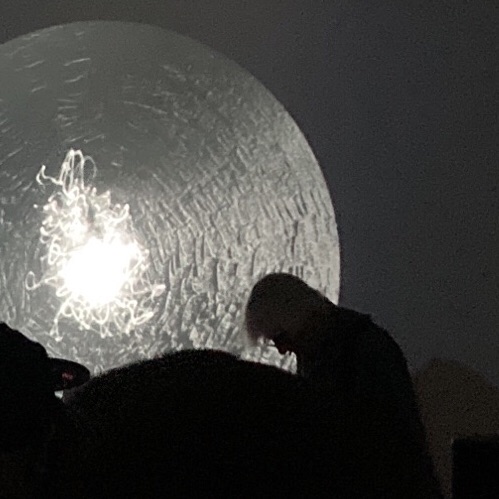
The final element of the collection was a live event in the Fridman Gallery surrounded by the artworks. For this thirty-minute performance to effectively kick off the brief exhibition, Szypura was joined by Ranaldo, Amba and Stanier. The small stage was so cramped that Ranaldo had to climb over an amp to get into position, while Amba played on the floor in the front row of the audience. Animated videos of the artworks – another discrete element of the overall Chopin Residue project – bathed the shadowy forms of the players in soft light, as if to draw your attention away from their playing.

That was often hard to do with Ranaldo, who was here at his most intense and restless. He strikes his guitar with a drum-stick, bows the strings to produce squeals of feedback and taps the neck of the guitar against the gallery wall. Rarely did he ever settle into playing his guitar straight – that was Szypura’s job. At one point, his pressing of the guitar neck against the wall prompted one of Szypura’s circular artworks to vibrate in sympathy. It’s as if he is both unplaying the guitar and playing the artworks – and the building – simultaneously.

His guitar is loud, wild and freighted with heavy distortion. These are the moments where Stanier’s drumming becomes less rigid, more loose, and Amba’s saxophone takes on the wild intensity of an avenue full of angry New York cab drivers during rush-hour. To Ranaldo’s right, Szypura alternated between steady, rhythmic guitar playing and inchoate electronics.

A second movement begins with a quiet pulse and drones formed from the residues of the distortion from the first movement. As the piece progresses, it gathers intensity. Stanier’s drumming becomes increasingly firm, rejecting the tentative drum machine beat that opened the piece and guiding it toward a noisy, apocalyptic crescendo filled with layers of intense overlapping guitar work and terrifying sax dissonance.

“After one has played a vast quantity of notes, it is simplicity that emerges as the crowning reward of art,” Chopin is quoted as saying. Szypura’s multi-faceted project is far from simple. It stands as an ambitious, engaging and complex enterprise, and one that illustrates how one source idea can result in many creative tributaries.

Chopin Residue is released November 28 by Black Element.

With thanks to Nico.

Words: Mat Smith

(c) 2025 Further.

Shots: Divergion / Critical Objects / Soho Electronic / Nik Kershaw / Oasis

DIVERGION – TRIGOMORPH

Chance processes are the foundational layer of this collaborative release between Shane Hope (The Last Ambient Hero) and Rob Reeves (Kaleida / Bob’s Bakery). Two old school friends who had drifted apart, they were reconnected after Hope sold a synth on eBay, only for it to be acquired by Reeves. That randomness fed into Trigomorph, where they would use stimuli similar to the Oblique Strategies cards created by Brian Eno and Peter Chilvers in the mid-1970s.

Personally, I’m very grateful that Hope and Reeves reconnected. This is a powerfully atmospheric collection of five individual tracks, each one presented as two distinct versions – one by each member – that take in field recorded conversations, landscape sounds, drones and haunting, elusive melodies. The first version of ‘Viroclast’ has a poignant nostalgia, with a snippet of conversation across a naturalistic sonic landscape capturing an exchange between two walkers about memories of lockdown. Its second incarnation has a rough, angst-filled edge, full of discordant pathways, wavering Orb-esque synth spirals and resonant bass, all of which drop away toward the end as an inquisitive piano melody arrives. Released July 21 2025.

https://divergion.bandcamp.com/album/trigomorph


CRITICAL OBJECTS – REWIND

This one is special. A collaboration between Jules Straw (Pinklogik) and the anonymous Veryan, I can only hope this is a taste of a much bigger project between two friends and talented electronic artists. Outwardly, ‘Rewind’ is a slice of oven-hot, crisp synth pop, using the metaphor of the venerable cassette as a vehicle for Straw singing about catharsis and moving on from some unspoken event.

While it may have all the requisite characteristics of classic electronic pop – insistent drum machines, one note melodies, a fragile and emotive vocal – there’s something else here, some powerful atmospheric layer that has a critical impact on the track’s mood. That effect is reminiscent of Veryan’s shimmering ambient music, and once you identify it you begin to understand how balanced this collaboration is. The single is rounded-out with a remix apiece by Pinklogik and Veryan, each one tilting ‘Rewind’ to their individual styles. More, please. Released September 5 2025.


Agnes Haus (Photo: Andy Sturmey)

SOHO ELECTRONIC, VARIOUS VENUES (SEPTEMBER 27 2025]

Soho Electronic is a new electronic music festival featuring 20 artists performing in four venues in and around London’s Soho area, spearheaded by a live performance by Mute founder Daniel Miller. The performances were all focused on the endlessly adaptable possibilities of modular synthesis, spanning everything from delicate ambience to otherworldly transmissions to jazz to punishing noise. The festival also saw a brilliant, noir performance from Agnes Haus, whose Inexorable Ascent album for Penelope Trappes’ Nite Hive imprint is astounding. I covered the festival for Electronic Sound with my friend Andy Sturmey, who I’ve been covering concerts with since 2012. Full report and photographs below.

https://www.electronicsound.co.uk/reviews/soho-electronic-festival-review/


NIK KERSHAW, THE STABLES, MILTON KEYNES (SEPTEMBER 28 2025)

‘Don’t meet your idols,’ is advice I’ve chosen never to follow. And so it is that I met Nik Kershaw at my local concert venue, the fantastic Stables in Milton Keynes, at the end of September. He was touring his Musings & Lyrics show in support of a new book, where he’d perform songs, tell wry stories and offer insights into his creative process. Human Racing, his debut album from 1984, was the first album I owned, and I probably wouldn’t be writing at all if it wasn’t for that pivotal moment, listening to that cassette on my shitty Sanyo player as a callow seven year-old. I made a point of telling him that. I’d spoken to Kershaw in 2021 for an Electronic Sound interview in 2021, but had never met this idol in person. A treasured memory.


DEFINITELY, MAYBE… OR NOT AT ALL? : INSURING CONCERTS

This article is, I admit, a bit niche. Precipitated by the occasion of Oasis announcing their reformation and tour a year ago, and prompted by the question of whether the Gallagher brothers would be insured for losses if they broke up on tour, I set about exploring the world of concert insurance. The article was written for the Insurance Museum, a charity “working to discover and share with all audiences, the incredible story of insurance, past, present and future”. I’m a member. I have a badge and everything. I’m happy to talk about why insurance matters all day long. Find out if an on-tour bust-up would be covered at the link below.

https://insurance.museum/definitely-maybe-or-not-at-all-insuring-concerts


Words: Mat Smith

(c) 2025 Further.

Reed Hays – Buchla 100 Album (For David Baron)

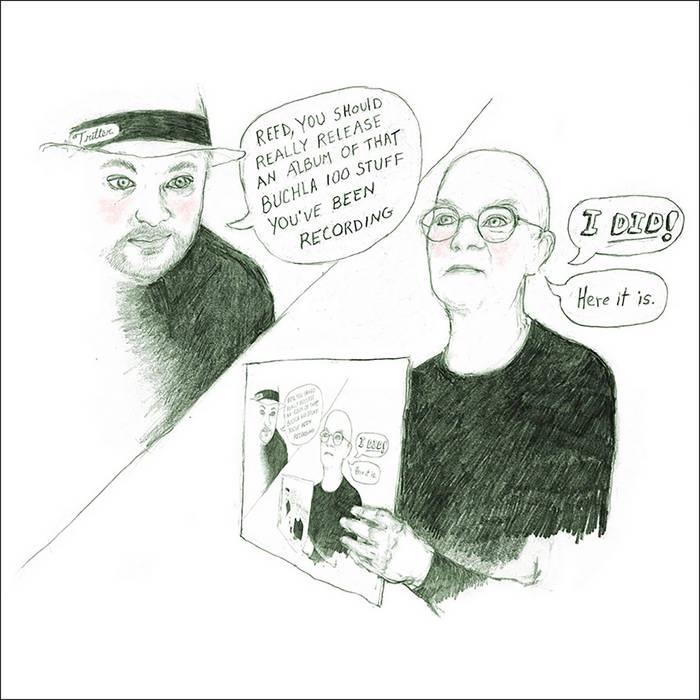
“Reed, you should really release an album of that Buchla 100 stuff you’ve been recording.”

“I did! Here it is.”

 – From the sleeve illustration by Caroline Schutz

Buchla 100 Album is a conversation.

It is a conversation, as illustrated by the cartoon sleeve image, between two electronic musicians who can trace their friendship back to their studies at Oberlin College in Ohio – David Baron, a formidable synth master, and Reed Hays, a similarly formidable synth genius.

Baron is classically-trained, adding his in-demand orchestral arrangements to pop tracks by Shaun Mendes and Meghan Trainor (to name but a few), while also holding down a parallel career in commercial sound work for clients like Verizon.

The classically-trained Hays’s career has followed a broadly similar path. Baron veered toward pop, but only after spell working with New York avant gardist Charlie Morrow. Hays similarly found himself immersed among New York’s sonic avant garde, also working with Morrow and then Phill Niblock, while also providing commercial music for major US broadcasters. In more recent years, he found a fast friendship in Erasure’s Vince Clarke, releasing two albums as Reed & Caroline with fellow Oberlin alumnus Caroline Schutz on Clarke’s VeryRecords, DJing with Clarke on Staten Island’s Maker Park Radioo, and adding his evocative cello to Clarke’s emotionally-fraught solo album Songs Of Silence. When Clarke ventured out on his own for shows in London and New York, it was the reassuring presence of Hays that appeared on-stage with him.

In 2023, Baron released The Arp 2500, a paean to the seminal 1970 synth created by Alan Robert Pearlman. The album found Baron making exclusive use of Pearlman’s synth. In that way, Hays’s Buchla 100 Album is a conversational response to his friend’s album, given it finds Hays at the synth which has provided him with creative sustenance and inspiration for years.

The Buchla is a curious synth, and, by most accounts, an absolute bugger to use. I spoke to Clarke about this almost ten years ago, when I was helping prepare the first Reed & Caroline album for release. He said he’d owned one, back in the days where his studio was in a circular space at the back of his house in Chertsey, but he’d gotten rid of it because he found it too difficult to use. It was a frank, and somewhat surprising, admission for someone who seems able to master any piece of electronic kit put in front of him. It wasn’t just him, though. I spoke to another Buchla enthusiast who said he’d been enlisted by a major, Bristol-based trip-hop collective, to set up a Buchla system in their studio, which they ultimately found unfathomable.

Originally designed by Don Buchla in the 1960s following a commission from San Francisco Tape Music Center founders Ramon Sender and Morton Subotnick, the Buchla synth deployed unique pressure-sensitive inputs, making it a awkward proposition compared to synths with a keyboard controller like the nascent Moog (or the Arp 2500). Somehow, Hays is a member of a small subset of Buchla aficionados who don’t see it as remotely troublesome or hard to use. I’ve always thought that Hays’s mastery of the cello is what means he finds the Buchla so accessible, but I can’t even read music, let alone play it, so what do I know?

The Buchla achieved a weird prominence at the hands of one Owsley Stanley, a peripheral member of Ken Kesey’s acid-tripping Merry Pranksters, who used the synth to create weird and trippy sounds for their happenings. I mention this for two reasons – first because (shhhh – don’t tell anyone!) Hays and I have a project referencing this lined up as a future Mortality Tables Product, and secondly because Hays’s coveted Buchla 100 modules were originally intended for Owsley.

So you could see this as a conversation between two friends, and their two favoured instruments. You could also see this as a fluid conversation between Hays and his Buchla. Prior to recording this album, Hays had gone through an extended spell of finding electronic composition unsatisfying, preferring instead to focus on his daily cello practice. This gives Buchla 100 Album an air of catharsis, almost as if you can hear the coldness toward electronic music slowly thawing as he explores resonant pathways on pieces like ‘Cardinal’.

‘Cardinal’ is emblematic of the way these pieces evolve. Beginning with thin, ahem, reedy sounds, ‘Cardinal’ feels inquisitive, as if finding its own path, taking in a wandering bassline and tuned percussion that nods to a Martin Denny-like exotica. I can well imagine this as a piece of through-composition, watching Hays as he gently guides the track where it wants to go while also allowing the Buchla to determine its own course. It feels curiously symbiotic, with the Buchla as an extension of Hays, and Hays as an extension of the Buchla.

Elsewhere, ‘Quantus’ has a spiky angularity, nudging forward on a resolute drum pattern while sounds ping-pong effervescently around it. It embodies a sort of controlled chaos, where sounds are anchored into place by the rhythm but allowed freedom to skip around all over the place. An extended breakdown finds Hays permitting the rhythm track to swing, injecting a jazz-like fluidity to proceedings, before it concludes with swooning, evocative, synth strings.

Not that this is a purely instrumental affair. ‘Silkworms’ and ‘Liquid Time’ represent a welcome return for Reed & Caroline and their deft brand of leftfield, science-infused, electronic pop. ‘Silkworms’ is a discussion of tiny creatures living on the moon, framed by a determined beat, cute, wriggling sounds and melodies, Schutz’s quietly affecting vocal, and wild, howling sounds that nod to Fad Gadget’s ‘Back To Nature’. ‘Liquid Time’ begins with a funereal, organ-like melody before opening out into an wall of pointillist pulses that flip-flop between slow ‘n’ steady and fast ‘n’ intense. Schutz’s vocal here is both mournful and wholly realistic, singing about the passage of time and a climate-ravaged, polar ice cap-melted, fully submerged world with a calm and unswerving frankness. It may be aspirational to hope for a third Reed & Caroline LP at this point, but if these two tracks provide a glimmer of hope, I’m happy to keep everything crossed that it may materialise.

‘Aria’ is, unquestionably, the album’s most poignant moment. To me, it feels like a moment of transition, between the classical practice that Hays honed while electronic music felt too daunting, and his tentative return to the electronic music form. It is a piece held in place by a stirring, mellifluous melody that will haunt you long after it fades into silence. In its own way, ‘Aria’ embodies the sentiment of albums like Wendy Carlos’s Switched On Bach, Don Dorsey’s Bachbusters or any of the early electronic albums that paired electronics with classical composition as a means of illustrating the potential of emerging synthesiser technology.

I said this felt like a conversation. Hays is a natural, enigmatic, engaging, humorous, self-deprecating conversationalist. For me, privileged as I am to have enjoyed many of these conversations, Buchla 100 Album (For David Baron) is your opportunity to appreciate Hays talking with you, through the electronic curiosity of the Buchla 100, in his inimitable, masterful way. It may have been intended to be a private chat between two friends, but it is one that we are all able to enjoy.

A welcome, and, as a friend, might I say overdue, return.

Buchla 100 Album (For David Baron) was released May 30 2025.

https://buchlareed.bandcamp.com/album/buchla-100-for-david-baron

(c) 2025 Further.

Shots: Cromwell Ate A Twix Here & Yol / Schmitz & Niebuhr / Audio Obscura / Autoreverse

CROMWELL ATE A TWIX HERE – FRAGILE / YOL – GLASSED ASCENSION (Strategic Tape Reverse)

Cromwell Ate A Twix Here is a typically wry and obtuse new alias from More Realistic Goals polymath Justin Watson. ‘Fragile’ features purloined spoken word commentary from David Yates set to a sound bed of pleasant strings, high-pitched voices, birdsong, noises of unknown provenance, occasional disharmony and myriad other sonic accompaniments. Yates’ chat recounts the first flushes of a new relationship in frank detail, his delivery carrying a frank flatness that belies a sense of dry humour – especially when he describes how the nascent couple arrange their breakfast plates. And then, a moment of revelation when Yates reveals that he is a widower. The sentences are delivered in the same dispassionate voice, and yet the implication is of extreme and devastating sadness, even if none of this is necessarily evident. Finally, the story lurches into a sort of Welcome To Night Vale weirdness. I won’t spoil the surprise, but the title makes a lot more sense after what happens.

In contrast, the Yol side is noisy, expressive and agitated, the voice as a sound source rather than a method of reportage. Insectoid vocal sounds and flat blocks of distortion occupy the background here, punctured by machine-like, menacing sonic objects that sound like they were entirely crafted from recordings of vintage late-1990s modem tones, as well as a sound that could be a spun glass bottle attached to a faulty contact mic. Yol’s voice flutters between shouted statements and exasperated, desperate repetitions about cushions and body parts. It is insistent, forceful and pretty terrifying, if I’m honest, but its challenging aesthetic is also weirdly liberating for reasons that I can’t quite explain. Uneasy listening for the hard of hearing, to quote Fad Gadget and Non. Released March 21 2025.

https://strategictapereserve.bandcamp.com/album/fragile-glassed-ascension


SCHMITZ & NIEBUHR – PORZ 1975 (Tillerfisch / Superpolar Taïps)

Well, this is an interesting one. An email popped into my inbox from Superpolar Taïps head honcho Marco Trovatello, entitled ‘Prog…?’, which certainly caught my attention. It wasn’t what I’d expect to receive from him. Then again, with Marco and his cassette imprint, I’ve come to expect the unexpected. Schmitz & Niebuhr sounds like a duo, but is in fact a trio of Trovatello, Dierk Düchting and Bernd Wilberg – none of whom, you will observe, is called Schmitz or Niebuhr.

To execute PORZ 1975, the trio were joined by at least a dozen guest musicians and also a marching band. The concept (there’s always a concept in prog music!) was to make an album celebrating the 16 districts of the German town of Porz, which was, in 1975, absorbed into Cologne. Each track is named after one of the districts, and Trovatello / Düchting / Wilberg constrained themselves to only using instruments that were available in 1975. That gives standout tracks like ‘Urbach’, ‘Westhoven’ and ‘Wahnheide’ all sorts of Moog-y richness, with impossibly groovy hooks laid over writhing nests of jangly guitars and driving rhythms. Crucially, there’s no showy-offy, onanistic, fifteen-minute soloing to be found here – just a double-album window into the 1970s electronically-augmented rock music that time politely forgot. Released May 2 2025.

https://superpolar.bandcamp.com/album/porz-1975


AUDIO OBSCURA – AS LONG AS GRAVITY PERSISTS ON HOLDING ME TO THIS EARTH

It may not seem like it, for an artist as prolific as Audio Obscura (Neil Stringfellow), but As Long As Gravity Persists In Holding Me To This Earth arose from an extended period of doubt, resulting in a form of creative paralysis. In 2024, Stringfellow hadn’t made any new music for some time because of that overriding lack of belief in something that anyone who has spent any time with his music will know is a rare talent that he possesses, but such is the way with our personal fears and inhibitions: we rarely see in ourselves what others see in us. His focus shifted away from composition toward live performance, and the process for preparing for a show in Whitby in November 2024 yielded the improvised piece that opens this collection, ‘Pyramid Song’

‘Pyramid Song’ has a hauntingly beautiful quality, something that is shared by all ten pieces on the album. There is a lightness of touch here that has perhaps been missing from Stringfellow’s previous music – unadorned field recordings; delicate and emotive piano; fragile and muted, dubby electronics; effusive but not intrusive strings; disparate and dislocated samples. There is, however, an undeniable sadness to pieces like ‘The Weight Of The World’, which speaks to this overriding mental state that he found himself prior to its creation. Being honest and transparent about these things, as we know, can liberate you from these feelings, and this austere, emotional collection is evidently a cathartic listen. A number of Stringfellow’s works, particularly his series of albums focused on impending climate disaster, have been about the macro – those things that will impact all of us; As Long As Gravity Persists In Holding Me To This Earth instead trains its lens on no one other than Stringfellow himself, but in so doing, he has made a universally-relatable album. Sequentially, there is another project that came before this album which explains more about how he unlocked his creativity, which will be released in September. Released May 23 2025.

https://audioobscura.bandcamp.com/album/as-long-as-gravity-persists-on-holding-me-to-this-earth

AUTOREVERSE – AUTOTUNES (Éditions Gravats)

Autoreverse is a duo of Arnaud Rivière and Nina Garcia, and Autotunes is their first studio album. Collaborations like this don’t just happen, however. Garcia and Rivière are seasoned partners in sound, their symbiotic technique and sonic presentation forged through countless gigs, some of which have been documented as live cassettes. It goes like this: Garcia is a renowned, Thurston Moore-tipped noise guitarist (check out her recent solo album Bye Bye Bird, which I enthusiastically covered for Electronic Sound), and Rivière utilises a busted turntable.

‘HI-SPEED DUB switch’ is a joyously abstracted collision between these elements. You hear Garcia’s growling, purring, distorted guitar, and then it is overwhelmed by an initially impenetrable block of squalling feedback from Rivière’s stylus. Listen closer, and textures and details reveal themselves, only they are frazzled and fractured beyond recognition. I thought I could hear voices at the epicentre of the din at one point, but quite honestly it could have been my imagination. The ensuing section seems to be where Garcia and Rivière begin to co-exist, an enmeshed discourse between hissing feedback, textures with all the smoothness of course-grade sandpaper, nuanced pulses, buzzing drones and finally a sense of latent, angry energy expressed as an anti-ambient, amp-bothering soundscape. Thrillingly and wilfully unpredictable. Released June 6 2025.

https://editions-gravats.bandcamp.com/album/autotunes

Words: Mat Smith

(c) 2025 Further.

Bendu – Lautner

Bendu is the alias of Ben Vance, originally from the Midwest but now based in Los Angeles. Lautner is an ode to architect John Lautner, responsible for innumerable distinctive buildings in LA, including the space age Chemosphere above Laurel Canyon.

Vance’s love of his fellow Midwestern emigré was forged after a tour of Lautner’s Sheats-Goldstein house in LA’s Beverly Crest area ten years ago. His ensuing research into Lautner’s practice, and the architect’s love-hate relationship with the adopted LA home where he forged his success, seems to have deepened his hero worship of a figure who sought to bring beauty to what he felt was the city’s inherent ugliness.

Quite how that all manifests itself in the twelve tracks included here is somewhat beyond me. Then again I’m (coincidentally) on a flight to LA as I write this, it’s 0230 back home, I’m trying to keep myself busy to stay awake, and not a lot makes much sense to me at this hour. Each track is named after a specific Lautner property, and its contents are sharp, many-layered electro tracks blessed by Vance’s astute approach to melody and rhythm.

Beachwood Market, designed by Lautner. Photo: Mat Smith, May 2025

The whistling, wandering top line of ‘Rainbow House’ is a highlight, laid over a fat bassline and chunky old school preset beats. A tension between linearity and unpredictable (and harmony and discordancy) characterises ‘Bergren’, acting as a metaphor for Vance’s (and Lautner’s) relationship to the city. Elsewhere, ‘Carling’ has a poignant plaintiveness, a squelchy, jazzy motif interfacing with pointillist tuned percussion, steady beats and an effusive, expansive central hook.

‘Lautner’ by Bendu was released April 25 2025 on Shady Ridge Records

Words: Mat Smith

(c) 2025 Further.

Shots: Stichflamme Barnick / Nick Storring / Love Stereo / Alex Zethson & Johan Jutterström / Sean Armstrong / Xqui

STICHFLAMME BARNICK – STICHFLAMME BARNICK (Superpolar Taïps)

Bring on the distortion: the pairing of Stichflamme Dormagen and Robin Barnick was recorded between 2022 and 2024 and finds the pair producing intensive blocks of sound that are subjected to punishing processing. ‘Dolce al Cucchiao’ is among the heaviest tracks here, sounding not unlike an outtake from Pat Metheny’s Zero Tolerance For Silence. Elsewhere, the comparative levity of the pan pipe melody that dominates ‘Montabaur 8’ is subsumed by a ceaseless bass oscillator sweep that, halfway through, threatens to swallow up the poor piper and his innocent, gleeful playing. Released November 15 2024.

https://superpolar.bandcamp.com/album/stichflamme-barnick

NICK STORRING – MIRANTE (We Are Busy Bodies)

For his ninth album, multi-instrumentalist Nick Storring looked to Brazil for inspiration. That impulse gives the seven tracks here a greater rhythmic quotient than his previous works, with layers of vibrant percussion offsetting the orchestral-leaning textures that have become the hallmark of his musical work. At times, these pieces are quiet and contemplative; at others they are noisy, impactful and direct. ‘Roxa’, a three-part suite-within-a-suite, is a case in point. ‘Roxa I’ starts with ephemeral textures and interjections of percussion before opening out to include a stalking blues guitar riff and clusters of tones arranged into a delicate, tentative melody. “Roxa II’ unfolds as a sonic journey, building slowly toward a crescendo of angular, discordant clashes between layers of tuned percussion. The symphonic ‘Roxa III’, which closes the album, begins with rich swells of languid strings before evolving into a series of fast-paced, joyous rhythms for percussion and assembled clapping hands. Released March 21 2025.

https://nickstorring.bandcamp.com/album/mirante

LOVE STEREO – TU MUNDO

I saw Love Stereo perform at the Whisky A Go-Go in LA last year. Their set followed the release of their first single, ‘Fool’, which I wrote about here. A trio of Jonathan Burkes (vocals, bass, synths), Diane Hernandez (drums) and Steve Abagon (guitars / synths), Love Stereo make music that fuses sensitive electronics with a sharp and incisive rock sound. ‘Tu Mundo’, their second single, opens with a heavy, techno-inflected bass line and kick drum pattern before evolving into a softer, more introspective number as Burkes’ fragile vocal drifts into view. As the track progresses, crashing waves of guitar collide with increasingly emphatic vocals, haunting synth tones and pounded drums, a far cry from the minimalist pulse that opened the song. Released 1 April 2025.

https://lovestereo.bandcamp.com/track/tu-mundo


ALEX ZETHSON / JOHAN JUTTERSTRÖM – IT COULD / IF I (Astral Spirits / Thanatosis Produktion)

It Could / If I pairs Alex Zethson (piano) and Johan Jutterström (saxophone). Comprising new arrangements of standards, their own pieces and interpretations of pieces by Pet Shop Boys and Leonard Cohen, the album provides a beatific insight into two players who have a symbiotic relationship going back to their teenage years. On their version of ‘If I Had You’ – recorded by everyone from Frank Sinatra to Art Blakey – Jutterström offers a delicate, light accompaniment to Zethson’s minimal keyboard playing, while the version of Cohen’s ‘If I Didn’t Have You’, from You Want It Darker – his final album released during his lifetime – finds both of the players fluidly alternating their way through the song’s core melody, providing a poignant, heart-wrenchingly emotional close to an absorbing jazz suite. Released April 11 2025.

https://alexzethson.bandcamp.com/album/it-could-if-i


SEAN ARMSTRONG – VELVET EVER AFTER (Rehberge Records)

Dear Sean,

Many thanks for sending me your album, Velvet Ever After, on March 27 2025. It’s always nice to receive new music, and I’m always very grateful for this.

I also know how inordinately stressful it can be sending out something you’ve created into the aether and hoping for someone to give it a listen. I’ve been there. It takes a lot of self-confidence and resilience. I also know how it feels when someone you’ve sent it to doesn’t respond. I’ve also been there.

And so, with that in mind, I wanted to apologise. I saw your email come in, and I didn’t reply. That sucks. It’s common courtesy to at least acknowledge receipt of an email, from a DIY label like yours. Had I replied at the time, I would have said how much I liked the fact that Rehberge is named after your favourite park in Berlin (who does that?), and how much I loved the fact that it’s something you run with your partner, Rocky Lorelei. But I didn’t reply, and so I didn’t say any of that to you. I could come up with a plethora of excuses and reasons – too many emails, too many problems, too little time etc – but it still sucks that I never replied.

I didn’t just want to apologise for that. I also wanted to say how much I loved the album. I listened to Velvet Ever After after it had already been released, on what had been a really, really stressful day with my day job. It soothed me in a way that I really needed after the day I’d had. Your guitar playing has such a delicate, graceful quality, and I also love the songs like ‘The Whirlpool’ where Rocky adds pretty synth melodies alongside you. Your voice is also superb, and I found myself actually breathing – like actually breathing, with proper, deep breaths – while listening to songs like ‘My God’ and ‘The Library’, for the first time since I got to the office just after 0700.

I’m getting dreamy, sun-drenched West Coast tasting notes and a nice reminder of Real Estate, a band I realised I haven’t played for years, but now really want to listen to again. The instrumental pieces are also absolutely beautiful. ‘Valley Of Racing Shadows’ is stunning, as is ‘Concertina Sundae’.

So, like I said at the top: I’m so sorry for ignoring your email. However, I’m overjoyed that you sent it my way. Please add me to your mailing list with the email I’ve sent you separately, and I look forward to staying in touch.

All the best,

Mat

Released April 25 2025.

https://rehbergerecords.bandcamp.com/album/velvet-ever-after


XQUI – ALBION

I have discovered that I gravitate to anonymous characters. Perhaps it’s because I have such a ubiquitous, boring, pedestrian name that it feels like I am in good company with people who keep their identities hidden (while I hide in plain sight). This explains why I get on pretty well with Homer Flynn, the spokesperson for the ultimate anonymous act, The Residents. I’ve spoken with Xqui. We had a Zoom call. Like The Residents, he wore a mask, and it was fucking terrifying.

‘Terrifying’ isn’t a word you could levy at Xqui’s latest missive, the three-track Albion EP. The release continues a series of muses that began back in 2018 with the Britannia EP, and which continued the following year with the Revisited EP. Xqui began, er, revisiting his series of pieces all entitled ‘Britannia’ on 2023’s Nights That Went On Too Long, a release that I contributed spoken word to. His ‘Britannia’ variations lean into a fuzzy, hazy, ephemeral manipulation of what might well be a classic display of pomp and circumstance, snatched from a rowdy Proms performance at the Royal Albert Hall. Your ear latches on to familiar sounds – a swooning orchestral passage, a choir, a distinctive melody – before reverb and heavy processing obliterates that which you believe you recognise.

Is this a social comment on Britishness and our declining global relevance, or just another glorious example of Xqui’s idiosyncratic approach to sound art? Well, it’s actually derived from recordings made at a Lancashire ‘Coconutters’ event, a tradition that dates back some 150 years, and one which originated from the diaspora created through Cornish miners taking their skills – and their traditions – to far-flung places. You can read about that here.

The bit about Xqui’s unique sound art approach remains completely true, however.

Released April 26 2025.

https://xqui.bandcamp.com/album/albion-ep

Words: Mat Smith

(c) 2025 Further.


Rupert Lally – Passages

Passages shines a light on Switzerland-based Rupert Lally’s enduring, but mostly unreleased, work as a sound designer and composer for theatre.

Specifically, the three long pieces here – ‘Cenote’, ‘Time Projection Chamber’ and ‘I Lost My Body To The Waves’ – were conceived for a dance group performance audition. They find Lally in deeply contemplative mode, the tones and shapes bearing most resemblance to some of the quieter moments in his series of hypothetical soundtracks to novels. I am loathe to call these pieces ambient; they are, but they are also highly melodic, giving each piece a simultaneous sense of both stillness and motion.

Motion is delivered on ‘Cenote’ by a percussive sequence that drives the piece relentlessly forward, while never totally dominating the piece and overwhelming its textural fabric. With ‘I Lost My Body To The Waves’, motion is achieved by continual, rapid evolutions and the constant addition of new layers, giving the piece a sense of euphoric ascendancy. And yet, heard another way, the piece is languid and reassuring. For some reason, even though ‘I Lost My Body To The Waves’ has no obvious beat, I’m reminded of Martin Hannett’s instruction to Joy Division drummer Stephen Morris: “Play faster but slower.”

///

I was listening to ‘Time Projection Chamber’ while travelling on the Tube from Liverpool Street to Euston Square, and then along the road to Euston Station. I’m not proud of this, but I stopped in at the W.H.Smith and bought a packet of salt ‘n’ vinegar McCoys that I didn’t really need. I hate wearing earphones while I eat crisps. It’s way too loud. So I boarded my train home, removed my earphones, paused ‘Time Protection Chamber’ and crunched my way through the crisps.

Why am I bothering to tell you this? Well, because the focal point of ‘Time Protection Chamber’ is a slowly-descending, exceptionally poignant and haunting synth melody that has the cyclical qualities of chiming, sonorous bells. Though there are many, many interventions and other sounds that arrive along the way, that melody is unswervingly, reassuring present. So much so that when I paused the music and devoured the crisps I didn’t really need, that melody lingered in my ears the entire time. It is a high watermark of beauty, and one of Lally’s most powerfully understated, resonant sequences in a catalogue overflowing with such moments.

As I said at the top, to date we’ve not really heard much of the music Lally has been steadfastly composing for these types of performances, for years. One can only hope that Passages is just that – a pathway to him releasing many more of these pieces.

Passages by Rupert Lally is released March 28 2025

Words: Mat Smith

(c) 2025 Further.

Billy Malm – SPÄTZLE

On occasion, I write press releases for artists. I think of it as a side hustle to a side hustle, given that writing for this blog and Electronic Sound isn’t my main job. I find it a wonderful, liberating experience. A review needs to be relatively objective whereas a press release, given its stated purpose of trying to attract attention to a particular product, is much more free.

As a upstanding, responsible, and, I hope, relatively good music journalist, one of the key disciplines you learn is that you don’t simply rewrite the press release when you’re composing a review. It’s not the first rule of review writing, but it’s fairly close to the top. However, I do notice that quite often the press releases I’ve written get copied completely and passed off as a review, or get subtly edited to show some modicum of originality. And I’m not fully sure how I feel about this, if I’m honest. I don’t know if I’m offended by the laziness, or flattered by the wholesale appropriation of my words.

So, with all of that said, I’m now going to appear completely hypocritical by lifting the entire press release text for Billy Malm’s SPÄTLZLE and pasting it in below.

Self-taught Euro-dance instrumentalist Billy Malm is back with a new collection of studio cuts showcasing the artist’s flair for combining sounds in the same way you might, for example, mix together different kinds of Fanta, maybe Fanta Limón and Fanta Orange, or if you have access to some of the more niche Fantas, like Strawberry or Haunted Apple, you can use those as well, and share that with a friend, giving them some of the mixed together Fantas to drink out of their own glass, so they can experience something that you made for them, even though it’s all just really Fanta and the components of the mixture were produced by the company that makes Fanta, probably in a factory or possibly a workshop if they do it in smaller batches for new flavour prototyping, but the mixture kind of becomes more than Fanta and you can tell by looking at it because it’s not a normal Fanta color, like there’s normally no brown Fanta or dark yellow Fanta, so the friend who you share it with gets this multisensory moment of realizing something unique for the first time and they can swirl it around in the glass and smell it as if they’re at a fancy wine tasting event, and they could be doing this as a funny joke or even in earnest because they are genuinely immersed in this personal act of creation you have prepared for them and to be honest, everyone knows that smell plays a significant role in how things taste, so there’s actually nothing ridiculous about them smelling their drink in this situation, and they might even take things a bit further, holding their ear close to the glass to observe how this combination of Fantas sparkles, perhaps noticing some surprising properties relating to the carbonation, for example that while the bubbles occur more frequently than in normal Fanta, they might sound less explosive when they burst, more like the tiny air pockets in the Fanta are just opening gently like cactus flowers when they reach the surface because this mixture somehow contains less internal violence than other Fantas or mixtures of Fanta that they’ve tried and this evidence of a seemingly miraculous harmony within the beverage might place in them a kernel of optimism that, given the right conditions, could develop into something that at this point in time, they don’t even have the ability to comprehend, and they might go so far as to pour a small amount of the drink you made for them onto the palm of their hand, to feel this thing, to really explore what it is by using the middle finger, ring finger and little finger to rub the liquid into the soft center of their hand, working it like a wholemeal dough, so that the sugars and the previously invisible dirt or dead skin on the skin starts to form tiny sticky tubular strands, kneading the mass, the actually quite disgusting dark micro baguettes of filth, which your friend frowns at, pulling back, suddenly realizing that maybe they’ve taken things too far and that the norms within society aren’t all just completely arbitrary, though some of them absolutely are, but in this case the disapproval earned from pouring sweet beverages on oneself does seem reasonable given this viscid, unheimlich outcome, and the friend looks to you for reassurance that there is a way back for them, a line they can grab before being swept out by the now relentless tides of chaos, swirling all around, threatening to pull apart any notion of stability they once held and you reach out and take the glass of mixed Fantas away from them and they meekly let you have it, this seemingly cursed chalice, this gift infused with so much hope that they irresponsibly abused potentially precipitating any number of currently unknowable consequences and you look them in the eye as they sheepishly return your gaze and raising the glass high between you and your friend, you release a what could be a moment of smile from one corner of your lips, above which a faint twitch ripples across the eyebrow (a waggle? your perceptive friend cautiously wonders) and you slowly draw the glass of mixed together Fantas back in a gentle arc and pour the contents of the vessel, approximately 250ml of Fanta-based liquid, over your head, the soda instantly absorbed into your hair and running down the facial features and neck as you roll the empty glass onto the middle of the laminate-topped table and start vigorously massaging the Fantas into your scalp like some high-fructose 2-in-1 shampoo/conditioner, laughing, cackling, on the precipice of what people refer to as hysteria, but without any trace of malice, and your friend, after a few abbreviated false starts, now fully joins in your extreme merriment, howling, shrieking, whooping, convulsing, yelping, hiccupping, coughing, resonant swells ringing off nearby surfaces when the frequencies of the two vocalizations of pure joy align, these roaring tsunamis of euphoric sound sweeping over and blocking out the rest of the world, the humming and hissing of hidden HVAC systems, babies crying, the traffic noises, concerned exclamations from passersby, some kind of alarm, religious bellringing, all squashed into insignificance by the laughter, all but perhaps the rising telltale buzz of the inevitable gathering wasps.


Maybe you can see why I did that. I’m not sure that one sentence even is a press release. It certainly intended to be one by the way it started, but that’s most definitely not how it ends up. I would posit that this is less a bit of sales-y text designed to sell a product and a work of surrealist art.

A traditional press release it may not be, but it is more than adequate preparation for what SPÄTLZE sounds like. This is a collection of fizzy, effervescent tracks that flip ceaselessly between wonky electro and leftfield techno. These pieces are dominated by heavy bass, sprays of seemingly random pulses, unpredictable synths and beats that seem hellbent on freeing themselves from a DAW grid-prison.

That’s not to suggest that tracks like the title track or ‘Fragola’ are wayward, messy sprawls. Far from it. There’s discipline here, in abundance, but Malm actively skews any sense of linearity. With ‘Spätzle’, when a steady, glass-like staccato sequence emerges, that’s his cue to mess everything else up, rather than allowing the track to coalesce around that pretty focal point. I appreciate that this analogy might get lost on non-British readers, but what Malm does here reminds me a lot of the late and lamented comedian Les Dawson. Dawson was a talented, almost virtuoso-standard pianist, but he would do these skits where he completely ballsed-up the music he was playing. It was a talent that he could only do convincingly, and with hilarious results, because he was so talented a player in the first place. So there you have it: Billy Malm is experimental electronic music’s Les Dawson. Go figure.

SPÄTZLE concludes with ‘How Are You Doing?’ (I’m fine, thanks). It begins with a web of siren-like sounds that nod in the direction of Fad Gadget’s ‘Back To Nature’, before ushering in a solid 4/4 rhythm that’s probably one of the tightest and unaltered set of beats on the whole album. Stuttering, chugging synths that sound like electronic wah-wah funk guitar, a sprightly bass pattern, friendly drones and harshly-filtered tones are then thrown in over the beats, creating an alternately playful and resolute finale to this brilliantly inventive, wonderfully madcap and boldly other banger of an album.

SPÄTZLE by Billy Malm was released January 30 2025 by Strategic Tape Reserve

Words: Mat Smith

(c) 2025 Further.