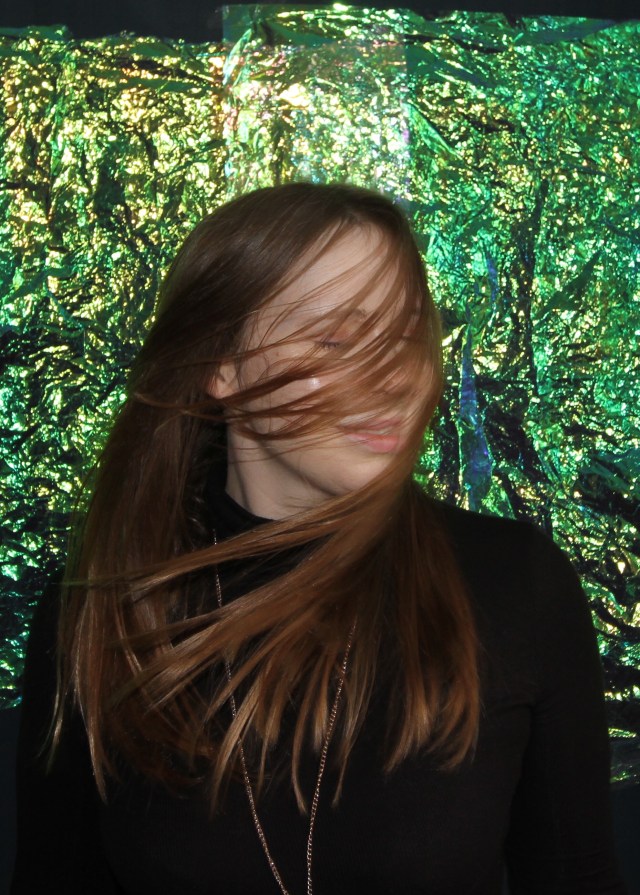
Alice Hubble is the new solo project of Alice Hubley, known for her work with Rodney Cromwell (Adam Creswell) in Arthur & Martha, Mass Datura, Cosines and several other groups. Her debut Alice Hubble LP, Polarlichter, arrives in August – I’ve heard it and it’s an absolutely sensational melting pot of electronic music reference points underpinned by Hubley’s own international wanderlust that will be well worth waiting for.
The first single from Polarlichter, ‘Goddess’, was released in May by Happy Robots.
What is your earliest memory?
My earliest memory, rather tragically, is being about three or four years old and watching the first episode of the Care Bears. I remember watching it on our old 80s white TV thinking, “They get me,” (hmm…) and that it was the best thing ever.
This sort of makes sense as I do love watching TV. I had very similar reactions later on in life watching Buffy, Girls and Crazy Ex-Girlfriend.
What’s the best piece of advice anyone’s given you?
Most recently it’s been advice I’ve given myself to stop focussing on the things I haven’t achieved, and to just try and enjoy the here, the now and the process.
I think with the Alice Hubble LP I’ve tried not to have any expectations on what could happen, and just tried to enjoy the experience. Of course myself and Adam from Happy Robots – Adam more so – are working hard, but everything feels like a bonus to the fact that I recorded an album and it’s actually coming out.
When are you most productive or inspired?
Like most musicians I’m not really a morning person, but I’m not really that productive later on in the day. I have a small window between 11 o’clock and 4 o’clock when I’m most productive. That being said, when I’m in the studio I’m quite happy to do long days, and when we were doing the album, both myself and Mikey Collins pulled long shifts working on the LP. (You should check out his album, Hoick!)
Inspiration can hit anytime. I do find things will come to me when I’m walking out and about, and so my phone’s voice memos are filled with breathy mumblings that generally take some time to decipher!
Goddess by Alice Hubble is out now on Happy Robots.
The third cassette release in the Bibliotapes label’s pairing of iconic books to music finds Norwich’s adaptable electronic sound artist Audio Obscura (Neil Stringfellow) providing a soundtrack to George Orwell’s chillingly accurate Nineteen Eighty-Four, released to coincide with the 70th anniversary of the its publication.
To be clear, this is not an opportunity for Stringfellow to cover, or even offer an alternative to, the (controversial) soundtrack put together by Eurythmics for the movie released in the year that the book was set in; this is about interpreting the actual text through the medium of completely newly-imagined music, and, a bit like a media-controlled slogan in Nineteen Eighty-Four itself, for the purposes of this we should profusely deny the existence of said film.
What that means is that his accompaniment to the daily, mandatory ritual of venting and screaming in collective anger on ‘Two Minutes Hate’ is presented as a bleak, primal, dissonant noisefest set to a insistent post-industrial beat; the pieces soundtracking the scenes depicting Winston, the book’s protagonist, and his attempts to wilfully evade surveillance and the controlling hand of the Party are freighted with both a pastoral, naturalistic serenity and a sort of nagging tension, filled with mournful strings and birdsong; the scenes set inside Room 101 are laced with a nagging, slow-motion sense of foreboding (and the displaced voice of Frank Skinner).
In Stringfellow’s hands, the haunting familiarity of ‘Oranges And Lemons’ is presented twice, first as a shimmering, gauzy memory resplendent in childhood innocence, and later laced with harshly-processed impending operatically-voiced doom, a vestigial scrap of something that didn’t get fully processed in a memory hole.
Something about the way that Stringfellow has crafted these pieces seems to simultaneously remind us of the unflinching horror of daily life that Orwell predicted in his dystopian musings, while also presenting a sense of resignation and dismay that this is the world we currently occupy – and one that we have willingly submitted to.
Nineteen Eighty-Four by Audio Obscura is released on June 8 2019 by Bibliotapes.
Swedish composer Ellen Arkbro’s time studying with La Monte Young and Marian Zazeela at their New York Dream House is self-evident on her follow-up to 2017’s For Organ And Brass. CHORDS consists of two pieces, one for organ and one for guitar, both utilising the just intonation microtonal methodology which Young has espoused for the majority of his sixty-odd year career.
‘CHORDS for organ’ was recorded at Malmö’s Art Deco St. John’s Church on its early twentieth century organ, following its original realisation in Stockholm. The 15-minute piece consists of a series of long, held tones and a number of carefully-deployed harmonic additions that subtly alter the dynamic propensities of the organ tones, the intersections gently pulsing phasing like a soft breeze through the wood-clad nave of the church. Initially harsh and grating, as the piece concludes you find yourself experiencing a sort of meditative transcendence, the brusque edges of the organ turning into something altogether more enlightened.
Its companion piece, ‘CHORDS for guitar’ blends Arkbro’s playing with the addition of digital synthesis. The piece is resented as a sequence of constantly-evolving patterns, where the resonances between the metallic-sounding strings are not unlike whole, vast universes of intricate sound.
CHORDS by Ellen Arkbro is released by Subtext Recordings on June 7 2019. Arkbro will perform CHORDS at the church of St. Giles-without-Cripplegate within London’s Barbican Centre on June 22 2019. Tickets are available from barbican.org.uk
Neil Campbell, Alexander Tucker, Daniel O’Sullivan
Plasma Splice Trifle pairs together Vibracathedral Orchestra member Neil Campbell’s Astral Social Club project with Alexander Tucker and Daniel O’Sullivan’s Grumbling Fur. Consisting of four lengthy, many-layered, pieces occupying the electronic music’s most eclectic hinterlands, Plasma Splice Trifle was recorded over the course of three years, each piece overflowing with ideas and a constantly-moving inner turbulence.
Ahead of the album’s release, Further. spoke to Neil Campbell about the collaboration.
You hadn’t worked with Daniel or Alexander before this album. How did this collaboration come about?
I honestly can’t remember! I think we were probably hanging out after a Grumbling Fur or Vibracathedral Orchestra gig and it was mentioned by one of us – probably either Daniel or Alex – and it seemed like a good idea, in as much as none of us could imagine how such a collaboration would turn out. No better reason than that for me!
The four tracks on the LP were started in 2015 and completed last year, and involved time spent in three different recording settings. How did the process of writing these pieces work? Was there a plan for what the pieces would be like, or was each track conceived and developed relatively spontaneously?
I don’t think of it as ‘writing’, more ‘doing’, always in the present, without much of a plan. I really like how Grumbling Fur work – they’re really open to quick decisions and where they may lead you with a good sense of play / fun too.
Most of the record was generated from a day’s recording together at Tower Gardens, with three of the tracks having their genesis in an open-ended hour long live jam. We then each took the recordings away and sculpted them into four very distinct shapes and worked from there, adding and editing where appropriate, passing sounds back and forth through the e-aether. We then pulled the tracks into their final form with another studio session together at the end.
‘Back To The Egg’ And ‘Toejam Boxdrum’ are very busy pieces, with lots and lots of layered detail. I’m always intrigued with very densely-packed tracks as to when you know you’re finished versus a temptation to just keep adding details – more and more layers, more and more sounds – and with three musicians that feels like it could be a challenge to know when to stop. How did that work?
Strangely, ‘Toejam Boxdrum’ is actually a really simple construct, with most of the sounds all coming from this initial jam, which was all recorded live to 2-track. We then added very little. So I guess it’s not always the way it seems.
But it’s a good question – all three of us like to work that maximal / minimal dichotomy, so there is a danger of, ahem, over-egging it. I guess someone says, “Enough!” or, “Too much!” and we trust each other to go along with their vision. ‘Toejam…’ would have been even simpler if it was left to me, but Daniel and Alex each had small additions they wanted to add underneath the initial jam, so we tried them and they worked. But, equally, if they hadn’t worked then we’d have left them out.
In contrast, ‘Three Years Apart’ is more sparse, though it also has a denseness when the drones and fluttering tones start to mesh together. To me it sounds a lot like some of John Cale’s work on the first Velvets album – urgent and expressive, but also possessing a dark spirituality.
Conversely, that’s quite a dense track from our point of view, with myriad layers of strings and processed strings.
‘Ozone Antifreeze Intelligence’ seems to be channelling the work of various celebrated groups emerging out of Germany in the 70s. Are those groups a major influence for you all? The vocals on that track are mesmerising – I like the interplay between the main vocal and the bassier voices.
Sure, I’ve enjoyed loads of those German bands for a long time now, and I’m sure the same goes for the other two. Some bands chime with me more than others though, and I’ve got a particular emotional attachment to the whole Cluster / Neu! axis. I think ‘Ozone…’ is my favourite track on the record.
After the initial sounds went through the Grumbling Fur mangle / spanglemaker, it was a very pretty instrumental that I added some sounds around the edges to. But I think we all thought it needed just an extra something, probably to create a more direct human connection. So when we met up for the final session we each brought one line of resonant text with us and sang them one at a time, pretty much first take, and the whole song unfolded from there.
As I said, I like to work quickly, and Grumbling Fur naturally work like that too. We’re all happy to take the germ of an idea and just go with it to see where it leads. Added to that, I love how those two naturally, effortlessly harmonise with each other when they sing together on their own records, like it’s the expression of a deep friendship you’re hearing, so I really wanted to get some of that on the record just for my own kicks.
You each created a piece of artwork to go with the album. How integral to your music is that visual accompaniment?
The initial idea was to each create a piece of collage art so we could layer them all on top of each other for maximum confusion/density. When we had each done out piece we realised this probably wasn’t going to work as well as just letting the pieces breath on their own. An example of someone calling, “Too much!”, and us not being too hidebound by our original concepts to throw them out the window when they weren’t working. Improvisation / praxis!
Plasma Splice Trifle by Astral Social Club & Grumbling Fur Time Machine Orchestra is released on June 7 2019 by VHF Records. Read the Further. review here.
Since arriving in 2009, LA’s Sweatson Klank (Thomas Wilson) has played around with hip-hop’s ever-flexible template, veering from heavily sample-based cuts to those built up from his own mastery of vintage synthesizer sound programming. For Super Natural Delights, this musical polymath offers up a sun-drenched series of twelve relaxed pieces showcasing his enduring ability to mix instrumental dexterity with engaging rhythms.
‘Walking On Air’ is the first of many highlights on the album, built up as it is on a bed of rich, elastic basslines and 808 beats, all carefully overlaid with gauzy strings and languid flute hooks to present a crisp, carefree, summery simplicity. Elsewhere, ‘What A Night’ captures a jazzy, 80s atmosphere with squelchy synth lines, snatches of vocals and uncluttered drum machine rhythms, while the sedate ‘Island Life Calling’ sounds like the kind of sultry, inoffensive jazz muzak played on the porch at a branch of Bahama Breeze, replete with the sound of ice cubes rattling around in a Mai Tai and a crisp beat prised straight from a vintage Sadé number.
Towering above everything else is the chunky, all-too-brief slowmo disco of ‘Fat Cookie’, containing a groove so infectious it could literally cause a musical pandemic.
Super Natural Delights by Sweatson Klank is released June 7 2019 by Friends Of Friends.
Plasma Splice Trifle pairs together Vibracathedral Orchestra member Neil Campbell’s Astral Social Club project with Alexander Tucker and Daniel O’Sullivan’s Grumbling Fur, and follows the duo’s collaborations with organ and stuffed toy enthusiast Charlemagne Palestine.
Recorded over the course of three years, Plasma Splice Trifle consists of four longform pieces full of arresting sonic detail and overflowing with ideas, each one possessing an inner turbulence resulting in layer upon layer of engaging ideas. ‘Back To The Egg’ bespeaks humankind’s backwards motion rather than its enlightenment, moving forward on an unstoppable pulse across which all manner of textures are permitted to develop – vocal loops, percussive splinters, the sounds of babies crying and gurgling wordlessly. The piece is placed in direct contrast with ‘Three Years Apart’, its restless clustering of synths, strings, drones and stuttering non-melodies swirling with a kind of psychedelic elegiac rapture.
The standout piece here is ‘Ozone Antifreeze Intelligence’, which progresses on a muted, heavily-phased rhythm at the intersection of dub’s atmospherics and a mid-70s Germanic motorik groove, offset by beautiful, questioning, haunting vocals and a hypnotic, cinematic piano refrain. The effect is like staring at a distant horizon, the entire landscape taking on a hazy, amorphous, liquified otherness.
Plasma Splice Trifle by Astral Social Club & Grumbling Fur Time Machine Orchestra is released on June 7 2019 by VHF Records.
When I interviewed Brighton quartet Fujiya & Miyagi two years ago around the time of the reissue of their second album, 2006’s Transparent Things, singer and guitarist David Best expressed his admiration for Talking Heads and what he called their “awkward funk” sound. Perhaps more so than on any other Fujiya & Miyagi album, that reverence for that slightly off-kilter groove can be heard right across Flashback, containing seven of the band’s most precisely-executed cuts to date.
In the last couple of years, both Best and fellow F&M founder Steve Lewis have busied themselves with side projects – Lewis’s crystalline torch songs with Johanna Bramli as Fröst and Best with Fujiya & Miyagi bandmate Ed Chivers as the Terry Riley-inspired art-rock of Ex-Display Model. Surprisingly, none of that time out from their main group seems to have had any sort of influence on these new songs. You won’t find any fuzzy introspection here – just solid drumming from Chivers, elastic basslines from Ben Adamo and an effortless interplay between Best’s signature guitar styles and Lewis’s sinewy and infectious electronic patterns.
That tightness provides the backdrop to some of Best’s most oblique and deceptively humorous lyrics – a semi-political character assassination rant on the closing track ‘Gammon’, a bitter tirade against self-importance on ‘Personal Space’ and a brilliantly ironic (and astute) rumination on our modern obsessions on ‘Fear Of Missing Out’. The highlight among highlights is ‘For Promotional Use Only’, a low-slung, many-layered slow-builder that plays on one of the most mundane of piracy risk warnings and turns it into a hypnotic, restless epic, Best’s vocal taking on a distinctly paranoid hue as it progresses.
Flashback by Fujiya & Miyagi is released by Impossible Objects Of Desire on May 31 2019.
FRUM is the electronic pop project of Jenny Augustudóttir Kragesteen. Hailing from the Faroe Islands, an archipelago of nearly twenty islands between Iceland and Norway in the Atlantic, Kragesteen has quietly issued a handful of singles over the past couple of years that highlight her dreamy, gently heartfelt approach to pop.
Her latest single, ‘Ocean’, follows on from last year’s anthem to defiant individualism, ‘Beat’, a song that played with the rhythms and textures of R&B and hip-hop intersected by a buzzing synth riff and deceptively uplifting chorus. ‘Ocean’ finds FRUM racing headlong into euphoric territory again, blending springy electronics, chunky beats and a carefree, swirling vocal together in a mesmerising displaying of summery, emotional pop songwriting prowess.
FRUM’s debut album is expected to land in 2020.
What is your earliest memory?
I sometimes feel like I can remember when I was in my mother’s womb but I know that’s not true – I just wish it was. It’s actually probably when I was two or three years old, sleeping on my mother’s chest or maybe sitting outside on a swing, looking at the blue sky.
What’s the best piece of advice anyone’s given you?
Be honest.
When are you most productive or inspired?
Definitely when I’m out in open nature. I get overwhelmed by a powerful feeling that everything is a part of everything and that I am somehow connected to it. I’m also quite productive when I’m sad and when I feel lonely. Being creative always makes me feel better.
‘Ocean’ is out now on hfn music. Listen to ‘Ocean’ at Spotify.
For the past sixteen years, Portland, OR’s Matthew Cooper has been issuing ambient albums full of dense layers and affecting emotional resonances. Pianoworks, as its name suggests, is an album made entirely with piano, a sequel to 2004’s An Accidental Memory In The Case Of Death. The inspiration this time around was the notion of childhood innocence and the struggle to retain that as the gravity of adulthood reveals itself.
That heavy sentiment gives pieces like ‘Quiet Children’ a hopefulness, its central melody evoking the notion of looking back on early memories through the sepia-tinged lens of time. In contrast, ‘Carrier 32’ has a subtle stridency, portraying the determination of a child to talk, walk or grab at objects that you’d rather they didn’t touch. There’s also a prevailing sadness that those days seem like a lifetime ago, with that melancholic dimension existing most notably in the concluding, unresolved melodies of ‘Empathy For A Silhouette’.
By stripping back the layers Cooper normally deploys, he has created a precise, beatific album that will leave an indelible mark on anyone – even the most curmudgeonly of souls – who are prone to bouts of wistful nostalgia for those halcyon, simple, lost days of youth.
Pianoworks by Eluvium is released on May 31 2019 by Temporary Residence.
Japanese composer and future Fluxus acolyte Mieko (Chieko) Shiomi was the founder of Group Ongaku, a spirited collection of likeminded experimental artists that she brought together in 1960 specifically to explore improvisation. After completing her studies in Tokyo, Shiomi returned to her native Okayama and began solo performances by the likes of John Cage, who Group Ongaku had previously invited to Japan to perform.
Cage’s influence is evident in Shiomi’s series of action poems penned in 1963 and 1964, wherein musical notation was entirely eliminated in place of specific, but necessarily vague, performance instructions. In the case of Boundary Music (1963), the instruction to the performer is “Make your sound faintest possible to a boundary condition whether the sound is given birth to as a sound or not. At the performance, instruments, human bodies, electronic apparatuses and all the other things may be used.”
A new LP from the multi.modal imprint finds seasoned improvisers David Toop and Jan Hendrickse separately tackling Shiomi’s piece. In Toop’s case, his version is anything but quiet, but as he himself has pointed out, to assume that Boundary Music is about silence is entirely incorrect. Taking Shiomi’s instruction that any sound source may be utilised, his version employs field recordings of what are possibly prayer calls, inchoate percussion, electronic pulses, whistles, squeaks and a foundation sound in the form a high-pitched sound that runs with prominence through the entire piece. The result is a series of restlessly evocative events alternating between density and levity.
Hendrickse’s interpretation is much quieter, but not a bit less intense. In his hands, Boundary Music is offered as a series of low-level rumbles, thuds, scrapes and fuzzy tones that each lurk in the background until suddenly being thrust forward. For Hendrickse , the piece becomes fraught with unresolved tension, having all the notional silence of an empty space with all the atmospheric drama of a horror soundtrack, particularly when an ominously distorted drone emerges and rapidly cuts away again into squelchy, alien sounds.
Side two of the LP is given over to a performance by London’s City University Experimental Ensemble (CUEE) recorded at the IKLECTIK venue. Here, the 25-piece big-band improvising orchestra perform two works by saxophonist Cath Roberts (Off-World and March Of The Egos). Their placement alongside Shiomi’s Boundary Music almost acts as a form of confrontation, given how these pieces wilfully avoid faintness: clangorous synth splinters collide with plucked sounds, clusters of overlapping piano parts and expressive saxophone parts. This ensemble works best when they dive headlong into the maximalist sounds you would expect from this many musicians, with the thrilling denouement of Off-World taking the form of a vibrant, colourful, euphorically noisy collision between noir jazz and electronics.
March Of The Egos, meanwhile, is a discordant, joyously sprawling piece wherein each instrument and player seems to be vying for airtime. The initial winners are a 1920s ragtime trumpet solo and a sustained synth tone that seems to cut across (and through) just about everyone else until the horn section and wandering piano join forces with the drums for a massed, and ultimately successful, assault on the electronics.
Boundaries by David Toop, Jan Hendrickse and CUEE is out now on multi.modal. See Mieko Shiomi’s instructions for Boundary Music at the MoMA website.
You must be logged in to post a comment.