Piano And Patterns, London Institute for Mathematical Sciences (February 13 2026)

What happens if the left hand doesn’t know what the right hand is doing? What if there are two left hands and two right hands? What if both left hands don’t know what both right hands are doing?

I could go on subdividing this conundrum up a few more times, but I won’t. I won’t, because it’s irrelevant. Irrelevant because, having watched performances of Brahms’ Variations On A Theme By Robert Schumann, Schubert’s Variations On An Original Theme In A-flat Major and Leontovych’s Shchedryk by Ukrainian pianist brothers Alexei and Sasha Grynyuk – two pianists playing the same piano, together – what I witnessed was an example of complete harmonious synchronisation. Then again, the Grynyuk brothers are two esteemed, award-winning musicians, so nothing short of perfection should have been expected.

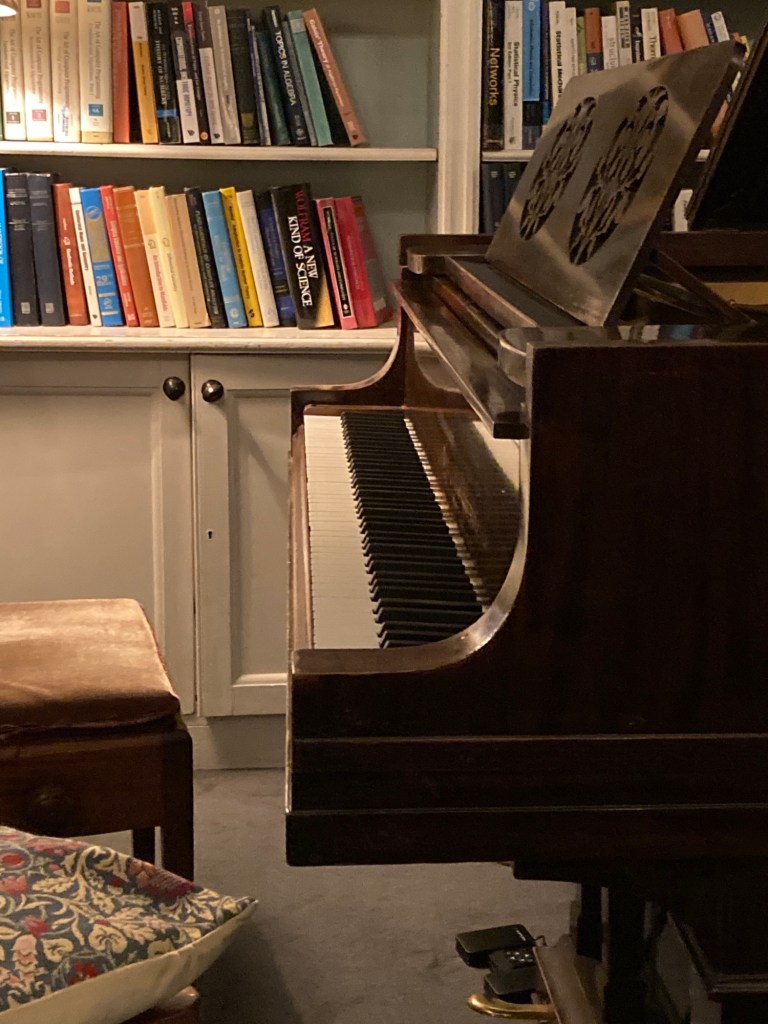
Watching their four hands frantically moving across the keys of the antique Steinway piano was a mesmerising display of dizzying dexterity. I watched Vanessa Wagner performing Philip Glass pieces at the Royal Albert Hall a few years ago and I was reminded of her lightning fast performance while watching the Grynyuk brothers as their hands raced at impossibly high speeds across the keys. It was like a display of kinetic energy; appropriate, given that the London Institute for Mathematical Sciences is located at the Royal Institute, where Michael Faraday conducted his pioneering experiments in energy.

It was also, occasionally, a little stressful to watch from a front-row seat that afforded a perfect view of those hands clustered at the centre of the keyboard. I watched, simultaneously in awe of what I could see, and strangely fearful that their hands might collide. It felt like there wasn’t enough space for their hands to co-exist at the instrument together. I anticipated moments of unintentional disharmony through some sort of mid-melodic crash, but, of course, there were none. See my previous comment about their award-winning status.

The two pieces were punctuated by a lecture by Professor Yang-Hui He, a Fellow at the London Institute for Mathematical Sciences (and self-proclaimed failed musician), who posited that the true architect of harmony was Pythagoras. Exploring the mathematical theory that explains the note intervals of scales and different harmonic patterns used in Chinese / Japanese, Western and Indian scales, I’ll be completely honest that I wished I’d paid more attention in both my music and maths lessons. It was just as baffling, to a maths novice like me, as trying to untangle the four Grynyuk hands as they played, but it involved fractions, and nothing is more likely to induce educational PTSD in me than trying to fathom fractions all over again.

Self-evidently, this piece is a departure from the usual words placed here on Further. It illustrates that I know very little about musical (or indeed mathematical) theory. Bearing in mind that my two careers – in finance and music writing – rely on a degree of knowledge of both of these, that’s a fairly brave admission.

It also illustrates that I’m more than happy to be put in situations where I am materially outside of the comfort zone in which I tend to operate. It also refutes, to my mind, the notion that your appetite for musical exploration atrophies as you get older. I’ll continue to seek out enlightening, enlivening and mind-expanding musical experiences like these until my ears fully fail me.

With sincere thanks to Katya Gorbatiouk and Sarah Myers Cornaby for the invite.

Words: Mat Smith

(c) 2026 Further.


Erland Cooper – Hether Blether

ErlandCooper_HetherBlether_artwork

At some point in May, a letter dropped through my letterbox with a handwritten envelope that stood apart from the endless clusters of bills that seem to be our only engagement with the UK postal service these days. Inside was a signed map of Orkney created by musician Erland Cooper containing walking routes and birdspotting locations. That delivery accompanied the imminent release of Hether Blether, the concluding instalment of Cooper’s trilogy of releases that celebrate the collection of islands where he grew up.

Where 2018’s Solan Goose eulogised the islands’ birdlife and 2019’s Sule Skerry the sea, Hether Blether turns its attention on the land. Sort of. The land in question is the mythological island of the album’s title, a folkloric, missing location that naturally does not appear on the map that Cooper sent me. What does appear on that map, however, are the likes of ‘Noup Head’, ‘Longhope’ and ‘Rousay’, all tracks on the new album, continuing the theme of the previous two albums wherein Cooper named pieces of music after specific locations.

Resplendent in lush, yet fragile string arrangements and choral texture, the tracks on Hether Blether are joyous, celebratory even, albeit in a self-reflective, muted fashion. The synth passages and field recordings that ran through Skule Skerry here take a backseat, emerging briefly on pieces like the stirring, slowly evolving ‘Skreevar’, one of the most beatific moments here. We once again eavesdrop on the local, distinctive Scottish / not Scottish accents on ‘Longhope’ and explore Orkney’s mythology through the strangely affecting poetry of John Burnside on ‘Noup Head’, each word in Kathryn Joseph’s narration containing a sort of gravity and poise that makes you yearn for the islandscape of Cooper’s youth.

Appropriately enough, it is Cooper’s own voice that we hear more prominently throughout Hether Blether, most notably on the album’s centrepiece, ‘Peedie Breeks’, where he is accompanied by poignantly seesawing strings, bells, and operatic vocals that drift in like an icy breeze. His is a lilting, tender voice, effortlessly tugging at your heartstrings as he delivers this song of innocence, playfulness and the unbridled, unshakeable optimism of youth.

Hether Blether by Erland Cooper is released May 29 2020 by Phases.

Words: Mat Smith

(c) 2020 Further.

Jazzrausch Bigband – Beethoven’s Breakdown

The follow-up to last year’s Christmas album Still! Still! Still! and the reissue of 2018’s Dancing Wittgenstein, Beethoven’s Breakdown exemplifies what composer / arranger Leonhard Kuhn and bandleader Roman Sladek’s Jazzrausch Bigband do best: namely, creating large-scale sonic landscapes occupying the nexus of jazz, classical music and house music.

If that still seems unlikely, one cursory listen to the group’s arrangement of Beethoven’s ‘Moonlight’ sonata should help dispel any sort of notion that this is some sort of novelty hybrid. Here, the piece’s familiar melodic motif is interwoven with a thudding dance beat and freeform brass solos that swing gently on the framework of the composition, never detracting, but highlight this Munich-based sixteen-piece band’s dexterity within the jazz oeuvre. The major surprise are the small, subtly evolving circular sections running throughout the piece, creating a familiar sensation for anyone used to hearing the tweaked modulations of a minimal techno track, but here providing the connective tissue between that strain of dance music, Terry Riley and Ornette Coleman’s harmolodics. It perhaps shouldn’t work, but it does.

Beethoven’s Breakdown sees Kuhn and Sladek distinctively re-interpreting three Beethoven pieces – the aforementioned ‘Moonlight’ sonata, his Symphony No. 7 and the two-part String Quartet No. 14. Each one is delivered with the flair and sensitivity that Jazzrausch Bigband have become known for, in other words being respectful of the source material, the jazz tradition and the expected formalism of house while still allowing enough room for gentle improvisation. Leonhard Kuhn’s synths are deployed carefully, never detracting from the traditional jazz instrumentation but also providing interesting detail and colour throughout.

The album also includes a four-part sonata composed by Kuhn and featuring the trombone of Nils Landgren. This piece nods firmly in the direction of Beethoven but have more of an open, less densely-packed dimension that allows greater room for soloing – Landgren’s expressive trombone, the combined pianos of Severin Krieger and Kevin André Welch and Kuhn’s blipping electronics.

The element that is perhaps least appreciated, yet omnipresent, here is Silvan Strauß’s drum technique, wherein the entire album hinges on his ability to play unwavering robotic drum machine patterns and more complex polyrhythms, often alongside Kuhn’s programmed rhythms.

Beethoven’s Breakdown by Jazzrausch Bigband is released March 27 2020 by ACT Records.

Words: Mat Smith

(c) 2020 Further.