In Conversation: Kemper Norton

kempernorton_oxlandcylinder.jpg

Kemper Norton is a Cornish electronic music adventurer who often uses the local history of his home county as the basis for complex, evocative albums that defy easy classification.

His latest work, Oxland Cylinder, is the counterpart to last year’s Brunton Calciner. The titles of these two albums might sound like some sort of abstract concatenation of random words but they are in fact the names of facilities developed for the extraction of arsenic, a lucrative byproduct of the tin mining that Cornwall was once famed for.

Further. spoke to Kemper Norton to find out more about his enduring interest in developing music inspired by the mythology and stories of his local surroundings.

Your albums Brunton Calciner and Oxland Cylinder are concerned with the arsenic manufacturing process that has left abandoned facilities across the Cornish and Devonshire hills. What was it that made you want to use these as the basis for an album?

They’re one of the classic picture postcard icons of Cornwall and have led to areas of the coast being designated a World Heritage site, but I wanted there to be a wider awareness of their original purpose and role in the industrial revolution, and in the West Country and the global economy.

The creation of arsenic as a byproduct of the mining process also tapped into many themes of toxicity, domestic life and physical transformation that I’m interested in at the moment. They’re also buildings that I’ve seen every day growing up and I wanted to explore them more deeply before the landscape changes further into the view from a millionaire’s second home, and it becomes less accessible.

History – Cornish history especially – has a big presence in your work. The new album includes an old tin miners’ song interpolated into the piece ‘Halan’ that threads through Brunton Calciner and Oxland Cylinder, while 2017’s Hungan used a mythical pirate active along the coast as its foundations.

How do you go about researching and unearthing things like that? What is it about the history of this county that inspires you so much? Or is history in general something that inspires you?

I have never been interested in personal songwriting based on my own experiences in a literal way. There are loads of artists doing that and I don’t think we need another bloke telling his stories or desires, but I do feel there are neglected areas and people in history that still have interesting stories, at least to me! History, particularly social history and folklore – both old and modern – have always been a big influence, and I’m sure they will continue to be. As I grew up mainly in Cornwall, that’s bound to be a major element.

I don’t think there’s necessarily anything unique or magical about Cornwall any more than other counties or countries though – that’s part of its image that tourists go for and which residents exploit. The history of Coventry, Croatia or car parks will all have resonance and amazing hidden stories.

You have, on occasion, described your music as being ‘rural electronics’. What does that mean, in practice? Is it a style that comes from what you’re inspired by, or do you think it’s more a set of rules governing how you approach making your music?

When I started I just thought it was an honest way of pointing out that my upbringing is generally rural and I wasn’t that influenced by many urban styles of music, although that’s definitely changed.

The synth sounds, samples and field recordings were explicitly meant to sound rural in the North Cornwall sense – blasted by the Atlantic, rough, salty and hopefully unique. I was aware of artists like Aphex Twin and it was great that a Redruth boy could make it so far, so that in itself was inspiring, but I hope I’ve manage to avoid using tropes and conventions used by other artists too much. That’s pretty much the only rule!

Although it would be tempting to associate you with the hauntological genre, your music doesn’t seem intent on creating this wistful sense of nostalgia but instead seems to mourn that which is at the point of being lost from memories completely. Is that a conscious part of what you do?

Definitely. I can’t be nostalgic for Britain in the 1970s, Doctor Who or the Radiophonic Workshop because they’re not my memories or influences – I only moved to the UK in 1982 as a child. I also think that type of nostalgia for those specific cultural touchstones and era seems both oversaturated and close to cosy UKIP nationalism to me.

The idea of any kind of golden age is bollocks, particularly a recent British one. I’m also not interested in easy references to shared cultural memories of television or whatever. In terms of focusing on specific histories or stories being on the verge of lost , that’s definitely a theme in my work but it’s not necessarily limited to a specific era or mood.

If we take Brunton Calciner and Oxland Cylinder as representative of your interest in taking historical inputs as a starting point, how did you go about actually converting those inputs into music?

I’m not that technical. I use a combination of samples, field recordings and sounds as a mood board for a specific album, and then they undergo a range of processes including granular synthesis and effects processing. Some come out the other end intact, whereas other sounds are absolutely unrecognisable, and others become base sounds for new instruments and melodies. Then they attempt to become songs!

Recently I’ve become interested in using as few sound sources as possible. Most of Brunton Calciner is based on two samples which are layered and continually reprocessed, which ties in with the themes of the album.

The two most recent albums exhibit a strong sense of narrative, meaning its presentation felt more like a radio play than an experimental electronic album. Was that deliberate? Do you see your music as being a form of story telling?

I like stories and narrative in music, and no matter how much I try to avoid it I can’t help creating or following a narrative in an album. It’s rather old-fashioned but I do see each album as a story, with a beginning, middle and end during construction, however ambiguous. At the same time, I don’t think it matters if listeners deconstruct or ignore that.

Do you think could be inspired in the same way by, say, the history of somewhere like London? Or is it under-appreciated histories that appeal to you the most?

Everywhere is interesting if you look at it closely. Even Surrey.

Oxland Cylinder by Kemper Norton is released February 24 2020.

Interview: Mat Smith

(c) 2020 Further.
John Chantler & Johannes Lund – Andersabo

Johs&John1_front

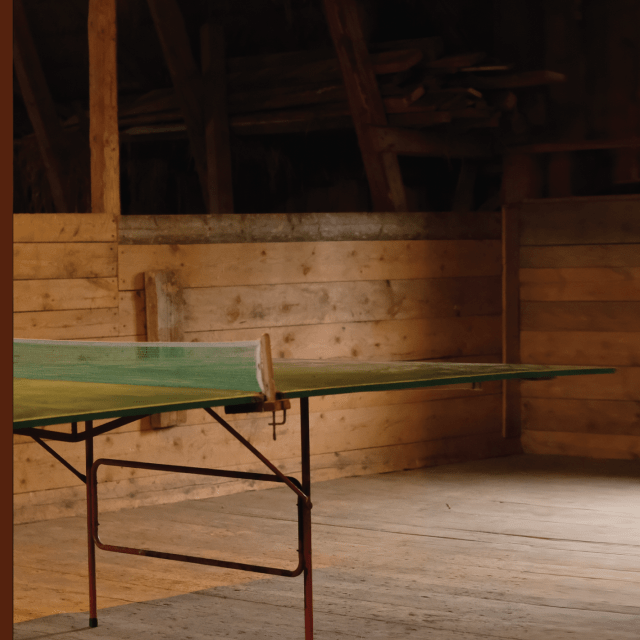
A second duo outing for Swedish / Australian John Chantler (pump organ, synths) and Denmark’s Johannes Lund (saxophone), recorded during a residency in Sweden’s Andersabo.

Consisting of three long tracks, each piece here is its own unique soundworld full of clashing sounds, vibrant tensions and noisy interplay. Opener ‘Back Of The House’ has a playful quality thanks to Lund’s rapid, fluttering saxophone cycles, performed in such a way that he never seems to pause once for breath; his sax might be the focal point but it is the swirling, droning, seesawing organs that set the mood here, creating a beautiful discordant energy.

‘Open Field & Forest’ acts as a moment of quiet repose, Chantler’s sounds acting like a bed of ambient noise over which field recordings of birdsong, creaking wood and insectoid chatter are overlaid. Lund arrives in the piece’s final minutes with some processed, murky bleating that sounds like metallic scraping, but on the whole this piece is a delicate pause for reflection.

In contrast, ‘Under Barn Floor’ is a busy, maximalist summation of both the preceding pieces, built up from earthy, growling sounds, shimmering organ layers and a grubby, subtly nihilistic intensity.

Andersabo by John Chantler and Johannes Lund was released February 12 2020 by Johs & John.

(c) 2020 Further.

3 Questions: Charlotte Spiral

Charlotte Spiral is a duo of Amy Spencer and Avi Barath, two former Goldsmiths students now writing complicated songs laced with lyrics loaded with emotional uncertainty; those words are only matched in their complexity by the many-layered musical architecture that supports Spencer’s distinctive voice.

“I kind of like it that people think my name’s Charlotte,” laughs Amy. “The name Charlotte Spiral came from a pose in figure skating. We started putting the music on top of old figure skating videos and then Avi and I decided that our band name should have something to with it because it’s so elegant. We wanted that to be reflected in the music.”

Upon the release of their debut EP, the gorgeous, mesmerising and haunting Ideal Life, Charlotte Spiral spoke to Further. about fake medicine and ‘A Lovely Bunch Of Coconuts’ – very probably the one and only time that song’s going to get a mention here, and highly unlikely to feature on their debut album, I imagine.

What’s your earliest memory?

Amy: When my brother and I were kids my grandparents would look after my brother and I, mostly after school and also in the summer when our parents were at work.

I have a strong memory of them sitting together on a bench under the apple tree in the garden. My granddad loved music and he could sing beautifully – he could play the harmonica and even the spoons! My grandma would sing that song ‘I’ve Got A Lovely Bunch Of Coconuts’. I’m sure she sang many other songs too but for some reason that one sticks!

Avi: There is a place in Rhodes that is meant to be very beautiful called Butterfly Valley. Sadly, my earliest memory is of being very sick there. My dad tricked me and gave me a Mentos sweet, which he told me was medicine. I think it actually worked…

What’s the best piece of advice you’ve been given?

Amy: Stop worrying!

Avi: Trust your instincts.

Where are you most productive or inspired?

Amy: I often get ideas for lyrics when I’m travelling or walking somewhere. It’s usually just a line or two that I will finish once I have a chord progression and melody.

Avi: It changes all the time to be honest, but recently it’s been wherever there is a piano.

Ideal Life by Charlotte Spiral is released February 7 2020.

Interview: Mat Smith

(c) 2020 Further.

Avi Pfeffer – A Lasting Impression

avipfeffer.jpg

Classical music and electronics are currently locked in a comfortable embrace. This has arisen largely as a consequence of modern compositional methods which rely heavily on the ambience and atmospherics that a careful-deployed analogue synth or some after-hours digital manipulation can add to the music.

It wasn’t ever thus. From more or less the beginning of synthesizer technology becoming more accessible, the game in town was to produce electronic arrangements of classical pieces, and that’s the jumping-off point for Boston composer Avi Pfeffer’s A Lasting Impression.

The four-part suite uses classical structures and figures but is delivered entirely electronically. Beats drift in then ebb away, melodic gestures re-emerge continually and Pfeffer deploys a dizzying array of sounds, textures and rhythms throughout the almost hour-long album. The tonality of these collected sounds is especially important – this isn’t gauzy, drifting ambience or modern glitch-heavy soundtrack noir, but bold, grandiose sounds arranged into longform movements. I’ve never quite grasped the vernacular to articulate why this is, but there’s something about hearing electronics used in this way – a particular challenge when your diet consists primarily of people twiddling modular synth knobs or making electronic pop – that makes me think of Don Dorsey’s distinctive retrofuturism.

Dorsey made a series of electronic albums in the mid-1980s that essentially took Bach’s music and recreated their austere presentation with an enviable kitlist of cutting-edge electronic equipment, much as Wendy Carlos had done twenty years before. He also went on to be the in-house sound designer for Walt Disney World, composing the fresh, euphoric, scientific-sounding music that’s still memorably piped into places like Epcot and Tomorrowland.

I get the same feeling of hearing something exceptionally forward-looking yet locked in a particular era when listening to A Lasting Impression. If the press release had said Pfeffer had written these pieces thirty-five years ago and they’d languished, unreleased, I’d have not been surprised. To do this type of thing today is brave. We’re not used to hearing electronics like this in 2020, and so to enjoy it requires a little adjustment. Once you do, it’s a perfectly enjoyable record, full of interesting details and moments.

My personal favourite sequence arrives with the gleeful, squelchy opening minutes of the third part, largely because it transports me to the deck of Narcoossee’s on a balmy Florida evening several years ago watching The Electrical Water Pageant (originally scored by Dorsey) burble and fizz its inimitable way past with my daughters; just for giving me the the opportunity to reminisce about that makes this album entirely worth it.

A Lasting Impression by Avi Pfeffer is released February 7 2020 by Pumpedita.

Words: Mat Smith

(c) 2020 Further.

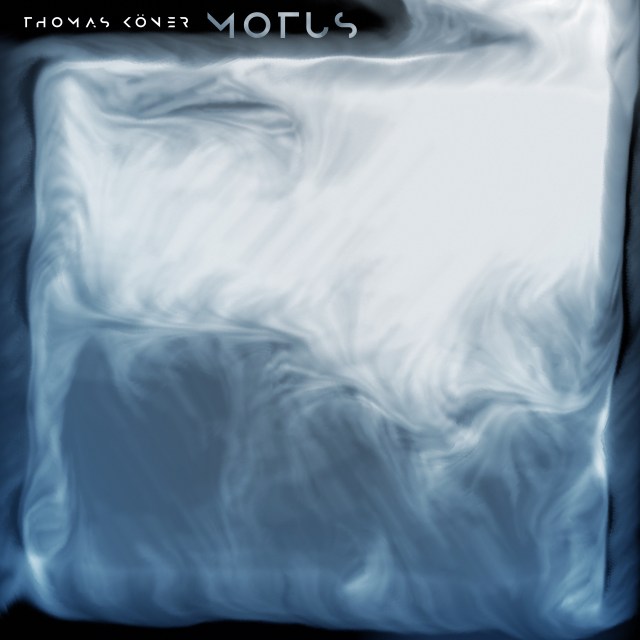
Thomas Köner – Motus

MP6_front.jpg

“I dream of a dance floor where Motus would be enjoyed,” says Thomas Köner. “What kind of society would allow that?”

His ambition isn’t necessarily wilfully controversial or provocative, but it nevertheless underpins a desire to unshackle music from the notion of grids, beats, BPMs and electronic music formalism. Motus is the latest instalment in Köner’s gently subversive approach to analogue synthesis, something I first experienced way back in June 1996 with ‘Untitled’, a track included on a CD given away with The Wire (Miaow! (…Cats What I Call Music)). That track was, on face value, a recording containing virtually nothing, a distant, ephemeral rumble easily overtaken by real life; to experience it, one had to tune everything out, turn it up loud and concentrate very hard. Only then could you hear the rich, undulating turbulence that the piece was actually constructed from. It was loud music, just presented very quietly.

Motus, comparatively, is bold, noisy and restless. Freed from the tyranny of the beat, tracks like ‘SUBSTRATE (Binaural)’ take their forward motion not from an obvious rhythm, but the ebbing waves of a modular sequence, whose pace only alters materially when the waveform is tweaked. The effect is, for those used to hearing music anchored to a pattern of kick drums, hi-hats and snare sounds, mildly unnerving. You want to attach these sequences to a rhythm, even though it’s not there, your inner clock suddenly thrown off track by a subtle modulation here or there.

Strangely, the effect of this – despite being made from nothing more than artificial waveforms and electrical current – is to remind you that nature does not cling rigidly to perfection. Gusts of wind don’t readily adhere to a quantised location on a screen; a bird’s flapping wings are not operating at a consistent BPM; your heart is more than likely not beating at precisely the same pace as it was when you started reading this (it will either have slowed down through disengagement or sped up through the panic of a beat-less musical world). It takes pieces like ‘SUBSTANCE (Suicide)’, and the other six tracks on Motus to make you realise that.

Motus by Thomas Köner is released February 6 2020 by Mille Plateaux.

Words: Mat Smith

(c) 2020 Further.

Infinite Scale – The Value of Accessibility

Following on from their excellent BUNKR and Echaskech releases, VLSI Records continue to cultivate that rare ability in a label of creating a cohesive identity while simultaneously showcasing acts who have their own personalities.

Such is the case with Harmi Paldi, who has been creating music under the alias of Infinite Scale since 2005. Opening track ‘Caught On Tape’ gives the feeling of leaning forward without falling over, like a glitchy, fragmented Jack Dawson holding Rose Dewitt Bukater at a 45-degree angle on the bow of the Titanic.

‘The Chauffeur’ is fuelled by a laconic bass-line that tethers all the other moving parts to its roots. ‘Ordinary Familiar’ splutters wonderfully to a halt like ‘French Kiss’ deprived of its morning caffeine. Album closer ‘Steppa Side’s wooziness suggests a more playful side which strikes a nice balance with the more muted tones of the track that precedes it, ‘Pay For This’.

The album concerns itself with the ease we have of accessing information and the sheer volume of data available to us. It also suggests a longing for the pre-internet days of anticipation and manual discovery. The use of the word ‘tape’ in one of the titles reveals a fondness for the tactile joy of physical objects. In a digital world items such as audio and video cassettes look and feel antiquated, and it’s easy to see why they might become fetishised by generations who were deprived of the pleasure of possessing them first time around.

Does accessibility trump first-hand experience? Can second-hand experiences ever match seeing and feeling things unfold in the flesh? Does it matter? Are we guilty of setting our personal filters too far to the point where we only interact with our own doppelgängers?

Perhaps the reality is if we solely embrace this constant source of never-ending information we will end up isolated and our opinions homogenised.

The Value Of Accessibility‘s strength lies in its ability to process and present ideas without losing its humanity or identity. To have information at one’s fingertips suits those of us who can no longer can be free in their movements, whether due to geographical responsibilities, mobility issues, or the end of free movement in Europe post-Brexit. Luckily, records such as these transcend physical borders.

The Value Of Accessibility by Infinite Scale is released January 31 2020 by VLSI Records.

Words: David Best. David is a founding member of Fujiya & Miyagi and Ex-Display Model.

(c) 2020 David Best for Further.

Waclaw Zimpel – Massive Oscillations

waclawzempel_massiveoscllations.jpeg

For anyone interest in the rudiments of electronic music, titles don’t come much more thrilling than Massive Oscillations, the name of the second album by Polish multi-instrumentalist Waclaw Zimpel. It is both a perfectly accurate depiction of the structure of the title track’s enormous, ever-shifting undercurrent of snarling, wild, grinding synth lines, and the guiding principle that runs throughout the record.

The album finds Zimpel, an arsenal of vintage electronics from oscillators to tape machines, a piano, his clarinet and a guitar operating in a many-layered excursion into the underexplored territory between the slow evolutions of minimalism, avant-garde jazz and intense electronics. The four tracks were recorded at Willem Tweestudio in Den Bosch, Netherlands over a period of nine days and then mixed by James Holden, a musician who knows more than a thing or two about fusing together jazz and electronics (see his deployment of Ornette Coleman’s harmolodic theory with fellow auteur Marcus Hamblett for evidence).

Both ‘Massive Oscillations’ and ‘Sine Tapes’ deploy a tension between wandering electronics and Zimpel’s clarinet, resulting in something that can – on one level – appear meditative and soothing but at other times presages a dirty, turbulent discordancy. The expressive reed playing could easily be allowed to dominate, but instead it threads noisily through the wavering, oscillating tones that dominate the foreground, only rising to the top when developed into thick, heavy blocks of drones, squeals and resonant melodies.

‘Release’ is perhaps the biggest departure from the sonic architecture used on the preceding three tracks, given that the electronics take something of a backseat, reduced to textural white noise, gentle shimmers and air cylinder hissing. Here we find Zimpel exploring territory not dissimilar to Terry Riley’s In C, repeated motifs for prepared piano, clarinet and guitar quietly developing over the course of its eight beatific minutes. The introduction of heavenly vocals provides the piece with an unexpectedly transcendent, dream-like quality.

Massive Oscillations by Waclaw Zimpel is released January 31 2020 by Ongehood.

Words: Mat Smith

(c) 2020 Further.

OUTLANDS – The Joyous Thing: Secret Flight / BodyVice

Two polar opposite live performances forming part of The Joyous Thing, a weekend of events at Milton Keynes Gallery investigating the UK experimental music scene. The Joyous Thing is part of the nationwide OUTLANDS interdisciplinary project.

Secret Flight is a local MK electronic musician whose current concerns involve fusing reverb-drenched vocals to delicate synth melodies and minimalist rhythms. The result is dreamy, angelic, choir-like voices delivered with a gauzy, hypnotic warmth, only laced with an uncertain quality somewhere between intense rapture and crushing disappointment. Her last album, 2018’s My Forever Mirage is a brilliant and understated gem of an album. Listen to My Forever Mirage at Bandcamp.

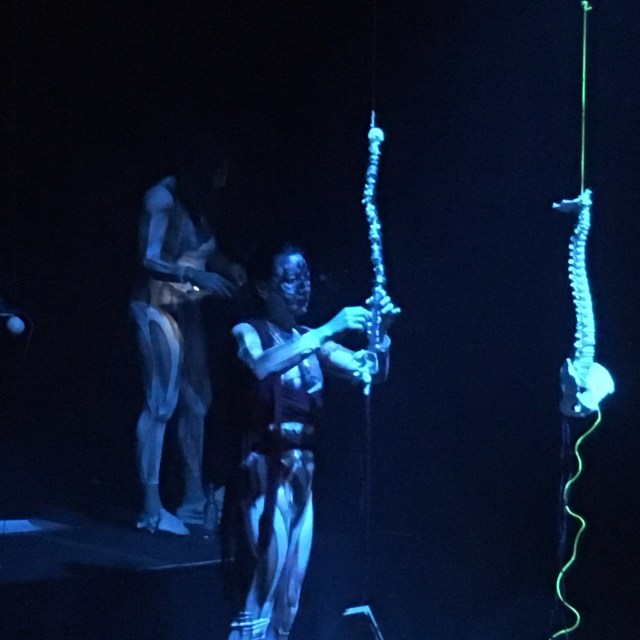
BodyVice is the latest project from Natalie Sharp, best known for her audacious, confrontational performances as Lone Taxidermist and as a Gazelle Twin collaborator. For BodyVice, the subject matter is the intense and excruciating back pain that she suffers with, and finds her channelling her experience at the hands of doctors as they seek to identify the cause.

Beginning with a hospital gown-wearing male collaborator’s Irvine Welsh-style delivery of what initially sounds like a misty-eyed recollection of a Speedy J set at a Belgian rave – all intense beats of rising velocity and modulating electronics – it becomes apparent that he is, in fact, describing an MRI scan experience. What ensues is nothing short of unnerving – Sharp (with a collaborator and occasional flautist) rotating on turntables against a backdrop of howling, impenetrable noise to evoke the claustrophobia and unnatural experience of an MRI scan, all frantic, rising rhythms and industrial-strength walls of unending sound.

The performance then proceeds through angry lists of precautionary statements from a clipboard waiver, mesmerising sounds and non-melodies played on modified spinal chords (pun intended) designed by Tara Pattenden (Phantom Chips), guttural invocations worthy of Diamanda Galás and a thrilling coda of punishing, strobe-lit industrial techno as Sharp douses herself in fake blood while screaming.

According to Sharp, BodyVice is a reaction against the proliferation of stale, insipid electronic-musician-on-stage-with-MacBook performances. It is most definitely that. It is also uncomfortable, challenging and frequently terrifying; as a physical, visual and aural metaphor for Natalie Sharp’s chronic pain, it is forcibly and viscerally accurate.

January 25 2020. Thanks to Zoe and Simon. MK Gallery: mkgallery.org

Words and terrible photographs: Mat Smith

(c) 2020 Further.

First Play: Novelty Island – Saturn Alarms

Novelty Island is the brainchild of Tom McConnell, who hails from an indeterminate location somewhere in the north of England, and whose group may or may not be named after a Vic and Bob skit.

Featuring deft choruses, woozy retro synths and a wonky, space-age sensibility, Novelty Island released their debut single, ‘Magdapio Falls’ last year and follow that understated, singalong gem with ‘Saturn Alarms’ which will be released this Friday.

Both tracks feature on the debut Novelty Island EP, Welcome To Novelty Island, which is due to land in March. ‘Saturn Alarms’ is the counterpoint to ‘Magdapio Falls’s languid, laidback structure, being an urgent rush through the turbulent reaches of our solar system and the omnipresent sauce junk floating around out there, replete with catchy vocals and star-scraping electronics. The track was named after some inexplicable graffiti that McConnell spotted tagged onto his mother’s house in Liverpool, and thenceforth transformed into a retro-futurist pop monster.

Listen to the exclusive first play of ‘Saturn Alarms’ below.

Novelty Island play The Social, London on March 19 and Shipping Forecast, Liverpool on 26 March. Saturn Alarms is released January 24 2020 through Ditto Music.

Words: Mat Smith

(c) 2020 Further.

3 Questions: YOVA

YOVA are a duo of Jova Radevska and Mark Vernon. Their first single, ‘Moondog’, was released last year and found the pair accompanied by a diverse group of players including Grumbling Fur’s Daniel O’Sullivan and PJ Harvey collaborator Rob Ellis.

On new single ‘Rain’, Jova ratchets up the mesmerising, enthralling innocence of her naturally soulful voice on a song detailing a painful, terminal break-up. The track has been given a a special mix from Erasure’s Vince Clarke that will be available from February 28. Both tracks will then be released as part of a four track digital bundle on March 6 2020.

To celebrate the release of ‘Rain’, Further. asked Jova and Mark our customary 3 Questions, with typically revealing results.

What is your earliest memory?

Jova Radevska: Wrapping my stuffed monkey in a blanket and also screaming my lungs out near a scarecrow in a cornfield with my grandmother.

Mark Vernon: The psychedelic colour of leaves, buildings, blues skies, clouds, stars and moon from the pram

What’s the best piece of advice you’ve been given?

JR: Trust yourself and don’t put all your Easter eggs in one basket.

MV: Never take no for an answer. Less is more. Don’t put the cart before the horse. The latter is from The Velvet Underground’s John Cale.

Where are you most productive or inspired?

JR: Mostly in solitude and when I’m sad and angry.

MV: When I’m either within reach of a keyboard or fretboard.

Rain by YOVA is out now. Listen here.

Interview: Mat Smith