Mariusz Szypura – Chopin Residue

Chopin Residue is a series of multi-media works by Polish artist and former indie rock musician Mariusz Szypura.

One part is a collection of ‘deconstructions’ of Chopin’s music, featuring the likes of Adrian Utley, Lee Ranaldo, Justin Meldal-Johnsen, John McEntire and many others. These pieces range from the ethereal, fleeting tones of ‘Prelude Op. 28 No. 20’ (with Charlie Draper on ondes Martenot and Theremin) to the ferocious guitar-heavy ‘Prelude Op. 28 No. 22’ with Ranaldo and saxophonist Zoh Amba, wherein strings emerge only to be battered down into submission. ‘Prelude Op. 28 No. 4’, with Utley, drummer Joey Waronker and thereminist Carolyn Eyck sounds like it belongs on Utley’s first Portishead album, with its chunky jazz rhythms and shimmering, maudlin guitar and electronic textures.

On the deconstruction of ‘Prelude Op. 28 No. 2’, Szypura presents Chopin’s mellifluous arpeggios as a snarling web of grubby synth sequences, offset by rigid drumming by John Stanier, feisty guitars from Sugar Yoshinaga and Draper’s electronics. ‘Prelude Op. 28 No. 15’ features jangly guitar from Ranaldo, measured kitwork from Stanier, and an array of tuned percussion from Milosz Pękala, the sum of whose parts is a long, hazy, psychedelic piece framed by the tracest outlines of classical melodicism.

Another part of this collection is a series of ‘reworks’ by Fennesz, Jim O’Rourke, Matthew Herbert, Christine Ott and others, which you are encouraged to play simultaneously with the deconstructions, if you happen to own two turntables.

Herbert’s version of ‘Prelude Op. 28 No. 22’ hitches sprinkles of Chopin’s piano to a dubby rhythm track, while Adrian Utley reimagines ‘Étude Op. 25 No. 12’ as a bouncy electronic wonderland complete with delicate, flute-like melodic gestures. Fennesz introduces skipping electronics and oscillating guitar to his version of ‘Berceuse Op. 57’, in the process turning the piece into a vibrant, unpredictable, becalming soundscape. Sean O’Hagan takes ‘Prelude Op. 28 No. 4’ and renders it as skipping, fragmented leftfield electro, while Jim O’Rourke subjects ‘Prelude Op. 28 No. 2’ to heavy reverb and phasing, the result of which sounds like an orchestra tuning up.

Christine Ott floods ‘Nocturne Op. 72 No. 1’ with layers of beatific ondes Martenot, an extension of her own prowess and practice as a solo artist and in the Snowdrops ensemble. Benoît Pioulard’s version of ‘Prelude Op. 28 No. 9’ is constructed entirely from layers of sensitively-arranged drones and swirling cycles of guitar feedback, while Abul Mogard approaches ‘Prelude Op. 28 No. 15’ as an opportunity to offer up a web of edgy, modular synth drones and white noise textures, through which occasionally poke amorphous elements from the piece on the deconstructions disc.

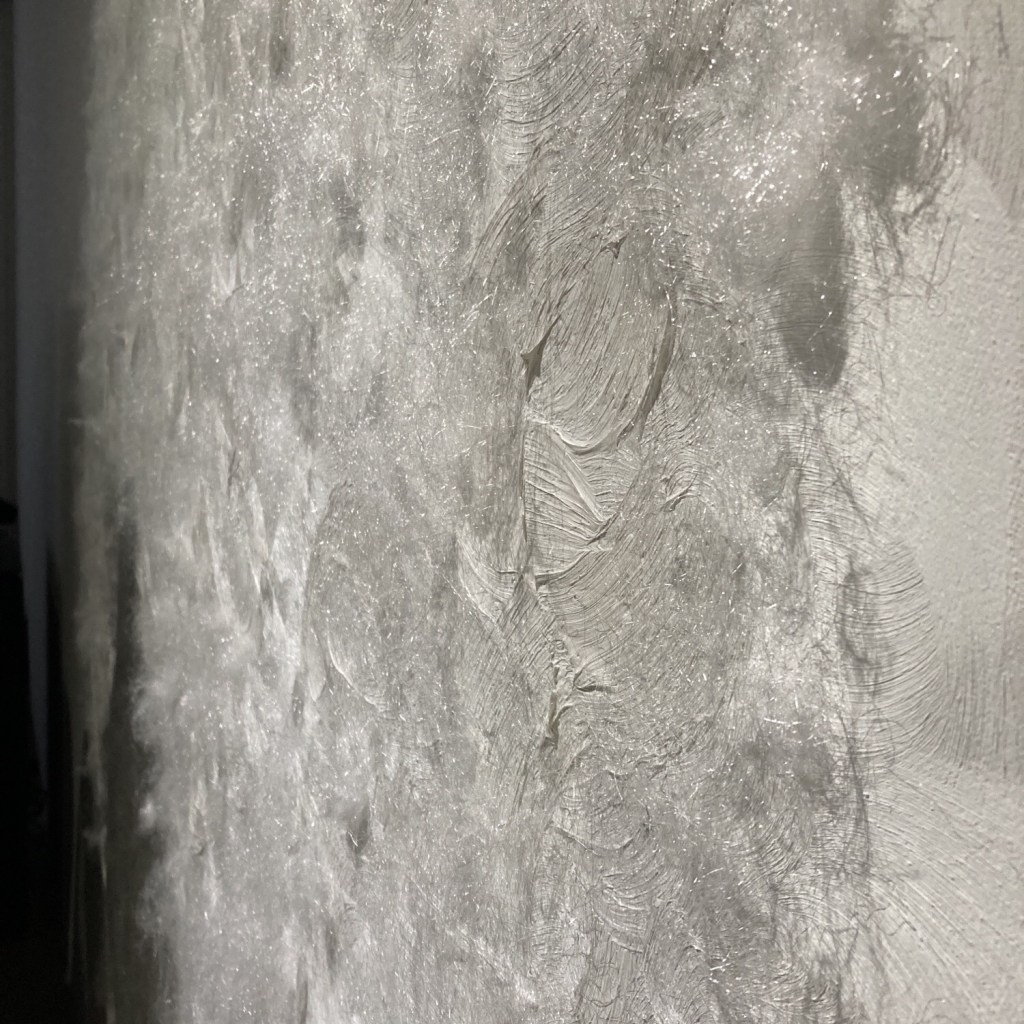
The process of lathe-cutting the vinyl albums of deconstructions and reworks yielded a third part of the collection, in the form of large circular artworks constructed using the plastic residues from the lathe process. Pure white and of varying textures – from fluffy and whispy to brittle, razor sharp and angular – these pieces were installed in the Fridman Gallery on New York’s Bowery between November 2 and November 9 2025. On one level, these pieces may be a comment on wastefulness; in another sense, they are no different from either the deconstructed Chopin pieces or their reworks, for they are entirely new structures arising from something else.
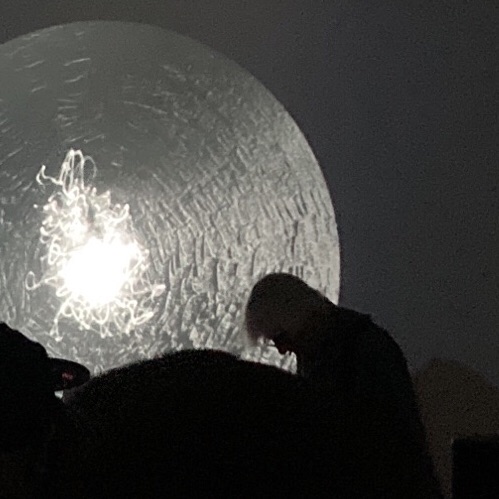
The final element of the collection was a live event in the Fridman Gallery surrounded by the artworks. For this thirty-minute performance to effectively kick off the brief exhibition, Szypura was joined by Ranaldo, Amba and Stanier. The small stage was so cramped that Ranaldo had to climb over an amp to get into position, while Amba played on the floor in the front row of the audience. Animated videos of the artworks – another discrete element of the overall Chopin Residue project – bathed the shadowy forms of the players in soft light, as if to draw your attention away from their playing.

That was often hard to do with Ranaldo, who was here at his most intense and restless. He strikes his guitar with a drum-stick, bows the strings to produce squeals of feedback and taps the neck of the guitar against the gallery wall. Rarely did he ever settle into playing his guitar straight – that was Szypura’s job. At one point, his pressing of the guitar neck against the wall prompted one of Szypura’s circular artworks to vibrate in sympathy. It’s as if he is both unplaying the guitar and playing the artworks – and the building – simultaneously.

His guitar is loud, wild and freighted with heavy distortion. These are the moments where Stanier’s drumming becomes less rigid, more loose, and Amba’s saxophone takes on the wild intensity of an avenue full of angry New York cab drivers during rush-hour. To Ranaldo’s right, Szypura alternated between steady, rhythmic guitar playing and inchoate electronics.

A second movement begins with a quiet pulse and drones formed from the residues of the distortion from the first movement. As the piece progresses, it gathers intensity. Stanier’s drumming becomes increasingly firm, rejecting the tentative drum machine beat that opened the piece and guiding it toward a noisy, apocalyptic crescendo filled with layers of intense overlapping guitar work and terrifying sax dissonance.
“After one has played a vast quantity of notes, it is simplicity that emerges as the crowning reward of art,” Chopin is quoted as saying. Szypura’s multi-faceted project is far from simple. It stands as an ambitious, engaging and complex enterprise, and one that illustrates how one source idea can result in many creative tributaries.

Chopin Residue is released November 28 by Black Element.

With thanks to Nico.

Words: Mat Smith

(c) 2025 Further.

Shots: Stichflamme Barnick / Nick Storring / Love Stereo / Alex Zethson & Johan Jutterström / Sean Armstrong / Xqui

STICHFLAMME BARNICK – STICHFLAMME BARNICK (Superpolar Taïps)

Bring on the distortion: the pairing of Stichflamme Dormagen and Robin Barnick was recorded between 2022 and 2024 and finds the pair producing intensive blocks of sound that are subjected to punishing processing. ‘Dolce al Cucchiao’ is among the heaviest tracks here, sounding not unlike an outtake from Pat Metheny’s Zero Tolerance For Silence. Elsewhere, the comparative levity of the pan pipe melody that dominates ‘Montabaur 8’ is subsumed by a ceaseless bass oscillator sweep that, halfway through, threatens to swallow up the poor piper and his innocent, gleeful playing. Released November 15 2024.

https://superpolar.bandcamp.com/album/stichflamme-barnick

NICK STORRING – MIRANTE (We Are Busy Bodies)

For his ninth album, multi-instrumentalist Nick Storring looked to Brazil for inspiration. That impulse gives the seven tracks here a greater rhythmic quotient than his previous works, with layers of vibrant percussion offsetting the orchestral-leaning textures that have become the hallmark of his musical work. At times, these pieces are quiet and contemplative; at others they are noisy, impactful and direct. ‘Roxa’, a three-part suite-within-a-suite, is a case in point. ‘Roxa I’ starts with ephemeral textures and interjections of percussion before opening out to include a stalking blues guitar riff and clusters of tones arranged into a delicate, tentative melody. “Roxa II’ unfolds as a sonic journey, building slowly toward a crescendo of angular, discordant clashes between layers of tuned percussion. The symphonic ‘Roxa III’, which closes the album, begins with rich swells of languid strings before evolving into a series of fast-paced, joyous rhythms for percussion and assembled clapping hands. Released March 21 2025.

https://nickstorring.bandcamp.com/album/mirante

LOVE STEREO – TU MUNDO

I saw Love Stereo perform at the Whisky A Go-Go in LA last year. Their set followed the release of their first single, ‘Fool’, which I wrote about here. A trio of Jonathan Burkes (vocals, bass, synths), Diane Hernandez (drums) and Steve Abagon (guitars / synths), Love Stereo make music that fuses sensitive electronics with a sharp and incisive rock sound. ‘Tu Mundo’, their second single, opens with a heavy, techno-inflected bass line and kick drum pattern before evolving into a softer, more introspective number as Burkes’ fragile vocal drifts into view. As the track progresses, crashing waves of guitar collide with increasingly emphatic vocals, haunting synth tones and pounded drums, a far cry from the minimalist pulse that opened the song. Released 1 April 2025.

https://lovestereo.bandcamp.com/track/tu-mundo


ALEX ZETHSON / JOHAN JUTTERSTRÖM – IT COULD / IF I (Astral Spirits / Thanatosis Produktion)

It Could / If I pairs Alex Zethson (piano) and Johan Jutterström (saxophone). Comprising new arrangements of standards, their own pieces and interpretations of pieces by Pet Shop Boys and Leonard Cohen, the album provides a beatific insight into two players who have a symbiotic relationship going back to their teenage years. On their version of ‘If I Had You’ – recorded by everyone from Frank Sinatra to Art Blakey – Jutterström offers a delicate, light accompaniment to Zethson’s minimal keyboard playing, while the version of Cohen’s ‘If I Didn’t Have You’, from You Want It Darker – his final album released during his lifetime – finds both of the players fluidly alternating their way through the song’s core melody, providing a poignant, heart-wrenchingly emotional close to an absorbing jazz suite. Released April 11 2025.

https://alexzethson.bandcamp.com/album/it-could-if-i


SEAN ARMSTRONG – VELVET EVER AFTER (Rehberge Records)

Dear Sean,

Many thanks for sending me your album, Velvet Ever After, on March 27 2025. It’s always nice to receive new music, and I’m always very grateful for this.

I also know how inordinately stressful it can be sending out something you’ve created into the aether and hoping for someone to give it a listen. I’ve been there. It takes a lot of self-confidence and resilience. I also know how it feels when someone you’ve sent it to doesn’t respond. I’ve also been there.

And so, with that in mind, I wanted to apologise. I saw your email come in, and I didn’t reply. That sucks. It’s common courtesy to at least acknowledge receipt of an email, from a DIY label like yours. Had I replied at the time, I would have said how much I liked the fact that Rehberge is named after your favourite park in Berlin (who does that?), and how much I loved the fact that it’s something you run with your partner, Rocky Lorelei. But I didn’t reply, and so I didn’t say any of that to you. I could come up with a plethora of excuses and reasons – too many emails, too many problems, too little time etc – but it still sucks that I never replied.

I didn’t just want to apologise for that. I also wanted to say how much I loved the album. I listened to Velvet Ever After after it had already been released, on what had been a really, really stressful day with my day job. It soothed me in a way that I really needed after the day I’d had. Your guitar playing has such a delicate, graceful quality, and I also love the songs like ‘The Whirlpool’ where Rocky adds pretty synth melodies alongside you. Your voice is also superb, and I found myself actually breathing – like actually breathing, with proper, deep breaths – while listening to songs like ‘My God’ and ‘The Library’, for the first time since I got to the office just after 0700.

I’m getting dreamy, sun-drenched West Coast tasting notes and a nice reminder of Real Estate, a band I realised I haven’t played for years, but now really want to listen to again. The instrumental pieces are also absolutely beautiful. ‘Valley Of Racing Shadows’ is stunning, as is ‘Concertina Sundae’.

So, like I said at the top: I’m so sorry for ignoring your email. However, I’m overjoyed that you sent it my way. Please add me to your mailing list with the email I’ve sent you separately, and I look forward to staying in touch.

All the best,

Mat

Released April 25 2025.

https://rehbergerecords.bandcamp.com/album/velvet-ever-after


XQUI – ALBION

I have discovered that I gravitate to anonymous characters. Perhaps it’s because I have such a ubiquitous, boring, pedestrian name that it feels like I am in good company with people who keep their identities hidden (while I hide in plain sight). This explains why I get on pretty well with Homer Flynn, the spokesperson for the ultimate anonymous act, The Residents. I’ve spoken with Xqui. We had a Zoom call. Like The Residents, he wore a mask, and it was fucking terrifying.

‘Terrifying’ isn’t a word you could levy at Xqui’s latest missive, the three-track Albion EP. The release continues a series of muses that began back in 2018 with the Britannia EP, and which continued the following year with the Revisited EP. Xqui began, er, revisiting his series of pieces all entitled ‘Britannia’ on 2023’s Nights That Went On Too Long, a release that I contributed spoken word to. His ‘Britannia’ variations lean into a fuzzy, hazy, ephemeral manipulation of what might well be a classic display of pomp and circumstance, snatched from a rowdy Proms performance at the Royal Albert Hall. Your ear latches on to familiar sounds – a swooning orchestral passage, a choir, a distinctive melody – before reverb and heavy processing obliterates that which you believe you recognise.

Is this a social comment on Britishness and our declining global relevance, or just another glorious example of Xqui’s idiosyncratic approach to sound art? Well, it’s actually derived from recordings made at a Lancashire ‘Coconutters’ event, a tradition that dates back some 150 years, and one which originated from the diaspora created through Cornish miners taking their skills – and their traditions – to far-flung places. You can read about that here.

The bit about Xqui’s unique sound art approach remains completely true, however.

Released April 26 2025.

https://xqui.bandcamp.com/album/albion-ep

Words: Mat Smith

(c) 2025 Further.


Shots – Kemper Norton / Veryan / Wil Bolton / Runar Blesvik / the klingt.collective

Kemper Norton - Tall Trees

KEMPER NORTON – TALL TREES (AND OTHER TALES) (Zona Watusa)

I absolutely love Kemper Norton. His music, very often inspired by Cornish folklore, mythological figures or its forgotten Industrial Age contribution, has a highly distinctive and wonderfully idiosyncratic originality. For Tall Trees (and other tales), he focuses his attention on his own personal history and mythology, celebrating a bunch of nightclubs that have closed their dance floors for good. “None of these places still exist, and some of the people have gone too,” he writes. “But not all of them.” This is club music as filtered the disjointed fog of memory, of too many nights out that you thought you’d remember forever but now can’t. That poignancy and nostalgia is all over Tall Trees, but it’s elusive, hidden beneath grids of dirty beats and lysergic energy. The eponymous opener is punishing and insistent, but it’s also ever-so-slightly wonky, as if the neatness of Kemper Norton’s grid itself is protesting against the uniformity of recollection. The two parts of ‘Victor Dragos’ carry a vital latency, with suggestions of rapid-fire hardcore beats subsumed under washes of amorphous, psychedelic texture and restless acid house pulses. A truly original work from one of electronic music’s most enigmatic of mavericks. Released 28 November 2024.

 https://kempernorton.bandcamp.com/album/tall-trees-and-other-tales

Veryan - Paper Hearts

VERYAN – PAPER HEARTS

Scotland-based electronic musician Veryan released her latest EP just before Christmas. Containing three tracks featuring prominent piano and breathy vocal textures, Paper Hearts has a sort of frozen quality to it, as if the pieces were created while looking across a frosty winterscape. The title track features an icicle-sharp countermelody and a sinewy arpeggio filled reminiscent of Higher Intelligence Agency’s Colourform album from thirty years ago (ah, the memories…). Veryan’s music has always carried a searching, inquisitive dimension, embodied here by the unfurling textures and refracted journey of ‘Gossamer’. The EP concludes with ‘Soft Lights Dance On Walls’, whose circular central piano motif leans into classical minimalism, while its shimmering electronic accompaniment is freighted with a powerfully contemplative energy. Released 23 December 2024.

https://veryan.bandcamp.com/album/paper-hearts-ep

Wil Bolton - South Of The Lake

WIL BOLTON – SOUTH OF THE LAKE (Quiet Details)

I’ve regularly written about Quiet Details releases here, and, on the strength of their first release of 2025, it seems like it will be another year of high quality, gently reflective albums. Wil Bolton’s contribution to the series was inspired by journeys around South Korea, featuring accumulated field recordings, instruments found and played on his journey, and electronic arrangements of extreme subtlety. In many ways, what Bolton has delivered with South Of The Lake is the very essence of what Quiet Details founder Alex Gold was seeking to achieve with this series. Pieces like the standout ‘Sun Tree Trail’ are deeply contemplative, evoking the Buddhist notion of being the still point in the turning world, wherein the listener is surrounded by bird calls, running water and a textural accompaniment of singing bowls and synths that rest lightly and comfortingly upon you. Last year, I spent some time at Lake Shrine in Los Angeles, not far from Pacific Palisades. It was a transcendent experience, and one of the most significant places I’ve ever had the privilege to visit. My only disappointment was the sound of cars whizzing down the mountain toward the Pacific Coast Highway, something that took some intense meditation to ignore completely. If I ever get to go back, South Of The Lake is what I would choose to listen to while there. Bolton’s album is a truly beautiful listening experience. Released 8 January 2025.

 https://quietdetails.bandcamp.com/album/south-of-the-lake

Runar Blesvik - All The Difference

RUNAR BLESVIK – ALL THE DIFFERENCE (Fluttery Records)

Runar Blesvik is a Norwegian pianist and composer whose work seeks to transcend the frontiers of modern classical music, a genre with some of the least defined of frontiers to begin with. Accompanied by strings from the Arcobaleno String Quartet, clarinettist Jussan Cluxnei and Blesvik’s own piano and electronic textures, All The Difference is a gently ruminative listening experience that subtly demonstrates the emotional power of his compositional sleight of hand. The album opens with the achingly minimalist ‘Finding’, wherein Blesvik’s piano is accompanied by sepia-tinted static, a powerfully restrained statement that might have been overburdened by layers of additional sounds or melodies in the hands of another composer. That’s not to say these pieces are all uniformly sparse – ‘One And The Other’ adds strings, rhythms and a beatific synth motif to create a soaring piece that rises quickly before falling back into comparative quietude. Across the remaining tracks, Blesvik pivots his classical vision toward jazzy levity, blissful Terry Riley circularity, gamelan chimes and ambient atmospherics, rendering All The Difference an impactful, exquisite listen, executed with extreme precision. Released 10 January 2025.

 https://runar-blesvik.bandcamp.com/album/all-the-difference

the klingt.collective - Variable Densities

THE KLINGT.COLLECTIVE – VARIABLE DENSITIES (Interstellar)

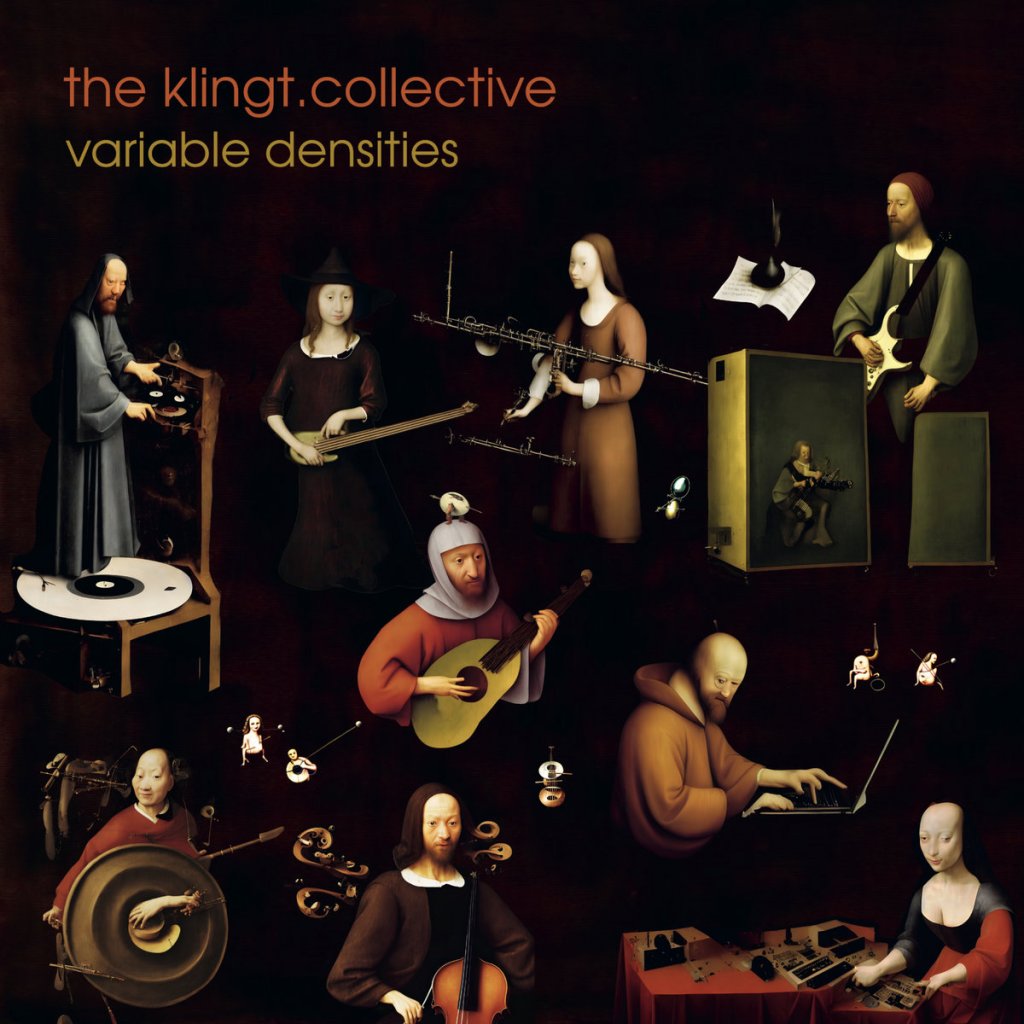
Viennese experimental unit the klingt.collective consists of Martin Brandlmayr (drums), Angélica Castelló (recorders and tapes), dieb13 (turntables), Klaus Filip (ppooll), Susanna Gartmayer (bass clarinet), Noid (cello), Billy Roisz (electronics and bass), Martin Siewert (guitars and electronics) and Oliver Stotz (guitars and electronics). Variable Densities was recorded at the densités festival in north-eastern France back in October 2023 and highlights just how seasoned these improvising musicians are. No mistaking, this is a large group, and the capacity for everyone to be playing over everyone else to assert dominance is high. Fortunately, that isn’t the case. There are moments of multitimbral, densely-layered intensity where necessary, but for the most part Variable Densities finds small sub-units working an idea to its conclusion before another sub-unit starts a new idea. This creates unexpected, unpredictable juxtapositions as different ideas coalesce, with electronics, tapes and turntables nestling up against strings, percussion, guitar and other traditional instruments. There’s a constant fluidity within these exchanges which means nothing hangs around for long or outstays its welcome. A diverse and compelling listening experience full of vitality, energy and impressive meshing together of disparate influences. Released 11 January 2025.

https://theklingtcollective.bandcamp.com/album/variable-densities

Words: Mat Smith

Shots: wræżlivøść / Snowdrops / Rupert Lally / Dogs Versus Shadows & Nicholas Langley / Stephen Reese / Everyday Dust

WRÆŻLIVØŚĆ – WRÆŻLIVØŚĆ

wræżlivøść is a Polish pianist and sound artist. His debut three-track release was recorded in Poland, Denmark and the US, and fuses classical piano with extreme sound processing. The result is an EP that is in constant flux, with moments of noise intersected by meditative piano – some of it recorded from his graduation concert at Det Jyske Musikkonservatorium in Aarhus in April of this year – and long, ambient drones pulled out of the myriad sound sources. It is at once chaotic and beautiful, its different textures and sequences being sliced together with rough and sudden cuts that make each track wonderfully unpredictable. The ten-minute ‘wræżlivøść II’ is a marvel, ranging from ear-splintering bursts of noise to dexterous notes, finally collapsing into quiet and soothing textures generated from rippling piano reverberations. Released 27 September 2024. Thanks to Phil Dodds for the recommendation.

https://wraezlivosc.bandcamp.com/album/wr-liv

SNOWDROPS – SINGING STONES (VOLUME. 1) (Gizeh)

Snowdrops are a duo of Christine Ott (ondes Martenot, xylophone, piano) and Mathieu Gabri (piano, keyboards, electric hurdy-gurdy, vibraphone) who make music that leans into the expansive realm of modern classical music. Their sound is, however, hard to pin down, offering a compelling symbiosis of electronics and classical reference points with an evenness that few operating in this genre are prepared to offer, instead favouring a light spraying of synths over relatively traditional playing. The centrepieces of this collection are ‘Crossing’ and ‘Arctic Passage’. Both are long and evolving pieces that the duo have performed for a few years. ‘Crossing’ begins and ends with delicate circular motifs, but at its height is a rousing, stentorian piece where electronic threads and resonant piano collide. ‘Arctic Passage’ is darker, containing drone-y electronic textures that sound like grim frozen winds across the tundra, and sprinkles of brittle melodies and ondes Martenot fluctuations. Elsewhere, the beguiling ‘Ligne de Mica’ is a deep listening exercise for ondes Martenot, analogue synth and Bartosz Szwarc’s accordion, its gentle interwoven undulations taking on a mysterious, unknowable quality where individual elements are barely distinguishable from the next. Another beautiful and engaging release from this remarkable duo. Released 25 October 2024.

https://snowdrops.bandcamp.com/album/singing-stones-volume-1

RUPERT LALLY – THE OWL SERVICE

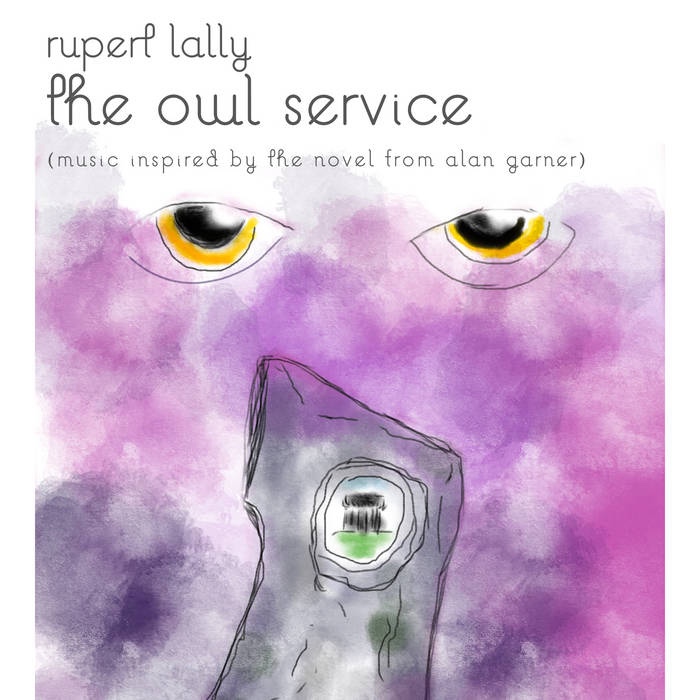
The Owl Service is Rupert Lally’s seventh soundtrack to accompany a book. His first was for J.G. Ballard’s High Rise, and the intermittent series has taken in William Golding’s Lord Of The Flies and Frank Herbert’s Dune. This time he attaches his compositional nous to Alan Garner’s 1967 award-winning children’s book. At the risk of repeating myself, only with different words and different context (last time it was about film), Lally is an avid reader – and accomplished author – and he has a honed skill for creating music that plots narrative and its key events. Key to the 18 cues that comprise his score for The Owl Service are strings, arranged in such a way as to create a sort of maudlin, mysterious tension throughout the unfolding events. Key pieces like ‘A Night In The Woods’ eschew the strings for wispy synth textures and slowly-unfurling electronic melodies, but its moments such as ‘Ghost Images’ and ‘The Argument’, where strings and synths effortlessly intertwine themselves that stand out the most. A remarkable and carefully-considered score, and several worlds away from his subsequent album, Interzones, released through my Mortality Tables venture. Released 31 October 2024. Interzones by Rupert Lally & Friends was released 29 November through Mortality Tables.

https://rupertlally.bandcamp.com/album/the-owl-service-music-inspired-by-the-novel-from-alan-garner

DOGS VERSUS SHADOWS & NICHOLAS LANGLEY – SALT COAST (Strategic Tape Reserve)

I’ve had the pleasure of working with both Lee Thompson (Dogs Versus Shadows) and Nicholas Langley in different capacities this year. Even after getting to appreciate their methods and processes well because of that, Salt Coast is a surprise. Both know a thing about how to transform sounds almost to the point of being unrecognisable, but Salt Coast finds the pair creating a sort of impenetrable fogginess around noises, melodies and borrowed segments. ‘Marching Through The Radiation’ and ‘Crabtree’ are cases in point – what could be fairground melodies are subjected to such a blanket of echoes that any twee gentility they once possessed are returned as a murky, queasy cues for distressing scenes in a horror film. Probably involving clowns. I’m reluctant to suggest that the technique is analogous to degradation, which has become shorthand for the gauziness of memory; what Thompson and Langley do here is smother their inputs, not decay them. It’s both terrifying and beautiful in its own special way. Released 1 November 2024. Nicholas Langley collaborated with Mortality Tables on LF25 / Matthew’s Hand, part of the LIFEFILES series.

https://strategictapereserve.bandcamp.com/album/salt-coast

STEPHEN REESE – HYPERCATHETIC

Stephen Reese is a singer-songwriter from Toronto. A purveyor of smart rhythmic electronic pop, Reese is also a deft lyricist, able to dive deep into emotional themes but also unafraid of levity, metaphor and humour. He first invited me to listen to an early mix of his debut album back in 2022 as we bonded over our love of Erasure and the synth mastery of Vince Clarke, and its strange and beautiful cocktail of sounds and styles really grabbed me. ‘Bog Mound’ is one of many highlights, sounding as fragile, sparse and mysterious as tracks from Depeche Mode’s A Broken Frame, Reese offering a plaintive lyric that seems to be concerned with falling face-first into a muddy puddle. ‘Shatter Pattern’ is dark and edgy, Reese’s vocal containing a sort of dream-like ethereality while a sparse melody encircles a shuffling rhythm. ‘Bathysphere’, which opens the collection, features a submerged beat and clusters of sonar-like pulses, framing a lyric where he gives a small submarine a lonely, isolated personality. Intensely maudlin, stirring yet infused with wryness, it reminds me of Sparks and Reed & Caroline, sung with a quality that suggests Reese has a penchant for folk tunes. A brilliant debut. Released 23 November 2024.

https://stephenreese.bandcamp.com/album/hypercathectic


EVERYDAY DUST – OVERTONES (Dustopian Frequencies)

Overtones is a remarkable study of the resonant frequencies contained within a single 200-year-old handbell. The bell was struck, shaken and played with a bow to generate a series of tones and textures, all of which were then processed with techniques that owe a debt to the pioneers of musique concrète. Everyday Dust is something of a modern-day tapeloop aficionado, and his experience with these processes shows through here in the form of an evolving series of considered sequences or movements; the effect is one of slow evolution, rather than the restless jumping around that colours a lot of tape pieces. Heard as a single 30-minute piece, Overtones is simultaneously euphoric and elegiac, yet dark and ominous, qualities that make this immediately recognisable as the work of Everyday Dust. Released 29 November 2024.

https://everydaydust.bandcamp.com/album/overtones

Words: Mat Smith

(c) 2024 Further.

Vanessa Wagner – Royal Albert Hall, London 24.10.2022

At the end of her performance in a small room near the roof of the Royal Albert Hall, Vanessa Wagner leaned back, shook her hands vigorously, and issued a smile and a sigh of relief.

What came before was nothing short of mesmerising. As Wagner tackled complex, undulating, restless pieces by Philip Glass and Harold Budd, her fingers appeared to dance on the keys, sometimes lightly, often with resolute firmness. Between pieces her hands would float gently above the keys, as if contemplating what should come next. They would then fall lightly to the keys and begin their signature dance once more.

It is easy to regard minimalism – the genre of classical music into which Wagner has been perhaps inconveniently placed – as sparse and empty, of the spaces between notes as much as the notes themselves. Watching Wagner play literally thousands and thousands of notes challenges this. There are spaces. There is sparseness. But there is also density and intensity here, vital, energetic passages which are dizzying to watch. Her fingers move as if possessed, delivering lightning fast arpeggios and improbable clusters of notes.

Wagner’s most recent album, Study Of The Invisible, from which tonight’s pieces were taken, used electronic compositions as its starting point, out of which Wagner produced amazingly intricate piano versions. Watching her perform a piece like Suzanne Ciani’s ‘Rain’, wherein she seemed to turn her piano into a stream of liquid, coruscating notes and textures, will stay with this writer forever. A truly transcendent and vital musician, and a truly memorable concert.

Thanks to Dean.

Words: Mat Smith

(c) 2022 Further.

Kjetil Mulelid – Piano

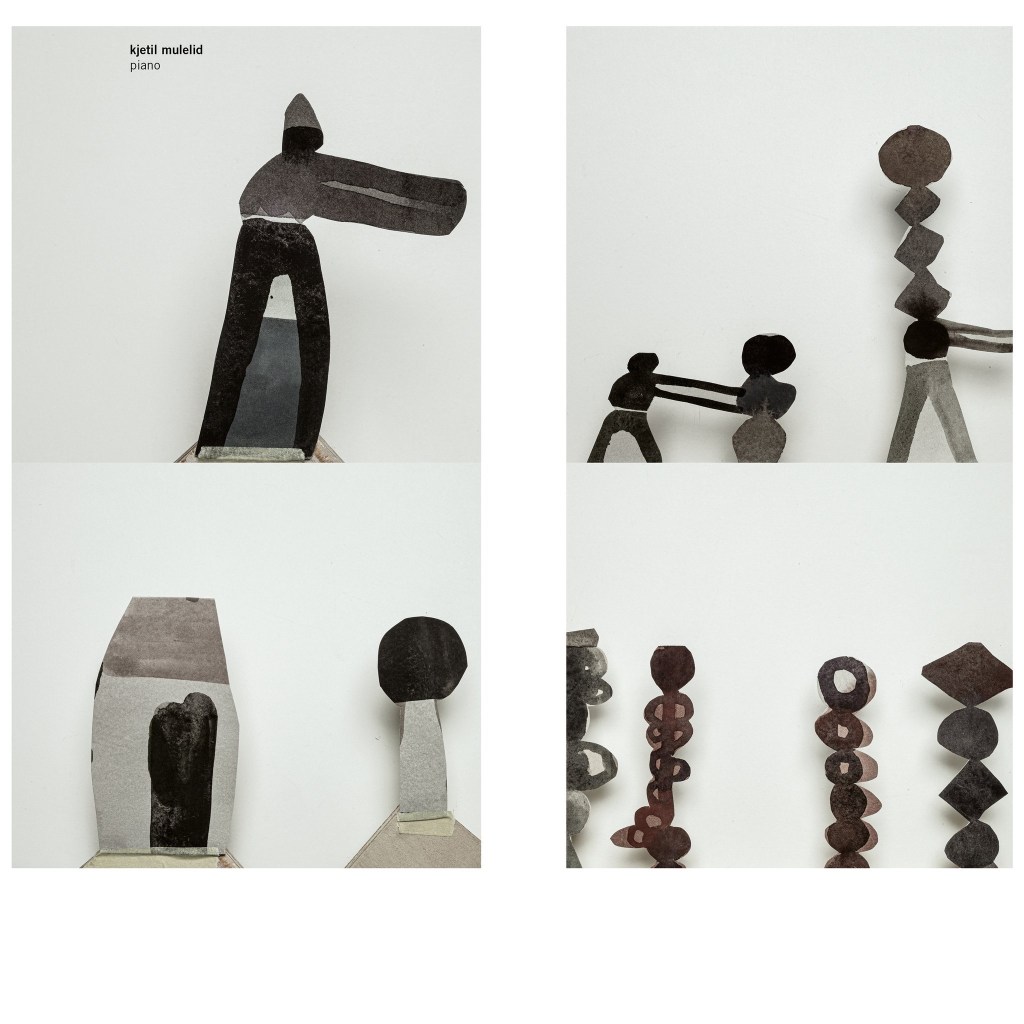
Piano is Norwegian jazz musician Kjetil André Mulelid’s first solo album. Ordinarily to be found leading a trio with drummer Andreas Skår Winther and bassist Bjørn Marius Hegge, the pianist had been encouraged to make a solo piano album nearly two years before recording the two locked-down sessions in June and September of last year that yielded Piano.

The eleven pieces here were each performed on the 1919 Bösendorfer grand piano located at Halden’s Athletic Sound studio. Mulelid talks about the instrument’s imperfect sound being a direct contributor to the tone of the album, but unless you are a pianist of his calibre, it’s hard to detect. Instead, what you hear are pieces like the fragile, introspective ‘Le Petit’ or the pretty ‘Skjong’ that straddle the gulf between classical music and jazz.

The majority of the album was recorded during a heatwave. Strange, then, that in these pieces I can hear rain. Specifically, I find myself imagining being sat in an empty café – probably in Paris; when my heart aches I usually find myself transported to the Paris of my mind – staring out onto puddles forming in the road. Perhaps it’s because I hear a sort of muted, haunting lightness of touch in Mulelid’s playing, or maybe it’s just the frame of mind I’ve found myself in every time I’ve put this album on. There is undoubtedly euphoria and beauty here in the languid note formations of a piece like the tender ‘For You I’ll Do Anything’ or closing track ‘The Sun’, but I also hear a sadness, a contemplative dimension that feels oddly anguished.

Lockdown may have limited Mulelid’s options to get his band together, but in Piano he has produced a striking, transcendent album that I expect to return to endlessly.

https://open.spotify.com/album/7yRzVFzD4b5aTWlXsFIm6k?si=ac_tzZeJQjWZs_h3K0h3bQ

Piano by Kjetil Mulelid was released March 19 2021 by Rune Grammofon. Thanks to Jim.

(c) 2021 Further.

Shots: Immy, Spacelab, Lagoss, John Frusciante, Snowdrops, Body/Negative, Paradise Cinema, Espen Eriksen Trio

Immy – In The Morning (2433392 Records DK) 

Immy is London-born, Falmouth-based singer-songwriter Imogen Leach. ‘In The Morning’ is her debut single, showcasing a lightness of touch and a haunting vocal intonation that prompts comparison with the work of First Aid Kit. Ostensibly a frustrated paean to the transiency and impermanence of one-night stands, ‘In The Morning’ concludes with a firmness and resolution, even as Imogen delivers the song with a quietly stirring grace and subtlety. Expect great things. Released September 28 2020. 

Spacelab – Kaleidomission (Wormhole World / HREA’M)

A joint release by the ever-dependable Wormhole World and HREA’M labels for Spacelab, a mysterious electronic project with absolutely no biographical backstory. Containing 36 short tracks, Kaleidomission is an exercise in plunderphonic dexterity, taking in freaky little segments of speech or birdsong culled from the ether, wonky loops of jazz drumming and ambient texture like ‘We Love Can’ and ‘Astral Dynamics’ that sound like they’re being broadcast from a broken AM transmitter in the overgrown grounds of Aleister Crowley’s house. The title of the standout skewed electronica of ‘Fucked Casio Melody’ requires no further explanation. Released October 16 2020. 

https://wormholeworld.bandcamp.com/album/kaleidomission

Lagoss – Imaginary Island Music, Vol. 1 : Canary Islands (Discrepant) 

Lagoss is a collaboration between Discrepant label head Gonçalo F. Cardoso and Tenerife-based electronica duo Tupperware. The 37 short tracks on Imaginary Island Music, Vol. 1 are like listening to Les Baxter or Martin Denny at a post-apocalyptic exotica club on a broken soundsystem. Swooning tropical lushness abounds here, but it’s skewed to the point of nauseating discordancy as vibraphones wobble and shimmer into dissonant sprawls and hip-hop / electro beats lurch awkwardly. If you listen closely to tracks like ‘Chipude’, you can hear the sound of waves lapping around a wrecked beach bar run by an old stoner dude in a Hawaiian shirt mixing Mai Tais for thirsty ghosts. Released October 9 2020. 

https://discrepant.bandcamp.com/album/imaginary-island-music-vol-1-canary-islands

John Frusciante – Maya (Timesig) 

For his first electronic album under his own name, Red Hot Chili Peppers guitarist John Frusciante (aka Trickfinger) delivers an energetic tribute to two vastly different things: his recently-departed feline companion Maya, present with him in the studio since RHCP’s Stadium Arcadium, and his hitherto unknown love of jungle and drum ‘n’ bass. A time machine back to the period 1991 – 1996, tracks like ‘Brand E’ and ‘Amethyblowl’ fizz with turbulent breakbeat edginess, while his instantly-recognisable awareness of melody offsets that rhythmic freneticism and intensity with stirring ambient colour. Released October 23 2020. 

https://johnfrusciante.bandcamp.com/album/maya

Snowdrops – Volutes (Injazero) 

Volutes is the debut album by French duo Christine Ott and Mathieu Gabry. With a title referring to the spiralling patterns evident in both architecture and nature, Volutes is a breathtaking masterpiece full of gentle, emotive twists. With a palette of sounds including piano, electronics and the expressive violin of Anne Irène-Kempf, moments such as ‘Trapezian Fields’ are freighted with an unpredictable, austere, haunted quality full of intricate detail. Ott’s work with Yann Tiersen can be heard in the mesmerising Ondes Martenot-led ‘Ultraviolet’, wherein layers of the instrument’s characteristic reedy alien sounds are encircled by Irène-Kempf’s savagely heart-wrenching violin as it plunges into minor key despair. Un album d’une beauté poignante. Released October 16 2020. 

https://snowdrops.bandcamp.com/album/volutes

Body/Negative – Fragments (Track Number Records) 

Fragments is the debut album from LA’s Body/Negative, the pseudonym of nonbinary multi-instrumentalist and producer Andy Schiaffino, and follows their Epoche EP from 2019. Beginning with an instrumental cover of Elliott Smith’s ‘Figure 8’ that sounds like it’s being heard through the gauzy vestiges of sleep, Schiaffino has produced an ambient album full of unique personality and highly personal, almost diaristic reference points. Here you can just make out their classical musical roots poking through on pieces like ‘Catholic Guilt’, but they are presented like elusive memories appearing out of the haze of long-buried emotions, making the fifteen minutes of Fragments one of the most haunting and transcendent albums I’ve ever heard. Released October 23 2020. 

https://bodynegative.bandcamp.com/album/fragments

Paradise Cinema – Paradise Cinema (Gondwana Records) 

Paradise Cinema is a trio consisting of Portico Quartet multi-instrumentalist Jack Wyllie with percussionists Khadim Mbaye and Tons Sambe. Recorded while Wylie was on location in Dakar, Senegal, his vision for the album was prompted by the ceaseless rhythms he’d hear through the night and the faded aspirations and historical grandeur of the city. The timbres on pieces like ‘Liberté’ are immediately recognisable from Wylie’s day job with Portico Quartet, all shimmering ambience and considered, absorbing electronics, but it is their fusion with the Mbaye and Sambe’s percussive backbone that focusses the attention. ‘It Will Be Summer Soon’ is a restless, urgent highlight, sounding like rush-hour traffic on a hopeful Senegalese morning. Released October 9 2020.

https://paradise-cinema.bandcamp.com/album/paradise-cinema

Espen Eriksen Trio – End Of Summer (Rune Grammofon) 

Seven tracks of piano jazz from the versatile fingertips of Espen Eriksen, recorded in Oslo during lockdown after the trio of Eriksen, double bassist Lars Tormod Jenset and drummer Andreas Bye saw all of their shows cancel in quick succession. Released as the strangest of summers drew to a close and the dork Norwegian autumn commenced, pieces like ‘Transparent Darkness’ carry a ruminative, reflective quality in their melodic structures, while the Latin rhythms of the album’s title track carries a sense of quietly chilled optimism. There is also a sense of catharsis and energy in the pieces here, borne from the trio finally getting back together in the studio for a vibrant, socially-distanced session. Released September 25 2020. 

www.runegrammofon.com 

Words: Mat Smith

(c) 2020 Further.

Christian Wallumrød Ensemble – Many

As innovative as it is, modern classical music has settled into something of a comfortable pattern, with a relatively predictable interplay between acoustic instruments and electronics. What once felt like progressive, modernistic flourishes now feel familiar; there’s nothing wrong with this, per se, but with a few notable exceptions, it’s often easy to form an impression of what a modern classical album will sound like before you’ve even put it on.

One of those exceptions is Norwegian composer and ensemble leader Christian Wallumrød. After a series of celebrated albums for the venerable ECM label, alternative musical paths in his sibling electronic duo Brutter, and parallel time spent in the Dans Le Arbre quartet, Wallumrød released the brilliant Kurzsam And Fulger through Hubro in 2016. His is a modern classical that nudges into jazz territory without ever fully giving in to that movement’s improvisatory pedigree, creating music with an inherent fluidity that nods to traditions in its foundations, but which aggressively looks to more experimental territory for its final appearance.

Wallumrød’s new ensemble recording, Many, finds inspiration in the musique concrète innovations made by Pierre Schaeffer at the Groupe de Recherche Musicales in 1950s Paris or the early deployment of tape technology by John Cage and Karlheinz Stockhausen. What you won’t find here, however, are moments of forcibly-processed sound or intrusive technological gestures. This is an album which – at times – is heavily electronic without using heavy electronics, its reverential concession to musique concrète being some of its confounding, nonconformist rhythmic basis. A piece like ‘Danszaal’ with its chiming trumpet and saxophone passages from Eivind Lønning and Espen Reinertsen respectively progresses with a dizzying, stop-start judderiness that nevertheless carries subtle, microtonally shifting beauty. A similar effect is achieved on ‘Staccotta’, led by Wallumrød’s unswerving piano stabs and plucked cello, blasts of brass and a breakdown into pure electronics giving this a playful, elusive, ever-changing quality.

Elsewhere, that use of electronics is more prominent, and each of Wallumrød’s ensemble – himself, Lønning, Reinertsen, cellist Tove Törngren Brun and drummer / percussionist Per Oddvar Johansen – is credited with the use of electronics alongside their usual instrument. Opening track ‘Oh Gorge’ weaves sprinkles of bleeping, synths around Brun’s mesmeric cello cycles, the whole thing pushed through a heavy echo that gives any of the additional elements – Johansen’s vibraphone, Wallumrød’s upper register piano playing – a sense of spinning out from a turbulent vortex. ‘Abysm’ is perhaps the moment where the electronics take over, the whole piece dominated in the foreground by droning synth textures, effects, loops and a general feeling of wild experimentation, its discordant tendencies operating at odds with a prevailing sense of calm.

The key piece here, perhaps, is the fourteen-minute ‘El Johnton’, a series of three movements that begins with a strident piano, saxophone and brushed snare passage that sounds like the coda to a Billy Joel song, before evolving into something firmer and yet more free. The following section develops as a thrilling minimalist, electroacoustic sound field of electronic pulses, bursts of synthetic tones and arrays of metallic non-rhythms, offset with unpredictable acoustic interventions, almost as the extremest counterpoint to the opening passage; brief passages of that starting point’s piano section drift in and out like melodic memories, suggesting and forcing a connection between the two with the most unlikely sonic construction. By the time the original section is reprised, it feels altered somehow, less straight, its traditional structure sounding suddenly alien after being mauled, manipulated and brutally erased in the ten intervening minutes.

Many by the Christian Wallumrød Ensemble was released February 28 2020 by Hubro.

Words: Mat Smith

(c) 2020 Further.

Avi Pfeffer – A Lasting Impression

avipfeffer.jpg

Classical music and electronics are currently locked in a comfortable embrace. This has arisen largely as a consequence of modern compositional methods which rely heavily on the ambience and atmospherics that a careful-deployed analogue synth or some after-hours digital manipulation can add to the music.

It wasn’t ever thus. From more or less the beginning of synthesizer technology becoming more accessible, the game in town was to produce electronic arrangements of classical pieces, and that’s the jumping-off point for Boston composer Avi Pfeffer’s A Lasting Impression.

The four-part suite uses classical structures and figures but is delivered entirely electronically. Beats drift in then ebb away, melodic gestures re-emerge continually and Pfeffer deploys a dizzying array of sounds, textures and rhythms throughout the almost hour-long album. The tonality of these collected sounds is especially important – this isn’t gauzy, drifting ambience or modern glitch-heavy soundtrack noir, but bold, grandiose sounds arranged into longform movements. I’ve never quite grasped the vernacular to articulate why this is, but there’s something about hearing electronics used in this way – a particular challenge when your diet consists primarily of people twiddling modular synth knobs or making electronic pop – that makes me think of Don Dorsey’s distinctive retrofuturism.

Dorsey made a series of electronic albums in the mid-1980s that essentially took Bach’s music and recreated their austere presentation with an enviable kitlist of cutting-edge electronic equipment, much as Wendy Carlos had done twenty years before. He also went on to be the in-house sound designer for Walt Disney World, composing the fresh, euphoric, scientific-sounding music that’s still memorably piped into places like Epcot and Tomorrowland.

I get the same feeling of hearing something exceptionally forward-looking yet locked in a particular era when listening to A Lasting Impression. If the press release had said Pfeffer had written these pieces thirty-five years ago and they’d languished, unreleased, I’d have not been surprised. To do this type of thing today is brave. We’re not used to hearing electronics like this in 2020, and so to enjoy it requires a little adjustment. Once you do, it’s a perfectly enjoyable record, full of interesting details and moments.

My personal favourite sequence arrives with the gleeful, squelchy opening minutes of the third part, largely because it transports me to the deck of Narcoossee’s on a balmy Florida evening several years ago watching The Electrical Water Pageant (originally scored by Dorsey) burble and fizz its inimitable way past with my daughters; just for giving me the the opportunity to reminisce about that makes this album entirely worth it.

A Lasting Impression by Avi Pfeffer is released February 7 2020 by Pumpedita.

Words: Mat Smith

(c) 2020 Further.

Richard Skelton – LASTGLACIALMAXIMUM

72d0cd62-eda7-4df4-81b1-0825ec841b75.jpg

Richard Skelton’s latest album is a forty-minute evocation of the growth, peak and accelerated thawing of the British and Irish glacial landscapes, presented as a series of eight movements of slow, developing tones that ebb away into quiet murmurs; basically, it’s like Morton Feldman, on ice.

The effect is powerfully disconcerting when heard in the context of climate change and the insistent messages of politician, scientists, protesters about the urgency of the corrective action that might be required to arrest the impact.

Across these movements there is a sense of stillness and calm, but also a slightly dizzying sensation. The precise instrumentation is not disclosed, and one never knows the origins of these long, eddying indeterminate tones and warped, muffled drones; at times it sounds like industrial, metallic noise, while at others we hear what could be an especially mournful, poignant cello, only presented like a vague outline of something that once was, but which can never be again. Sounds drift in and out, like gusts of wind across the arctic tundra, only presented as fleetingly melancholic, and edged with a frosty tension. There is a feeling of isolation, a panic-inducing out-of-placeness, that sensation being all the more remarkable given the levels of nothingness one experiences here.

Your response to music is often entirely situational. For me, I chose to listen to this during the clamour and franticity of a walk three and a half blocks from a hotel in New York to a downtown E train during the rush hour. Something about the slow, ominous passage of the music chimed menacingly with the post-work streetscene of manic Manhattan, a world removed from the subject matter of Skelton’s remarkable work, yet somehow entirely in tune with it.

LASTGLACIALMAXIMUM by Richard Skelton is released February 2 2020 by Corbel Stone Press

(c) 2020 Further.