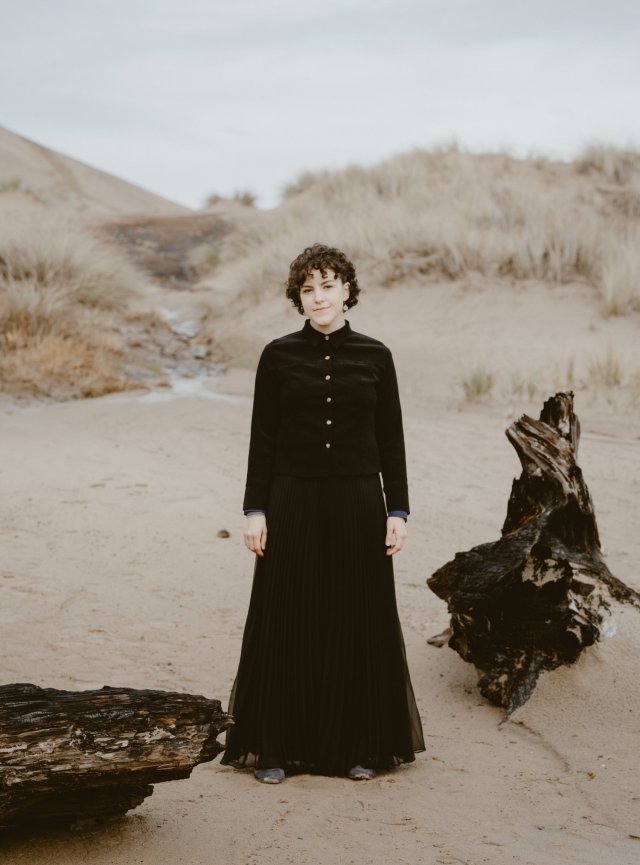
Alexandra Burress is a 21-year old singer / songwriter and producer from Portland, OR. Her latest album, Ecdysis, was recorded in the San Diego of her formative years, and finds her crafting a warm, tender, dreamlike suite of eight electronically-infused songs that gently wrap the listener in their gauzy, affecting textures. Read the Further. review here.
What is your earliest memory?
My earliest memory is eating a Spongebob popsicle in China as a 3-year-old and relishing the sugar flavour on my tongue. Surrounding me was a deep grey cloud sky with palm trees the size of dinosaurs swaying heavily in the wind.
What’s the best piece of advice you’ve ever been given?
My favourite piece of advice is something my mom always said. ‘Everybody just wants to be loved,’ and if we approach the world with this knowledge, we can all be a little kinder, a little more empathetic towards one another. We’re all searching for the same thing.
When are you most productive or inspired?
My head feels clearest after a long walk on the beach or in the forest, after sipping on a big batch of homemade hot cocoa and having no plans in the day but to create. Watching my talented friends perform their own music is another especially inspiring thing for me.
Ecdysis by Alexandra was released July 26 2019 by Spirit House Records.
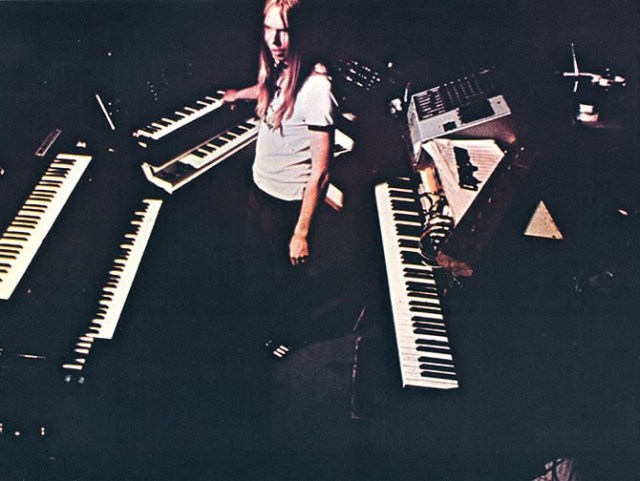
Rick Wakeman originally wanted to be a concert pianist until the steady work of a session musician beckoned. His dependable talent for nailing a part in one solitary take lead to memorable contributions such as playing Mellotron on David Bowie’s ‘Space Oddity’, work on Lou Reed’s post-Velvets debut LP and with Marc Bolan’s as he metamorphosed into a glam megastar with T-Rex.
Best known for several stints in Yes alongside his solo work and complex and extravagantly-executed stage shows, Wakeman was also one of the earliest keyboardists to see the limitless potential of the synthesizer through a bargain purchase of a Minimoog from actor Jack Wild. (The Artful Dodger-playing actor had assumed his synth was on the blink because it could only play one note at a time.)
This weekend, Wakeman celebrated turning seventy earlier in 2019 with two final performances of his Journey To The Centre Of The Earth album at the Royal Festival Hall in London, the location of its original presentation in 1974.
What is your earliest memory?
Crawling backwards. I never crawled forwards. I can remember getting stuck under the sideboard and having to be yanked out.
I was a very early talker and a very late walker. I can remember the first time I walked and checked it with my mother many years later and, to her amazement, I was spot on.
What’s the best piece of advice you’ve ever been given?
Always look for the good points in people. My father said that everybody has some good points and if you can find them, you will get more out of knowing the person.
In general he was right, but I have met a few who have absolutely no endearing qualities!
When are you most productive or inspired?
Early morning. I get up around 5 and my brain is whirring from the moment I put the kettle on. Things go downhill after that!
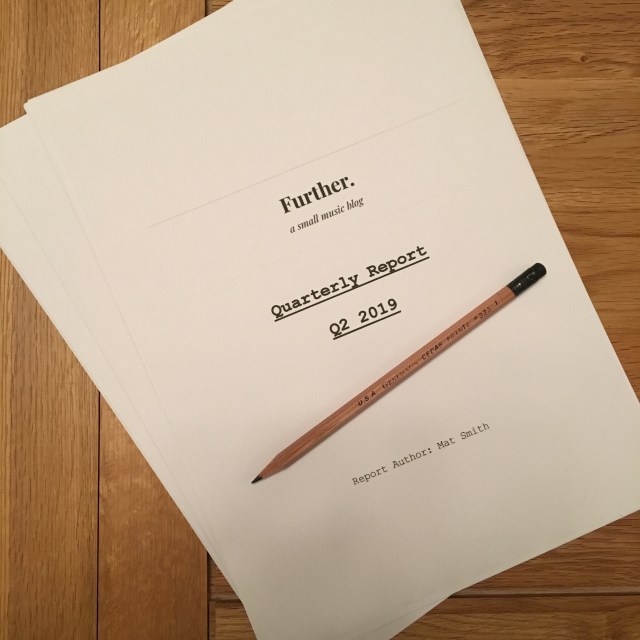
At the end of March, reviewing Further.’s first three months of operation, I made the commitment to try harder during the second quarter to significantly increase the delivery of content to the site. I’m pleased to report to readers that this commitment was fully delivered during the period under review, with a total of 23 albums reviewed.
During the second quarter I also consciously increased the site’s diversification and eclecticism, covering graphic score improvisations, just intonation microtonal works, modern classical, glitchy electronica, ambient soundscapes, electronic psychedelia and electronic pop with an even-handed and balanced review policy. I covered releases by some of the most niche cassette labels to the largest independents. I also welcomed two new guest writers to the Further. team in the form of Reed Hays (from Reed & Caroline) and Bryan Michael (from Alka).
I added a new micro-feature to the site in the form of 3 Questions, intended to provide a small window into what an artist values and what motivates them. This was added in an effort to provide bite-sized interviews that were both easily digestible and yet which provided significant depth of insight despite only consisting of the three open questions posed to each artist, sitting alongside traditional feature writing and longer In Conversation Q&A interviews.
I’m pleased that I was able to feature more female electronic artists during the second quarter, and this will continue to be a growing focus in successive quarters.
I look forward to reviewing Further.’s ongoing progress in three month’s time. Thank you for supporting my small music blog.
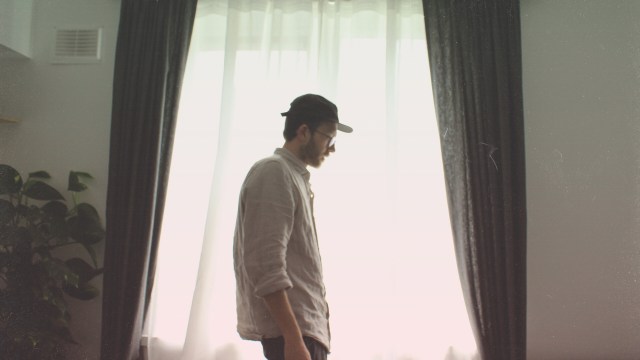
S. T. Manville released his debut album, Somebody Else’s Songs, earlier this year, collecting together eleven surprising covers of tracks by Jimmy Eat World, Green Day and others. At the very end of June, Manville released ‘Make Believe’, a self-penned piece of tranquil acoustic music for guitar, ukulele and violin that perfectly details our uncomfortable relationship with growing up, being full of wistful nostalgia, regret and hope.
Here, Manville talks about spelling, overcoming shyness and being inspired during the middle of the night.
What’s your earliest memory?
There are a few and I don’t know what order they came in so here’s the two that contend for earliest…
I think my brother Patrick was born but still a baby so I would have been about two or three. My mum took us to feed the ducks, which was a short drive from where we lived. God knows how but she managed to throw the house and car keys into the pond along with the bread. After getting really flustered and shouting a bit she jumped in after them and managed to get them out.
I was thinking about this recently and decided it was too insane to have really happened so I asked my mum if I’d made it up. I hadn’t. When I asked her why she jumped in and didn’t just leave it her reasoning was that ‘Mobiles didn’t exist then.’ I’m not fully sure I see the logic in that, but she’s a smart woman and so there must have been some sense in it.
The other memory is being in the car with my mum and dad around the same age. They used to use the time old trick of spelling out words to each other when they didn’t want me to understand what they were talking about. During one of these covert conversations I asked if we could get some ‘B-C-P-S.’ When they asked what I was on about I replied with ‘Chips’. I’ve always been a great speller.
What’s the best piece of advice you’ve ever been given?
‘Shy kids get nought,’ a really good friend said it in passing once, and it’s stuck with me. He probably doesn’t even remember saying it, but I genuinely live my life by it. There’s no shame in asking for help, guidance, or bit of shameless self promotion, if you ask in the right way and it comes from a sincere place.
Where are you most productive or inspired?
I’ve learnt that when inspiration happens, I just need to get on with it while it’s there, and when it isn’t I need to be patient, not force it and just wait until it reappears.
The times in the cycle that I’m not being musically creative can be pretty horrible, with plenty of self doubt and worrying about whether I’ll ever be able to write again, but I’ve been doing this for so long I’ve gotten better at dealing with those feelings. Sometimes it helps to find new music that inspires me, and sometimes I find that it’s better not listening to any music at all for weeks.
I tend to find inspiration in two places – from other music or art that I enjoy, and from watching general life unfold around me. The only real criteria for creativity, in my case, is sobriety and sun light. I’ve never been able to write or do anything creative unless I’m sober, and so I usually tend to work during the day. I find it really hard to work after about 7pm. When I see people in the studio at 3am getting stoned, drinking beers I always think, ‘How are you getting anything done?’
That said, I have woken up in the middle of the night a few times over the years with lyrics and melodies that I’ve written in my sleep, and then I’ve had to sneak downstairs to record a voice note. My wife loves that…
Make Believe by S. T. Manville is out now on Difficult. Listen on Spotify. Read the Further. review of Somebody Else’s Songs here.
Earlier this month LA’s Sweatson Klank (Thomas Wilson) dropped what is undoubtedly an early contender for the album of the summer in the form of his Super Natural Delights LP, containing twelve tracks of feel-good, electronically-infused hip-hop. The collection showcases Wilson’s uncanny ability to solder dexterous instrumental components to a circuit board of engaging, inventive rhythms, taking in everything from jazz to soul to electro.
In the latest of Further.’s 3 Questions micro-features, Wilson talks about early cycle experiences and the value of a decent night’s sleep.
Read the Further. review of Super Natural Delightshere.
What is your earliest memory?
My earliest memory is of my dad trying to teach me to ride a bike in Paris, France. I was born there and he used to bring me to the park so I could learn to ride. I started with training wheels of course and I still remember the day the training wheels came off. It was a glorious feeling.
What’s the best piece of advice you’ve ever been given?
The best advice I’ve ever gotten was to stop comparing myself to other people. It’s still a daily practice to remind myself not to do that. Comparison only leads to disappointment.
Part of that advice was also to learn to love yourself and embrace who you are and be grateful for what you have. Once you can put this into practice, life just seems a lot more enjoyable.
Where are you most productive or inspired?
I used to be most inspired and productive late at night but in the last few years it’s totally reversed. I’m at my best in the morning. Ideas flow clearly, and I get as much done in a couple hours in the morning as I used to get done all day! It’s amazing what being well rested does for creativity and productivity.
Super Natural Delights by Sweatson Klank is out now on Friends Of Friends.
WARMLAND are a Reykjavík duo of Arnar Guðjónsson and Hrafn Thoroddsen, whose debut album Unison Love is released by the Aeronaut label on June 21 2019.
Comprising twelve songs showcasing quietly sincere, beatific vocals and a rich, compelling tapestry of icy synth melodies, Unison Love is executed with a knowingly anthemic, widescreen intelligent pop smarts.
WARMLAND play Secret Solstice this weekend in Reykjavík. Watch the video for ‘Further’ below.
What is your earliest memory?
Arnar: Escaping kindergarten by digging a hole under the fence and running down the street when I was three or four years old. I managed to run quite a distance until a random person from the street spotted me and stopped me. I guess I never really liked kindergarten.
Hrafn: I guess it would be my dog, her name was Dimma (Dark) and she was absolutely crazy, but kind to me. She used to drag me across the playground, terrorise the postman and dig up the neighbourhood. She eventually went on to live on the ‘farm’.
What’s the best piece of advice anyone’s given you?
Arnar: Stay true to yourself and don’t worry about what other people say or think. Working in music and creative arts, you can’t make everyone happy and there are always going to be negative voices out there. So it’s very important that you stay true to your vision and never compromise.
Hrafn: Be good to people and don’t be an asshole. I gravitate to good people both professionally and personally so thankfully my life is asshole-free… mostly.
When are you most productive or inspired?
Arnar: Over the dark winter in Iceland. I get easily distracted by good weather and sun. Maybe the 24-hour darkness forces you to go within yourself and be more creative. Working on music in the studio in a snow storm is the perfect condition for me.
Hrafn: I get inspired after dark and I censor things less between the twilights. I sometimes sit and do nothing in the studio until the light fades, then things get going. The midnight sun during summer can be a bit problematic, but then you just go out and enjoy it.
Unison Love by WARMLAND is released by Aeronaut on June 21 2019. Buy the record at Bandcamp.
Since arriving in 2017 with her debut self-titled EP, LA-based electronic artist Dresage (Keeley Bumford) has quietly issued track after track of disarmingly emotional modern synthpop music full of the crystalline melodies that get all but the most hard-hearted synth heads excited accompanied by introspective, poetic wordplay. Keeley is also one half of the electronic unit More Giraffes with Mark Hadley, which they view as a place to experiment freely within the confines of pop.
Her most recent single, ‘Therapy’, a collaboration with fellow electronic chanteuse G. Smith, was released in April 2019, and a second Dresage EP is being worked on right now. A new More Giraffes collaboration with Brooklyn’s Sweater Beats (Antonio Cuna), ‘Playground’, is officially released on June 14.
What is your earliest memory?
I grew up in the mountains of Washington State, between Seattle and Vancouver in Canada. I remember always hiking and backpacking with my parents as a toddler around Mount Baker. Even as a tiny human only a couple feet tall, I can still recall the view I had from so close to the ground as I marched up and over ridges, snow patches and past glacial lakes. The damp ground, dark green trees and crystal blue skies of the Pacific Northwest are deeply engrained geography in my being. I feel very grateful for that.
What’s the best piece of advice anyone’s given you?
My friend Connie, who goes by the artist name MILCK, always drops massive knowledge when I spend time with her. She told me once that “clarity is kindness.” I’ve always been deeply afraid of confrontation in all aspects of my life, but when I try and practice setting clear boundaries for myself, I find it to be the kindest thing you can do in any situation, as opposed to being unclear and inefficient in communication because I’m afraid to be harsh, judged, or thought of as rude. This is something I try to apply to my professional life all the time. It’s a work in progress, but I think I’m getting better.
When are you most productive or inspired?
I’m most productive or inspired when I feel empowered by myself. It’s a cat-and-mouse game I play with my psyche, but when I’m kindest to me, I tend to do my best work. Speaking, looking, thinking with self-love goes a long way as opposed to an inner dialogue of anger, fear or self deprecation. Also candles, incense and meditation always help me get to a better place. This is also a constant work in progress: I start back at square one with every morning.
Therapy by Dresage and G. Smith is out now. Listen to Therapy at Spotify. Playground by More Giraffes and Sweater Beats is released June 14. Listen to Playground at Spotify.
Alice Hubble is the new solo project of Alice Hubley, known for her work with Rodney Cromwell (Adam Creswell) in Arthur & Martha, Mass Datura, Cosines and several other groups. Her debut Alice Hubble LP, Polarlichter, arrives in August – I’ve heard it and it’s an absolutely sensational melting pot of electronic music reference points underpinned by Hubley’s own international wanderlust that will be well worth waiting for.
The first single from Polarlichter, ‘Goddess’, was released in May by Happy Robots.
What is your earliest memory?
My earliest memory, rather tragically, is being about three or four years old and watching the first episode of the Care Bears. I remember watching it on our old 80s white TV thinking, “They get me,” (hmm…) and that it was the best thing ever.
This sort of makes sense as I do love watching TV. I had very similar reactions later on in life watching Buffy, Girls and Crazy Ex-Girlfriend.
What’s the best piece of advice anyone’s given you?
Most recently it’s been advice I’ve given myself to stop focussing on the things I haven’t achieved, and to just try and enjoy the here, the now and the process.
I think with the Alice Hubble LP I’ve tried not to have any expectations on what could happen, and just tried to enjoy the experience. Of course myself and Adam from Happy Robots – Adam more so – are working hard, but everything feels like a bonus to the fact that I recorded an album and it’s actually coming out.
When are you most productive or inspired?
Like most musicians I’m not really a morning person, but I’m not really that productive later on in the day. I have a small window between 11 o’clock and 4 o’clock when I’m most productive. That being said, when I’m in the studio I’m quite happy to do long days, and when we were doing the album, both myself and Mikey Collins pulled long shifts working on the LP. (You should check out his album, Hoick!)
Inspiration can hit anytime. I do find things will come to me when I’m walking out and about, and so my phone’s voice memos are filled with breathy mumblings that generally take some time to decipher!
Goddess by Alice Hubble is out now on Happy Robots.
Neil Campbell, Alexander Tucker, Daniel O’Sullivan
Plasma Splice Trifle pairs together Vibracathedral Orchestra member Neil Campbell’s Astral Social Club project with Alexander Tucker and Daniel O’Sullivan’s Grumbling Fur. Consisting of four lengthy, many-layered, pieces occupying the electronic music’s most eclectic hinterlands, Plasma Splice Trifle was recorded over the course of three years, each piece overflowing with ideas and a constantly-moving inner turbulence.
Ahead of the album’s release, Further. spoke to Neil Campbell about the collaboration.
You hadn’t worked with Daniel or Alexander before this album. How did this collaboration come about?
I honestly can’t remember! I think we were probably hanging out after a Grumbling Fur or Vibracathedral Orchestra gig and it was mentioned by one of us – probably either Daniel or Alex – and it seemed like a good idea, in as much as none of us could imagine how such a collaboration would turn out. No better reason than that for me!
The four tracks on the LP were started in 2015 and completed last year, and involved time spent in three different recording settings. How did the process of writing these pieces work? Was there a plan for what the pieces would be like, or was each track conceived and developed relatively spontaneously?
I don’t think of it as ‘writing’, more ‘doing’, always in the present, without much of a plan. I really like how Grumbling Fur work – they’re really open to quick decisions and where they may lead you with a good sense of play / fun too.
Most of the record was generated from a day’s recording together at Tower Gardens, with three of the tracks having their genesis in an open-ended hour long live jam. We then each took the recordings away and sculpted them into four very distinct shapes and worked from there, adding and editing where appropriate, passing sounds back and forth through the e-aether. We then pulled the tracks into their final form with another studio session together at the end.
‘Back To The Egg’ And ‘Toejam Boxdrum’ are very busy pieces, with lots and lots of layered detail. I’m always intrigued with very densely-packed tracks as to when you know you’re finished versus a temptation to just keep adding details – more and more layers, more and more sounds – and with three musicians that feels like it could be a challenge to know when to stop. How did that work?
Strangely, ‘Toejam Boxdrum’ is actually a really simple construct, with most of the sounds all coming from this initial jam, which was all recorded live to 2-track. We then added very little. So I guess it’s not always the way it seems.
But it’s a good question – all three of us like to work that maximal / minimal dichotomy, so there is a danger of, ahem, over-egging it. I guess someone says, “Enough!” or, “Too much!” and we trust each other to go along with their vision. ‘Toejam…’ would have been even simpler if it was left to me, but Daniel and Alex each had small additions they wanted to add underneath the initial jam, so we tried them and they worked. But, equally, if they hadn’t worked then we’d have left them out.
In contrast, ‘Three Years Apart’ is more sparse, though it also has a denseness when the drones and fluttering tones start to mesh together. To me it sounds a lot like some of John Cale’s work on the first Velvets album – urgent and expressive, but also possessing a dark spirituality.
Conversely, that’s quite a dense track from our point of view, with myriad layers of strings and processed strings.
‘Ozone Antifreeze Intelligence’ seems to be channelling the work of various celebrated groups emerging out of Germany in the 70s. Are those groups a major influence for you all? The vocals on that track are mesmerising – I like the interplay between the main vocal and the bassier voices.
Sure, I’ve enjoyed loads of those German bands for a long time now, and I’m sure the same goes for the other two. Some bands chime with me more than others though, and I’ve got a particular emotional attachment to the whole Cluster / Neu! axis. I think ‘Ozone…’ is my favourite track on the record.
After the initial sounds went through the Grumbling Fur mangle / spanglemaker, it was a very pretty instrumental that I added some sounds around the edges to. But I think we all thought it needed just an extra something, probably to create a more direct human connection. So when we met up for the final session we each brought one line of resonant text with us and sang them one at a time, pretty much first take, and the whole song unfolded from there.
As I said, I like to work quickly, and Grumbling Fur naturally work like that too. We’re all happy to take the germ of an idea and just go with it to see where it leads. Added to that, I love how those two naturally, effortlessly harmonise with each other when they sing together on their own records, like it’s the expression of a deep friendship you’re hearing, so I really wanted to get some of that on the record just for my own kicks.
You each created a piece of artwork to go with the album. How integral to your music is that visual accompaniment?
The initial idea was to each create a piece of collage art so we could layer them all on top of each other for maximum confusion/density. When we had each done out piece we realised this probably wasn’t going to work as well as just letting the pieces breath on their own. An example of someone calling, “Too much!”, and us not being too hidebound by our original concepts to throw them out the window when they weren’t working. Improvisation / praxis!
Plasma Splice Trifle by Astral Social Club & Grumbling Fur Time Machine Orchestra is released on June 7 2019 by VHF Records. Read the Further. review here.
FRUM is the electronic pop project of Jenny Augustudóttir Kragesteen. Hailing from the Faroe Islands, an archipelago of nearly twenty islands between Iceland and Norway in the Atlantic, Kragesteen has quietly issued a handful of singles over the past couple of years that highlight her dreamy, gently heartfelt approach to pop.
Her latest single, ‘Ocean’, follows on from last year’s anthem to defiant individualism, ‘Beat’, a song that played with the rhythms and textures of R&B and hip-hop intersected by a buzzing synth riff and deceptively uplifting chorus. ‘Ocean’ finds FRUM racing headlong into euphoric territory again, blending springy electronics, chunky beats and a carefree, swirling vocal together in a mesmerising displaying of summery, emotional pop songwriting prowess.
FRUM’s debut album is expected to land in 2020.
What is your earliest memory?
I sometimes feel like I can remember when I was in my mother’s womb but I know that’s not true – I just wish it was. It’s actually probably when I was two or three years old, sleeping on my mother’s chest or maybe sitting outside on a swing, looking at the blue sky.
What’s the best piece of advice anyone’s given you?
Be honest.
When are you most productive or inspired?
Definitely when I’m out in open nature. I get overwhelmed by a powerful feeling that everything is a part of everything and that I am somehow connected to it. I’m also quite productive when I’m sad and when I feel lonely. Being creative always makes me feel better.
‘Ocean’ is out now on hfn music. Listen to ‘Ocean’ at Spotify.





 Further.
You must be logged in to post a comment.