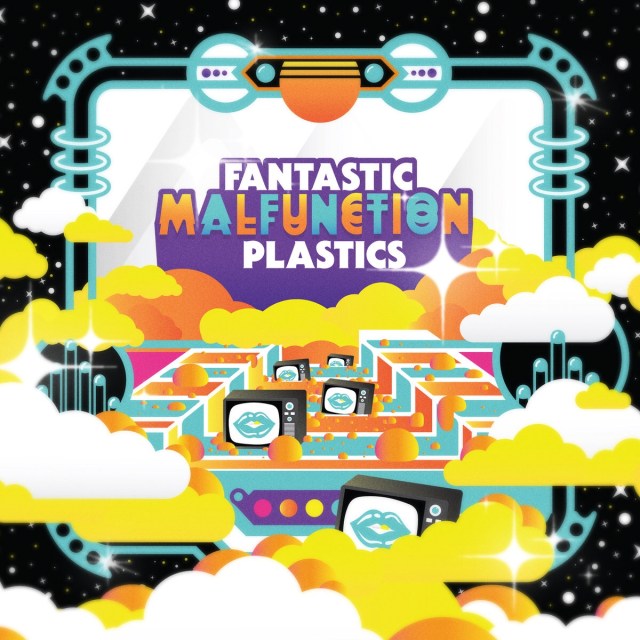
The Fantastic Plastics – Malfunction

Recorded over a period of two years at their brilliantly-monikered CoCo Beat Studios in Brooklyn, Malfunction is the follow-up to The Fantastic Plastics’ 2015 debut album, Devolver. As with that first record, the order of events here is hyperactive tracks threaded with spiky guitar riffs, buzzing synths and chunky drums that offer up a futuristic vision of pop drawing a line back to the most effervescent and innovative moments of electrically-infused post-punk.

From the energetic forward motion and symbolism of ‘Numan’ (with its general nod in the direction of the erstwhile Gary Webb and possibly Wayne Knight’s annoying character in Seinfeld) to the insistent high-speed glam-punk of opening track ‘Disintegration’, Malfunction is (mostly) an upbeat record. The harmonic interplay between the band’s Tyson Plastic and Miranda Plastic has a gleeful charm, even if their outwardly euphoric tracks appear to mask a general cynicism at the state of the world today. The effect, on the sinewy, Cars-y ‘Telephone’ or the feisty political grandstanding of ‘Disconnect’ – a thinly-veiled bash at a certain high profile abusing the freedom of social media – is slightly disorienting: here you are, pogo-ing around like a complete lunatic, and then when you start to focus in on the lyrics, you realise you’re actually hearing a cheerful protest song.

The frantic pace drops just twice, once on the charming space-age instrumental vintage synth interlude ‘Neon Satellite’ and again – briefly – with the jangly guitar intro to the otherwise perky ‘Bad Day’. The latter has a brilliant, cutesy quality that wouldn’t go amiss on a kids’ TV show, even if its theme – about either being chronically hungover or clinically depressed – sit slightly uncomfortably with the joyous ‘la-la-la’ing and generally upbeat mood of Miranda’s delivery.

The standout track here, ‘Evacuate’, finds Tyson doing a brilliant impersonation of Phil Oakey’s leaden delivery, its lyrics and insistent guitar riffery urging us to get the hell out of dodge before the world ends. That it ends suddenly with a brief, dissonant electronic tone suggests we didn’t quite make it, but if this album was the last thing you heard before the world ended, frankly it doesn’t seem like the worst way to go.

Malfunction by The Fantastic Plastics was released October 4.

Words: Mat Smith

(c) 2019 Further.

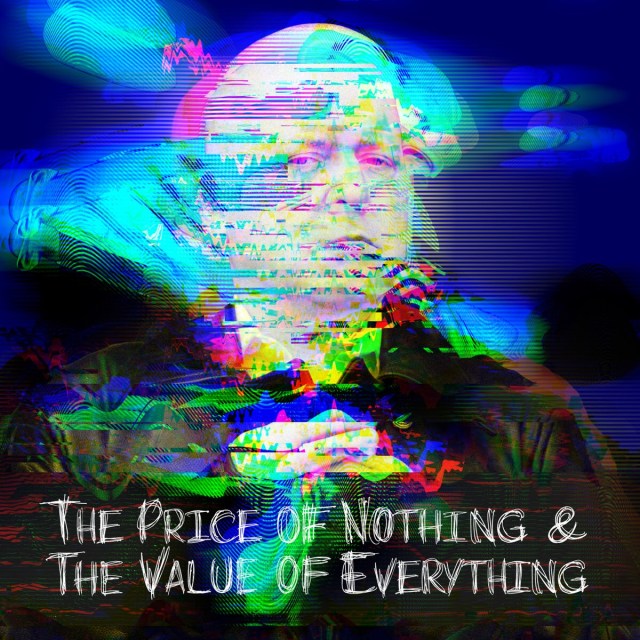
Circuit3 – The Price Of Nothing & The Value Of Everything

“My debut album sold out, so I spent all the money on more synths,” says Dublin’s Peter Fitzpatrick, who trades under the name Circuit3.

His third album, the sagely-titled The Price Of Nothing & The Value Of Everything follows a 2017 collection of Yazoo covers and vocal contributions to Jonteknik’s intensely-personal Alternative Arrangements LP from last year. Both projects were reverential, in similar ways: they both looked back wistfully on songs that were important to their creators, songs that inspired their own individual musical journeys and fervent experiments with electronic music technology.

A prevailing sense of nostalgia for the best-preserved vintages of 1980s synthpop can be felt throughout Fitzpatrick’s latest record. This isn’t remotely intended as an insult. In Fitzpatrick’s hands, the signature sounds, drum machine rhythms and lyrical stylings of that era are handled with exceptional care, with the fragile mystique of a track like ‘Face In The Crowd’ sounding like a newly-discovered tape of a Reset Records session left in a dusty corner of Vince Clarke’s Splendid studio space.

Throughout the record there is a deep connection to the vibrancy and forward-looking – yet alien-sounding – optimism that came with that period of electronic pop music: that sense of punk rock (and its post-punk reconfiguration) sounding as dated and irrelevant as the hairy prog music that punk spat at so vehemently. Partly this is down to the palette of period synths that Fitzpatrick uses, and partly it’s a consequence of his vocal style. On tracks like the standout ‘Electric’ or ‘The Rain’, you hear a questing, unresolved quality in that voice, a sort of searching and uncertainty that offsets the shimmering melodies and arpeggios that characterise the ten tracks here. The effect is gently disorientating, being neither fully happy on the most upbeat of tracks or fully maudlin on the most saddening of ballads.

Perhaps the most surprising moment here comes with the cynicism and anguish of closing track ‘For Your Own Good’, a sparse, infectious, chunky little gem of a pop song which jerks back and forth along a pleasantly unpredictable, carefully randomised pathway. As I always suspected, The Price Of Nothing & The Value Of Everything tells me that the future I wanted is hiding squarely in the past.

The Price Of Nothing & The Value Of Everything by Circuit3 was released October 1 2019 by Diode Records.

Words: Mat Smith

(c) 2019 Further.

Twenty-Three Hanging Trees – Cat’s Cradle

Another week, another immediately sold-out cassette on Stuart McLean’s eclectic Bibliotapes. This time around the subject is Kurt Vonnegut’s allegorical Cat’s Cradle (1963), and the artist offering up a soundtrack is Twenty-Three Hanging Trees, the alias of UK-based French electronic musician Xavier Watkins.

For a book so intertwined with dramatically apocalyptic sentiment, Watkins’ accompaniment is surprisingly and remarkably ephemeral. Fuzzy melodies and gauzy atmospheres dominate the eleven tracks, creating a sort of detached, observational response to Vonnegut’s dark humour. The album’s most dramatic moments come on ‘As It Happened’, finding Watkins creating a soundfield of crackling static approximating the terminal solidifying of the world’s oceans thanks to the escape of the ‘ice nine’ chemical on the island shores of San Lorenzo; the piece is full of a nauseating, unstoppable terminal motion, reaching a crescendo as gentle liquified ripples are replaced by a horrifying stillness.

Elsewhere, ‘The Illustrious Hoenikkers’ finds layers and cycles of vintage, fluttering synthesizer passages, full of mystery and retro-futuristic promise; its gentle phasing and questing arpeggios recall the earliest electronic albums, only offset by a brooding sense of things being far from optimistic. The languid guitar-like textures and delicate melodic washes of ‘I See The Hook’ are arguably among the most surprising moments here given that their serene tonalities are paired to the San Lorenzo ruler’s favoured form of execution and dictatorial enforcement.

Cat’s Cradle by Twenty-Three Hanging Trees was released by Bibliotapes on September 27 2019 and is now sold out. A digital version is available at Bandcamp.

Words: Mat Smith

(c) 2019 Further.

electronic mOnkee – mOnkee kingdom

When I was ten years old, I came to own my first computer – an Amstrad CPC464, complete with integrated cassette loader and accompanied by a green-screen monitor. I divided my leisure time between playing with my Star Wars figures and Transformers while waiting the interminable period for games to load on the Amstrad, programming rudimentary little things in BASIC or playing out on the street. My embarrassing attempts at making music with computers were a whole hardware upgrade and around five years away.

And so it’s hard not to be impressed by mOnkee kingdom, a six-track EP of short electronic music vignettes by ten year old Clement Street as electronic mOnkee. On the evidence of tracks like the skittish, hyperactive ‘demented robot’ or ‘NERDY’, it suggests that Clement was brought up listening to the music of Mike Paradinas’s Planet Mu imprint instead of more predictable children’s fare like The Wiggles.

These are tracks filled with imaginative clashes between hardcore vacuum cleaner non-melodies, flashes of calypso-jazz piano and beats that have a go-anywhere randomness, giving each piece an unpredictable, edgy dimension. For me, the standouts are ‘sci-fi-ify that sound’ and ‘twilight octopus’ thanks to the addition of some neat sounds that evoke the memories of my beloved Amstrad’s cassette-noise squealing.

Any fundraising I did as ten year old was confined to sponsored whatevers at school – rounders, silences, spelling tests, etc – but then again we lacked both imagination and the ability to crowdfund in 1986. As if it wasn’t impressive enough that Clement made the EP, proceeds from its sale go toward an ethical store being set up in St. Neots, Cambridgeshire that will offer things like eco refills, coffee and in-house production of vegan chocolate. The crowdfunding page can be reached here.

Buy mOnkee kingdom at Bandcamp.

Words Mat Smith

(c) 2019 Further.

The Night Monitor – This House Is Haunted // Phono Ghosts – Warm Pad, Sharp Stab

Two new releases from Blackpool’s Neil Scrivin, an electronic music maverick who also records under the alias Meatbingo.

The first, This House Is Haunted, is yet another gem of a release on Stuart McLean’s Bibliotapes cassette imprint, now long since sold out. The Bibliotapes ethics is to curate soundtracks to accompany a book, and Scrivin’s chosen subject is Guy Lyon Playfair’s account of the purported poltergeist haunting at a house in Enfield that caught the imagination of the media in the late Seventies. Whether the events in Enfield were true or a complete hoax developed by teenage imagination and fuelled by tabloid curiosity matters not to Scrivin; his soundtrack under a new alias, The Night Monitor, is bestowed with a paranormal creepiness – heavily-shrouded melodies emerge out of thick rivers of ectoplasm, looped voices chatter and babble incoherently, and thudding percussive sounds evoke the phantasmic movement of furniture.

The occluded tonalities of standout moments like ‘One For No, Two For Yes’ or ‘Ten Coincidences’ will give chills to anyone who spent their childhood evenings cowering behind the sofa because of an especially vivid Doctor Who episode or who couldn’t sleep thanks to the BBC’s hammy Ghost Watch (which was inspired by the Enfield haunting). However, Scrivin’s conceit is not to lace pieces like the evocative, static-hued soundfield of ‘I Can’t Make That Noise’ – a collage of whining drones, clamouring, scratchy sounds and a truly terrifying bass anchor – with a schlocky sequence of hauntological reference points. In doing so, This House Is Haunted is poised somewhere between the terrifying and inquisitive. Its twenty cues face inexplicable phenomena with an overriding sense of fear yet an underlying nausea-inducing intrigue, the final echoes of concluding piece ‘The Enfield Syndrome’ casting a long sonic shadow long after it has dissipated in silence.

A different – and potentially more visceral and relatable – sort of haunting takes place on Warm Pad, Sharp Stab, Scrivin’s fourth album as Phono Ghosts. Here you find the same melodic sensibilities melodies that colour This House Is Haunted, just set in a wholly different context, the result being a deft lightness thanks to being positioned as the top line in cuts that don’t rely on creepy textures for their emotional impact.

Instead, Phono Ghosts deals with the spectres of Eighties R&B and soulful electro – all fat digital basslines, chunky rhythms and a presentation that leans into a half-remembered pop vernacular. That tracks like the upbeat ‘L’Amour And Her Hot-Wired Hands’, the shimmering PWL-esque refrain of the serene ’81 Love’ or the emotional grandeur of the muted ‘Tears Over Chroma’ were not executed during digital synthesis’s takeover of music beggars belief.

Curiously, the melodic quotient isn’t the only crossover with The Night Monitor. On this brilliant collection you also find disembodied voices fluttering gently into view, only here they are vestiges of forgotten soul tracks, not the chance capture of elusive spirit echoes.

This House Is Haunted by The Night Monitor was released September 6 2019 by Bibliotapes and is sold out. A digital version will be released by Fonolith on October 25 2019.

Warm Pad, Sharp stab by Phono Ghosts was released September 13 2019 by Fonolith.

Words: Mat Smith

(c) 2019 Further.

Rupert Lally – Dune

Lally - Dune Tape

My youth was, I now realise, haunted by Dune. My mother, sensing a Star Wars-led interest in science fiction films, bought my an empty Panini sticker album that was issued to go along with David Lynch’s 1984 adaptation of Frank Herbert’s celebrated novel. No one else at my primary school was collecting the stickers, and with no one to swap the endless, frustrating supply of duplicate stickers I invariably ended up with, it languished, unfinished until it found itself in the bin. Later still, I ended up receiving a copy of the 1992 Amiga computer game from a friend and, like a lot of games, I was utterly hopeless at it and I guess I either offloaded it back to that friend or it went off to some floppy disc recycling place upon the occasion of one of my successive house moves.

So to say I have mixed feelings about Dune is an understatement. Those youthful experiences have meant I never bothered to read the book, and I’d rather watch Eraserhead or The Elephant Man over Lynch’s take on Dune. I know – sacrilege, right?

But maybe there’s hope for me yet in the form of Rupert Lally’s brilliant new soundtrack to Herbert’s book, released as part of the Bibliotapes series. Lally is no stranger to this endeavour, releasing a coveted score to another sci-fi novel, John Wyndham’s The Day Of The Triffids, via the label earlier this year. Herbert’s book was originally presented in the science fiction periodical Analog, and, perhaps with intentional reverence, Lally enriches these 26 evocative cues with a beautifully-rendered analogue synth spice (pun intended).

Pieces like ‘Giedi Prime’, ‘Remember The Tooth!’ and ‘Leave No Trace’ proceed on prowling, throbbing bass tones full of both threat and mystery, representing a recognisable stylistic motif that runs through the whole of Lally’s vivid score. There are moments, such as on ‘A Deal With Kynes’, where those tones eddy upward with aggressive and intensifying malice, signalling danger, while elsewhere they ebb away into distant, mollified texture.

And yet nestled within these bleak wastelands of atmospheric sound, we find the spiralling melodies, intensifying arpeggios and pulsing beats of the singular ‘Wormsign’, representing a seamless entanglement of Seventies space disco, progressive house and Eat Static-y galactic psychedelia.

The fifty copies of the cassette edition of Lally’s Dune justifiably sold out in record time. Fortunately, these absorbing, pulse-sharpening tracks are all available at Rupert’s Bandcamp page, a link to which can be found below. I’m now finally going to go and track down a copy of Herbert’s book. It’s about time…

Dune by Rupert Lally was released September 13 2019 by Bibliotapes.

Words: Mat Smith

(c) 2019 Further.

Brook – Built You For Thought

Informed by thought and feeling, rather than fashion and nostalgia, beneath a backdrop of well-thumbed science fiction paperbacks, the debut album from Brook creates a soundtrack to the loneliness of romance gone wrong, a longing for the past to be corrected by the future

The wonderfully-titled ‘Prince’ is propelled by an Escher-style arpeggio from Howard Rider, which enables vocalist Beth Brooks’ voice to swoop and spiral around it, like a sophisticated cat taking occasional swipes at a persistent wasp.

Whiplash snares, isolated pianos and synthetic music box melodies complement the emotional weight of the confessional nature of the lyrics, while also providing a safety net letting Brooks’ elegant trapeze act soar above it. The temptation may have been to match the scale of the vocals with layers and layers of sound but that would have been suffocating and overpowering. Instead, the music swells and crashes. Standout track ‘Everglades’ swaggers confidently on to the dancefloor, heartbroken but defiant.

So many musicians still feel the need to fill the kettle above the water line; it’s pleasing that Brook have adhered to the recommended level, both in content and quantity. By taking a nuanced and subtle approach, the two distinct elements of Built You For Thought combine to create a cohesive, timeless, whole.

Built You For Thought by Brook is released on September 20 2019 by VeryRecords.

Words: David Best. David Best is from Brighton’s Fujiya & Miyagi.

(c) 2019 David Best for Further.

Polypores – Radiance

Radiance, the latest release from the formidably active Polypores (Stephen James Buckley), was released in a tiny cassette edition of just thirty copies and sold out before most people even registered that it was even being issued. Containing four tracks of live modular synthesizer music, the pieces here are far from aimless meanderings; instead, they represent carefully-constructed moments that could well be the quintessence of what experimental electronic music always promised.

Each piece here is distinct, each carrying its own palette of tonalities and following a path unto itself, oftentimes feeling like Buckley is directing pure, unadulterated electrical current into his music. Two long tracks – ‘Mass’ and ‘Suns’ – dominate the cassette. The former features glacially-paced melodies over a turbulent, restless bed of drones and tightly-packed layers taking in everything from paranoia to dread to a sort of oblique optimism. That elegiac quality is more acutely felt on ‘Suns’, being full of sustained tones rising into a heart-stopping crescendo of skyward-facing hope and beauty. Its reassuring palette of tones and the insistent rush of fluttering, dramatic arpeggios that conclude the piece seem to be saying, “It may feel like chaos, but trust me – everything is going to be okay.”

Elsewhere, on the two shorter tracks that open each side of the tape, Buckley plays with panic-inducing siren sounds offset by pretty, delicate plucked-guitar-esque melodies on the otherwise serene ‘Escapism’, and offers an evocative, nagging melodic creep on the sinister-edged ‘In Marbles’.

Radiance by Polypores was released on September 10 2019.

Words: Mat Smith

(c) 2019 Further.

BUNKR – The Initiation Well

It’s no coincidence that the first track on the debut album by Brighton’s BUNKR is titled ‘East Of Eden’, for its creator is named James Dean. Drifting forward on a serene topography of heat-haze, gauzy pads and gently-accelerating synth sprinkles, ‘East Of Eden’ is a delicate, purposeful move that ushers in a brilliantly diverse collection of nine finely-crafted electronic opuses.

From the processed vocal melodies of the spacey ‘Docking Procedure’ onwards, this is a record that neatly fuses together Dean’s interest in vintage kit with the gridded framework of techno. 4/4 beats are omnipresent throughout the album, but the resourceful Dean finds ample space within those rhythmic strictures to play with convention. The standout ‘Solar Wings’ is case in point, offering a beatific melodic poignancy over shuddering percussion that nods to the epochal ‘Spastik’ before emotive bass patterns carry the piece off into evocative, widescreen territory. Dean does something similar with the haunting closing track, ‘Rheasilvian Lakes’, delivering an atmospheric, many-layered piece that concludes with the eerie sound of distant rainfall.

Perhaps the biggest surprise here is the beatless ‘Solar Drift’, whose shimmering, tentative astral melodic counterpoints evoke sepia-tinged recollections of early electronic classical LPs, while the gently-evolving, evocative title track is nothing short of a mesmeric, understated wonder to behold.

The Initiation Well by BUNKR was released September 6 2019 by VLSI Records.

Words: Mat Smith

(c) 2019 Further.
Inside Tracks & New Remixes: Fujiya & Miyagi – Flashback

Olly Hearsey 1_.jpg
Fujiya & Miyagi by Olly Hearsey.

Brighton quartet Fujiya & Miyagi’s latest album, Flashback, was released in May. Containing some of the group’s finest electro- and funk-inflected songs, Flashback covered everything from a political character assassination, self-importance and reflections on our collective (and absurd) paranoia that we might miss out. Further. spoke to the band’s guitarist and vocalist David Best about the tracks on Flashback and the often serious personal concerns and reminiscences that lie behind his deftly humorous lyrics.

Today we’re also premiering the latest two remixes of tracks from Flashback. Following on from Vince Clarke’s mix of ‘Fear Of Missing Out’ and W. H. Lung’s new version of the title track, the new latest mixes come from Shakedown and BUNKR. Shakedown’s robust re-rendering of album highlight ‘For Promotional Use Only’ gives the track an urgent insistency while BUNKR tap into acid house nostalgia on their new version of ‘Personal Space’. Listen to both mixes below.

Flashback

Part of getting older is spending more time remembering when you were younger. Both myself and Steve Lewis from Fujiya & Miyagi are similar ages so we both grew up in the early 80s where our childhoods were soundtracked by electro. It was all over the top 40. I think subconsciously the music that you hear in your youth becomes important later on in life, although it’s natural to initially turn away from it.

I was jealous of my neighbour’s Nike windcheater. I used offcuts of kitchen linoleum to spin on my back poorly. I briefly spray painted really bad graffiti on portacabins. I pretended I was from somewhere that I wasn’t.

‘Flashback’ is a nostalgic look to a less complicated time with no responsibilities. It’s also about the odd fragments of memories that stay with you. Often these appear inconsequential but are impossible to shift and frequently come back to me in times of stress or anxiety.

Personal Space

This takes the underlying anxiety of ‘Flashback’ and adds a layer of claustrophobia on top. Inspired by James Brown’s 70s one-chord vamps, updated to incorporate aspects of electro and finished off by a middle-aged man struggling with being bombarded with technology and other people sitting too close to him in enclosed spaces in Taiwan.

For Promotional Use Only

‘For Promotional Use Only’ is about trying to do the most with the least possible. This is possibly my favourite song on the album. My friend described it as a song to listen to while rollerskating at a disco, which is a nice image.

a0267673109_10

Fear Of Missing Out

This has a 70s West African feel to it, hinting at William Onyeabor. It then morphs into a paranoid disco outro. Lyrically it has parallels to the end section of ‘Personal Space’. By always wanting your life to be better it’s easy to forget what you have that’s worth having. I was unsure whether to use such a relatively new and ubiquitous phrase but I wanted to cement the album in the present while being informed by the past.

Subliminal

This is a reworking of our song ‘Subliminal Cuts’. It was inspired by a Columbo episode ‘Double Exposure’ from 1973. We reversed our old song ‘In One Ear’, cut it up, and wrote a new one on top. It’s an idea stolen from David Bowie’s Lodger album.

Dying Swan Act

‘Dying Swan Act’ refers to a phrase my parents would say whenever myself or my sister were being a bit pathetic. This song was initially inspired by the origins of disco rap, hence its simplicity both lyrically and musically. It has a dissonant guitar line that also links it too ‘Fear Of Missing Out’.

Gammon

It’s hard to ignore the split in opinion in the UK so I thought we should address it. I know nobody would listen to Fujiya & Miyagi for our political insight but morally I felt I wanted it to be known where I stood. It’s easy to oversimplify the reasons why people want to leave the EU. Being a racist is definitely one of them, though. I also wanted to poke fun at the other side of the argument. It’s easy to take the moral high ground without seeing the reasons for why we got to this point.

Interview: Mat Smith

Flashback by Fujiya & Miyagi is out now on Impossible Objects Of Desire. Read the Further. review here.

(c) 2019 Further.