Big Bend – Radish

Radish is the second album by Brooklynite Nathan Phillips’s Big Bend. Here you find layers of guitar and piano combining with electronics, processing, backward effects and a mournful sheen, designed to evoke the inexorable passing of time and the development – then eventual collapse – of memories.

While it’s not necessarily an album in which you can identity much joy, the inclusion of vocals from Phillips’s mother on tracks like ‘Swinging Low’ creates a wistful, almost folksy contrast with some of the other pieces, her voice having a clarion quality that glides effortlessly over her son’s inventive musical tapestry.

‘1000 Ways’ and ‘Long Time’ are complex, tightly-woven pieces full of heartbreaking emotion, supported by an accompanying architecture of noisy, unpredictable sounds, while reversed guitar, meditative piano and a restless vari-speed synth loop allows ‘12’ – 15’’ to convey just as much as Phillips’s haunting vocal tracks.

The album’s central piece is ‘Can’t Get Around’, wherein whining guitar is blended with a vocal processed into pure texture; the track has a post-rocky, dubbiness where Phillips’s vocal seems to bespeak of everything from lethargy to demotivation to emotional helplessness. Even when the track approaches a sort of resigned euphoria, it is still fully laden with tension.

Radish by Big Bend was released by Ohie Records on May 10 2019.

Words: Mat Smith

(c) 2019 Further.

Dark Star Safari – Dark Star Safari

Dark Star Safari is a quartet of Jan Bang (vocals, samples, piano), Erik Honoré (synths, samples, lyrics), Eivind Aarset (guitar, bass, electronics) and Samuel Rohrer (drums / percussion, synths).

The sessions were instigated by Rohrer at Berlin’s Candy Bomber studios with the assistance of Conny Plank accomplice Ingo Krauss, and were originally intended to be relatively freeform instrumental improvisations; instead, as the reductivist recordings progressed, Bang found himself compelled to add vocals to the tracks, giving the ten tracks on this eponymous album a searching quality that lifts these pieces from interesting sketches to powerful, song-based compositions.

The fragile musings of ‘Resilient Star’, ‘White Rose’ and ‘Faultline’ emerge as highlights, finding Bang delivering his vocals in an almost-whisper that prompts comparisons with David Bowie at his most introspective, while the four-piece lay down a rich, turbulent bed of quiet, but ever-evolving accompaniment.

Bang’s delivery of Honorés cryptic lyrics is given a natural prominence across the album, but divert your attention toward the atmospheric music embedded within pieces like the languid ‘Child Of Folly’ or the faltering synth theatricality of ‘Your Father’s Names’ and what you hear is an understated, restrained complexity that whirs with relentless inventiveness just below the surface.

Dark Star Safari by Dark Star Safari is released by Arjunamusic Records on May 10 2019.

Words: Mat Smith

(c) 2019 Further.
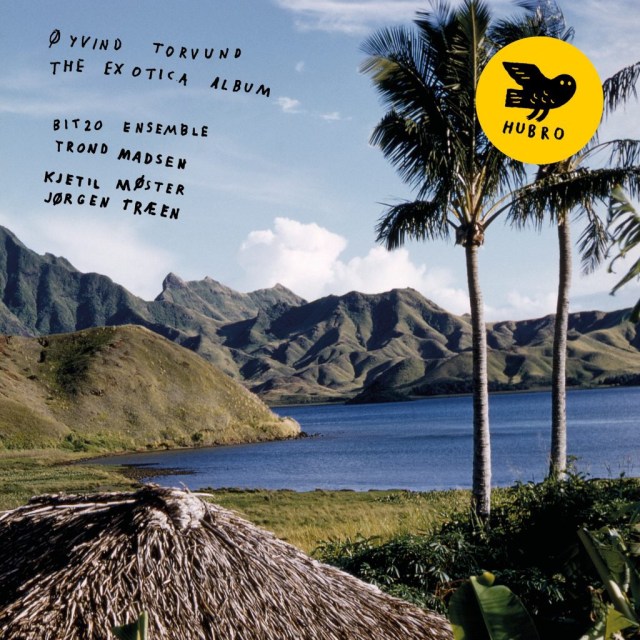
Øyvind Torvund – The Exotica Album

To paraphrase David Byrne, upon diving into Norwegian composer Øyvind Torvund’s remarkably broadminded The Exotica Album you may well ask yourself: how did I get here?

‘Here’ is a place where early electronic experimentation collides with Hollywood’s heavily romanticised vision of the South Pacific. The album was composed by Torvund at the behest of the Bit20 ensemble, conducted by Trond Madsen, and features wildly inventive synth contributions from Jørgen Træen alongside Kjetil Møster’s expressive sax.

‘Here’ is a place where you can hear the musique concréte of ‘Ritual 2’ sipping mai tais next to to the beautiful, retro-luscious swoon of ‘Starry Night’ with R2-D2 tending the Tiki bar; where the rapid flip-flop between noise and melodic intricacy of ‘Waking Up Again’ makes for an especially vivid tone poem; where the water-like synth sprinkles, pizzicato strings and xylophone of the enthralling ‘Rainforest Morning’ pitches your hammock at the centre of a tranquil sonic oasis.

By the time you reach the end of the springy ersatz synth bird calls, bongos and strings of ‘Out Of The Jungle’, you’re ejected back into a normality that comes as massive disappointment after spending the best part of an hour inside Torvund’s vivid vision of exoticism.

The Exotica Album by Øyvind Torvund is out now on Hubro.

Words: Mat Smith

Further. : Quarterly Report Q1 2019 & Playlist

Further. launched in January 2019. Its objective was to create a place where I could review things that caught my attention but which didn’t ‘fit’ Documentary Evidence, or where I didn’t get to cover that particular release for Electronic Sound.

During the first quarter of the year I reviewed 15 albums or singles, published one interview, and included a guest review written by Erasure’s Vince Clarke. It was a modest start to the blog, a testing of the water if you will. I will try harder during the second quarter.

Below is the full list of content published during the first quarter. There’s also an accompanying Spotify playlist including tracks from each record (where available on that platform), along with ‘Gallery’ by Californian electronic pop artist Dresage which completely passed me by at the time.

Reviews

Kaada – ZombieLars (Soundtrack) (Mirakel Recordings)
Kamaal Williams – New Heights / Snitches Brew (Black Focus Records)
The Silver Field – Rooms (O Genesis)
TOTM – Bliss / Blurred (Flickering Lights)
Karolina Rose – Invicta (Violet Sunset Records)
Neu Gestalt – Controlled Substances (Alex Tronic Records)
Lucy Mason – Flashback Romance (self-released)
Hugh Marsh – Violinvocations (Western Vinyl)
Bayonne – Drastic Measures (City Slang)
Modular Project – 1981 (hfn music)
Evelyn Glennie/ Roly Porter – One Day Band 17 (Trestle Records)
Maja S. K. Ratkje – Sult (Rune Grammofon)
d’Voxx- Télégraphe (DiN) – reviewed by Vince Clarke
Kilchhofer / Anklin – Moto Perpetuo (Marionette)
Jonteknik – Electricity (The People’s Electric)

Interview
The Silver Field

Playlist
Spotify

Words: Mat Smith

(c) 2019 Further.

Maja S. K. Ratkje – Sult

Norway’s Maja S. K. Ratkje has built a formidable reputation for vocal and electronic experimentation. Despite that pedigree, this is a performer who can still find room to challenge her compositional methods, and this latest release for Rune Grammfon is case in point.

Accompanying a Norwegian National Ballet realisation of Knut Hamsun’s 1890 novel Sult, to compose the score Ratkje ditched her electronics and employed a broken pump organ subjected to all sorts of Cageian preparations. The output takes the form of curious, and occasionally unsettling, drones and tones, over which Ratkje threads her distinctive voice, itself ranging from quiet murmuring to powerful rapture.

The result is a suite of nine intense pieces that have the power and breadth to utterly displace you. The urgent note clusters and noisy cycles that open a track like ‘et hvitt fyrtårn midt i et grumset menneskehav hvor vrak fløt om’ (roughly translating as ‘a white lighthouse in a muddy sea of humans where wrecks floated about’) will either quicken your pulse with restless energy or cause massive panic depending on the way you approach it. Closing track ‘Kristiania’ is perhaps the most fragile, unadorned moment here, containing a wistfulness that disguises a turbulent, volatile centre.

Sult by Maja S. K. Ratkje is released by Rune Grammofon on March 8 2019.

Words: Mat Smith

(c) 2019 Further.

The Silver Field – Rooms

The central figure in The Silver Field is Coral Rose, whose debut album for Tim Burgess’s O Genesis imprint concerns itself with the metaphorical act of leaving a home, and the metaphorical rooms of that home that begat the album’s title.

Composed of off-kilter tape loops and an anything-goes approach to sound layering – everything from strings to the queasy drones of a bagpipe chanter – Rooms is a captivating progression through an ethereal landscape lying somewhere between organic, mystical folk and an electronically-enhanced post-modern ambience thanks to heavy processing and the deployment of a breath-controlled analogue synth. The effect on tracks like ‘Gost’ is to draw you into a dense, undulating web of sonic events – clattering sounds and percussive micro-noises, a gently repeating guitar, low vocals and patches of jarring discordance.

The instrumental lamentation of ‘Rosebud’, a pairing of acoustic guitar and unpredictable, noisy interventions sounding not unlike a distorted, reverb-drenched recording of a bow being dragged across a metal bench, is nothing short of an heartbreaking, arresting moment among arresting, heartbreaking moments. It is on ‘Nourish’ when the album’s electronic dimension presents itself most clearly, with a spiralling, eddying array of echoing crystalline sequences rapidly circling a mournful, affecting vocal.

Rooms is out now on O Genesis.

Words: Mat Smith
(c) 2019 Further.