MONOCREO Label Night: Alessandro Cau / ELS / Jonny Hill

Eclectic Milton Keynes label MONOCREO’s label night at the town’s gallery performance space was timed to coincide with the release of Sardinian percussionist Alessandro Cau’s intricate and complex Brenti.

The product of over ten hours of playing, Brenti (‘stomach’ in Sardinian) found Cau working his way methodically around his drum kit, deploying metal bowls, fabric and other objects to skew and alter its sound, accompanied by occasional moments of modular synth from Miles Cooper Seaton and trombone from Federico Fenu. The result is four pieces ranging from quiet and meditative calm to skittish, manic playing, creating a thought-provoking rumination on Cau’s roots nevertheless filled with a sense of perpetual, unpredictable motion.

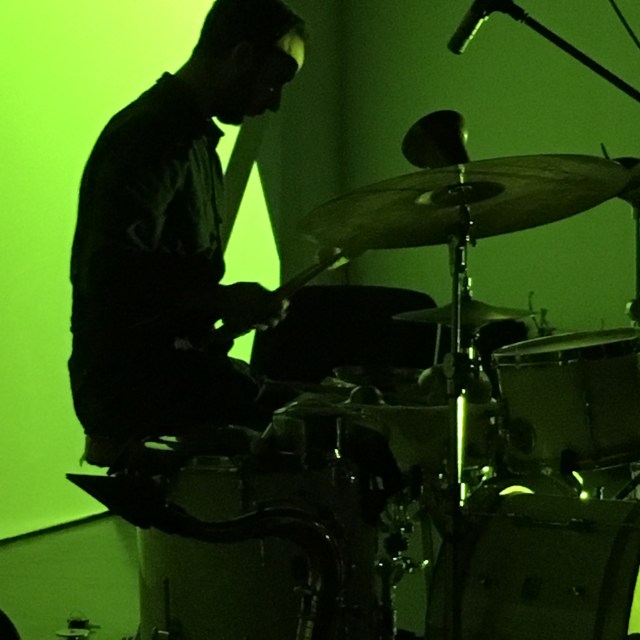
Accompanied sensitively by MONOCREO co-founder Jonny Hill on processed saxophone and clarinet, watching Cau assemble and dissemble his percussive palette while playing is utterly mesmerising, maintaining a sense of direction and purpose where other improvising percussionists might resort to aimless meandering. The dexterity and awareness of his sound sources is reflected in varied playing running from quiet, melodic passages full of sonorous harmonics to moments of thrilling, yet nuanced noise. At one point he pounds his cymbals into a sheer wall of beautiful metallic noise, occupying a sonic hinterland between an amplified rainstorm, a shrieking Jubilee Line train in the tunnel between Canary Wharf and Canada Water and the end of days. A final, emotive melodic refrain played gently on a collection of different-sized bowls stays with you long after its final echoes have faded into silence.

Elsewhere, Jonny Hill delivered an all-too-brief set of tender clarinet melodies that were slowly and progressively buried under a wall of gently-sculpted noise, full of everything from chiming tonalities, fluctuating distortion and clashing electrifying dissonance. During its most serene and strangely stirring moments, Hill’s set recalls the soundscape works of Robert Fripp: namely a richness of sound that is occasionally soothing and frequently confrontational, but always completely enveloping, finally fading out into a sequence of genteel, unadorned clarinet notes.

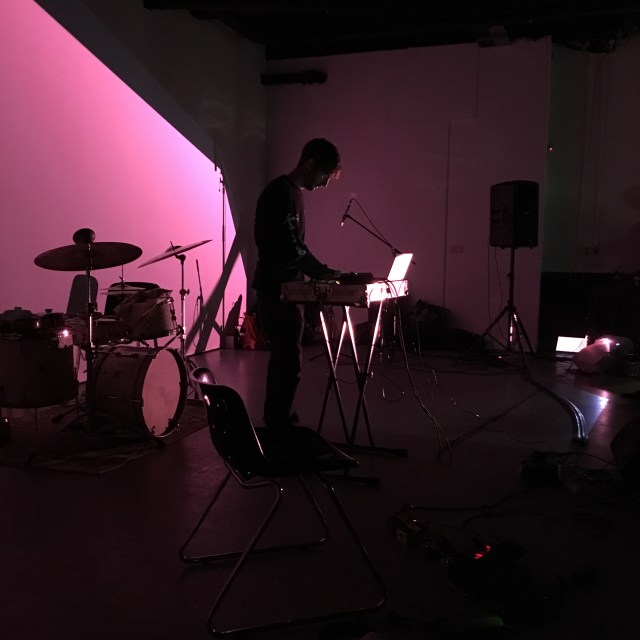
One half of sibling electronics duo Circuit Breaker, Edward Simpson’s solo performance as ELS opened with layered, ghostly voices and proceeded to evolve into an endlessly restless sequence of gestures that nodded squarely in the direction of vintage industrial music and the most devastating of dub rhythms. Though of an entirely different discipline, Simpson’s never-repeating rhythms and motifs echoed those of Alessandro Cau, even if the presentation was a nausea-inducing, nightmarishly-paced techno rather than an acoustic drum workout. Toward the end of Simpson’s set, you hear a brief snatch of vintage 303 vibrancy, ushering in a passage of Berghain-speed insistence that is ultimately overtaken by metallic-sounding arpeggios and a brilliant, threatening, prowling danger.

Brenti by Alessandro Cau was released September 20 2019 by MONOCREO. Find MONOCREO releases at Bandcamp.

Words and bad photography: Mat Smith

With sincere thanks to Simon.

(c) 2019 Further.

Pétra – Aunis

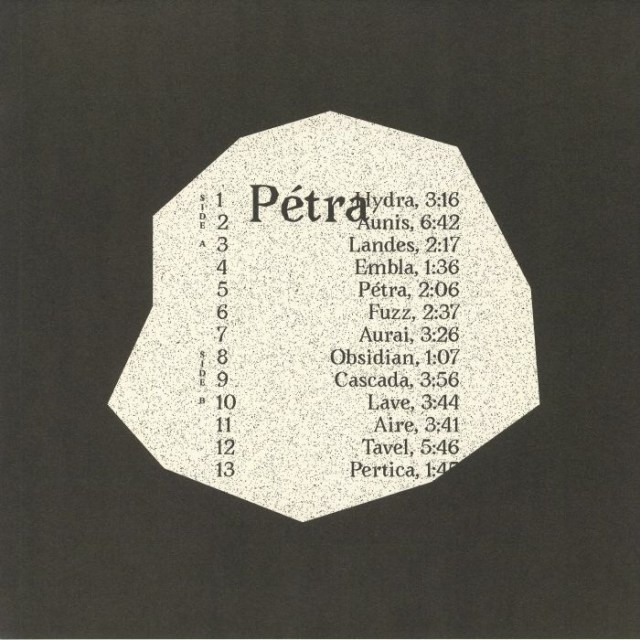
Pétra is a collaboration between dancer, musician and former NYC gallery owner Chantal Chadwick and LA electronic musician Brian Allen Simon, better known by his alias Anenon. The vast majority of Aunis was created on the Greek island of Nisyros after Chadwick and Simon were invited to participate in an artist residency, its thirteen beatific moments acting as a response to the unspolit rocky environs they found themselves among juxtaposed with the curious built environment photography of Daniel Boudinet.

The album operates at a significant distance from Simon’s long-standing Anenon project. While both Petrol (2016) and Tongue (2018) – like Aunis – found Simon creating musical responses to a specific place (LA and Tuscany respectively), both of those albums found Simon complementing field recordings with expressive soprano sax and a consummate modern classical compositional dexterity. Placed in Nisyros with Chadwick, the music they have created together is structured principally around a more pronounced electronic palette of sounds, each piece taking the form of a soundscape evoking, in some way, the landscape of the island. Simon’s saxophone appears briefly on the meditative ‘Aire’ and as the coda on ‘Tavel’, but for the most part his horn rarely comes out of its case.

Like Boudinet’s pictures, these pieces are presented with a directness and a flat, almost emotionless observational quality. A piece like ‘Lave’ has an inner warmth, its soft pads, bassy undercurrent and occasional flutters of synth arpeggios as gently evocative as a Boudinet Polaroid of the sun rising over a crumbling Parisian palace balustrade. Other tracks feature the gentle lapping of waves against the shore, creating a serenity and mournfulness thanks to the unresolved textures that surround the field recording, while pieces like ‘Tavel’ or ‘Hydra’ are more consciously melodic, their chiming synths carrying a roughened, imperfect quality bordered by atmospheric white noise.

On these pieces, it is as if Chadwick and Simon are drawing attention to the essential chaos and unpredictability that characterises all of nature, despite our best endeavours to apply a sense of order to that which we cannot control. That their collaboration can be so expressly in tune with nature while never once sounding like ambient new age meandering is a wonder to behold.

Aunis by Pétra was released September 20 2019 by Injazero.

Words: Mat Smith

(c) 2019 Further

3 Questions: Brook

Brook. Photograph by Lianne Burnham.

Brook is an electronic duo of Beth Brooks and Howard Rider. Two years in the making, the intimate songs on their debut album Built You For Thought bring together Beth’s schooling in blues and soul performance with Howard’s carefully-restrained synth arrangements.

With highly personal, carefully-shrouded lyrics that feel like we are reading Beth’s most private concerns, and Howard’s skill in crafting subtly dramatic accompaniments, Brook’s music is delicately poised between the futuristic and the human.

Built You For Thought is out now on Vince Clarke’s VeryRecords. Read David Best from Fujiya & Miyagi’s review of the album here.

What is your earliest memory?

Beth Brooks: Hiding under the bath from my two elder sisters at about four. I had made a den under there. I had to hide from them a lot as a youngster.

Howard Rider: Glancing down the street at four years old when moving in to a new family home, and seeing someone of a similar age who would then become one of my closest friends for life. I can still see him now!

What’s the best piece of advice you’ve been given?

BB: Don’t always listen to advice!

HR: Live now.

Where are you most productive or inspired?

BB: When I’m alone.

HR: When there’s a strong element to work with, or something that excites me, whether that’s a thought, an emotion or a sample. The most important thing, though, is a strong vocal.

Built You For Thought by Brook is released by VeryRecords on September 20 2019.

Interview: Mat Smith

(c) 2019 Further.

Aki Onda + Paul Clipson – Make Visible The Ghosts

R-13903378-1563715033-1258.jpeg

“It’s not about the sound and image resolving. It’s about the ambiguity between them and suddenly this feeling of coalescence, then also disparity and dissonance.” – Paul Clipson (1965 – 2018)

For the best part of nine years until his untimely death at the start of 2018, filmmaker Paul Clipson and experimental audio artist Aki Onda were friends and like-minded collaborators, both sharing similar and complementary sensibilities and interests despite working in arguably distinct disciplines.

Make Visible The Ghosts was originally conceived for a date at Brooklyn’s ISSUE Project Room. The premise that the pair came up with was a collaboration without collaboration: each would prepare a seventy-minute piece in isolation without revealing to the other what they were doing, which the pair would then perform simultaneously in February 2013.

In Onda’s case, his intended accompaniment to Clipson’s film left ample room for improvisatory, in-the-moment responses. He talks about hearing the whirring motion of the reels as something that needed to be brought into the sound-field he had crafted, quickly amplifying the sound during the performance with a microphone and giving that prominence in his audio collage; similarly, the progress and switches of Clipson’s images inspired him to add intra-channel radio static – that unpredictable, ghostly, between-frequency, unplaceable sound somewhere between the capture of spirit voices and out-of-control analogue synth spurts – across the length of his piece.

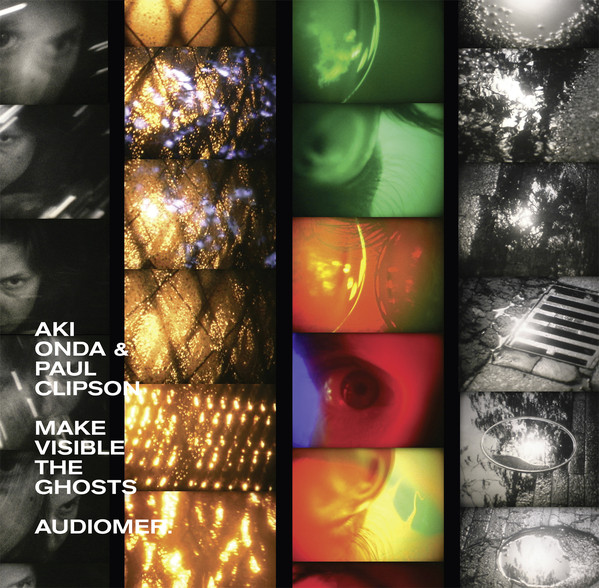
The version of Make Visible The Ghosts released by audioMER consists of four ten-minute tracks developed out of the material delivered at ISSUE and subsequently reworked over a period of three years, with stills from Clipson’s visuals presented as a regimented collage to form the LP sleeve. Perhaps out of reverence, or perhaps because it felt like it had become an integral part of the piece, Onda’s amplified reel recordings provide an occasional rhythm of sorts, and the freeform radio manipulations run throughout the four tracks like an improvised solo by a bandleader. Beneath those two chance-derived elements you hear the staples of Onda’s approach to field-recorded sound: traffic, conversation, atmospheres, all glued together by electronic tones, drones and processing that, while meticulously prepared, nevertheless feel spontaneous and brimming with energy. Though often contemplative, there are also moments of tension, such as the growling electronic interjections that dominate large sections of ‘Palm Held Out For Us To Read’.

Make Visible The Ghosts could not have existed, in this form, without Clipson. His death has left an indelible mark on Onda, and this album represents both a tribute to a friend and mentor, while also acting as a necessarily unique celebration of what is possible in the field of multi-disciplinary collaboration.

Make Visible The Ghosts by Aki Onda and Paul Clipson is released September 20 2019 by audioMER.

Words: Mat Smith

(c) 2019 Further.

electronic mOnkee – mOnkee kingdom

When I was ten years old, I came to own my first computer – an Amstrad CPC464, complete with integrated cassette loader and accompanied by a green-screen monitor. I divided my leisure time between playing with my Star Wars figures and Transformers while waiting the interminable period for games to load on the Amstrad, programming rudimentary little things in BASIC or playing out on the street. My embarrassing attempts at making music with computers were a whole hardware upgrade and around five years away.

And so it’s hard not to be impressed by mOnkee kingdom, a six-track EP of short electronic music vignettes by ten year old Clement Street as electronic mOnkee. On the evidence of tracks like the skittish, hyperactive ‘demented robot’ or ‘NERDY’, it suggests that Clement was brought up listening to the music of Mike Paradinas’s Planet Mu imprint instead of more predictable children’s fare like The Wiggles.

These are tracks filled with imaginative clashes between hardcore vacuum cleaner non-melodies, flashes of calypso-jazz piano and beats that have a go-anywhere randomness, giving each piece an unpredictable, edgy dimension. For me, the standouts are ‘sci-fi-ify that sound’ and ‘twilight octopus’ thanks to the addition of some neat sounds that evoke the memories of my beloved Amstrad’s cassette-noise squealing.

Any fundraising I did as ten year old was confined to sponsored whatevers at school – rounders, silences, spelling tests, etc – but then again we lacked both imagination and the ability to crowdfund in 1986. As if it wasn’t impressive enough that Clement made the EP, proceeds from its sale go toward an ethical store being set up in St. Neots, Cambridgeshire that will offer things like eco refills, coffee and in-house production of vegan chocolate. The crowdfunding page can be reached here.

Buy mOnkee kingdom at Bandcamp.

Words Mat Smith

(c) 2019 Further.

memorycarderror – semiotic staples

logo2.jpg

Adroitly described as “a hallucination inside brutalist concrete”, Toronto-based Steven Tait’s memorycarderror deals in drones, repetition and harsh tonalities that nod squarely in the direction of early industrial music.

On his second cassette album for Industrial Coast, the two 15-minute tracks possess a ground-out, fuzzy quality reminiscent of the early DIY 7-inch releases by Thomas Leer and Robert Rental: namely a punk spirit wrapped in warped and dirty effects. As it progresses, the single repeated bass-heavy riff of the A-side gently evolves, almost imperceptibly, but never once static. A sudden fade into silence reveals the tiniest of rhythms that may actually just be grimy intra-frequency radio pulses, before an ominous, brain-melting overdriven bass shape aggressively becomes the focus of the thrilling final five minutes.

The B-side is, if it’s even possible, harsher still. Its carefully-wrought, clashing cycles of angry distorted loops are delivered with a frantic, inescapable energy. Lying somewhere between metal, dark ambient and the sort of headcleaning noise that peppered David Lynch’s Eraserhead, it is not for the faint-hearted. Here, a sudden break in the tension locks your attention on a heavily-skewed beat that sounds as if it was developed from the wildest of malfunctioning amp feedback, slowly building back up into extremest malevolence.

semiotic staples by memorycarderror is out soon on Industrial Coast.

Words: Mat Smith

(c) 2019 Further.
The Night Monitor – This House Is Haunted // Phono Ghosts – Warm Pad, Sharp Stab

Two new releases from Blackpool’s Neil Scrivin, an electronic music maverick who also records under the alias Meatbingo.

The first, This House Is Haunted, is yet another gem of a release on Stuart McLean’s Bibliotapes cassette imprint, now long since sold out. The Bibliotapes ethics is to curate soundtracks to accompany a book, and Scrivin’s chosen subject is Guy Lyon Playfair’s account of the purported poltergeist haunting at a house in Enfield that caught the imagination of the media in the late Seventies. Whether the events in Enfield were true or a complete hoax developed by teenage imagination and fuelled by tabloid curiosity matters not to Scrivin; his soundtrack under a new alias, The Night Monitor, is bestowed with a paranormal creepiness – heavily-shrouded melodies emerge out of thick rivers of ectoplasm, looped voices chatter and babble incoherently, and thudding percussive sounds evoke the phantasmic movement of furniture.

The occluded tonalities of standout moments like ‘One For No, Two For Yes’ or ‘Ten Coincidences’ will give chills to anyone who spent their childhood evenings cowering behind the sofa because of an especially vivid Doctor Who episode or who couldn’t sleep thanks to the BBC’s hammy Ghost Watch (which was inspired by the Enfield haunting). However, Scrivin’s conceit is not to lace pieces like the evocative, static-hued soundfield of ‘I Can’t Make That Noise’ – a collage of whining drones, clamouring, scratchy sounds and a truly terrifying bass anchor – with a schlocky sequence of hauntological reference points. In doing so, This House Is Haunted is poised somewhere between the terrifying and inquisitive. Its twenty cues face inexplicable phenomena with an overriding sense of fear yet an underlying nausea-inducing intrigue, the final echoes of concluding piece ‘The Enfield Syndrome’ casting a long sonic shadow long after it has dissipated in silence.

A different – and potentially more visceral and relatable – sort of haunting takes place on Warm Pad, Sharp Stab, Scrivin’s fourth album as Phono Ghosts. Here you find the same melodic sensibilities melodies that colour This House Is Haunted, just set in a wholly different context, the result being a deft lightness thanks to being positioned as the top line in cuts that don’t rely on creepy textures for their emotional impact.

Instead, Phono Ghosts deals with the spectres of Eighties R&B and soulful electro – all fat digital basslines, chunky rhythms and a presentation that leans into a half-remembered pop vernacular. That tracks like the upbeat ‘L’Amour And Her Hot-Wired Hands’, the shimmering PWL-esque refrain of the serene ’81 Love’ or the emotional grandeur of the muted ‘Tears Over Chroma’ were not executed during digital synthesis’s takeover of music beggars belief.

Curiously, the melodic quotient isn’t the only crossover with The Night Monitor. On this brilliant collection you also find disembodied voices fluttering gently into view, only here they are vestiges of forgotten soul tracks, not the chance capture of elusive spirit echoes.

This House Is Haunted by The Night Monitor was released September 6 2019 by Bibliotapes and is sold out. A digital version will be released by Fonolith on October 25 2019.

Warm Pad, Sharp stab by Phono Ghosts was released September 13 2019 by Fonolith.

Words: Mat Smith

(c) 2019 Further.

Rupert Lally – Dune

Lally - Dune Tape

My youth was, I now realise, haunted by Dune. My mother, sensing a Star Wars-led interest in science fiction films, bought my an empty Panini sticker album that was issued to go along with David Lynch’s 1984 adaptation of Frank Herbert’s celebrated novel. No one else at my primary school was collecting the stickers, and with no one to swap the endless, frustrating supply of duplicate stickers I invariably ended up with, it languished, unfinished until it found itself in the bin. Later still, I ended up receiving a copy of the 1992 Amiga computer game from a friend and, like a lot of games, I was utterly hopeless at it and I guess I either offloaded it back to that friend or it went off to some floppy disc recycling place upon the occasion of one of my successive house moves.

So to say I have mixed feelings about Dune is an understatement. Those youthful experiences have meant I never bothered to read the book, and I’d rather watch Eraserhead or The Elephant Man over Lynch’s take on Dune. I know – sacrilege, right?

But maybe there’s hope for me yet in the form of Rupert Lally’s brilliant new soundtrack to Herbert’s book, released as part of the Bibliotapes series. Lally is no stranger to this endeavour, releasing a coveted score to another sci-fi novel, John Wyndham’s The Day Of The Triffids, via the label earlier this year. Herbert’s book was originally presented in the science fiction periodical Analog, and, perhaps with intentional reverence, Lally enriches these 26 evocative cues with a beautifully-rendered analogue synth spice (pun intended).

Pieces like ‘Giedi Prime’, ‘Remember The Tooth!’ and ‘Leave No Trace’ proceed on prowling, throbbing bass tones full of both threat and mystery, representing a recognisable stylistic motif that runs through the whole of Lally’s vivid score. There are moments, such as on ‘A Deal With Kynes’, where those tones eddy upward with aggressive and intensifying malice, signalling danger, while elsewhere they ebb away into distant, mollified texture.

And yet nestled within these bleak wastelands of atmospheric sound, we find the spiralling melodies, intensifying arpeggios and pulsing beats of the singular ‘Wormsign’, representing a seamless entanglement of Seventies space disco, progressive house and Eat Static-y galactic psychedelia.

The fifty copies of the cassette edition of Lally’s Dune justifiably sold out in record time. Fortunately, these absorbing, pulse-sharpening tracks are all available at Rupert’s Bandcamp page, a link to which can be found below. I’m now finally going to go and track down a copy of Herbert’s book. It’s about time…

Dune by Rupert Lally was released September 13 2019 by Bibliotapes.

Words: Mat Smith

(c) 2019 Further.

Brook – Built You For Thought

Informed by thought and feeling, rather than fashion and nostalgia, beneath a backdrop of well-thumbed science fiction paperbacks, the debut album from Brook creates a soundtrack to the loneliness of romance gone wrong, a longing for the past to be corrected by the future

The wonderfully-titled ‘Prince’ is propelled by an Escher-style arpeggio from Howard Rider, which enables vocalist Beth Brooks’ voice to swoop and spiral around it, like a sophisticated cat taking occasional swipes at a persistent wasp.

Whiplash snares, isolated pianos and synthetic music box melodies complement the emotional weight of the confessional nature of the lyrics, while also providing a safety net letting Brooks’ elegant trapeze act soar above it. The temptation may have been to match the scale of the vocals with layers and layers of sound but that would have been suffocating and overpowering. Instead, the music swells and crashes. Standout track ‘Everglades’ swaggers confidently on to the dancefloor, heartbroken but defiant.

So many musicians still feel the need to fill the kettle above the water line; it’s pleasing that Brook have adhered to the recommended level, both in content and quantity. By taking a nuanced and subtle approach, the two distinct elements of Built You For Thought combine to create a cohesive, timeless, whole.

Built You For Thought by Brook is released on September 20 2019 by VeryRecords.

Words: David Best. David Best is from Brighton’s Fujiya & Miyagi.

(c) 2019 David Best for Further.

Polypores – Radiance

Radiance, the latest release from the formidably active Polypores (Stephen James Buckley), was released in a tiny cassette edition of just thirty copies and sold out before most people even registered that it was even being issued. Containing four tracks of live modular synthesizer music, the pieces here are far from aimless meanderings; instead, they represent carefully-constructed moments that could well be the quintessence of what experimental electronic music always promised.

Each piece here is distinct, each carrying its own palette of tonalities and following a path unto itself, oftentimes feeling like Buckley is directing pure, unadulterated electrical current into his music. Two long tracks – ‘Mass’ and ‘Suns’ – dominate the cassette. The former features glacially-paced melodies over a turbulent, restless bed of drones and tightly-packed layers taking in everything from paranoia to dread to a sort of oblique optimism. That elegiac quality is more acutely felt on ‘Suns’, being full of sustained tones rising into a heart-stopping crescendo of skyward-facing hope and beauty. Its reassuring palette of tones and the insistent rush of fluttering, dramatic arpeggios that conclude the piece seem to be saying, “It may feel like chaos, but trust me – everything is going to be okay.”

Elsewhere, on the two shorter tracks that open each side of the tape, Buckley plays with panic-inducing siren sounds offset by pretty, delicate plucked-guitar-esque melodies on the otherwise serene ‘Escapism’, and offers an evocative, nagging melodic creep on the sinister-edged ‘In Marbles’.

Radiance by Polypores was released on September 10 2019.

Words: Mat Smith

(c) 2019 Further.